
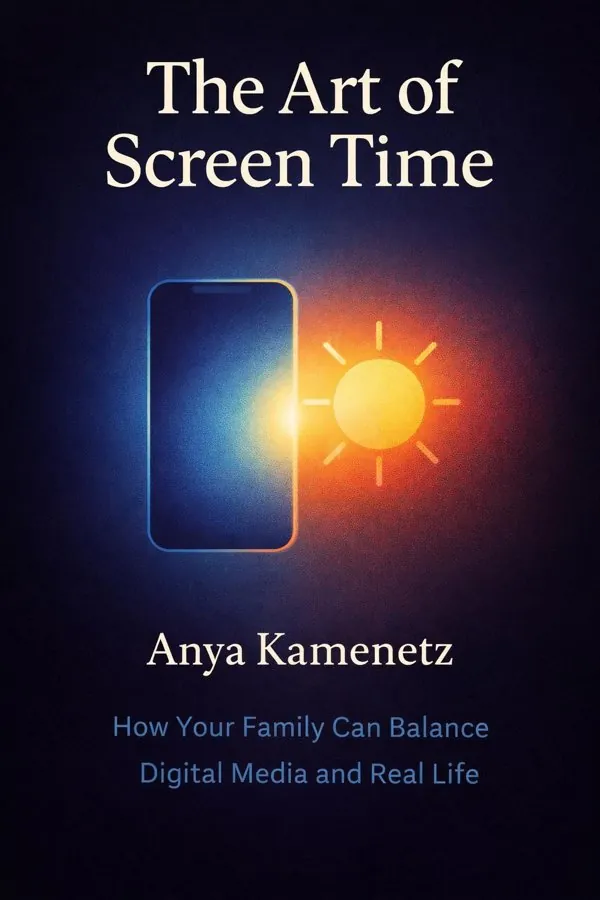
The Art of Screen Time: How Your Family Can Balance Digital Media and Real Life: Summary & Key Insights
 10 min5 chaptersAudio available
What Is The Art of Screen Time: How Your Family Can Balance Digital Media and Real Life About?
The Art of Screen Time: How Your Family Can Balance Digital Media and Real Life by Anya Kamenetz is a parenting book spanning 5 pages. Drawing on the latest research and her own experience as a parent, Anya Kamenetz offers a practical, evidence-based guide to managing children's screen use. The book explores how families can find a healthy balance between digital media and real-world activities, emphasizing communication, flexibility, and mindful engagement rather than rigid rules.
This FizzRead summary covers all 5 key chapters of The Art of Screen Time: How Your Family Can Balance Digital Media and Real Life in approximately 10 minutes, distilling the most important ideas, arguments, and takeaways from Anya Kamenetz's work. Also available as an audio summary and Key Quotes Podcast.
The Art of Screen Time: How Your Family Can Balance Digital Media and Real Life
Drawing on the latest research and her own experience as a parent, Anya Kamenetz offers a practical, evidence-based guide to managing children's screen use. The book explores how families can find a healthy balance between digital media and real-world activities, emphasizing communication, flexibility, and mindful engagement rather than rigid rules.
Who Should Read The Art of Screen Time: How Your Family Can Balance Digital Media and Real Life?
This book is perfect for anyone interested in parenting and looking to gain actionable insights in a short read. Whether you're a student, professional, or lifelong learner, the key ideas from The Art of Screen Time: How Your Family Can Balance Digital Media and Real Life by Anya Kamenetz will help you think differently.
- ✓Readers who enjoy parenting and want practical takeaways
- ✓Professionals looking to apply new ideas to their work and life
- ✓Anyone who wants the core insights of The Art of Screen Time: How Your Family Can Balance Digital Media and Real Life in just 10 minutes
Want the full summary?
Get instant access to this book summary and 100K+ more with Fizz Moment.
Get Free SummaryAvailable on App Store • Free to download
Key Chapters
To understand where we stand today, we have to look back to how technology entered family life. The story begins with television — once the centerpiece of shared media experiences and parental concern. Over decades, screens multiplied: computers came into play, then laptops and smartphones blurred boundaries between work, play, and rest. Each transition brought new hopes and fresh anxieties. I trace this trajectory to show how they mirror our shifting fears — from TV’s supposed passive consumption to worries about social media, digital distraction, and online safety.
But fear alone never helps us navigate reality. That’s why I draw deeply on scientific research. Through interviews with neuroscientists, developmental psychologists, and pediatricians, I found no clear evidence of catastrophic outcomes from moderate, thoughtful media use. What matters is *context* — how screens are used, what they replace, and how parents engage with their children around them. Studies highlight that interactive, educational, and socially connected uses differ greatly from passive binge consumption. Moreover, family environment and communication moderate those effects. A child who watches a nature documentary while discussing it with a parent experiences a richer, cognitively engaging moment than one who scrolls through random clips alone.
The research teaches us humility. There is no one-size-fits-all rule because human development thrives on diverse experiences. Screen time, when managed well, becomes another form of experience — one that can be creative, informative, and connective. The key lies not in counting minutes but in cultivating balance and awareness. Science urges us to shift focus from mere quantity to quality — a theme that runs through every page of this book.
Many people assume that children born into the age of touchscreens are instinctively endowed with tech fluency — as though curiosity and scrolling were the same as understanding. But as I show, this myth of the 'digital native' often masks a deeper gap. Children might navigate apps easily, but that doesn’t mean they grasp privacy risks, social nuance, or digital ethics. True digital literacy demands guidance, conversation, and modeling. Parents still play an irreplaceable role, translating digital behaviors into human values.
Through my reporting, I encountered educators who witnessed this disparity firsthand. Students could post videos but struggled to discern truth from misinformation. They could use devices but didn’t always use them wisely. This reminded me that technology doesn’t replace parenting; it amplifies its need. Children learn empathy, critical thinking, and boundaries not by swiping screens, but by observing how we communicate and make choices around media.
As I tell parents, you don’t need to be a tech expert to teach digital wisdom. You need curiosity, humility, and willingness to engage. Ask your kids what they love online; share what concerns you. Watch together, learn together. When we turn screen time into storytelling time — moments of dialogue, laughter, and shared attention — it ceases to be a dividing force and becomes a connection tool. The myth fades, and genuine learning begins.
+ 3 more chapters — available in the FizzRead app
All Chapters in The Art of Screen Time: How Your Family Can Balance Digital Media and Real Life
About the Author
Anya Kamenetz is an American journalist and author known for her work on education, technology, and parenting. She has written for NPR, Fast Company, and The New York Times, and is the author of several books on the intersection of learning and digital culture.
Get This Summary in Your Preferred Format
Read or listen to the The Art of Screen Time: How Your Family Can Balance Digital Media and Real Life summary by Anya Kamenetz anytime, anywhere. FizzRead offers multiple formats so you can learn on your terms — all free.
Available formats: App · Audio · PDF · EPUB — All included free with FizzRead
Download The Art of Screen Time: How Your Family Can Balance Digital Media and Real Life PDF and EPUB Summary
Key Quotes from The Art of Screen Time: How Your Family Can Balance Digital Media and Real Life
“To understand where we stand today, we have to look back to how technology entered family life.”
“Many people assume that children born into the age of touchscreens are instinctively endowed with tech fluency — as though curiosity and scrolling were the same as understanding.”
Frequently Asked Questions about The Art of Screen Time: How Your Family Can Balance Digital Media and Real Life
The Art of Screen Time: How Your Family Can Balance Digital Media and Real Life by Anya Kamenetz is a parenting book that explores key ideas across 5 chapters. Drawing on the latest research and her own experience as a parent, Anya Kamenetz offers a practical, evidence-based guide to managing children's screen use. The book explores how families can find a healthy balance between digital media and real-world activities, emphasizing communication, flexibility, and mindful engagement rather than rigid rules.
You Might Also Like
Never Enough
Jennifer Breheny Wallace
10 min
Bluey: Sleepytime
Joe Brumm
10 min
In My Heart: A Book of Feelings
Jo Witek
10 min
Love From The Crayons
Drew Daywalt, Oliver Jeffers
10 min
Pete The Cat: Big Easter Adventure
James Dean, Kimberly Dean
10 min
Smart Money Smart Kids: Raising the Next Generation to Win with Money
Dave Ramsey, Rachel Cruze
10 minBrowse by Category
Ready to read The Art of Screen Time: How Your Family Can Balance Digital Media and Real Life?
Get the full summary and 100K+ more books with Fizz Moment.