
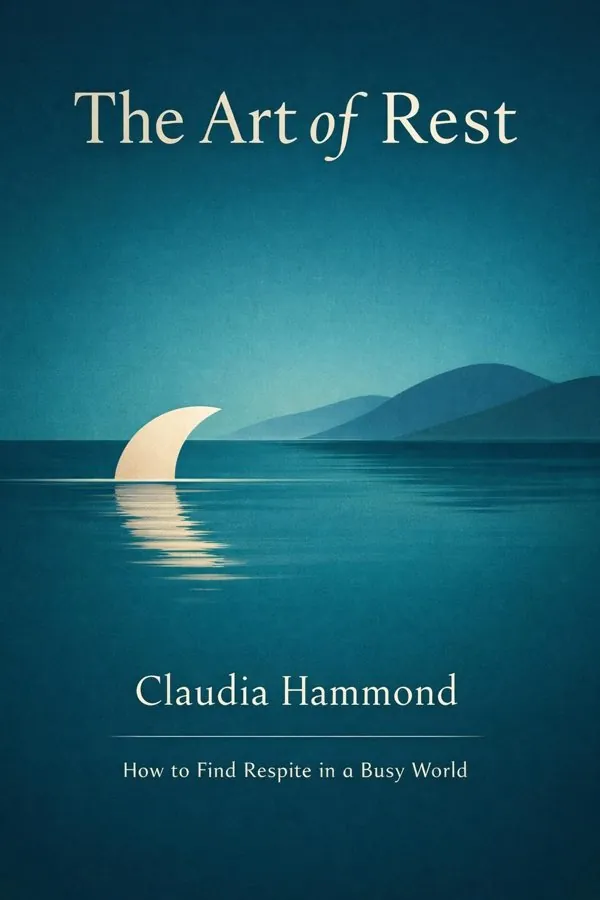
The Art of Rest: How to Find Respite in a Busy World: Summary & Key Insights
 10 min9 chaptersAudio available
Key Takeaways from The Art of Rest: How to Find Respite in a Busy World
One of the book’s most important insights is that rest and sleep are not the same thing.
Hammond’s Rest Test, involving more than 18,000 participants from over a hundred countries, is the book’s foundation.
A busy mind often feels productive, but Hammond makes clear that nonstop mental activity comes at a cost.
One of Hammond’s sharpest observations is that many people do not merely lack rest; they mistrust it.
Many people fear being alone, yet Hammond shows that solitude is one of the most commonly reported forms of rest.
What Is The Art of Rest: How to Find Respite in a Busy World About?
The Art of Rest: How to Find Respite in a Busy World by Claudia Hammond is a mental_health book spanning 5 pages. What does it really mean to rest in a culture that glorifies busyness? In The Art of Rest, Claudia Hammond takes a question that seems simple and reveals just how neglected, misunderstood, and essential it has become. Drawing on findings from the Rest Test, one of the largest global surveys ever conducted on the subject, Hammond explores how people across the world think about rest, which activities they find most restorative, and why so many of us struggle to rest without guilt. Her argument is both scientific and humane: rest is not laziness, indulgence, or wasted time, but a basic human need tied to mental clarity, emotional balance, creativity, and health. Hammond is especially well placed to guide this conversation. As a broadcaster, psychology lecturer, and writer known for making behavioral science accessible, she combines research evidence with stories, cultural analysis, and practical reflection. The result is a thoughtful, reassuring book that helps readers understand why rest matters, why it is so difficult in modern life, and how to reclaim it in forms that genuinely restore rather than merely distract.
This FizzRead summary covers all 9 key chapters of The Art of Rest: How to Find Respite in a Busy World in approximately 10 minutes, distilling the most important ideas, arguments, and takeaways from Claudia Hammond's work. Also available as an audio summary and Key Quotes Podcast.
The Art of Rest: How to Find Respite in a Busy World
What does it really mean to rest in a culture that glorifies busyness? In The Art of Rest, Claudia Hammond takes a question that seems simple and reveals just how neglected, misunderstood, and essential it has become. Drawing on findings from the Rest Test, one of the largest global surveys ever conducted on the subject, Hammond explores how people across the world think about rest, which activities they find most restorative, and why so many of us struggle to rest without guilt. Her argument is both scientific and humane: rest is not laziness, indulgence, or wasted time, but a basic human need tied to mental clarity, emotional balance, creativity, and health.
Hammond is especially well placed to guide this conversation. As a broadcaster, psychology lecturer, and writer known for making behavioral science accessible, she combines research evidence with stories, cultural analysis, and practical reflection. The result is a thoughtful, reassuring book that helps readers understand why rest matters, why it is so difficult in modern life, and how to reclaim it in forms that genuinely restore rather than merely distract.
Who Should Read The Art of Rest: How to Find Respite in a Busy World?
This book is perfect for anyone interested in mental_health and looking to gain actionable insights in a short read. Whether you're a student, professional, or lifelong learner, the key ideas from The Art of Rest: How to Find Respite in a Busy World by Claudia Hammond will help you think differently.
- ✓Readers who enjoy mental_health and want practical takeaways
- ✓Professionals looking to apply new ideas to their work and life
- ✓Anyone who wants the core insights of The Art of Rest: How to Find Respite in a Busy World in just 10 minutes
Want the full summary?
Get instant access to this book summary and 100K+ more with Fizz Moment.
Get Free SummaryAvailable on App Store • Free to download
Key Chapters
One of the book’s most important insights is that rest and sleep are not the same thing. Many people hear the word “rest” and immediately think of bedtime, exhaustion, or catching up after a demanding week. But Hammond shows that rest also includes conscious experiences that replenish us while we are awake. It is a state in which the mind and body are no longer being pushed, monitored, or overstimulated. That distinction matters, because someone can sleep enough and still feel mentally crowded, emotionally strained, and deeply unrested.
Drawing on the global Rest Test, Hammond reveals that people describe rest in many ways: peace, stillness, freedom from demands, time alone, reading, walking, listening to music, or simply not being interrupted. This broadens the conversation. Rest is not a single activity prescribed to everyone; it is a restorative relationship to time, attention, and pressure. For one person it may mean sitting quietly with a book. For another it may mean gardening, bathing, praying, or spending time in nature. The key is that the activity creates relief from internal and external strain.
This idea is especially useful in modern life, where many people assume they can only recover through long vacations or extra hours of sleep. Hammond’s research suggests that small pockets of real rest can also make a difference. A phone-free lunch break, ten quiet minutes before work, or a solitary walk after dinner may offer restoration if they reduce stimulation and obligation.
The practical lesson is simple: stop defining rest too narrowly. Identify two or three waking activities that leave you calmer, clearer, and less pressured, and begin treating them as necessary forms of restoration rather than optional luxuries.
A busy mind often feels productive, but Hammond makes clear that nonstop mental activity comes at a cost. Rest is not empty time; it is biologically useful time. Research in psychology and neuroscience suggests that periods of quiet wakefulness help the brain consolidate memories, regulate emotions, and recover from cognitive effort. In other words, when we stop pushing attention outward, the mind performs essential maintenance.
Hammond explores studies showing that people who take breaks often think more clearly, sustain attention longer, and become less error-prone. Continuous demand depletes mental resources, while even short pauses can improve performance. This helps explain why people may struggle to make decisions, recall information, or stay patient after long stretches of work without interruption. The issue is not always lack of effort; sometimes it is lack of recovery.
Rest also supports creativity. Ideas often arrive not in the middle of concentrated effort but afterward, during a walk, a shower, a period of staring out the window, or a quiet moment before sleep. These experiences feel accidental, yet Hammond shows they reflect the way the mind benefits from release. When attention softens, different connections become possible.
In practice, this means that building pauses into the day is not a sign of weakness. A teacher stepping outside between classes, a manager sitting silently for five minutes before the next meeting, or a student taking a deliberate break from revision may all be improving rather than undermining their work. Rest supports the very capacities that modern life often demands most.
The takeaway is to stop waiting until collapse to recover. Schedule short intervals of genuine mental quiet into your day, especially after cognitively demanding tasks, and view them as part of effective thinking rather than an escape from it.
One of Hammond’s sharpest observations is that many people do not merely lack rest; they mistrust it. In cultures that prize productivity, visibility, and constant responsiveness, rest can feel morally suspect. We learn to admire being busy, to equate speed with importance, and to treat downtime as something that must be earned. This creates a painful paradox: the more exhausted people become, the harder it may feel to stop.
Hammond examines the social values behind this guilt. Modern work patterns blur boundaries between labor and leisure. Emails arrive at night, phones keep us perpetually available, and social media amplifies the performance of busyness. Even rest becomes instrumentalized, valued only if it makes us more efficient afterward. Under these conditions, simply sitting still can trigger anxiety. We may feel lazy when resting, then more depleted because the rest itself is contaminated by self-judgment.
The book invites readers to question these assumptions. Rest is not the opposite of worth. It is part of a sustainable human life. Without it, concentration frays, relationships suffer, health declines, and joy narrows. Hammond’s argument is not anti-work; it is anti-exhaustion as identity. She asks us to notice how often we apologize for pausing, and to consider what kind of society treats restoration as indulgence.
A practical application is to change the language we use. Instead of saying, “I’m doing nothing,” try “I’m recovering,” “I’m resetting,” or simply “I’m resting.” Teams and families can also normalize breaks by making them visible and acceptable rather than secretive and apologetic.
The actionable takeaway is to examine one belief you hold about rest being undeserved or unproductive, and deliberately replace it with a healthier principle: rest is a requirement for living well, not a reward for overwork.
Many people fear being alone, yet Hammond shows that solitude is one of the most commonly reported forms of rest. That does not mean isolation or loneliness. The distinction is crucial. Loneliness is the pain of unwanted disconnection; solitude is chosen space away from social demands. In a world of constant messages, conversations, and notifications, time alone can feel like oxygen returning to the mind.
The Rest Test found that spending time alone ranked highly among restful experiences. Hammond explores why. Social life, even when enjoyable, requires attention, responsiveness, self-presentation, and emotional management. We read cues, regulate reactions, and adapt ourselves to others. Solitude allows those processes to soften. It can restore people who feel overstimulated, overobserved, or emotionally crowded.
At the same time, Hammond avoids romanticizing solitude. For some people, especially those already struggling with depression or social disconnection, being alone may not feel restful. Context matters. The same silence that soothes one person may unsettle another. Rest is therefore not about following a cultural ideal of the solitary retreat, but about recognizing when chosen aloneness supports recovery.
Practical examples include protecting a short period at the start of the day before engaging with devices, taking a walk without company, reading alone in a cafe, or sitting quietly after work before reentering family routines. These moments help create psychological breathing room.
The key takeaway is to experiment with intentional solitude in small doses. If your days are crowded by conversation, caregiving, or digital contact, set aside even ten to fifteen minutes of uninterrupted time alone and notice whether it leaves you more settled, less irritable, and more like yourself.
Rest does not always happen indoors or in stillness. Hammond highlights the remarkable restorative power of nature, which appears repeatedly in both research and personal reports. People often feel refreshed after being among trees, near water, or simply outside in open air. This is not sentimental nostalgia. Environmental psychology suggests that natural settings can reduce stress, improve mood, and gently restore depleted attention.
Unlike urban environments, which often demand constant filtering of noise, movement, and alerts, nature tends to hold attention more softly. A path, a garden, birdsong, wind, or changing light can engage the mind without overloading it. Hammond connects this to the experience many people know intuitively: after time outdoors, problems often feel less claustrophobic and the nervous system less tightly wound.
Importantly, restorative contact with nature does not require wilderness or expensive travel. A park bench, an allotment, a riverside walk, a tree-lined street, or tending plants on a balcony can all matter. Hammond’s approach is practical and inclusive. The question is not whether you can escape to a remote forest every weekend, but whether you can build more contact with the natural world into ordinary routines.
For example, a commuter might walk part of the journey through a green space. A remote worker might take calls while walking outside. A parent might sit in a park for ten quiet minutes after school drop-off. Even visual exposure to nature, such as looking at greenery from a window, may offer some benefit.
The actionable takeaway is to attach rest to place. Choose one accessible outdoor location that consistently calms you, and return to it regularly as part of your recovery routine rather than waiting for ideal circumstances.
One of the most fascinating findings in Hammond’s work is that reading topped the Rest Test list as the activity people found most restful. At first this may seem surprising. Reading is mentally active, not passive. It requires attention, imagination, and engagement. Yet that is precisely why it can be restorative. Good reading absorbs the mind without the fragmentation of digital life. It offers escape, focus, intimacy, and calm all at once.
Hammond suggests that reading rests us not because it empties the mind but because it gathers it. In contrast to scrolling, multitasking, or continuous partial attention, reading asks us to inhabit one sustained stream of thought. This can reduce cognitive clutter. Fiction may create immersion and emotional distance from immediate worries; nonfiction may satisfy curiosity in a deliberate, unrushed way. In both cases, the reader steps temporarily out of demand and into concentration without pressure.
Reading also works well because it is highly portable and adaptable. A few pages before sleep, twenty minutes on a train, or a weekend hour in an armchair can create a pocket of restoration. The form matters, though. Restful reading is usually self-directed and unhurried, not done to meet a deadline or prove productivity.
In practical terms, this means choosing books that invite absorption rather than obligation. Keep one nearby in places where you would usually default to your phone. Build a ritual around it: tea, a comfortable chair, a lamp, and notifications off. Even brief but regular sessions can become a reliable source of rest.
The takeaway is to reclaim reading as restoration. Replace one low-quality screen habit each day with fifteen minutes of enjoyable reading and notice whether your attention feels steadier and your mind less scattered.
A quiet warning runs through Hammond’s book: rest can easily become another task to optimize. Once society starts talking about mindfulness apps, sleep tracking, wellness routines, and recovery protocols, people may begin performing rest rather than experiencing it. Hammond resists this trend by insisting that real rest is deeply individual. It cannot be measured solely by appearance, trendiness, or whether it fits a fashionable self-care image.
This matters because many common leisure activities are not actually restful for everyone. A crowded party may energize one person and drain another. Yoga may soothe one body and frustrate another. Even activities generally considered relaxing, such as watching television or taking a bath, may be restorative only under certain conditions. Hammond encourages honesty over conformity: the point is not to look like someone who rests well, but to feel restored.
This perspective is liberating. It allows introverts, extroverts, parents, shift workers, students, and older adults to define rest according to their own needs and limitations. For some, rest means sensory reduction. For others, it means gentle activity. For some, it involves companionship; for others, privacy. The test is simple: after this activity, do I feel more spacious, less pressured, and better able to meet life?
A useful application is to separate entertainment, avoidance, and rest. An evening of compulsive scrolling may feel easy, but does it leave you restored? A long social event may be enjoyable, but does it calm your system or overstimulate it? By asking these questions, you build a more accurate rest vocabulary.
The actionable takeaway is to create a personal “rest menu” of five activities that genuinely replenish you, and use it as a guide when you notice depletion instead of defaulting to habits that merely fill time.
Rest rarely appears by accident in a busy world. Hammond shows that if we leave recovery to chance, work, devices, errands, and obligations will usually take over. The solution is not necessarily dramatic life change, but intentional structure. Small rituals, boundaries, and repeated habits can create reliable places for rest inside demanding schedules.
This is one of the book’s most practical contributions. Rather than presenting rest as a rare retreat, Hammond frames it as something that can be woven into everyday life. Rituals matter because they reduce friction. If you always read for twenty minutes before bed, walk after lunch, keep your phone out of the bedroom, or take a quiet tea break at the same time each afternoon, rest becomes easier to access. It no longer depends entirely on motivation.
Boundaries are equally important. Hammond notes how modern technology erodes transitions between work and non-work. Without clear limits, the mind remains partially activated. A simple end-of-day routine, closing the laptop, writing tomorrow’s list, dimming lights, changing clothes, or stepping outside, can signal that effort is over and restoration may begin.
These practices are especially useful for people who believe they are too busy to rest. In reality, many forms of rest require less time than they imagine but more intention than they usually give. Five minutes of stillness protected from interruption may be more restorative than an hour spent half-working and half-scrolling.
The takeaway is to choose one repeatable rest ritual tied to an existing part of your day, such as after lunch or before sleep, and protect it for a week. Consistency, more than intensity, is what allows rest to become part of a livable routine.
All Chapters in The Art of Rest: How to Find Respite in a Busy World
About the Author
Claudia Hammond is a British author, broadcaster, and psychology lecturer best known for translating scientific research into engaging, accessible writing. She has presented several BBC Radio 4 programs, including All in the Mind, where she has explored topics related to psychology, behavior, and mental health for a broad audience. Hammond has written widely on subjects such as time perception, decision-making, money, and well-being, earning a reputation for combining academic rigor with warmth and clarity. Her work often focuses on how psychological science can illuminate everyday life. In The Art of Rest, she brings those strengths together by pairing research findings with cultural analysis and practical reflection, helping readers better understand why rest matters and how to make space for it in an overbusy world.
Get This Summary in Your Preferred Format
Read or listen to the The Art of Rest: How to Find Respite in a Busy World summary by Claudia Hammond anytime, anywhere. FizzRead offers multiple formats so you can learn on your terms — all free.
Available formats: App · Audio · PDF · EPUB — All included free with FizzRead
Download The Art of Rest: How to Find Respite in a Busy World PDF and EPUB Summary
Key Quotes from The Art of Rest: How to Find Respite in a Busy World
“One of the book’s most important insights is that rest and sleep are not the same thing.”
“Hammond’s Rest Test, involving more than 18,000 participants from over a hundred countries, is the book’s foundation.”
“A busy mind often feels productive, but Hammond makes clear that nonstop mental activity comes at a cost.”
“One of Hammond’s sharpest observations is that many people do not merely lack rest; they mistrust it.”
“Many people fear being alone, yet Hammond shows that solitude is one of the most commonly reported forms of rest.”
Frequently Asked Questions about The Art of Rest: How to Find Respite in a Busy World
The Art of Rest: How to Find Respite in a Busy World by Claudia Hammond is a mental_health book that explores key ideas across 9 chapters. What does it really mean to rest in a culture that glorifies busyness? In The Art of Rest, Claudia Hammond takes a question that seems simple and reveals just how neglected, misunderstood, and essential it has become. Drawing on findings from the Rest Test, one of the largest global surveys ever conducted on the subject, Hammond explores how people across the world think about rest, which activities they find most restorative, and why so many of us struggle to rest without guilt. Her argument is both scientific and humane: rest is not laziness, indulgence, or wasted time, but a basic human need tied to mental clarity, emotional balance, creativity, and health. Hammond is especially well placed to guide this conversation. As a broadcaster, psychology lecturer, and writer known for making behavioral science accessible, she combines research evidence with stories, cultural analysis, and practical reflection. The result is a thoughtful, reassuring book that helps readers understand why rest matters, why it is so difficult in modern life, and how to reclaim it in forms that genuinely restore rather than merely distract.
More by Claudia Hammond

You Might Also Like
Big Feelings: How to Be Okay When Things Are Not Okay
Liz Fosslien, Mollie West Duffy
10 min
Creative Arts Therapies Handbook: Art, Music and Dance Therapy Practices for Wellbeing
Susan I. Buchalter
10 min
Emotional First Aid: Healing Rejection, Guilt, Failure, and Other Everyday Hurts
Guy Winch
10 min
Lost Connections: Why You're Depressed and How to Find Hope
Johann Hari
10 min
No Time to Panic: How to Stop Worrying and Embrace Life
Matt Gutman
10 min
Overcoming Mobbing: A Recovery Guide for Workplace Aggression and Bullying
Maureen Duffy, Len Sperry
10 minBrowse by Category
Ready to read The Art of Rest: How to Find Respite in a Busy World?
Get the full summary and 100K+ more books with Fizz Moment.