
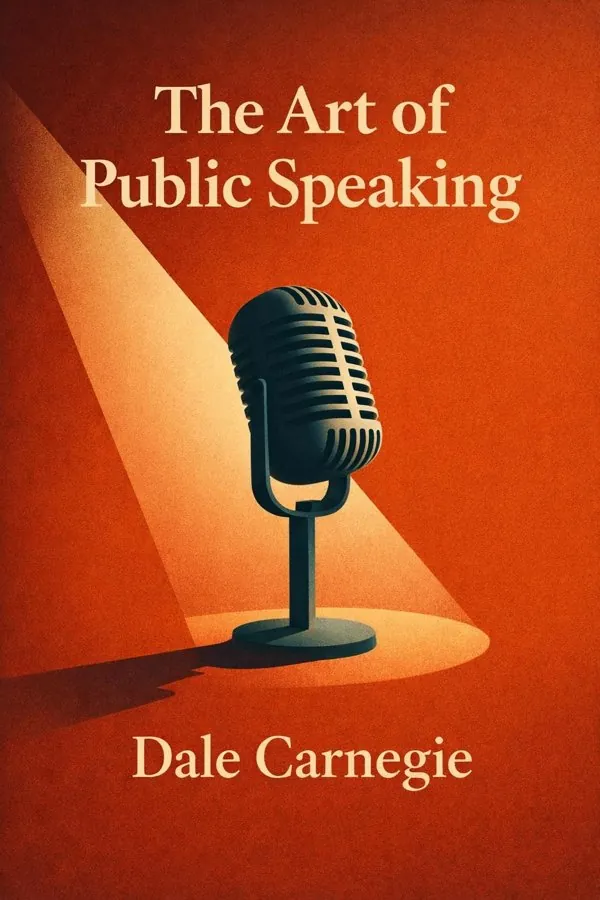
The Art of Public Speaking: Summary & Key Insights
 10 min9 chaptersAudio available
Key Takeaways from The Art of Public Speaking
Fear often feels like proof that we are not meant to speak in public, but Carnegie argues the opposite: nervousness is usually the starting point of every developing speaker.
A speech without real understanding may sound polished for a moment, but it rarely leaves a lasting impression.
Even strong ideas can fail if they arrive in a confusing order.
Words alone do not move an audience; they must be carried by a living voice and embodied presence.
People rarely remember every argument in a speech, but they remember whether the speaker seemed genuine.
What Is The Art of Public Speaking About?
The Art of Public Speaking by Dale Carnegie is a communication book spanning 13 pages. First published in 1915, The Art of Public Speaking remains one of the most enduring guides to spoken communication because it addresses a truth that never changes: speaking well is not a gift reserved for a talented few, but a skill that can be developed through understanding, preparation, and repeated practice. In this classic work, Dale Carnegie explores how ordinary people can overcome fear, think clearly, organize ideas persuasively, and speak with energy that captures attention. The book is not only about formal speeches. It is about influence in every setting where words matter, from classrooms and boardrooms to civic meetings and personal conversations. Carnegie’s authority comes from decades of teaching communication and self-development to people who wanted practical improvement rather than abstract theory. His approach is grounded, encouraging, and relentlessly focused on action. What makes this book still valuable today is its blend of psychology, rhetoric, and performance: it teaches that effective speaking depends as much on sincerity and conviction as on technique. For anyone who wants to become more confident, persuasive, and memorable, this book offers timeless principles that still work.
This FizzRead summary covers all 9 key chapters of The Art of Public Speaking in approximately 10 minutes, distilling the most important ideas, arguments, and takeaways from Dale Carnegie's work. Also available as an audio summary and Key Quotes Podcast.
The Art of Public Speaking
First published in 1915, The Art of Public Speaking remains one of the most enduring guides to spoken communication because it addresses a truth that never changes: speaking well is not a gift reserved for a talented few, but a skill that can be developed through understanding, preparation, and repeated practice. In this classic work, Dale Carnegie explores how ordinary people can overcome fear, think clearly, organize ideas persuasively, and speak with energy that captures attention. The book is not only about formal speeches. It is about influence in every setting where words matter, from classrooms and boardrooms to civic meetings and personal conversations. Carnegie’s authority comes from decades of teaching communication and self-development to people who wanted practical improvement rather than abstract theory. His approach is grounded, encouraging, and relentlessly focused on action. What makes this book still valuable today is its blend of psychology, rhetoric, and performance: it teaches that effective speaking depends as much on sincerity and conviction as on technique. For anyone who wants to become more confident, persuasive, and memorable, this book offers timeless principles that still work.
Who Should Read The Art of Public Speaking?
This book is perfect for anyone interested in communication and looking to gain actionable insights in a short read. Whether you're a student, professional, or lifelong learner, the key ideas from The Art of Public Speaking by Dale Carnegie will help you think differently.
- ✓Readers who enjoy communication and want practical takeaways
- ✓Professionals looking to apply new ideas to their work and life
- ✓Anyone who wants the core insights of The Art of Public Speaking in just 10 minutes
Want the full summary?
Get instant access to this book summary and 100K+ more with Fizz Moment.
Get Free SummaryAvailable on App Store • Free to download
Key Chapters
Fear often feels like proof that we are not meant to speak in public, but Carnegie argues the opposite: nervousness is usually the starting point of every developing speaker. The problem is not fear itself; it is the habit of avoiding the situations that would weaken fear over time. Public speaking anxiety is deeply human because standing before others exposes us to judgment, uncertainty, and the possibility of failure. Yet confidence does not arrive before speaking. It is built by speaking. Carnegie’s essential lesson is that courage comes from action, not from waiting until you feel ready.
He emphasizes preparation as the first antidote to fear. A speaker who knows their material, has thought through their opening, and understands the purpose of the speech begins from a place of strength. Practice then transforms knowledge into familiarity. The more often you stand up, organize your thoughts aloud, and survive the experience, the less terrifying it becomes. Even imperfect attempts are useful because they prove you can continue despite discomfort.
Imagine a manager who avoids presenting quarterly results because she fears sounding unconvincing. If she starts by practicing a three-minute summary alone, then with one colleague, then with her team, her fear gradually loses its grip. The goal is not to eliminate all nerves, but to channel that energy into alertness and presence.
Carnegie also reminds us that audiences are not hostile judges waiting for mistakes. Most listeners want a speaker to succeed because they want to learn something, feel something, or be usefully guided. That shift in perspective can reduce self-consciousness and increase connection.
Actionable takeaway: stop waiting to feel confident before you speak. Prepare one short talk on a subject you know well, deliver it aloud several times, and seek a real audience as quickly as possible.
Even strong ideas can fail if they arrive in a confusing order. Carnegie teaches that speech preparation is not merely collecting material; it is shaping that material into a clear, purposeful progression. Audiences listen in real time. Unlike readers, they cannot easily go back and review what they missed. That is why organization is one of the speaker’s greatest responsibilities. A well-structured speech helps listeners follow, remember, and believe.
At its core, effective structure answers three questions: What is my main point? What does the audience need to understand first? What should they remember or do at the end? Carnegie encourages speakers to define a central objective before anything else. A speech trying to do too much usually does nothing well. Once the purpose is clear, supporting ideas can be arranged logically: problem then solution, past then present then future, or principle then example then application.
Openings matter because first impressions shape attention. A strong beginning may pose a question, present a striking fact, or introduce a vivid example. The middle should develop the core argument with orderly points, transitions, and illustrations. The ending should not drift away but land with force, reinforcing the message and moving the audience toward thought or action.
Imagine giving a speech on remote work. Instead of listing scattered observations, you could organize it into three sections: why remote work grew, what challenges it creates, and how teams can thrive within it. That simple structure turns complexity into clarity.
Carnegie also values brevity and selection. Not every interesting fact belongs in the speech. Good preparation means choosing what best serves the audience and cutting what distracts from the main point.
Actionable takeaway: draft your next speech in three parts only: a compelling opening, three major points, and a memorable close. If a point does not support your main purpose, remove it.
Words alone do not move an audience; they must be carried by a living voice and embodied presence. Carnegie stresses that delivery is not decorative performance layered on top of content. It is part of the meaning itself. The same sentence can sound inspiring, indifferent, sincere, or weak depending on tone, pacing, emphasis, facial expression, and gesture. A speech succeeds when thought and expression work together.
One of Carnegie’s central warnings is against monotony. A flat voice dulls even excellent material because it signals emotional distance. Variety in pace, volume, and emphasis helps listeners stay attentive and understand what matters most. Pauses are equally powerful. Silence at the right moment can create suspense, allow an idea to sink in, or highlight conviction more effectively than constant speech.
Gesture should arise naturally from genuine feeling, not from theatrical habits. Forced movements distract because they seem artificial. But when a speaker truly cares about a point, the body often supports the message on its own. Eye contact matters for the same reason: it turns a speech from recitation into communication. It tells listeners they are being addressed, not merely talked at.
Think of a teacher explaining a difficult concept. If she changes her pace to emphasize key parts, pauses before the most important idea, and uses her hands to map relationships, students understand more. Delivery clarifies thought as much as it conveys emotion.
Carnegie ultimately links strong delivery to sincerity. Technique is useful, but it should serve expression rather than replace it. The audience responds most deeply when your manner shows that the message matters to you.
Actionable takeaway: practice one short section of a speech aloud and focus on three things only: vary your pace, pause before your strongest line, and maintain steady eye contact with one person at a time.
People rarely remember every argument in a speech, but they remember whether the speaker seemed genuine. Carnegie places enormous weight on conviction because audiences are highly sensitive to insincerity. A polished speaker without belief may impress briefly, yet a speaker with honest feeling often reaches listeners more deeply. Trust begins when the audience senses that your words are connected to real thought, real experience, and real commitment.
This does not mean you must be emotional in an exaggerated way. Rather, you must speak from a place of internal agreement. If you are discussing education reform, workplace ethics, or personal resilience, your examples, tone, and emphasis should reflect that you actually care about the subject. Conviction produces energy. It sharpens phrasing, strengthens delivery, and makes persuasion more credible.
Carnegie also links sincerity to authenticity. Trying to imitate another great speaker often weakens impact because imitation creates distance between your words and your personality. One speaker may persuade through quiet seriousness, another through humor, another through intensity. What matters is not copying style but expressing your own mind clearly and honestly.
For example, a nonprofit leader speaking to donors will be more effective if she tells a true story of the people served by her organization than if she relies on generic inspirational language. Listeners trust concrete sincerity more than vague eloquence.
Sincerity also helps in difficult moments. If you forget a line or lose your place, audiences are often forgiving when you remain candid and composed. Trying to conceal every imperfection can make you seem less human, not more professional.
Actionable takeaway: before giving a speech, ask yourself why this message matters to you personally. Write one sentence that captures your real conviction, and let that emotional truth guide your tone and examples.
A speech is never delivered into a vacuum. Carnegie repeatedly emphasizes that effective speaking depends on understanding the listeners in front of you. The same message may need a different tone, level of detail, example set, or emotional emphasis depending on who is in the room. A speaker who ignores the audience may still speak fluently, but not effectively. Communication begins where the listener is, not where the speaker wishes they were.
Audience awareness involves several questions: What do these people already know? What do they care about? What are they skeptical of? What language will feel familiar rather than alienating? Speaking to students differs from speaking to investors. Addressing factory workers differs from addressing policy experts. The content may overlap, but the framing must change if the message is to land.
Carnegie sees public speaking as a relationship, not a performance. Listeners want to feel recognized. They respond when they sense that the speaker understands their interests, needs, and concerns. This can be as simple as using examples from their world, acknowledging their challenges, or anticipating objections respectfully.
Suppose a doctor is giving a public health talk to parents. Technical detail alone may overwhelm them. But if the doctor translates data into everyday decisions, addresses common fears, and explains what actions families can take, the audience becomes more engaged and more likely to act.
Adaptation also requires responsiveness in the moment. If listeners appear confused, slow down. If attention drops, shift to a story or a stronger example. Great speakers read the room and adjust without losing direction.
Actionable takeaway: before your next presentation, write a short audience profile covering their goals, concerns, and level of knowledge. Then revise your examples and language so the speech clearly speaks to their world.
Facts inform, but stories stay. Carnegie understood that audiences remember ideas more easily when those ideas are attached to people, moments, and images. Abstract statements can be intellectually valid yet emotionally thin. A story, example, or illustration gives the mind something to picture and the heart something to feel. That is why storytelling is not an optional ornament in speaking; it is one of the most effective tools for making meaning memorable.
A story works because it creates movement. Instead of hearing a principle in isolation, the audience sees it unfold in action. If you want to teach perseverance, a brief account of someone overcoming repeated setbacks will usually have more impact than a definition. If you want to explain poor customer service, a concrete anecdote reveals the issue faster than a list of complaints.
Carnegie values illustrations not only for emotional appeal but also for clarity. A comparison, analogy, or case study can simplify complicated ideas. For instance, a financial adviser explaining compound interest might compare it to a snowball rolling downhill. The image gives shape to the concept instantly.
Good stories in speeches are typically concise, relevant, and purposeful. They should support the main point, not distract from it. They also become stronger when specific details are included: a place, a time, a visible action, a line of dialogue. Specificity makes the example believable and vivid.
Used well, stories also reinforce the speaker’s personality. They show observation, experience, and human understanding. They help transform speeches from information dumps into shared experiences.
Actionable takeaway: for every major point in your next speech, add one brief story, analogy, or concrete example. If your audience can picture it, they are far more likely to remember it.
Many people fear not the planned speech, but the unexpected moment: the question they cannot predict, the note they lose, the interruption they did not expect. Carnegie treats impromptu speaking as a vital skill because real communication is rarely perfectly scripted. Meetings, interviews, conversations, and public discussions all demand the ability to organize thoughts quickly under pressure.
The first lesson is that spontaneity improves with preparation. People who think clearly about their subject, notice patterns, and practice speaking often are far better equipped to respond in the moment. Impromptu speaking is not magic. It is prepared intelligence expressed without a script. Carnegie encourages speakers to develop the habit of instantly asking: What is the main point here? What is one example? What is the conclusion? That mental structure can stabilize even a brief answer.
Composure matters as much as content. When surprised, many speakers rush, apologize excessively, or wander. A short pause is usually wiser than immediate panic. Taking a breath, repeating the question, or briefly framing your response creates time to think and signals confidence rather than weakness.
Imagine a team leader asked in a meeting why a project failed to hit its deadline. A poor response becomes defensive and scattered. A stronger response calmly states the cause, identifies the lesson, and proposes the next step. That structure turns pressure into credibility.
Carnegie also sees impromptu speaking as a training ground for authenticity. Without a script to hide behind, your clarity of thought and steadiness of character become visible. Practiced spontaneity can therefore strengthen every other kind of speaking.
Actionable takeaway: practice answering common questions aloud in one minute using a simple format: state your main point, support it with one example, and end with a clear conclusion or recommendation.
Strong speaking is not the result of one breakthrough performance but of steady refinement across many small habits. Carnegie connects improvement to three ongoing disciplines: clearer language, stronger recall, and persistent practice. Together they turn a hesitant speaker into a capable one.
First, language matters because unclear wording often reflects unclear thinking. Carnegie encourages speakers to improve diction and vocabulary not to sound grand, but to speak with precision and ease. The right word can sharpen an idea; the wrong one can blur it. Simple, direct language usually serves audiences better than inflated phrasing. Reading widely, listening carefully, and speaking thoughtfully all strengthen verbal command over time.
Second, memory supports confidence. Carnegie does not advocate mechanical memorization of every sentence, which can make delivery stiff and fragile. Instead, he favors mastering the sequence of ideas. When you know the structure, examples, and transitions, you can speak naturally and recover more easily if you lose a phrase. Memory should support freedom, not create dependence.
Third, mastery requires persistence. There is no shortcut around repetition. The speaker who practices regularly, reflects honestly, and keeps improving will surpass the one who merely waits for inspiration. Recording yourself, rehearsing aloud, seeking feedback, and speaking in different settings all accelerate growth.
For example, a student preparing for a thesis defense might outline key points rather than memorize paragraphs, practice answering likely objections, and review recordings to improve clarity and pacing. That process produces both competence and calm.
Carnegie’s larger message is hopeful: eloquence is trainable. The ordinary person who works steadily can become remarkably effective.
Actionable takeaway: create a weekly speaking routine that includes reading to improve language, outlining one short talk from memory, and practicing aloud until your ideas flow without dependence on a full script.
All Chapters in The Art of Public Speaking
About the Author
Dale Carnegie (1888–1955) was an American writer, lecturer, and one of the most influential figures in modern self-improvement. Born in Missouri, he began his career in sales before discovering his talent for teaching communication and confidence-building. He later developed public speaking and human relations courses that became widely popular among professionals, business leaders, and everyday learners seeking practical self-development. Carnegie’s teachings focused on skills that could be learned through effort, including speaking effectively, influencing others, and building better relationships. He is best known for How to Win Friends and Influence People, but his broader body of work helped establish the foundations of personal development training in the twentieth century. His ideas remain widely read because they combine psychological insight with actionable advice.
Get This Summary in Your Preferred Format
Read or listen to the The Art of Public Speaking summary by Dale Carnegie anytime, anywhere. FizzRead offers multiple formats so you can learn on your terms — all free.
Available formats: App · Audio · PDF · EPUB — All included free with FizzRead
Download The Art of Public Speaking PDF and EPUB Summary
Key Quotes from The Art of Public Speaking
“Fear often feels like proof that we are not meant to speak in public, but Carnegie argues the opposite: nervousness is usually the starting point of every developing speaker.”
“A speech without real understanding may sound polished for a moment, but it rarely leaves a lasting impression.”
“Even strong ideas can fail if they arrive in a confusing order.”
“Words alone do not move an audience; they must be carried by a living voice and embodied presence.”
“People rarely remember every argument in a speech, but they remember whether the speaker seemed genuine.”
Frequently Asked Questions about The Art of Public Speaking
The Art of Public Speaking by Dale Carnegie is a communication book that explores key ideas across 9 chapters. First published in 1915, The Art of Public Speaking remains one of the most enduring guides to spoken communication because it addresses a truth that never changes: speaking well is not a gift reserved for a talented few, but a skill that can be developed through understanding, preparation, and repeated practice. In this classic work, Dale Carnegie explores how ordinary people can overcome fear, think clearly, organize ideas persuasively, and speak with energy that captures attention. The book is not only about formal speeches. It is about influence in every setting where words matter, from classrooms and boardrooms to civic meetings and personal conversations. Carnegie’s authority comes from decades of teaching communication and self-development to people who wanted practical improvement rather than abstract theory. His approach is grounded, encouraging, and relentlessly focused on action. What makes this book still valuable today is its blend of psychology, rhetoric, and performance: it teaches that effective speaking depends as much on sincerity and conviction as on technique. For anyone who wants to become more confident, persuasive, and memorable, this book offers timeless principles that still work.
More by Dale Carnegie

How to Win Friends and Influence People
Dale Carnegie
10 min
How to Enjoy Your Life and Your Job
Dale Carnegie
10 min
The Leader In You: How to Win Friends, Influence People, and Succeed in a Changing World
Dale Carnegie
10 min
How to Stop Worrying and Start Living
Dale Carnegie
10 minYou Might Also Like

Magic Words: The Science and Secrets Behind Seven Words That Motivate, Engage, and Influence
Tim David
10 min
Talking Across The Divide: How to Communicate with People You Disagree with and Maybe Even Change the World
Justin Lee
10 min
The Exceptional Presenter: A Proven Formula to Open Up! and Own the Room
Timothy J. Koegel
10 min
4 Essential Keys to Effective Communication in Love, Life, Work--Anywhere!: Including the 12-Day Communication Challenge!
Bento C. Leal III
10 min
Active Listening Techniques: 30 Practical Tools to Hone Your Communication Skills
Nisha Gupta
10 min
Bargaining for Advantage: Negotiation Strategies for Reasonable People
G. Richard Shell
10 minBrowse by Category
Ready to read The Art of Public Speaking?
Get the full summary and 100K+ more books with Fizz Moment.