
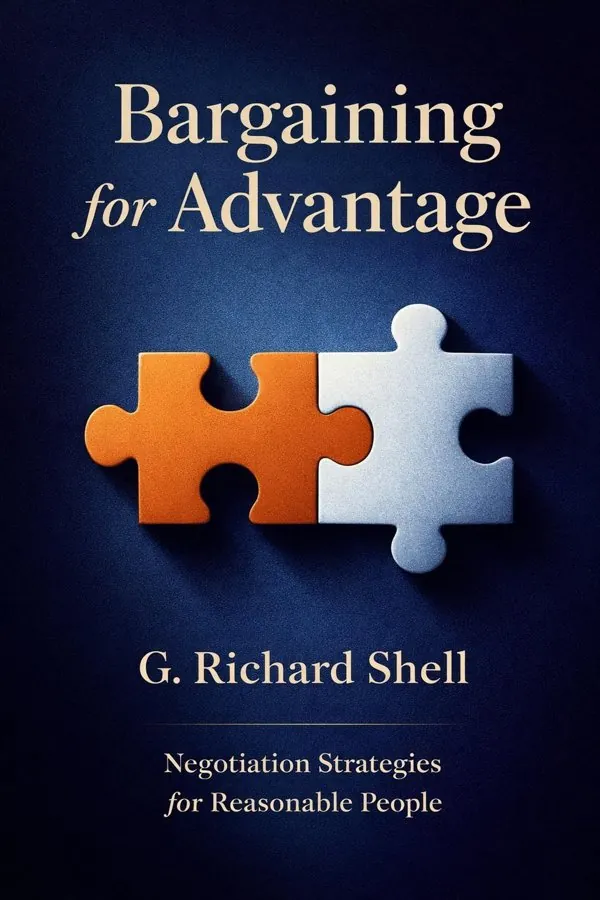
Bargaining for Advantage: Negotiation Strategies for Reasonable People: Summary & Key Insights
 10 min9 chaptersAudio available
What Is Bargaining for Advantage: Negotiation Strategies for Reasonable People About?
Bargaining for Advantage: Negotiation Strategies for Reasonable People by G. Richard Shell is a communication book spanning 9 pages. Bargaining for Advantage is a comprehensive guide to negotiation that blends practical advice with insights from psychology and economics. G. Richard Shell presents a framework for understanding negotiation styles, strategies, and ethics, helping readers develop confidence and skill in both professional and personal negotiations. The book emphasizes preparation, understanding interests, and building relationships to achieve mutually beneficial outcomes.
This FizzRead summary covers all 9 key chapters of Bargaining for Advantage: Negotiation Strategies for Reasonable People in approximately 10 minutes, distilling the most important ideas, arguments, and takeaways from G. Richard Shell's work. Also available as an audio summary and Key Quotes Podcast.
Bargaining for Advantage: Negotiation Strategies for Reasonable People
Bargaining for Advantage is a comprehensive guide to negotiation that blends practical advice with insights from psychology and economics. G. Richard Shell presents a framework for understanding negotiation styles, strategies, and ethics, helping readers develop confidence and skill in both professional and personal negotiations. The book emphasizes preparation, understanding interests, and building relationships to achieve mutually beneficial outcomes.
Who Should Read Bargaining for Advantage: Negotiation Strategies for Reasonable People?
This book is perfect for anyone interested in communication and looking to gain actionable insights in a short read. Whether you're a student, professional, or lifelong learner, the key ideas from Bargaining for Advantage: Negotiation Strategies for Reasonable People by G. Richard Shell will help you think differently.
- ✓Readers who enjoy communication and want practical takeaways
- ✓Professionals looking to apply new ideas to their work and life
- ✓Anyone who wants the core insights of Bargaining for Advantage: Negotiation Strategies for Reasonable People in just 10 minutes
Want the full summary?
Get instant access to this book summary and 100K+ more with Fizz Moment.
Get Free SummaryAvailable on App Store • Free to download
Key Chapters
At the heart of every negotiation lies a set of universal forces—drivers that shape outcomes regardless of culture, context, or scale. I call these the six foundations of effective negotiation. They are not mechanical steps, but rather deep competencies that help you to read situations accurately and act strategically.
We begin with *personal bargaining style*. Are you a competitive negotiator, striving to maximize your own payoff? Or a cooperative one, seeking harmony and fairness? Most of us inhabit a spectrum between these two poles. Understanding your natural tendencies is essential, because every negotiation calls for balance—an appropriate mix of assertiveness and empathy. Through self-assessment, you learn where you are strongest and where you might overreach. When you realize how your emotional responses and communication preferences shape interactions, you can adapt with purpose instead of reacting out of habit.
Next come *goals and expectations*. People often settle for less not because they couldn’t have achieved more, but because they never defined what ‘more’ meant to them. Clear aspirational goals anchor your strategy. Expectation, in negotiation psychology, influences behavior as powerfully as actual capability. When you prepare well enough to set ambitious yet realistic targets, you create a psychological frame that directs both your actions and your counterpart’s perceptions.
Third are *authoritative standards and norms*. Every negotiator relies, consciously or not, on notions of fairness, legitimacy, and precedent. These standards function as tools of persuasion. By invoking agreed social norms—market value, industry benchmarks, moral fairness—you make your arguments harder to dismiss without confrontation. Effective negotiators don’t appeal to emotion alone; they appeal to principles both sides respect.
Fourth is the foundation of *relationships*. Negotiation is rarely a one-time event. Even when it appears transactional, reputational echoes linger. Trust and credibility form invisible capital—when you are known as fair and reliable, you gain power without saying a word. Relationships transform positional bargaining into long-term collaboration, enabling information exchange and creative problem-solving that pure competition never achieves.
Fifth, we explore *interests*. Positions tell you what people say they want; interests reveal *why* they want it. When you move from debating positions to uncovering interests, you open space for integrative solutions—agreements that expand value rather than divide it. This distinction, central to all modern negotiation theory, allows you to bridge differences by solving shared problems rather than fighting over fixed resources.
Finally, *leverage*. Power in negotiation does not come from bluster; it comes from knowing what alternatives exist, what constraints apply, and how perception shapes advantage. Positive leverage arises when you can offer something the other side desires; negative leverage when you can withhold something they need; normative leverage when you can appeal to what they believe is right. Understanding these forms gives you practical control over timing and tactics while staying true to principle.
Together, these foundations create a holistic negotiation mindset—strategic, ethical, and human. They remind us that negotiation is not about domination but design. Once you master them, you move from reactive bargaining to deliberate influence.
Your personality is your first negotiation tool. Every word, gesture, and tone emerges from it. Most of us carry a preferred style—competitive or cooperative—that shapes our approach to every exchange. Competitive negotiators value winning; cooperative negotiators value agreement. Each has strengths and risks. Competitors can secure high outcomes but may damage relationships; cooperators can build trust but may concede too easily.
Self-awareness means understanding where you fall on this spectrum and learning to modulate your behavior. I often remind students that negotiation rewards flexibility. A good negotiator behaves like a jazz musician: she knows the score but improvises to fit the rhythm of the moment. By reflecting on your successes and failures, you begin to see patterns in your responses—your thresholds for conflict, your tolerance for ambiguity, and your emotional triggers.
For instance, if you discover that you instinctively avoid confrontation, you must practice direct but respectful assertion to ensure your interests aren’t overlooked. Conversely, if you dominate conversations, learn to pause and invite input. True mastery emerges when you manage your style as consciously as you manage your data.
Self-awareness also extends beyond behavior to motivation. Ask yourself not just what you want, but why this negotiation matters to you. Financial gain? Recognition? Peace of mind? Understanding your deeper motives equips you to distinguish genuine needs from ego-driven impulses that can derail rational judgment. Negotiators who know themselves negotiate more calmly, because they recognize when emotion masquerades as principle.
+ 7 more chapters — available in the FizzRead app
All Chapters in Bargaining for Advantage: Negotiation Strategies for Reasonable People
About the Author
G. Richard Shell is a professor at the Wharton School of the University of Pennsylvania, specializing in negotiation, persuasion, and business ethics. He is known for his research and teaching on negotiation strategy and has authored several influential books in the field.
Get This Summary in Your Preferred Format
Read or listen to the Bargaining for Advantage: Negotiation Strategies for Reasonable People summary by G. Richard Shell anytime, anywhere. FizzRead offers multiple formats so you can learn on your terms — all free.
Available formats: App · Audio · PDF · EPUB — All included free with FizzRead
Download Bargaining for Advantage: Negotiation Strategies for Reasonable People PDF and EPUB Summary
Key Quotes from Bargaining for Advantage: Negotiation Strategies for Reasonable People
“At the heart of every negotiation lies a set of universal forces—drivers that shape outcomes regardless of culture, context, or scale.”
“Your personality is your first negotiation tool.”
Frequently Asked Questions about Bargaining for Advantage: Negotiation Strategies for Reasonable People
Bargaining for Advantage: Negotiation Strategies for Reasonable People by G. Richard Shell is a communication book that explores key ideas across 9 chapters. Bargaining for Advantage is a comprehensive guide to negotiation that blends practical advice with insights from psychology and economics. G. Richard Shell presents a framework for understanding negotiation styles, strategies, and ethics, helping readers develop confidence and skill in both professional and personal negotiations. The book emphasizes preparation, understanding interests, and building relationships to achieve mutually beneficial outcomes.
You Might Also Like

Magic Words: The Science and Secrets Behind Seven Words That Motivate, Engage, and Influence
Tim David
10 min
Talking Across The Divide: How to Communicate with People You Disagree with and Maybe Even Change the World
Justin Lee
10 min
The Exceptional Presenter: A Proven Formula to Open Up! and Own the Room
Timothy J. Koegel
10 min
4 Essential Keys to Effective Communication in Love, Life, Work--Anywhere!: Including the 12-Day Communication Challenge!
Bento C. Leal III
10 min
Active Listening Techniques: 30 Practical Tools to Hone Your Communication Skills
Nisha Gupta
10 min
Better Small Talk: Talk to Anyone, Avoid Awkwardness, Generate Deep Conversations, and Make Real Friends
Patrick King
10 minFeatured In
Browse by Category
Ready to read Bargaining for Advantage: Negotiation Strategies for Reasonable People?
Get the full summary and 100K+ more books with Fizz Moment.