
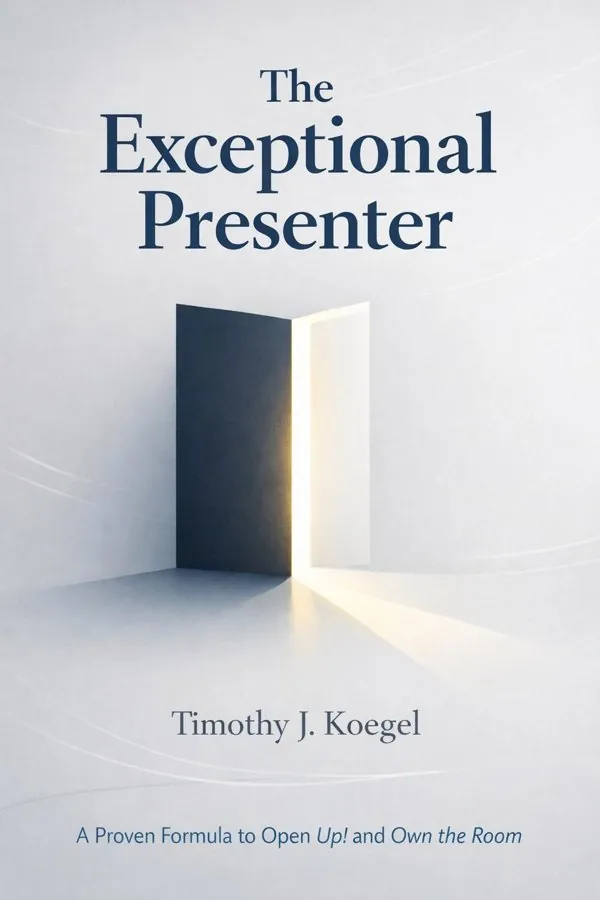
The Exceptional Presenter: A Proven Formula to Open Up! and Own the Room: Summary & Key Insights
 10 min9 chaptersAudio available
Key Takeaways from The Exceptional Presenter: A Proven Formula to Open Up! and Own the Room
A presentation becomes memorable not when people hear more facts, but when they feel more connection.
What many people call charisma is often disciplined presence.
Audiences rarely trust speakers who sound overly polished but emotionally sealed off.
Confidence often looks like spontaneity, but it is usually the product of strong structure.
People hear your message through your voice before they process it through logic.
What Is The Exceptional Presenter: A Proven Formula to Open Up! and Own the Room About?
The Exceptional Presenter: A Proven Formula to Open Up! and Own the Room by Timothy J. Koegel is a communication book. Most presentations fail for a simple reason: they inform without connecting. In The Exceptional Presenter, Timothy J. Koegel argues that great presenting is not about sounding polished, memorizing more slides, or imitating charismatic speakers. It is about learning a repeatable formula that helps you connect authentically, communicate clearly, and move an audience to action. The book shows that exceptional presenters are not born with rare talent; they develop habits that make them more engaging, more credible, and more persuasive in front of any room. Koegel writes from deep practical experience helping business leaders, sales professionals, and executives improve high-stakes communication. His approach is especially valuable because it combines performance skills with business substance. He does not treat presenting as theater detached from real work. Instead, he explains how to structure ideas, manage nerves, use your voice and body effectively, and build trust while still delivering meaningful content. For anyone who has to pitch, lead meetings, present strategy, sell ideas, or speak under pressure, this book matters. It turns presenting from a mystery into a trainable skill and offers a practical path to speaking with confidence and impact.
This FizzRead summary covers all 9 key chapters of The Exceptional Presenter: A Proven Formula to Open Up! and Own the Room in approximately 10 minutes, distilling the most important ideas, arguments, and takeaways from Timothy J. Koegel's work. Also available as an audio summary and Key Quotes Podcast.
The Exceptional Presenter: A Proven Formula to Open Up! and Own the Room
Most presentations fail for a simple reason: they inform without connecting. In The Exceptional Presenter, Timothy J. Koegel argues that great presenting is not about sounding polished, memorizing more slides, or imitating charismatic speakers. It is about learning a repeatable formula that helps you connect authentically, communicate clearly, and move an audience to action. The book shows that exceptional presenters are not born with rare talent; they develop habits that make them more engaging, more credible, and more persuasive in front of any room.
Koegel writes from deep practical experience helping business leaders, sales professionals, and executives improve high-stakes communication. His approach is especially valuable because it combines performance skills with business substance. He does not treat presenting as theater detached from real work. Instead, he explains how to structure ideas, manage nerves, use your voice and body effectively, and build trust while still delivering meaningful content.
For anyone who has to pitch, lead meetings, present strategy, sell ideas, or speak under pressure, this book matters. It turns presenting from a mystery into a trainable skill and offers a practical path to speaking with confidence and impact.
Who Should Read The Exceptional Presenter: A Proven Formula to Open Up! and Own the Room?
This book is perfect for anyone interested in communication and looking to gain actionable insights in a short read. Whether you're a student, professional, or lifelong learner, the key ideas from The Exceptional Presenter: A Proven Formula to Open Up! and Own the Room by Timothy J. Koegel will help you think differently.
- ✓Readers who enjoy communication and want practical takeaways
- ✓Professionals looking to apply new ideas to their work and life
- ✓Anyone who wants the core insights of The Exceptional Presenter: A Proven Formula to Open Up! and Own the Room in just 10 minutes
Want the full summary?
Get instant access to this book summary and 100K+ more with Fizz Moment.
Get Free SummaryAvailable on App Store • Free to download
Key Chapters
A presentation becomes memorable not when people hear more facts, but when they feel more connection. One of Koegel’s central insights is that audiences do not reward speakers simply for being knowledgeable. They respond to presenters who make information feel relevant, human, and emotionally accessible. In business settings, people often overload slides with data and assume the material will speak for itself. But information alone rarely wins attention. People decide whether to trust, listen to, and remember you based on how you show up in the room.
Koegel encourages presenters to shift from a transmission mindset to a connection mindset. Instead of asking, “How do I cover everything?” ask, “How do I help this audience understand why this matters?” That means reading the room, speaking conversationally, and organizing your message around audience needs rather than speaker convenience. A financial update, for example, should not begin with every metric on one slide. It should begin by framing what changed, why it matters, and what decisions need to follow. A sales pitch should not start with company history. It should begin with the client’s problem and the value of solving it.
This shift also reduces anxiety. When your focus moves away from your own performance and toward helping listeners, you become more natural and effective. Audiences are not waiting for perfection; they are waiting for relevance. The best presenters make people feel seen, not lectured.
Actionable takeaway: Before your next presentation, write one sentence answering this question: “What does my audience most need to understand, feel, or do by the end?” Build your opening and structure around that sentence.
What many people call charisma is often disciplined presence. Koegel pushes back against the myth that great presenters are naturally magnetic while everyone else must settle for being average. In his view, presence is not a mysterious gift. It is the visible result of preparation, self-awareness, and deliberate delivery choices. Anyone can learn to appear more grounded, confident, and compelling.
Presence begins with how you occupy the moment. Audiences quickly sense whether a speaker is mentally scattered, overly scripted, or fully engaged. A presenter with presence seems settled. They begin with intention, make eye contact, pause without panic, and avoid rushing to hide nervousness. This calm signals authority. It tells the audience, “You are in capable hands.” That impression matters whether you are introducing a quarterly plan, leading a workshop, or speaking to senior leadership.
Koegel’s approach suggests that presence grows through repeated practice under realistic conditions. Rehearsing only in your head is not enough. You need to hear your voice, test your pacing, and become comfortable with silence and physical stillness. For example, a manager preparing for a board update can practice entering the room, standing still for two seconds, looking at the audience, and delivering the first line clearly before touching a slide. That small sequence changes the entire emotional tone of the talk.
Presence also comes from congruence. Your facial expression, posture, tone, and message should align. If your content is urgent but your delivery is flat, your credibility drops. If your message is optimistic but your body looks tense and closed, the audience feels mixed signals.
Actionable takeaway: Rehearse your first 60 seconds out loud until you can begin slowly, make eye contact, and pause comfortably. Strong openings create instant presence.
Audiences rarely trust speakers who sound overly polished but emotionally sealed off. Koegel emphasizes the power of “opening up,” which means showing genuine energy, authenticity, and human accessibility rather than hiding behind a formal corporate mask. Many professionals believe that credibility requires stiffness. In reality, stiffness often creates distance. People trust presenters who feel real.
Opening up does not mean oversharing personal stories or performing exaggerated enthusiasm. It means allowing your personality, conviction, and interest in the topic to show. A speaker who sounds alive, curious, and engaged invites the audience to engage too. This can be as simple as using natural language instead of jargon, smiling at appropriate moments, or speaking with warmth when introducing a challenge the team must solve. When leaders present with visible humanity, they seem more believable and less defensive.
Consider two product managers giving the same launch update. One reads bullet points in a neutral tone and never looks up. The other explains the customer problem, describes the team’s effort with pride, and acknowledges both excitement and risk. The second presenter creates trust because listeners can sense commitment and honesty. Opening up also helps when discussing difficult topics. If a leader addresses bad news with directness, empathy, and steadiness, the audience is more likely to stay with them than if they hide behind abstract phrasing.
Koegel’s point is that audiences connect with people, not just content. If you suppress all personality in the name of professionalism, you weaken your message. Effective presenting requires controlled vulnerability: enough openness to be credible, enough discipline to stay focused.
Actionable takeaway: Identify one place in your next presentation where you can sound more human, such as using a personal observation, a direct statement of belief, or a warmer tone. Let the audience hear the person behind the message.
Confidence often looks like spontaneity, but it is usually the product of strong structure. Koegel shows that many presentation problems that seem like delivery issues are actually thinking issues. Speakers ramble, over-explain, and lose the audience because they have not shaped their message into a clear path. A well-structured presentation helps listeners follow the logic, and it helps the presenter stay composed under pressure.
At its core, structure answers three questions: Where are we? Why does it matter? What comes next? When audiences know the destination and the path, they relax and listen more carefully. This is especially important in business communication, where people are evaluating implications, not merely absorbing facts. A strategy presentation, for instance, becomes stronger when organized as current reality, key challenge, proposed response, and expected outcome. A team update becomes more useful when framed as progress, obstacles, decisions needed, and next steps.
Koegel encourages presenters to trim excess and elevate the main message. If every detail seems equally important, the audience will remember almost nothing. Good structure creates hierarchy. It tells people what to pay attention to and what action to take. It also makes Q&A easier because the speaker is anchored in a coherent framework rather than a loose collection of points.
A practical way to test structure is to summarize your presentation in a few short headlines. If you cannot explain the flow without slides, your presentation likely needs more work. Clear structure improves not just audience understanding but speaker poise. You feel more confident because you know exactly where you are in the story.
Actionable takeaway: Before building slides, outline your presentation in four simple sections with one key point each. If the logic is clear on paper, your delivery will be clearer in the room.
People hear your message through your voice before they process it through logic. Koegel treats vocal delivery as one of the most underused presentation tools. Speakers often focus heavily on wording and slides while neglecting pace, tone, volume, emphasis, and pauses. Yet these elements shape how the audience interprets confidence, sincerity, urgency, and authority.
A flat voice makes even strong content feel unimportant. A rushed voice signals anxiety and forces listeners to work harder. A monotone drains energy from the room. By contrast, a well-used voice adds texture and meaning. Slowing down at key moments signals significance. Pausing after an important idea gives the audience time to absorb it. Varying tone keeps attention alive and makes the presenter sound present rather than robotic.
In practical terms, vocal control matters in all kinds of settings. A consultant delivering recommendations should use strategic pauses before major conclusions. A startup founder pitching investors should avoid machine-gun pacing and allow conviction to come through in emphasis. A team leader announcing a change initiative should sound steady and grounded, not hurried and apologetic. The voice becomes a leadership instrument.
Koegel’s broader lesson is that audiences do not just listen to what you say; they listen for signals about whether you believe it, understand it, and can guide them through it. Improving vocal delivery is therefore not decorative. It is central to persuasive communication.
To improve, presenters should rehearse aloud, record themselves, and notice patterns. Do you speed up when nervous? Do you end sentences weakly? Do you avoid pauses because silence feels risky? Awareness is the first step toward change.
Actionable takeaway: In your next rehearsal, mark three places where you will intentionally pause and three words or phrases you will emphasize. Deliberate vocal variety instantly improves engagement.
The body often reveals what the mouth is trying to hide. Koegel explains that audiences continuously read posture, facial expression, movement, and gestures for clues about confidence and authenticity. If your nonverbal signals contradict your words, people tend to trust the nonverbal message more. That is why strong content can still fall flat when delivered with closed posture, restless pacing, or weak eye contact.
Effective body language is not about theatrical gestures. It is about alignment. When your stance is balanced, your gestures are purposeful, and your eye contact is inclusive, the audience feels that you are engaged and credible. For example, standing still while making a key point gives it weight. Moving with intention when transitioning to a new idea creates energy without distraction. Looking at individuals across the room builds connection and avoids the impression that you are merely reciting memorized lines.
Many presenters sabotage themselves with nervous habits: shifting weight constantly, gripping a clicker, touching their face, or pacing without purpose. These behaviors communicate discomfort and pull attention away from the message. Koegel’s solution is not rigid control but conscious replacement. Instead of random movement, use planted pauses. Instead of fidgeting hands, use open gestures that match the content. Instead of scanning vaguely, complete a thought while looking at one person, then move to another.
Body language is especially important in leadership moments. If you are announcing a difficult decision, your posture must convey steadiness. If you are inspiring a team, your expression should show belief in what you are saying. The body can amplify the message or quietly undermine it.
Actionable takeaway: Record yourself presenting and watch with the sound off. Notice whether your body alone communicates confidence, warmth, and clarity. Then adjust one distracting habit before your next presentation.
Most presenters prepare incorrectly: they gather content, make slides, review notes, and assume they are ready. Koegel argues that real preparation must include realistic rehearsal. You do not become presentation-ready by understanding your material intellectually. You become ready by practicing the actual act of presenting under conditions that resemble the real moment.
This distinction matters because presenting is a performance skill. Knowing what you want to say is different from delivering it with timing, clarity, and confidence. A speaker may feel prepared after hours of slide editing but still stumble through transitions, rush key points, or freeze during the opening because they never practiced aloud. Rehearsal exposes weaknesses that silent review conceals.
Effective rehearsal includes standing up, speaking at full volume, and moving through the talk in sequence. It also includes handling likely interruptions and questions. A sales leader preparing for a client meeting, for instance, should rehearse the opening, the core value proposition, and responses to objections. A senior executive preparing for a town hall should practice not only the prepared remarks but also the emotional tone needed for sensitive questions.
Koegel’s formula suggests that presenters should focus especially on openings, transitions, and endings. These are the moments where confidence and clarity matter most. Rehearsal should also include simplification. If a section feels hard to deliver, the issue may be that the thinking is still too complex.
The point is not to memorize every word. Over-memorization can make delivery stiff and fragile. Instead, rehearse the flow, the language of key points, and the emotional rhythm of the presentation. Then you can sound natural while staying in control.
Actionable takeaway: Replace one silent review session with a full spoken rehearsal. Practice standing, gesturing, and delivering the opening and closing exactly as you intend to do them live.
Owning the room does not mean dominating it. It means understanding the audience well enough to guide their attention, meet their needs, and influence their thinking. Koegel presents exceptional presenting as an act of awareness rather than self-display. The strongest speakers are not the most self-focused; they are the most audience-focused.
This begins with preparation. Different audiences care about different things. Executives usually want implications, priorities, and decisions. Technical teams want accuracy, logic, and feasibility. Clients want relevance and outcomes. A presentation that ignores these differences may be polished but ineffective. Owning the room requires asking: What does this group care about? What are they skeptical of? What do they already know? What action do I want from them?
Audience awareness also matters during delivery. Great presenters notice energy shifts, confusion, resistance, and curiosity. They adjust pace, clarify a point, or lean into what matters most. For example, if a team appears confused during a process update, a strong presenter pauses and reframes the idea in simpler terms. If a client becomes highly engaged on one issue, an effective presenter explores it rather than rigidly clinging to the original script.
Koegel’s message is that influence depends on responsiveness. The room is not a passive container. It is a living environment that gives feedback. Presenters who can read and respond to that feedback create more trust and impact. They look confident not because they force control, but because they remain composed while adapting.
Actionable takeaway: Before your next presentation, list the audience’s top three concerns and one likely objection. During the talk, watch for signs of confusion or interest and adjust rather than plowing ahead mechanically.
Presenting is often treated as a soft skill, but Koegel makes clear that it is a business skill with real consequences. Careers, deals, decisions, and team alignment are all shaped by how well ideas are presented. A weak presentation can cause a strong strategy to be ignored. A strong presentation can accelerate buy-in, reduce confusion, and create momentum around action.
This is why exceptional presenting matters beyond conference stages or keynote moments. It shows up in boardrooms, sales meetings, project reviews, investor pitches, team briefings, and change announcements. In each case, the presenter is not merely sharing information. They are shaping perception and directing attention. Their ability to be clear, confident, and engaging affects whether people trust the message and act on it.
A product leader introducing a new roadmap must secure commitment across functions. A founder pitching investors must convey not just market potential but command of the opportunity. A manager leading a difficult change conversation must reduce anxiety while creating clarity. In all these cases, delivery and substance work together. Great presenters gain an advantage because they make it easier for others to believe, decide, and move.
Koegel’s contribution is to show that presenting excellence is practical and learnable. It is not about becoming flashy. It is about aligning message, presence, and audience awareness to produce results. When you can open up and own the room, you do more than look impressive. You help ideas survive contact with reality.
Actionable takeaway: Treat your next important presentation as a business opportunity, not a communication chore. Define the specific result you need, then prepare your message and delivery to drive that outcome.
All Chapters in The Exceptional Presenter: A Proven Formula to Open Up! and Own the Room
About the Author
Timothy J. Koegel is a presentation coach, communication expert, and business author known for helping professionals speak with greater confidence and impact. His work centers on the idea that exceptional presenting is not a rare gift but a learnable skill built through preparation, authenticity, and audience awareness. Koegel has advised executives, leaders, sales professionals, and organizations on how to improve high-stakes communication, from formal presentations to leadership messages and client-facing talks. He is especially respected for combining practical business relevance with performance-based speaking techniques. In The Exceptional Presenter, he distills that experience into a clear formula for becoming more engaging, credible, and persuasive in the room. His teaching emphasizes real-world improvement rather than abstract theory or flashy stage tricks.
Get This Summary in Your Preferred Format
Read or listen to the The Exceptional Presenter: A Proven Formula to Open Up! and Own the Room summary by Timothy J. Koegel anytime, anywhere. FizzRead offers multiple formats so you can learn on your terms — all free.
Available formats: App · Audio · PDF · EPUB — All included free with FizzRead
Download The Exceptional Presenter: A Proven Formula to Open Up! and Own the Room PDF and EPUB Summary
Key Quotes from The Exceptional Presenter: A Proven Formula to Open Up! and Own the Room
“A presentation becomes memorable not when people hear more facts, but when they feel more connection.”
“What many people call charisma is often disciplined presence.”
“Audiences rarely trust speakers who sound overly polished but emotionally sealed off.”
“Confidence often looks like spontaneity, but it is usually the product of strong structure.”
“People hear your message through your voice before they process it through logic.”
Frequently Asked Questions about The Exceptional Presenter: A Proven Formula to Open Up! and Own the Room
The Exceptional Presenter: A Proven Formula to Open Up! and Own the Room by Timothy J. Koegel is a communication book that explores key ideas across 9 chapters. Most presentations fail for a simple reason: they inform without connecting. In The Exceptional Presenter, Timothy J. Koegel argues that great presenting is not about sounding polished, memorizing more slides, or imitating charismatic speakers. It is about learning a repeatable formula that helps you connect authentically, communicate clearly, and move an audience to action. The book shows that exceptional presenters are not born with rare talent; they develop habits that make them more engaging, more credible, and more persuasive in front of any room. Koegel writes from deep practical experience helping business leaders, sales professionals, and executives improve high-stakes communication. His approach is especially valuable because it combines performance skills with business substance. He does not treat presenting as theater detached from real work. Instead, he explains how to structure ideas, manage nerves, use your voice and body effectively, and build trust while still delivering meaningful content. For anyone who has to pitch, lead meetings, present strategy, sell ideas, or speak under pressure, this book matters. It turns presenting from a mystery into a trainable skill and offers a practical path to speaking with confidence and impact.
You Might Also Like

Magic Words: The Science and Secrets Behind Seven Words That Motivate, Engage, and Influence
Tim David
10 min
Talking Across The Divide: How to Communicate with People You Disagree with and Maybe Even Change the World
Justin Lee
10 min
4 Essential Keys to Effective Communication in Love, Life, Work--Anywhere!: Including the 12-Day Communication Challenge!
Bento C. Leal III
10 min
Active Listening Techniques: 30 Practical Tools to Hone Your Communication Skills
Nisha Gupta
10 min
Bargaining for Advantage: Negotiation Strategies for Reasonable People
G. Richard Shell
10 min
Better Small Talk: Talk to Anyone, Avoid Awkwardness, Generate Deep Conversations, and Make Real Friends
Patrick King
10 minBrowse by Category
Ready to read The Exceptional Presenter: A Proven Formula to Open Up! and Own the Room?
Get the full summary and 100K+ more books with Fizz Moment.