
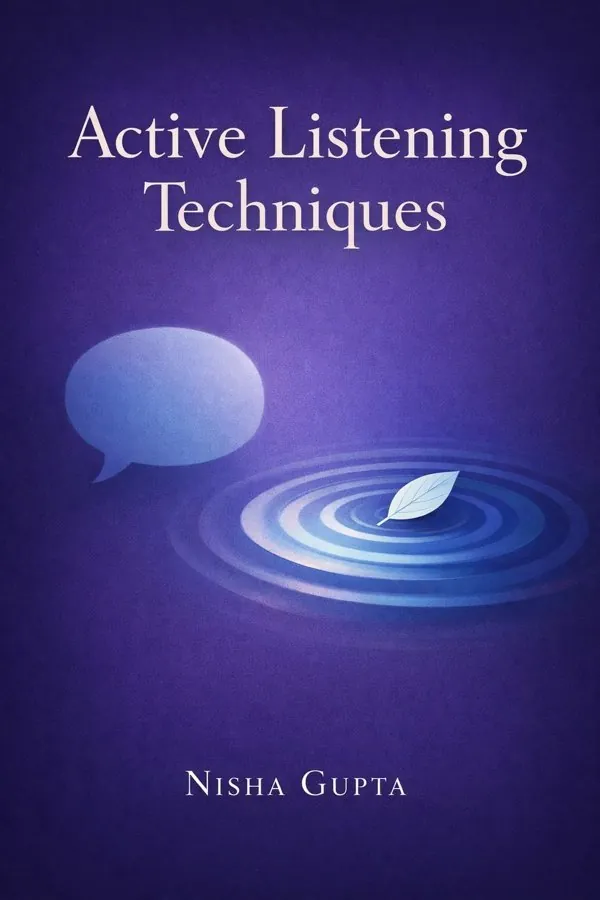
Active Listening Techniques: 30 Practical Tools to Hone Your Communication Skills: Summary & Key Insights
by Nisha Gupta
 10 min4 chaptersAudio available
What Is Active Listening Techniques: 30 Practical Tools to Hone Your Communication Skills About?
Active Listening Techniques: 30 Practical Tools to Hone Your Communication Skills by Nisha Gupta is a communication book spanning 4 pages. Active Listening Techniques offers practical exercises and strategies to improve communication, empathy, and understanding in personal and professional settings. The book emphasizes mindfulness, nonverbal cues, and emotional intelligence to help readers become more effective listeners and communicators.
This FizzRead summary covers all 4 key chapters of Active Listening Techniques: 30 Practical Tools to Hone Your Communication Skills in approximately 10 minutes, distilling the most important ideas, arguments, and takeaways from Nisha Gupta's work. Also available as an audio summary and Key Quotes Podcast.
Active Listening Techniques: 30 Practical Tools to Hone Your Communication Skills
Active Listening Techniques offers practical exercises and strategies to improve communication, empathy, and understanding in personal and professional settings. The book emphasizes mindfulness, nonverbal cues, and emotional intelligence to help readers become more effective listeners and communicators.
Who Should Read Active Listening Techniques: 30 Practical Tools to Hone Your Communication Skills?
This book is perfect for anyone interested in communication and looking to gain actionable insights in a short read. Whether you're a student, professional, or lifelong learner, the key ideas from Active Listening Techniques: 30 Practical Tools to Hone Your Communication Skills by Nisha Gupta will help you think differently.
- ✓Readers who enjoy communication and want practical takeaways
- ✓Professionals looking to apply new ideas to their work and life
- ✓Anyone who wants the core insights of Active Listening Techniques: 30 Practical Tools to Hone Your Communication Skills in just 10 minutes
Want the full summary?
Get instant access to this book summary and 100K+ more with Fizz Moment.
Get Free SummaryAvailable on App Store • Free to download
Key Chapters
Before we can listen well, we must recognize what keeps us from doing so. In my years as a psychologist and communication coach, I’ve seen the same patterns over and over again: distraction, assumption, and emotional reaction. These three barriers subtly drain our capacity to listen.
Distraction is perhaps the most pervasive. Our minds wander even as we nod along to a speaker’s words. We think about what to say next, our unread emails, or how the conversation might end. In active listening, mindfulness plays a central role in countering this drift. By anchoring our attention on the present—on tone, pacing, and emotion—we signal respect and readiness to the speaker. Active listening, then, becomes a mindful state rather than a passive act.
Assumption is another silent saboteur. We predict what someone will say next, or overlay their story with our own experiences. When we fill in the blanks, we stop hearing what’s actually being said. This is why I emphasize curiosity as the antidote. Instead of pre-empting meaning, we ask clarifying questions: “What did you mean when you said that?” or “Could you tell me more about that experience?” These questions reopen the conversational space.
Emotional reactions create the third and perhaps most challenging barrier. When someone’s words trigger anger, defensiveness, or shame, our instinct is to retreat into argument or silence. Managing these reactions requires emotional regulation—a key component of active listening. In the book, I guide readers through mindfulness exercises designed to help them notice when their body tenses or their thoughts become defensive. Simply noticing gives us power over reaction.
At its core, active listening rests on empathy and presence. Empathy allows you to step momentarily into another’s perspective, not to agree but to understand. Presence keeps you grounded in the exchange, aware of your own responses but not ruled by them. Once these foundations are in place, you can begin applying the techniques that make listening transformative.
Much of what is communicated never passes through words. When I teach teams or couples about active listening, I often have them engage in silent observation exercises—just watching someone speak for two minutes without interrupting. What they discover is astonishing: words are only a fraction of expression; the rest lives in tone, gesture, and energy.
To develop this awareness, mindfulness is our greatest ally. When you are mindful, you pay attention without judgment. You sense the rise and fall of someone’s voice, the pace of their speech, the flicker of discomfort in their eyes. Each of these clues tells a story the words may conceal. The technique of “mirroring” becomes essential here: subtly aligning your posture, breathing, or tone with the speaker’s to create coherence and trust. Mirroring is not mimicry—it’s attunement.
During workshops with corporate teams, I’ve seen leaders realize how their unconscious behaviors undermine their message. A manager offering feedback with crossed arms or a furrowed brow may seem closed or disapproving even when her words are supportive. Once leaders become aware of their own body language and learn to read others’, miscommunication drops sharply.
The next step is interpreting tone and pacing. A soft voice might indicate hesitation, but it might also signal deep thoughtfulness. Active listeners learn not to jump to interpretation but to combine what they sense with gentle inquiry. For example, “I notice your voice got quieter—are you feeling uncertain about this?” Such statements show care while inviting clarity.
Mastering nonverbal understanding transforms every relationship you hold. It turns everyday interactions into rich dialogues that transcend simple information exchange. It reminds us that human presence itself communicates meaning. Listening, then, becomes a full-body practice—mind, heart, and intuition attuned to another person’s reality.
+ 2 more chapters — available in the FizzRead app
All Chapters in Active Listening Techniques: 30 Practical Tools to Hone Your Communication Skills
About the Author
Nisha Gupta is a communication coach and psychologist specializing in interpersonal skills and emotional intelligence. She has conducted workshops and training programs for organizations worldwide, focusing on active listening and effective communication.
Get This Summary in Your Preferred Format
Read or listen to the Active Listening Techniques: 30 Practical Tools to Hone Your Communication Skills summary by Nisha Gupta anytime, anywhere. FizzRead offers multiple formats so you can learn on your terms — all free.
Available formats: App · Audio · PDF · EPUB — All included free with FizzRead
Download Active Listening Techniques: 30 Practical Tools to Hone Your Communication Skills PDF and EPUB Summary
Key Quotes from Active Listening Techniques: 30 Practical Tools to Hone Your Communication Skills
“Before we can listen well, we must recognize what keeps us from doing so.”
“Much of what is communicated never passes through words.”
Frequently Asked Questions about Active Listening Techniques: 30 Practical Tools to Hone Your Communication Skills
Active Listening Techniques: 30 Practical Tools to Hone Your Communication Skills by Nisha Gupta is a communication book that explores key ideas across 4 chapters. Active Listening Techniques offers practical exercises and strategies to improve communication, empathy, and understanding in personal and professional settings. The book emphasizes mindfulness, nonverbal cues, and emotional intelligence to help readers become more effective listeners and communicators.
You Might Also Like

Magic Words: The Science and Secrets Behind Seven Words That Motivate, Engage, and Influence
Tim David
10 min
Talking Across The Divide: How to Communicate with People You Disagree with and Maybe Even Change the World
Justin Lee
10 min
The Exceptional Presenter: A Proven Formula to Open Up! and Own the Room
Timothy J. Koegel
10 min
4 Essential Keys to Effective Communication in Love, Life, Work--Anywhere!: Including the 12-Day Communication Challenge!
Bento C. Leal III
10 min
Bargaining for Advantage: Negotiation Strategies for Reasonable People
G. Richard Shell
10 min
Better Small Talk: Talk to Anyone, Avoid Awkwardness, Generate Deep Conversations, and Make Real Friends
Patrick King
10 minFeatured In
Browse by Category
Ready to read Active Listening Techniques: 30 Practical Tools to Hone Your Communication Skills?
Get the full summary and 100K+ more books with Fizz Moment.