
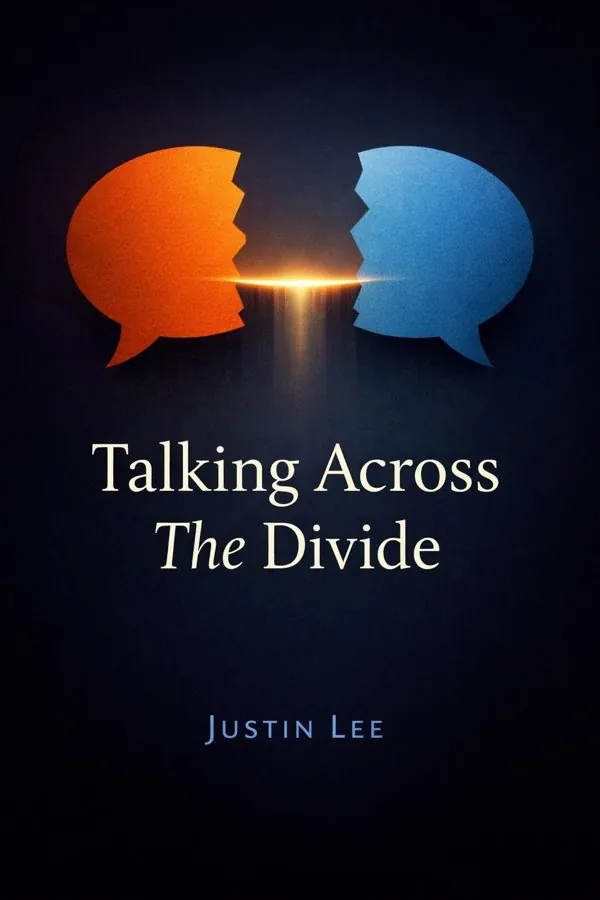
Talking Across The Divide: How to Communicate with People You Disagree with and Maybe Even Change the World: Summary & Key Insights
by Justin Lee
 10 min9 chaptersAudio available
Key Takeaways from Talking Across The Divide: How to Communicate with People You Disagree with and Maybe Even Change the World
People rarely change their minds when they feel attacked.
Behind almost every strong opinion lies a story.
When people feel humiliated, they stop listening.
Assumptions are efficient, but they are terrible for understanding.
Disagreement often feels total when it is actually partial.
What Is Talking Across The Divide: How to Communicate with People You Disagree with and Maybe Even Change the World About?
Talking Across The Divide: How to Communicate with People You Disagree with and Maybe Even Change the World by Justin Lee is a communication book. In a time when disagreement so often turns into hostility, Talking Across The Divide offers a practical and humane guide to having better conversations with people whose beliefs, values, or identities differ from our own. Justin Lee argues that persuasion rarely begins with better talking points. It begins with curiosity, trust, humility, and the willingness to understand why another person thinks the way they do. Rather than treating disagreement as a battle to win, he reframes it as a relationship to navigate. The book matters because polarization is no longer limited to politics. It affects families, workplaces, friendships, faith communities, and online culture. Lee shows that if we want to lower the temperature and create meaningful change, we must learn how to communicate without contempt. His approach is not naive optimism or conflict avoidance. It is a disciplined method for listening well, asking better questions, reducing defensiveness, and making people more open to reconsidering their views. Lee writes with authority born from experience. As a speaker, writer, and bridge-builder known for navigating difficult cultural and ideological divides, he brings both personal insight and practical communication wisdom to one of the most urgent challenges of modern life.
This FizzRead summary covers all 9 key chapters of Talking Across The Divide: How to Communicate with People You Disagree with and Maybe Even Change the World in approximately 10 minutes, distilling the most important ideas, arguments, and takeaways from Justin Lee's work. Also available as an audio summary and Key Quotes Podcast.
Talking Across The Divide: How to Communicate with People You Disagree with and Maybe Even Change the World
In a time when disagreement so often turns into hostility, Talking Across The Divide offers a practical and humane guide to having better conversations with people whose beliefs, values, or identities differ from our own. Justin Lee argues that persuasion rarely begins with better talking points. It begins with curiosity, trust, humility, and the willingness to understand why another person thinks the way they do. Rather than treating disagreement as a battle to win, he reframes it as a relationship to navigate.
The book matters because polarization is no longer limited to politics. It affects families, workplaces, friendships, faith communities, and online culture. Lee shows that if we want to lower the temperature and create meaningful change, we must learn how to communicate without contempt. His approach is not naive optimism or conflict avoidance. It is a disciplined method for listening well, asking better questions, reducing defensiveness, and making people more open to reconsidering their views.
Lee writes with authority born from experience. As a speaker, writer, and bridge-builder known for navigating difficult cultural and ideological divides, he brings both personal insight and practical communication wisdom to one of the most urgent challenges of modern life.
Who Should Read Talking Across The Divide: How to Communicate with People You Disagree with and Maybe Even Change the World?
This book is perfect for anyone interested in communication and looking to gain actionable insights in a short read. Whether you're a student, professional, or lifelong learner, the key ideas from Talking Across The Divide: How to Communicate with People You Disagree with and Maybe Even Change the World by Justin Lee will help you think differently.
- ✓Readers who enjoy communication and want practical takeaways
- ✓Professionals looking to apply new ideas to their work and life
- ✓Anyone who wants the core insights of Talking Across The Divide: How to Communicate with People You Disagree with and Maybe Even Change the World in just 10 minutes
Want the full summary?
Get instant access to this book summary and 100K+ more with Fizz Moment.
Get Free SummaryAvailable on App Store • Free to download
Key Chapters
People rarely change their minds when they feel attacked. That simple truth sits at the heart of Justin Lee’s approach. We often assume that if we just present the right facts, expose flaws in the other person’s logic, or win the argument in public, they will finally see reason. In reality, most people become more defensive when they sense judgment, disrespect, or social threat. Before ideas can move, the relationship has to feel safe enough to hold disagreement.
Lee emphasizes that communication across divides begins with connection, not correction. This does not mean pretending differences do not matter. It means recognizing that trust is the soil in which honest conversation can grow. If someone believes you see them as foolish, immoral, or dangerous, they are unlikely to seriously consider your perspective. But if they believe you are genuinely trying to understand them, they may lower their guard.
In practical terms, this can look like beginning a conversation with shared concerns rather than immediate rebuttals. A workplace disagreement about diversity training might start with a common desire for fairness and respect. A family conflict over politics might begin by affirming love and long-term relationship before addressing the issue itself. Even online, the tone of the first few sentences can determine whether a discussion becomes productive or toxic.
Connection also requires patience. You may not persuade someone in one conversation. But by preserving trust, you create the possibility of future conversations that go deeper. The goal is not to perform moral superiority. It is to make transformation possible.
Actionable takeaway: Before offering your argument, spend time showing the other person that you respect them as a human being and care more about understanding than scoring points.
Behind almost every strong opinion lies a story. People do not arrive at beliefs in a vacuum. Their views are shaped by experiences, fears, loyalties, identities, communities, and moments that made certain ideas feel true or necessary. Lee encourages readers to listen beneath a person’s position and ask what life experiences might have led them there.
This shift changes everything. When we hear only the surface-level opinion, we tend to reduce others to labels: conservative, progressive, religious, secular, traditional, radical. Labels make people easier to dismiss. But stories make them harder to hate. A person’s resistance to immigration, for example, may come from economic insecurity rather than cruelty. A person’s passionate activism may come from direct experience with exclusion rather than ideological fashion. Listening for the story does not require agreement. It requires curiosity.
Lee’s approach helps us avoid a common mistake: debating a point before we understand what the point represents. Sometimes people are defending not just an idea, but a sense of safety, belonging, dignity, or memory. If you challenge the idea without recognizing the deeper stake, your argument can feel like an attack on the person’s identity.
A practical way to do this is by asking open-ended questions: “What experiences shaped your view on this?” “When did this issue become important to you?” “What concern are you trying to protect?” Such questions invite reflection rather than combat. They also reveal whether your disagreement is really about facts, values, priorities, or fear.
Actionable takeaway: In your next difficult conversation, ask at least two sincere questions about the experiences behind the other person’s view before you offer your own response.
When people feel humiliated, they stop listening. Lee shows that one of the biggest barriers to productive dialogue is the fear of losing face. Many conversations fail not because the issue is impossible to discuss, but because one or both sides feel cornered, shamed, or publicly exposed. Once dignity is threatened, self-protection takes over.
This is especially important in politically or morally charged conversations. If you imply that someone is stupid, evil, backward, or irredeemable, they will likely cling even more tightly to their position. Even if your criticism contains truth, the delivery can make growth impossible. Dignity does not mean endorsing harmful beliefs. It means challenging ideas in a way that leaves room for the person to think, reconsider, and evolve without social annihilation.
Lee encourages readers to separate disagreement from contempt. You can firmly oppose someone’s opinion while still signaling that they are a person capable of thought and change. In practice, this might mean avoiding sarcastic exaggerations, public pile-ons, and gotcha questions designed only to embarrass. It may also mean giving someone a graceful exit from a bad argument instead of forcing them into stubborn defense.
Imagine a colleague makes an insensitive remark in a meeting. A response that publicly mocks them may win applause from allies but produce only shame and resentment. A response that names the problem clearly while inviting reflection is more likely to create learning. The same principle applies in families, classrooms, and online spaces.
Actionable takeaway: In moments of disagreement, ask yourself whether your words are confronting the issue or stripping the other person of dignity, and choose language that allows honesty without humiliation.
Assumptions are efficient, but they are terrible for understanding. Lee argues that many conflicts intensify because we assume we already know what the other person means, believes, or intends. We hear one phrase and mentally fill in the rest. We assign motive without evidence. We treat people as predictable representatives of a group rather than individuals with nuance.
Curiosity interrupts that pattern. Instead of reacting to our interpretation, we investigate the person’s actual meaning. This often reveals that the disagreement is either smaller than we thought or different from what we assumed. A phrase that sounded hostile may have come from unfamiliar vocabulary rather than bad intent. A statement that seemed politically loaded may reflect confusion, fear, or partial agreement rather than full opposition.
Lee’s method is especially useful in polarized environments where people are primed to detect enemies. Curiosity slows down emotional escalation. It replaces “I know exactly what you mean” with “Can you say more about that?” It shifts a conversation from accusation to clarification. In many cases, people become more careful and reflective simply because they feel invited to explain themselves rather than immediately condemned.
This does not mean endless benefit-of-the-doubt for clearly harmful behavior. It means resisting the temptation to overread limited information. In practical settings, curiosity can be built through habits such as paraphrasing before responding, checking definitions, and distinguishing between what was said and what you inferred.
For example, if a friend says, “I’m worried about what schools are teaching kids,” your first move could be to ask what specifically concerns them rather than assuming the worst ideological subtext.
Actionable takeaway: When you feel instantly triggered by someone’s comment, pause and ask one clarifying question before making any argument or judgment.
A devastating irony of conflict is that being right is not always enough. Lee points out that many people know how to dismantle an argument but do not know how to preserve a relationship. In a culture that rewards quick takedowns, public certainty, and verbal dominance, it is easy to confuse rhetorical victory with meaningful influence. Yet a person who feels defeated in the moment often leaves less open to change, not more.
This is why Lee pushes readers to examine their true goal. Is it to look smart, impress an audience, release frustration, or actually help someone reconsider? These goals lead to very different communication styles. If your aim is transformation, you may need to give up the emotional reward of crushing the opposing point. You may need to leave some things unsaid, acknowledge where the other person has a point, and focus on what can be productively discussed.
Consider social media debates. A sharp, humiliating reply can earn likes and solidarity from your side, but it often hardens the target and entertains onlookers rather than changing minds. In contrast, a slower conversation in private, where the person does not feel exposed, may be far more influential. The same applies to activism, management, mentoring, and family conflict.
Lee is not asking readers to become passive. He is asking them to become strategic and humane. Persuasion requires emotional intelligence as much as intellectual strength. Often the most effective communicator is not the one who dominates the exchange, but the one who leaves the other person thinking afterward.
Actionable takeaway: Before entering a disagreement, decide whether your real goal is to win the moment or to influence the person, and let that goal shape your tone and method.
Certainty can feel powerful, but humility is often more persuasive. Lee stresses that productive dialogue requires acknowledging the limits of our own knowledge, experiences, and assumptions. When we act as though our side is perfectly informed and morally flawless, we invite defensiveness and close ourselves off from learning. Humility does not weaken conviction. It makes conviction credible.
One reason humility matters is that most complex issues contain ambiguity. Even when one side is clearly stronger on the facts or morality, there are often trade-offs, blind spots, or emotional realities worth recognizing. Admitting uncertainty where it genuinely exists signals honesty. It tells the other person that you are not simply reciting tribal scripts. That can lower their resistance and make them more willing to be thoughtful in return.
Humility also helps us notice when we are using people as symbols. In polarized settings, it is easy to approach a conversation as if we are fighting an entire ideology through one person. That pressure distorts listening and encourages oversimplification. A humble mindset keeps us grounded in the actual human being in front of us.
Practically, humility can sound like: “I may be missing part of this,” “Here’s why I see it this way, but I know this issue is complicated,” or “I feel strongly about this, though I’m still learning.” These phrases are not signs of weakness when used sincerely. They model the kind of openness we often wish others would show.
Actionable takeaway: In your next difficult conversation, intentionally name one limitation in your own perspective to make the exchange more honest and invite mutual openness.
Few people abandon deeply held beliefs in a single conversation. Lee reminds readers that attitude change is often gradual, uneven, and mostly invisible at first. We tend to overestimate what one discussion can accomplish and underestimate the long-term impact of respectful engagement. This misunderstanding leads to frustration. If the other person does not immediately agree, we assume the conversation failed. But change often begins as a crack in certainty, not a dramatic reversal.
This perspective encourages patience. A productive conversation may simply plant a question, complicate a stereotype, or make someone less sure that opponents are ignorant or malicious. That may not feel satisfying in the moment, especially if the issue matters deeply. But these small shifts are often prerequisites for larger change later. People need time to process new information without feeling coerced.
Lee’s view is helpful for parents, educators, organizers, and leaders who want to influence culture without burning out. It suggests that consistency matters more than instant victory. Repeated interactions marked by respect, clarity, and emotional steadiness can gradually reshape what someone finds thinkable.
For example, someone raised in a rigid community may not openly revise their beliefs after one honest conversation. But they may remember your kindness, revisit the questions later, and slowly move over months or years. This is why bridge-building work matters even when results are not immediately visible.
Actionable takeaway: Measure difficult conversations not only by whether someone changed their mind today, but by whether you made future reflection and future dialogue more possible.
Communication is never just personal. Lee shows that the way we speak across differences shapes families, organizations, civic life, and culture itself. Polarization survives not only because people disagree, but because they lose the skills and habits needed to disagree constructively. Every contemptuous exchange trains us toward further division. Every respectful, truth-seeking conversation pushes in the opposite direction.
This gives ordinary dialogue a larger significance. A manager who models calm disagreement can influence team culture. A parent who teaches children to ask questions rather than ridicule differences can shape how the next generation handles conflict. A community leader who creates space for honest but respectful discussion can reduce fear and increase trust among groups who rarely interact well. These are not small acts. They are social interventions.
Lee’s optimism is practical rather than sentimental. He does not suggest that every disagreement can be solved through conversation alone, or that harmful systems disappear when people are nicer. Rather, he argues that without better communication, even necessary change efforts become harder. Reform, justice, cooperation, and coexistence all depend in part on the ability to keep people engaged long enough to hear, learn, and reconsider.
In daily life, this means treating communication as a form of civic responsibility. The habits you practice in one-on-one conversations ripple outward. If you can hold firm beliefs without dehumanizing opponents, you help create a healthier public culture.
Actionable takeaway: Choose one community you belong to, such as your family, workplace, classroom, or online group, and intentionally model one better way of handling disagreement this week.
All Chapters in Talking Across The Divide: How to Communicate with People You Disagree with and Maybe Even Change the World
About the Author
Justin Lee is an American author, speaker, and bridge-building advocate known for his work on difficult conversations across social, political, and cultural divides. He has spent years helping people communicate more thoughtfully in contexts where identity, belief, and values often collide. Lee is widely recognized for his ability to engage contentious issues with empathy, clarity, and honesty, making him a respected voice for readers who want to reduce hostility without avoiding hard truths. His writing combines personal experience with practical insight, focusing on how trust, listening, and dignity can open space for real dialogue. In Talking Across The Divide, he draws on that background to offer a hopeful but grounded framework for better communication in a polarized age.
Get This Summary in Your Preferred Format
Read or listen to the Talking Across The Divide: How to Communicate with People You Disagree with and Maybe Even Change the World summary by Justin Lee anytime, anywhere. FizzRead offers multiple formats so you can learn on your terms — all free.
Available formats: App · Audio · PDF · EPUB — All included free with FizzRead
Download Talking Across The Divide: How to Communicate with People You Disagree with and Maybe Even Change the World PDF and EPUB Summary
Key Quotes from Talking Across The Divide: How to Communicate with People You Disagree with and Maybe Even Change the World
“People rarely change their minds when they feel attacked.”
“Behind almost every strong opinion lies a story.”
“When people feel humiliated, they stop listening.”
“Assumptions are efficient, but they are terrible for understanding.”
“Disagreement often feels total when it is actually partial.”
Frequently Asked Questions about Talking Across The Divide: How to Communicate with People You Disagree with and Maybe Even Change the World
Talking Across The Divide: How to Communicate with People You Disagree with and Maybe Even Change the World by Justin Lee is a communication book that explores key ideas across 9 chapters. In a time when disagreement so often turns into hostility, Talking Across The Divide offers a practical and humane guide to having better conversations with people whose beliefs, values, or identities differ from our own. Justin Lee argues that persuasion rarely begins with better talking points. It begins with curiosity, trust, humility, and the willingness to understand why another person thinks the way they do. Rather than treating disagreement as a battle to win, he reframes it as a relationship to navigate. The book matters because polarization is no longer limited to politics. It affects families, workplaces, friendships, faith communities, and online culture. Lee shows that if we want to lower the temperature and create meaningful change, we must learn how to communicate without contempt. His approach is not naive optimism or conflict avoidance. It is a disciplined method for listening well, asking better questions, reducing defensiveness, and making people more open to reconsidering their views. Lee writes with authority born from experience. As a speaker, writer, and bridge-builder known for navigating difficult cultural and ideological divides, he brings both personal insight and practical communication wisdom to one of the most urgent challenges of modern life.
You Might Also Like

Magic Words: The Science and Secrets Behind Seven Words That Motivate, Engage, and Influence
Tim David
10 min
The Exceptional Presenter: A Proven Formula to Open Up! and Own the Room
Timothy J. Koegel
10 min
4 Essential Keys to Effective Communication in Love, Life, Work--Anywhere!: Including the 12-Day Communication Challenge!
Bento C. Leal III
10 min
Active Listening Techniques: 30 Practical Tools to Hone Your Communication Skills
Nisha Gupta
10 min
Bargaining for Advantage: Negotiation Strategies for Reasonable People
G. Richard Shell
10 min
Better Small Talk: Talk to Anyone, Avoid Awkwardness, Generate Deep Conversations, and Make Real Friends
Patrick King
10 minBrowse by Category
Ready to read Talking Across The Divide: How to Communicate with People You Disagree with and Maybe Even Change the World?
Get the full summary and 100K+ more books with Fizz Moment.