
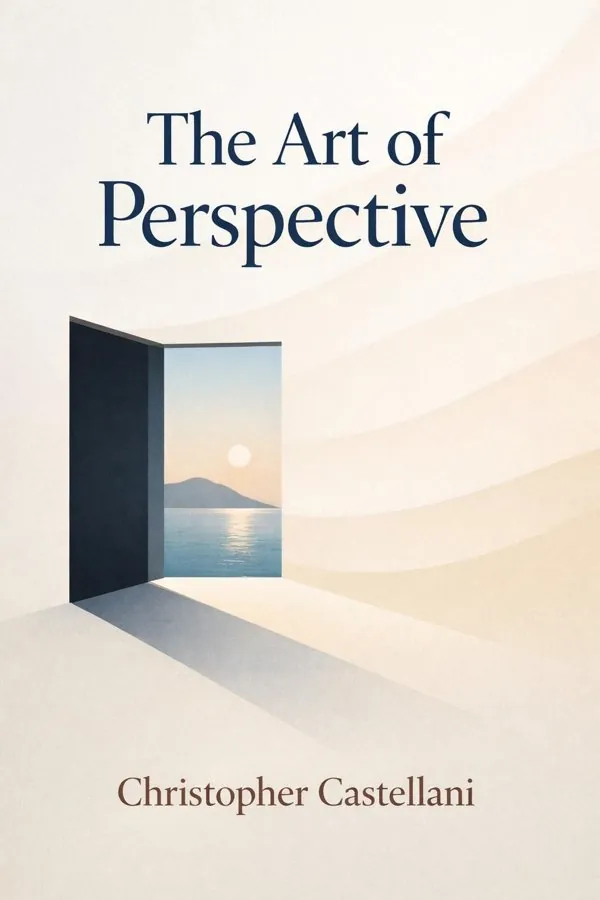
The Art of Perspective: Who Tells the Story: Summary & Key Insights
 10 min10 chaptersAudio available
What Is The Art of Perspective: Who Tells the Story About?
The Art of Perspective: Who Tells the Story by Christopher Castellani is a writing book spanning 10 pages. In this insightful volume, novelist Christopher Castellani explores the craft of narrative perspective—how the choice of who tells a story shapes everything from tone to meaning. Drawing on examples from classic and contemporary literature, he examines the subtle interplay between author, narrator, and reader, offering practical guidance for writers seeking to master point of view.
This FizzRead summary covers all 10 key chapters of The Art of Perspective: Who Tells the Story in approximately 10 minutes, distilling the most important ideas, arguments, and takeaways from Christopher Castellani's work. Also available as an audio summary and Key Quotes Podcast.
The Art of Perspective: Who Tells the Story
In this insightful volume, novelist Christopher Castellani explores the craft of narrative perspective—how the choice of who tells a story shapes everything from tone to meaning. Drawing on examples from classic and contemporary literature, he examines the subtle interplay between author, narrator, and reader, offering practical guidance for writers seeking to master point of view.
Who Should Read The Art of Perspective: Who Tells the Story?
This book is perfect for anyone interested in writing and looking to gain actionable insights in a short read. Whether you're a student, professional, or lifelong learner, the key ideas from The Art of Perspective: Who Tells the Story by Christopher Castellani will help you think differently.
- ✓Readers who enjoy writing and want practical takeaways
- ✓Professionals looking to apply new ideas to their work and life
- ✓Anyone who wants the core insights of The Art of Perspective: Who Tells the Story in just 10 minutes
Want the full summary?
Get instant access to this book summary and 100K+ more with Fizz Moment.
Get Free SummaryAvailable on App Store • Free to download
Key Chapters
Writing in the first person is seductive. The immediacy of the ‘I’ promises authenticity, a sense of confession. Yet every ‘I’ is also a crafted mask. The intimacy between narrator and reader depends on carefully managed illusion. In first-person narration, truth is always filtered through memory, bias, and need. The narrator becomes both witness and manipulator.
In my workshops, I encourage writers to treat first-person voices not as transparent reflections of themselves but as performances anchored in self-deception and vulnerability. The challenge is not only to make the reader hear a distinct human voice but to control the degree of unreliability within it. When the narrator is acutely self-aware, as in Baldwin’s *Giovanni’s Room*, the emotional charge arises from the conflict between confession and concealment. When the narrator lacks insight, as in Fitzgerald’s Nick Carraway observing Gatsby or Ishiguro’s Stevens in *The Remains of the Day*, the story gains its poignancy from what the teller cannot see.
First-person narration opens a corridor directly into emotion, but its limitations—the filter of a single mind—become its deepest strength. The writer’s task is to decide how much to reveal, how much to let silence speak. The most haunting first-person stories are not merely told by one person but are shadowed by what that person cannot tell.
+ 8 more chapters — available in the FizzRead app
All Chapters in The Art of Perspective: Who Tells the Story
About the Author
Christopher Castellani is an American novelist and educator, author of several acclaimed works including 'Leading Men'. He serves as the artistic director of GrubStreet, a creative writing center in Boston, and teaches writing at various institutions.
Get This Summary in Your Preferred Format
Read or listen to the The Art of Perspective: Who Tells the Story summary by Christopher Castellani anytime, anywhere. FizzRead offers multiple formats so you can learn on your terms — all free.
Available formats: App · Audio · PDF · EPUB — All included free with FizzRead
Download The Art of Perspective: Who Tells the Story PDF and EPUB Summary
Key Quotes from The Art of Perspective: Who Tells the Story
“Too often, writers assume the author and narrator are aligned, as if the story’s voice speaks directly from the writer’s soul.”
“Writing in the first person is seductive.”
Frequently Asked Questions about The Art of Perspective: Who Tells the Story
The Art of Perspective: Who Tells the Story by Christopher Castellani is a writing book that explores key ideas across 10 chapters. In this insightful volume, novelist Christopher Castellani explores the craft of narrative perspective—how the choice of who tells a story shapes everything from tone to meaning. Drawing on examples from classic and contemporary literature, he examines the subtle interplay between author, narrator, and reader, offering practical guidance for writers seeking to master point of view.
More by Christopher Castellani
You Might Also Like
The Art of Perspective
Christopher Castellani
10 min
Making a Point: The Persnickety Story of English Punctuation
David Crystal
10 min
The Elements Of Eloquence: How To Turn The Perfect English Phrase
Mark Forsyth
10 min
The Pocket Muse: Ideas and Inspirations for Writing
Monica Wood
10 min
A Little Book on Form: An Exploration into the Formal Imagination of Poetry
Robert Hass
10 min
Adventures In The Screen Trade: A Personal View Of Hollywood And Screenwriting
William Goldman
10 minBrowse by Category
Ready to read The Art of Perspective: Who Tells the Story?
Get the full summary and 100K+ more books with Fizz Moment.