
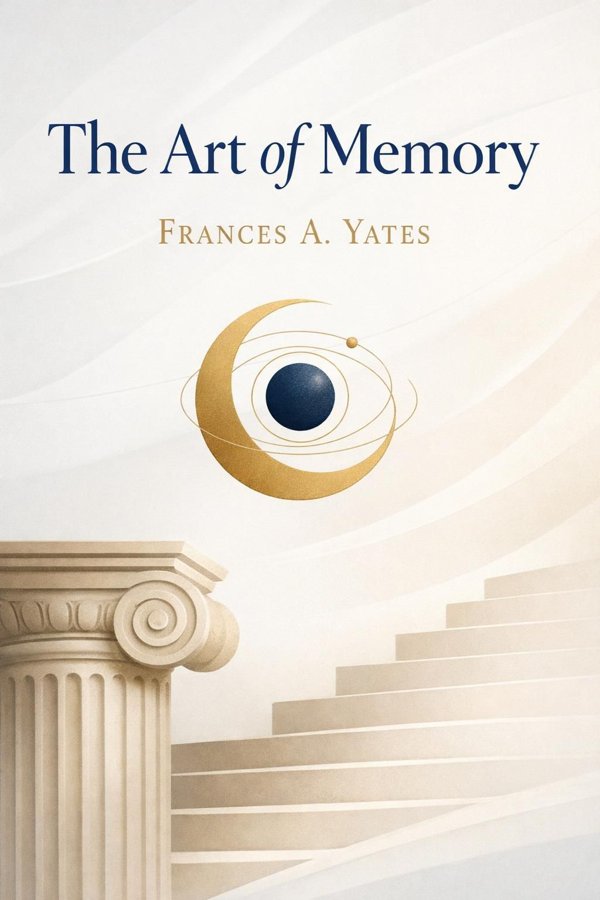
The Art of Memory: Summary & Key Insights
 10 min9 chaptersAudio available
Key Takeaways from The Art of Memory
One of the most powerful ideas in intellectual history begins with a disaster: memory becomes visible when chaos must be reordered.
We often assume that thinking clearly and remembering well are separate skills, but the classical tradition treated them as inseparable.
A cultural technique survives only if a new age finds a new purpose for it.
Memory becomes more powerful when it serves systems, not just isolated facts.
When old intellectual tools return, they rarely come back unchanged.
What Is The Art of Memory About?
The Art of Memory by Frances A. Yates is a civilization book spanning 4 pages. Frances A. Yates’s The Art of Memory is a landmark work of intellectual history that reveals how memory was once understood not as a passive storehouse, but as an active technology for shaping thought. Tracing mnemonic systems from ancient Greece and Rome through the Middle Ages and into the Renaissance, Yates shows that methods of remembering were deeply connected to rhetoric, religion, philosophy, and even the birth of modern science. Her book is not merely about tricks for recalling facts. It is about how entire civilizations organized knowledge before the age of print, search engines, and databases. What makes this study so important is its central claim: memory techniques influenced far more than education. They shaped habits of imagination, systems of classification, spiritual discipline, and ambitious attempts to comprehend the universe itself. Yates, one of the twentieth century’s most respected historians of Renaissance thought and a leading scholar at the Warburg Institute, brings extraordinary depth to this overlooked subject. The result is a rich, surprising account of how the architecture of memory became part of the architecture of Western culture.
This FizzRead summary covers all 9 key chapters of The Art of Memory in approximately 10 minutes, distilling the most important ideas, arguments, and takeaways from Frances A. Yates's work. Also available as an audio summary and Key Quotes Podcast.
The Art of Memory
Frances A. Yates’s The Art of Memory is a landmark work of intellectual history that reveals how memory was once understood not as a passive storehouse, but as an active technology for shaping thought. Tracing mnemonic systems from ancient Greece and Rome through the Middle Ages and into the Renaissance, Yates shows that methods of remembering were deeply connected to rhetoric, religion, philosophy, and even the birth of modern science. Her book is not merely about tricks for recalling facts. It is about how entire civilizations organized knowledge before the age of print, search engines, and databases.
What makes this study so important is its central claim: memory techniques influenced far more than education. They shaped habits of imagination, systems of classification, spiritual discipline, and ambitious attempts to comprehend the universe itself. Yates, one of the twentieth century’s most respected historians of Renaissance thought and a leading scholar at the Warburg Institute, brings extraordinary depth to this overlooked subject. The result is a rich, surprising account of how the architecture of memory became part of the architecture of Western culture.
Who Should Read The Art of Memory?
This book is perfect for anyone interested in civilization and looking to gain actionable insights in a short read. Whether you're a student, professional, or lifelong learner, the key ideas from The Art of Memory by Frances A. Yates will help you think differently.
- ✓Readers who enjoy civilization and want practical takeaways
- ✓Professionals looking to apply new ideas to their work and life
- ✓Anyone who wants the core insights of The Art of Memory in just 10 minutes
Want the full summary?
Get instant access to this book summary and 100K+ more with Fizz Moment.
Get Free SummaryAvailable on App Store • Free to download
Key Chapters
One of the most powerful ideas in intellectual history begins with a disaster: memory becomes visible when chaos must be reordered. Yates opens with the famous story of Simonides of Ceos, who allegedly discovered the principles of artificial memory after identifying banquet guests crushed in a collapsed hall by recalling where each person had been seated. From this legend emerged a foundational insight: place helps preserve thought. If ideas can be attached to vivid locations, the mind can revisit those locations and retrieve what it needs.
In classical antiquity, especially in Greek and Roman rhetoric, this insight developed into a formal discipline. Orators trained themselves to build “memory palaces,” mentally structured spaces filled with striking images that represented points in a speech. These images were not random; they were often emotionally vivid, exaggerated, or even grotesque, because unusual mental pictures were easier to remember. Memory, in this tradition, was not simply storage. It was an art tied to persuasion, education, and public life.
Yates shows that this classical system mattered because in oral and semi-oral cultures, remembering accurately was a practical necessity. A speaker without notes needed a disciplined internal architecture. Even today, the same principle survives in competitive memory techniques, language learning, and public speaking. A student might imagine walking through a childhood home, placing historical events in each room. A presenter might map sections of a talk onto landmarks along a familiar commute.
The deeper lesson is that memory improves when information becomes spatial, visual, and meaningful. To apply this idea, choose a familiar place and assign key concepts to distinct locations. Then mentally walk through it until recall feels natural.
We often assume that thinking clearly and remembering well are separate skills, but the classical tradition treated them as inseparable. In the ancient rhetorical world described by Yates, memory was one of the essential parts of eloquence. A great speaker did not merely gather arguments; he organized them internally so that thought could unfold with confidence, order, and force. The art of memory therefore belonged not to trivia or private study alone, but to civic power.
Roman authors such as Cicero and Quintilian helped formalize this connection. They described methods for constructing ordered mental places and placing images within them to preserve the sequence of arguments, examples, quotations, and emotional turns of a speech. This was not mechanical memorization. The speaker used memory to sustain structure, timing, and presence before an audience. Memory gave rhetoric not just accuracy but authority.
Yates emphasizes that this framework shaped education for centuries. To train memory was to train judgment and composition. The speaker who had built a solid memory system could improvise more effectively because ideas were internally classified and available. This has a modern equivalent. Professionals who deeply know their material can speak flexibly because they have mentally arranged it, not because they have memorized every sentence word for word.
The practical application is broad. Teachers can organize lectures into a small number of memorable stations. Writers can outline essays using visual anchors. Lawyers, executives, and students can remember complex presentations by linking each major point to a symbolic image in a set sequence. The key takeaway is simple: do not treat memory as an afterthought. Build it into how you structure ideas from the beginning, and your thinking will become clearer and more persuasive.
A cultural technique survives only if a new age finds a new purpose for it. One of Yates’s most fascinating arguments is that the art of memory did not vanish with the fall of the classical world; it was transformed by Christianity and the Middle Ages. The rhetorical halls of Rome gave way to monasteries, scriptoria, and devotional settings, but memory remained central because spiritual life also required inward order.
In medieval culture, memory became linked to moral and religious formation. Rather than serving primarily the orator in political life, it now served the monk, preacher, and theologian. Classical mnemonic structures could still be used, but they were adapted to help believers remember biblical narratives, virtues, vices, sermons, and sacred teaching. Memory was not only about retrieving information. It was about disciplining the soul. To remember properly was to orient the mind toward salvation, meditation, and right conduct.
Yates demonstrates that medieval thinkers integrated memory into broader systems of spiritual psychology. Internal images and ordered schemes helped believers contemplate divine truths and examine conscience. A preacher, for example, might organize a sermon around symbolic scenes. A monk might mentally order teachings in ways that encouraged regular reflection. In this world, memory art became part of an ethical and devotional practice.
This shift matters because it shows how techniques are shaped by values. The same mnemonic form can serve politics, education, or spirituality depending on the civilization using it. Modern readers can learn from this by connecting memory to purpose. If you want to retain ideas from philosophy, scripture, or personal reading, organize them around themes that matter to your life rather than isolated facts. The actionable takeaway: tie what you want to remember to a moral, emotional, or personal aim, and memory will become more durable and meaningful.
Memory becomes more powerful when it serves systems, not just isolated facts. Yates shows that in the medieval scholastic world, memory was increasingly woven into methods of classification, teaching, and intellectual organization. As universities emerged and theological reasoning became more elaborate, thinkers needed ways to manage large bodies of authoritative material. The art of memory evolved accordingly.
Scholastic culture prized order: distinctions, categories, hierarchies, and logical arrangement. Memory techniques supported this by helping students and teachers retain chains of argument, doctrinal divisions, scriptural interpretations, and moral taxonomies. In this context, mnemonic practice intersected with diagrams, tables, and conceptual structures. The mind was trained not only to remember images in places but also to hold an ordered map of knowledge.
Yates’s broader point is that memory systems were part of an entire epistemic culture. Before modern indexing and digital search, knowledge had to be internally arranged if it was to remain usable. A medieval student could not rely on instant retrieval from external tools. The educated mind itself functioned as a library, filing cabinet, and conceptual chart.
There is an obvious contemporary parallel. Many people collect notes, highlights, and bookmarks but cannot retrieve or apply them when needed. The medieval lesson is that accumulation without structure is weak memory. A practical method today might involve grouping reading notes into a few recurring categories, then attaching each category to a mental image or consistent visual map. A researcher could organize themes by rooms, diagrams, or symbolic figures to improve recall.
The actionable takeaway is to stop treating knowledge as a pile. Build a personal system of categories and review it regularly. The more clearly information is arranged, the easier it becomes to remember, connect, and use.
When old intellectual tools return, they rarely come back unchanged. Yates argues that the Renaissance revived the classical art of memory with extraordinary energy, but also with new ambitions. Humanists recovered ancient rhetorical texts and renewed interest in Ciceronian and Quintilian traditions. Yet the revival did more than restore a forgotten educational method. It turned memory into a gateway for reimagining the powers of the human mind.
Renaissance scholars lived in a world energized by the rediscovery of antiquity, the expansion of learning, and confidence in human capacity. In that setting, memory was no longer just a practical aid for speeches. It became part of a wider project of intellectual mastery. Classical mnemonic methods were studied, refined, and adapted to fit new educational, literary, and philosophical purposes.
Yates traces how this revival laid the groundwork for more speculative developments. Once thinkers accepted that the mind could construct ordered internal worlds, they began asking how far this power could go. Could memory be used to arrange all arts and sciences? Could it become a method for universal knowledge? Could symbolic images reveal hidden correspondences in nature? These questions pushed the mnemonic tradition beyond rhetoric and into philosophy.
Modern readers can relate to this shift. A technique that begins as a study hack can become a broader thinking system. Concept mapping, visual note-taking, and spaced repetition often start as memory aids but end up changing how people understand complexity. The Renaissance teaches that methods of recall can reshape methods of inquiry.
The takeaway is to revisit old tools with fresh goals. If a simple memory technique helps you retain information, ask whether it could also help you organize projects, synthesize research, or think more creatively across disciplines.
Some intellectual traditions become most revealing at their extremes. In Yates’s account, Giordano Bruno represents one of the most dramatic transformations of the art of memory. For Bruno, memory was not merely a practical rhetorical method. It became part of an expansive Hermetic and cosmological vision in which symbolic images, combinatory wheels, and mental structures were meant to mirror the deep order of the universe.
Yates treats Bruno as a key figure because he pushed mnemonic thought into the realm of magic, philosophy, and universal aspiration. Drawing on classical traditions, Lullian combinatorics, and Hermetic currents, Bruno developed systems of images and rotating symbolic arrangements designed to intensify the mind’s capacity. These were not just memory devices in the ordinary sense. They aimed at transformation: empowering imagination, grasping correspondences, and bringing the mind into relation with cosmic forces.
Whether or not modern readers accept Bruno’s metaphysical assumptions, Yates shows why he matters. He reveals a period when memory, symbolism, and knowledge were still deeply intertwined. The imagination was not seen as decorative or secondary; it was a vehicle of cognition. Bruno’s systems also anticipate later attempts to create universal languages, encyclopedic schemas, and combinatorial models of knowledge.
In practical terms, Bruno’s example reminds us that symbolic systems can deepen engagement with complex material. Students of philosophy, mythology, or science can use diagrams, archetypal images, and layered associations to create richer understanding. The caution, however, is equally important: systems can become so elaborate that they obscure rather than clarify.
The actionable takeaway is to use symbolism to strengthen thought, but always test whether your system actually improves understanding and recall. A memory method is valuable only if it remains mentally usable.
The dream of organizing everything is one of the recurring ambitions of civilization. Yates shows that in the Renaissance, this dream took astonishing mnemonic form in projects such as the memory theater. These systems aimed to arrange the totality of knowledge in spatial, symbolic, and often theatrical structures so that the mind could grasp vast networks of meaning at once.
The most famous example is Giulio Camillo’s memory theater, an imagined architectural space in which all branches of knowledge would be placed in ordered relation. Instead of an audience looking at a stage, the individual would stand within the structure and survey a symbolic cosmos. This reversal is significant. Knowledge was no longer something merely received; it was something internally navigated through carefully designed correspondences.
Yates interprets these grand mnemonic systems as more than curiosities. They reveal a period before modern disciplinary fragmentation, when scholars still hoped for a unified map of reality. Memory, architecture, symbolism, and metaphysics converged in attempts to build a total intellectual order. In this sense, the memory theater foreshadows encyclopedias, classification systems, and even modern interfaces for navigating information.
Today, knowledge workers face the opposite problem: too much information and too little coherence. The memory theater suggests that retrieval improves when information is embedded in an intentional overview. A modern analog might be a visual dashboard for a research project, a personal knowledge graph, or a whiteboard map linking themes across books and notes.
The takeaway is to create an overview before chasing detail. If you want to master a field, build a visible or mental framework that shows how parts relate to the whole. Memory strengthens when knowledge lives inside a larger structure.
Technologies do not simply replace mental habits; they reorganize them. One of Yates’s most important historical insights is that the rise of print gradually changed the role of the art of memory. As books became more available and systems of external storage improved, Western culture relied less on the heavily trained internal memory that had once been essential to education, rhetoric, and scholarship.
This did not mean memory disappeared. Rather, its cultural prestige and function changed. Where older societies required internalized systems to preserve and deploy knowledge, print culture allowed more dependence on indexes, libraries, and written reference. Knowledge could now be stored outside the mind with increasing efficiency. Over time, this altered educational ideals and cognitive expectations.
Yates presents this as a major civilizational shift. The decline of the classical and Renaissance memory arts was linked not only to changing philosophy but also to changing media. Once texts became easier to consult, memory no longer had to serve as the primary architecture of knowledge. This helps explain why modern readers often find earlier mnemonic cultures strange. We inhabit a world built on external recall.
The lesson remains highly relevant in the digital age. Search engines, note apps, and cloud storage extend the logic of print even further. Yet easy access can weaken internal organization. Many people save information constantly but remember little of it. Yates encourages us to see that external tools are powerful but incomplete.
The actionable takeaway is to balance storage with internalization. Use books, notes, and digital systems freely, but select key ideas to encode deeply in your own mind through review, visualization, and structured recall. Knowledge becomes most useful when it is both accessible externally and alive internally.
A history of memory is really a history of how humans imagine the mind. That is why Yates’s book still matters far beyond specialists in Renaissance studies. By tracing the art of memory across centuries, she reveals that methods of remembering are never neutral. They embody assumptions about truth, education, morality, imagination, and the structure of reality itself.
The modern tendency is to treat memory as a technical function: either you remember something or you do not. Yates recovers a much richer tradition in which memory was connected to character formation, eloquence, symbolic vision, and intellectual synthesis. This broader view challenges a narrow, purely utilitarian approach to learning. It invites us to ask not only how we remember, but what kind of people and cultures our memory practices create.
Her history also helps explain contemporary anxieties about distraction and information overload. We possess unprecedented external memory systems, yet many feel mentally fragmented. The older traditions Yates studies remind us that memory flourishes through structure, attention, imagery, repetition, and meaningful connection. These are not obsolete principles. They are enduring features of human cognition.
A practical application might be to redesign learning around deeper encoding rather than passive consumption. Instead of highlighting dozens of passages, choose three core ideas from a book, assign each a vivid image, connect them to a familiar mental route, and review them later in your own words. That simple exercise reflects insights stretching back to antiquity.
The actionable takeaway is this: treat memory as a creative discipline, not just a storage problem. The way you remember shapes the way you think.
All Chapters in The Art of Memory
About the Author
Frances Amelia Yates (1899–1981) was a British historian whose work transformed the study of Renaissance intellectual history. Closely associated with the Warburg Institute in London, she became known for tracing the interplay between classical tradition, Hermeticism, religion, symbolism, and early modern thought. Yates had a gift for recovering neglected strands of European culture and showing their influence on mainstream philosophy, science, and literature. Her major works include Giordano Bruno and the Hermetic Tradition and The Art of Memory, both of which helped reshape scholarly understanding of the Renaissance. Though not always uncontested, her interpretations were bold, original, and enormously influential. Yates remains one of the most important twentieth-century historians of ideas, admired for revealing hidden connections across centuries of Western civilization.
Get This Summary in Your Preferred Format
Read or listen to the The Art of Memory summary by Frances A. Yates anytime, anywhere. FizzRead offers multiple formats so you can learn on your terms — all free.
Available formats: App · Audio · PDF · EPUB — All included free with FizzRead
Download The Art of Memory PDF and EPUB Summary
Key Quotes from The Art of Memory
“One of the most powerful ideas in intellectual history begins with a disaster: memory becomes visible when chaos must be reordered.”
“We often assume that thinking clearly and remembering well are separate skills, but the classical tradition treated them as inseparable.”
“A cultural technique survives only if a new age finds a new purpose for it.”
“Memory becomes more powerful when it serves systems, not just isolated facts.”
“When old intellectual tools return, they rarely come back unchanged.”
Frequently Asked Questions about The Art of Memory
The Art of Memory by Frances A. Yates is a civilization book that explores key ideas across 9 chapters. Frances A. Yates’s The Art of Memory is a landmark work of intellectual history that reveals how memory was once understood not as a passive storehouse, but as an active technology for shaping thought. Tracing mnemonic systems from ancient Greece and Rome through the Middle Ages and into the Renaissance, Yates shows that methods of remembering were deeply connected to rhetoric, religion, philosophy, and even the birth of modern science. Her book is not merely about tricks for recalling facts. It is about how entire civilizations organized knowledge before the age of print, search engines, and databases. What makes this study so important is its central claim: memory techniques influenced far more than education. They shaped habits of imagination, systems of classification, spiritual discipline, and ambitious attempts to comprehend the universe itself. Yates, one of the twentieth century’s most respected historians of Renaissance thought and a leading scholar at the Warburg Institute, brings extraordinary depth to this overlooked subject. The result is a rich, surprising account of how the architecture of memory became part of the architecture of Western culture.
You Might Also Like
The Structure of Scientific Revolutions
Thomas S. Kuhn
10 min
Genius
Harold Bloom
10 min
A Cultural History of the Medieval Age
Various Editors
10 min
A History of God: The 4,000-Year Quest of Judaism, Christianity and Islam
Karen Armstrong
10 min
A History of the World in 10½ Chapters
Julian Barnes
10 min
A Short History of Progress
Ronald Wright
10 minBrowse by Category
Ready to read The Art of Memory?
Get the full summary and 100K+ more books with Fizz Moment.