
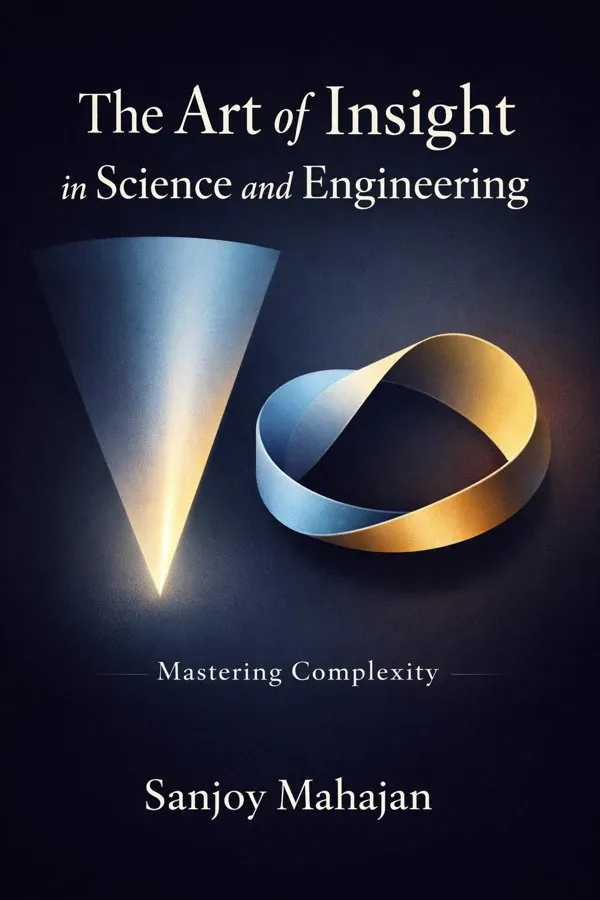
The Art of Insight in Science and Engineering: Mastering Complexity: Summary & Key Insights
 10 min9 chaptersAudio available
Key Takeaways from The Art of Insight in Science and Engineering: Mastering Complexity
Complexity often hides behind unnecessary detail.
Before an equation can be correct numerically, it must first be sensible physically.
Exact answers are often less useful than good approximations delivered quickly.
Much of deep learning happens when we recognize the same pattern wearing different clothes.
Not all change is linear, and one of the fastest ways to misunderstand a system is to assume that doubling an input doubles the outcome.
What Is The Art of Insight in Science and Engineering: Mastering Complexity About?
The Art of Insight in Science and Engineering: Mastering Complexity by Sanjoy Mahajan is a education book spanning 13 pages. The Art of Insight in Science and Engineering: Mastering Complexity is a practical guide to thinking like a scientist or engineer when the world refuses to behave like a textbook exercise. Rather than treating problem-solving as a matter of plugging numbers into formulas, Sanjoy Mahajan shows how real understanding begins with simplification, estimation, dimensional analysis, analogy, and careful modeling. His central promise is powerful: even the most complicated systems become manageable when you learn how to identify what matters, ignore what does not, and build intuition step by step. This matters because modern students and professionals are often trained to compute before they understand. Mahajan argues that this habit produces fragile knowledge—useful only in familiar situations. Insight, by contrast, travels well. It helps you reason through uncertainty, make better approximations, and solve novel problems with confidence. Drawing on his experience as an educator at Olin College and MIT, Mahajan offers a way of thinking that is rigorous without being rigid. The result is a book that equips readers not just to get answers, but to see deeply into how science and engineering actually work.
This FizzRead summary covers all 9 key chapters of The Art of Insight in Science and Engineering: Mastering Complexity in approximately 10 minutes, distilling the most important ideas, arguments, and takeaways from Sanjoy Mahajan's work. Also available as an audio summary and Key Quotes Podcast.
The Art of Insight in Science and Engineering: Mastering Complexity
The Art of Insight in Science and Engineering: Mastering Complexity is a practical guide to thinking like a scientist or engineer when the world refuses to behave like a textbook exercise. Rather than treating problem-solving as a matter of plugging numbers into formulas, Sanjoy Mahajan shows how real understanding begins with simplification, estimation, dimensional analysis, analogy, and careful modeling. His central promise is powerful: even the most complicated systems become manageable when you learn how to identify what matters, ignore what does not, and build intuition step by step.
This matters because modern students and professionals are often trained to compute before they understand. Mahajan argues that this habit produces fragile knowledge—useful only in familiar situations. Insight, by contrast, travels well. It helps you reason through uncertainty, make better approximations, and solve novel problems with confidence. Drawing on his experience as an educator at Olin College and MIT, Mahajan offers a way of thinking that is rigorous without being rigid. The result is a book that equips readers not just to get answers, but to see deeply into how science and engineering actually work.
Who Should Read The Art of Insight in Science and Engineering: Mastering Complexity?
This book is perfect for anyone interested in education and looking to gain actionable insights in a short read. Whether you're a student, professional, or lifelong learner, the key ideas from The Art of Insight in Science and Engineering: Mastering Complexity by Sanjoy Mahajan will help you think differently.
- ✓Readers who enjoy education and want practical takeaways
- ✓Professionals looking to apply new ideas to their work and life
- ✓Anyone who wants the core insights of The Art of Insight in Science and Engineering: Mastering Complexity in just 10 minutes
Want the full summary?
Get instant access to this book summary and 100K+ more with Fizz Moment.
Get Free SummaryAvailable on App Store • Free to download
Key Chapters
Complexity often hides behind unnecessary detail. One of the book’s most important insights is that understanding does not begin by capturing everything; it begins by deciding what can be safely ignored. In science and engineering, simplification is not intellectual laziness. It is a disciplined way of revealing structure. A good model is useful not because it includes every variable, but because it highlights the dominant ones.
Mahajan shows that experts routinely strip problems down to their essentials before attempting exact analysis. If you want to understand how an object falls, you may first ignore air resistance. If you want to understand an electrical circuit, you may begin by isolating one component or assuming ideal behavior. These simplified starting points create a mental map. Once the core mechanism is visible, you can add back complexity and see how much it changes the answer.
This approach works far beyond physics. In economics, you may model a market by focusing on a few key incentives before layering in human behavior. In biology, you may begin with a basic growth process before accounting for environmental constraints. In product design, you may sketch the minimum viable mechanism before refining user details.
The real skill lies in choosing simplifications that preserve the heart of the problem. Bad simplification distorts reality; good simplification clarifies it. Mahajan encourages readers to ask: what is the main effect here, and which details are second-order? That question turns confusion into traction.
Actionable takeaway: Before solving any difficult problem, write down three factors that matter most and three that can initially be ignored. Build your first explanation using only the essentials.
Before an equation can be correct numerically, it must first be sensible physically. Mahajan emphasizes dimensional analysis as one of the fastest and most reliable tools for developing insight. Dimensions—length, time, mass, energy, and so on—act like nature’s bookkeeping system. They expose errors, guide model building, and often reveal the shape of the answer before any detailed derivation begins.
If someone claims that distance equals speed plus time, the problem is obvious: the dimensions do not match. Distance can equal speed multiplied by time, but not speed added to time. This seems elementary, yet dimensional mistakes appear constantly in real work—especially when formulas are memorized without understanding. Dimensional analysis forces you to ask what kind of quantity you are dealing with and how quantities can combine meaningfully.
The deeper value is creative, not merely defensive. Suppose you want to estimate the period of a pendulum. Even without deriving the exact formula, dimensional reasoning suggests that the period should depend on length and gravitational acceleration in a specific way. In fluid dynamics, heat transfer, and electromagnetism, dimensionless groups help reveal which effects dominate and which can be neglected. Engineers use this thinking to design experiments on scale models, compare systems of very different sizes, and predict behavior in new situations.
Dimensional analysis also encourages humility. If the units fail, your intuition may be fooling you. If the units work, you have at least passed the first test of coherence. That makes it an ideal bridge between common sense and formal mathematics.
Actionable takeaway: Whenever you write or use an equation, check the units on both sides before doing anything else. If the dimensions do not match, stop and rethink the model.
Exact answers are often less useful than good approximations delivered quickly. Mahajan treats estimation as a core intellectual habit, not a backup strategy for when precise data are missing. Estimation trains you to reason from limited information, identify dominant factors, and judge whether an answer is plausible. In a world full of uncertainty, that ability is invaluable.
A classic example is the Fermi problem: how many piano tuners work in a large city? You do not need a database to get a useful estimate. You can break the question into smaller pieces: population size, households per piano, tuning frequency, tunings per day, working days per year. Each estimate may be rough, but together they produce an answer that is surprisingly informative. More importantly, the process teaches structured thinking.
In engineering, estimation helps assess loads, energy use, signal strength, heat loss, and time scales before detailed analysis begins. In medicine and public policy, order-of-magnitude reasoning can guide urgent decisions when complete information is unavailable. In everyday life, it helps you evaluate claims, budgets, risks, and schedules more realistically.
Mahajan also stresses that approximation is not guessing. Good estimation uses known anchors, reasonable assumptions, and transparent logic. The goal is not perfection but insight. A rough answer can reveal whether a design is feasible, whether a result is absurd, or whether a proposed solution is worth pursuing.
People who fear being imprecise often avoid estimation. Mahajan flips that perspective: refusing to estimate usually means refusing to think until someone hands you certainty. In practice, insight grows by making provisional judgments and refining them.
Actionable takeaway: Practice one estimation problem each day. Break the question into factors, state your assumptions clearly, and aim for the correct order of magnitude rather than an exact number.
Much of deep learning happens when we recognize the same pattern wearing different clothes. Mahajan highlights reasoning by analogy as a powerful way to solve unfamiliar problems by connecting them to familiar ones. The idea is simple: if two systems share an underlying structure, insight gained in one domain can illuminate the other.
For example, electrical circuits, fluid flow, and thermal conduction can often be understood through analogous relationships. Voltage resembles pressure difference, current resembles flow rate, resistance resembles friction or constriction. These analogies are not perfect, but they help learners see how conservation, driving forces, and impediments operate across fields. A spring-mass system may help you understand oscillations in electronics. Population growth may offer intuition for chemical reactions or epidemics. Feedback in biology may mirror control systems in engineering.
The danger, which Mahajan acknowledges, is taking an analogy too literally. Useful analogies illuminate one aspect of reality while hiding others. They should be treated as bridges, not destinations. A good thinker asks both: where does the analogy work, and where does it fail? That second question often generates the most insight.
Analogy is especially valuable when formal mathematics feels abstract. It gives intuition a foothold. Once you grasp the pattern in one context, you can transfer that mental model to another. This is how experts build versatile understanding rather than isolated facts.
In teaching, analogies also reduce intimidation. Students who feel lost in a new topic can often recover confidence when they recognize a known structure. In innovation, analogy can spark creative solutions by importing principles across disciplines.
Actionable takeaway: When facing an unfamiliar problem, ask yourself: what known system behaves similarly? Then list both the similarities and the limits of the comparison before using it to guide your reasoning.
Insight often emerges when you stop staring at the middle of a problem and look instead at its edges. Mahajan combines several complementary habits here: testing extreme cases, drawing diagrams, and thinking explicitly about uncertainty. Together, these practices make reasoning more robust and less fragile.
Extreme-case analysis asks what happens when a variable becomes very large, very small, or approaches a special limit. If friction vanished, how would the system behave? If resistance became enormous, what current would remain? If a population had unlimited resources, what growth pattern would you expect? These limiting cases simplify the problem and act as reality checks. A proposed model that fails in the extremes is usually flawed in the middle too.
Visual reasoning serves a similar purpose. A simple sketch, graph, or free-body diagram can reveal relationships that pages of algebra conceal. In mechanics, a force diagram identifies what matters. In thermodynamics, an energy-flow sketch clarifies transfers and losses. In data analysis, plotting a trend often reveals scaling, saturation, or instability faster than calculation alone.
Mahajan also stresses error analysis and uncertainty. Every measurement, estimate, and model carries limitations. The question is not whether uncertainty exists, but whether you understand its sources and consequences. Does a small measurement error explode into a large output error? Are two approximations independent, or do they reinforce each other? Knowing the uncertainty in a result often matters more than squeezing out extra digits.
Together, these habits create resilient understanding. You are not merely solving for one answer; you are probing whether the answer survives stress.
Actionable takeaway: For every important result, do three checks: test one extreme case, draw a diagram of the situation, and estimate the uncertainty range before trusting the conclusion.
Many systems fail not because of one dramatic cause, but because feedback quietly amplifies or suppresses change over time. Mahajan treats feedback and stability as central ideas for understanding complex systems, from electronics and ecosystems to economies and organizations. Once you learn to look for loops rather than isolated events, complexity becomes easier to interpret.
Negative feedback stabilizes. A thermostat detects temperature deviations and triggers heating or cooling to restore balance. Biological homeostasis works similarly: the body regulates temperature, glucose, and other variables through corrective responses. In engineering, feedback controllers keep systems near desired operating points despite disturbances.
Positive feedback amplifies. A microphone too close to a speaker creates escalating noise. Bank runs accelerate when fear triggers withdrawals, which in turn increase fear. In climate systems, melting ice reduces reflectivity, leading to more warming and more melting. Positive feedback is not always bad—it can enable rapid switching, growth, and signal amplification—but unmanaged, it often drives instability.
Mahajan’s contribution is to make these patterns intuitive rather than abstract. Stability is not a mysterious property; it depends on how a system responds to deviations. Does it counteract disturbances, ignore them, or magnify them? That simple question can organize your thinking across disciplines.
This perspective is practical. When designing a process, you ask where delay, amplification, and correction occur. When diagnosing a failure, you look for feedback loops that turned a small mismatch into a crisis. When evaluating policy, you consider unintended consequences generated by incentives and reactions.
Actionable takeaway: In any complex situation, map at least one feedback loop. Identify what variable changes, what response it triggers, and whether that response dampens or amplifies the original change.
When phenomena seem unrelated, energy and power often provide the common language that reconnects them. Mahajan uses these concepts as unifying tools because they cut across mechanics, electricity, thermodynamics, biology, and technology. Energy tells you what is conserved, transferred, stored, or dissipated. Power tells you how fast those changes happen. Together they offer a compact way to understand systems that might otherwise seem overwhelming.
Consider everyday examples. A battery stores energy, but power determines how quickly it can deliver that energy. A car climbing a hill may have enough fuel energy, yet insufficient engine power to maintain speed. A building’s heating bill depends not just on total heat loss over time, but also on the rate at which energy escapes. In exercise physiology, the distinction between endurance and burst performance often comes down to available energy versus available power.
These concepts are also diagnostic tools. If a machine overheats, where is energy being dissipated? If a design seems inefficient, where are the main losses? If a process takes too long, is the bottleneck one of total work required or of power delivery? In electrical engineering, power budgets determine feasibility. In environmental science, energy flows clarify sustainability claims. In computing, power consumption constrains performance as much as algorithmic elegance does.
Mahajan’s broader lesson is that unifying concepts reduce cognitive overload. Instead of memorizing disconnected facts, you can ask a small set of powerful questions about inputs, storage, transfer, and losses. That shift transforms problem-solving from scattered calculation into organized reasoning.
Actionable takeaway: When analyzing any physical or engineered system, write an energy-and-power account: where energy enters, where it is stored, where it leaves, and what limits the rate of change.
A model is not a final portrait of reality; it is a working hypothesis that becomes more useful through revision. Mahajan emphasizes that insight develops iteratively. You start with a crude model, compare it with experience or logic, identify what it misses, and then refine it. This process is how real science and engineering proceed, especially when confronting complex systems.
The first model should be simple enough to think with. It might ignore friction, assume uniform temperature, treat a population as homogeneous, or represent a market with a few average actors. Its job is to capture the dominant mechanism. Once that mechanism is visible, you ask what important effect was omitted. Perhaps drag matters at high speed, heat losses vary spatially, human behavior changes under incentives, or external disturbances alter stability. Each refinement should answer a specific deficiency, not merely add complexity for its own sake.
This mindset is liberating. Many learners think being wrong at first is failure. Mahajan presents it as progress. A rough model that reveals its own limits is more valuable than a polished calculation applied blindly. Iteration builds judgment: when is a model good enough, and when does the neglected detail become decisive?
The same principle applies across disciplines. Scientists calibrate and revise theories. Engineers prototype and test. Data scientists fit models, inspect residuals, and adjust assumptions. Designers launch simple versions, observe users, and improve. In every case, insight comes from a cycle of simplification, prediction, feedback, and refinement.
Actionable takeaway: For any hard problem, create a version-1 model quickly. Then ask one question only: what is the biggest effect this model leaves out? Refine the model by adding just that effect, and repeat as needed.
All Chapters in The Art of Insight in Science and Engineering: Mastering Complexity
About the Author
Sanjoy Mahajan is an applied scientist and educator known for his work on cultivating intuition in science and engineering. He has served as an Associate Professor of Applied Science and Engineering at Olin College and as a Visiting Associate Professor of Electrical Engineering and Computer Science at MIT. Across his teaching and writing, Mahajan focuses on helping students move beyond rote formula use toward estimation, dimensional analysis, simplification, and conceptual understanding. His approach reflects a strong belief that real expertise comes from seeing the structure of problems, not just calculating answers. By combining academic rigor with practical clarity, he has become a respected voice in engineering education and in the broader effort to teach people how to think more insightfully about complex systems.
Get This Summary in Your Preferred Format
Read or listen to the The Art of Insight in Science and Engineering: Mastering Complexity summary by Sanjoy Mahajan anytime, anywhere. FizzRead offers multiple formats so you can learn on your terms — all free.
Available formats: App · Audio · PDF · EPUB — All included free with FizzRead
Download The Art of Insight in Science and Engineering: Mastering Complexity PDF and EPUB Summary
Key Quotes from The Art of Insight in Science and Engineering: Mastering Complexity
“Complexity often hides behind unnecessary detail.”
“Before an equation can be correct numerically, it must first be sensible physically.”
“Exact answers are often less useful than good approximations delivered quickly.”
“Much of deep learning happens when we recognize the same pattern wearing different clothes.”
“Not all change is linear, and one of the fastest ways to misunderstand a system is to assume that doubling an input doubles the outcome.”
Frequently Asked Questions about The Art of Insight in Science and Engineering: Mastering Complexity
The Art of Insight in Science and Engineering: Mastering Complexity by Sanjoy Mahajan is a education book that explores key ideas across 9 chapters. The Art of Insight in Science and Engineering: Mastering Complexity is a practical guide to thinking like a scientist or engineer when the world refuses to behave like a textbook exercise. Rather than treating problem-solving as a matter of plugging numbers into formulas, Sanjoy Mahajan shows how real understanding begins with simplification, estimation, dimensional analysis, analogy, and careful modeling. His central promise is powerful: even the most complicated systems become manageable when you learn how to identify what matters, ignore what does not, and build intuition step by step. This matters because modern students and professionals are often trained to compute before they understand. Mahajan argues that this habit produces fragile knowledge—useful only in familiar situations. Insight, by contrast, travels well. It helps you reason through uncertainty, make better approximations, and solve novel problems with confidence. Drawing on his experience as an educator at Olin College and MIT, Mahajan offers a way of thinking that is rigorous without being rigid. The result is a book that equips readers not just to get answers, but to see deeply into how science and engineering actually work.
You Might Also Like

Bedtime Biography: Florence Nightingale
Isabel Thomas
10 min
Introduction To Museum Studies
Howard H. Hoyt
10 min
A Mind for Numbers: How to Excel at Math and Science (Even If You Flunked Algebra)
Barbara Oakley
10 min
AI for Educators: Learning Strategies, Teacher Empowerment, and the Future of Education
Matt Miller
10 min
Animation For Beginners
Morr Meroz
10 min
Artificial Intelligence for Learning
Donald Clark
10 minBrowse by Category
Ready to read The Art of Insight in Science and Engineering: Mastering Complexity?
Get the full summary and 100K+ more books with Fizz Moment.