
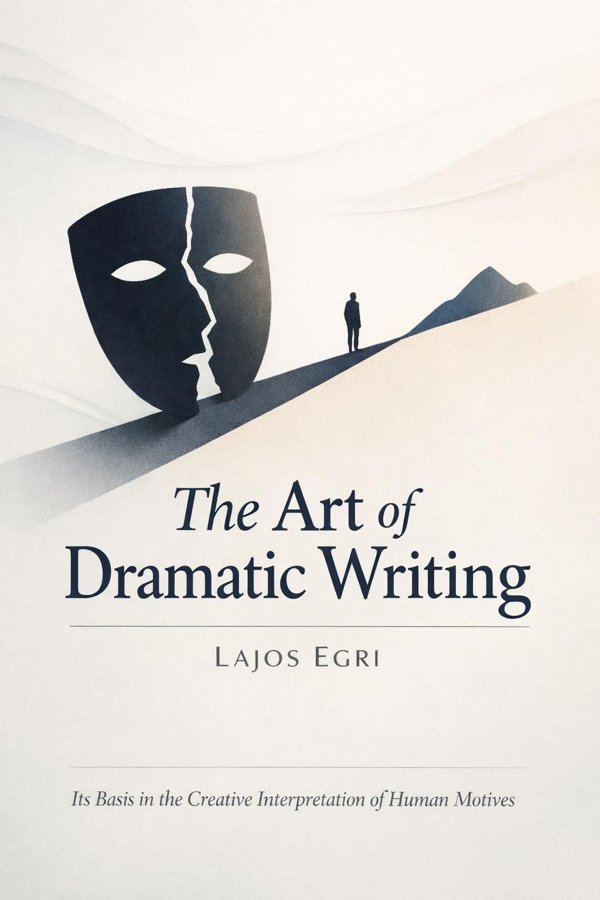
The Art of Dramatic Writing: Its Basis in the Creative Interpretation of Human Motives: Summary & Key Insights
by Lajos Egri
 10 min10 chaptersAudio available
What Is The Art of Dramatic Writing: Its Basis in the Creative Interpretation of Human Motives About?
The Art of Dramatic Writing: Its Basis in the Creative Interpretation of Human Motives by Lajos Egri is a writing book spanning 10 pages. Originally published in 1946, this influential work by Lajos Egri explores the fundamental principles of playwriting and dramatic structure. Egri emphasizes the importance of character motivation, conflict, and premise as the foundation of compelling drama. The book provides a systematic approach to constructing believable characters and coherent plots, making it a cornerstone text for playwrights, screenwriters, and storytellers.
This FizzRead summary covers all 10 key chapters of The Art of Dramatic Writing: Its Basis in the Creative Interpretation of Human Motives in approximately 10 minutes, distilling the most important ideas, arguments, and takeaways from Lajos Egri's work. Also available as an audio summary and Key Quotes Podcast.
The Art of Dramatic Writing: Its Basis in the Creative Interpretation of Human Motives
Originally published in 1946, this influential work by Lajos Egri explores the fundamental principles of playwriting and dramatic structure. Egri emphasizes the importance of character motivation, conflict, and premise as the foundation of compelling drama. The book provides a systematic approach to constructing believable characters and coherent plots, making it a cornerstone text for playwrights, screenwriters, and storytellers.
Who Should Read The Art of Dramatic Writing: Its Basis in the Creative Interpretation of Human Motives?
This book is perfect for anyone interested in writing and looking to gain actionable insights in a short read. Whether you're a student, professional, or lifelong learner, the key ideas from The Art of Dramatic Writing: Its Basis in the Creative Interpretation of Human Motives by Lajos Egri will help you think differently.
- ✓Readers who enjoy writing and want practical takeaways
- ✓Professionals looking to apply new ideas to their work and life
- ✓Anyone who wants the core insights of The Art of Dramatic Writing: Its Basis in the Creative Interpretation of Human Motives in just 10 minutes
Want the full summary?
Get instant access to this book summary and 100K+ more with Fizz Moment.
Get Free SummaryAvailable on App Store • Free to download
Key Chapters
Every drama is born from a single, powerful idea that contains the necessity for conflict and resolution. This idea—the premise—is your compass. It tells you not only what the story is about but what truths it will prove through action. A premise is never an abstract theme; it is a statement of movement, of cause leading to inevitable effect: 'Honesty leads to spiritual freedom,’ ‘Greed leads to destruction,’ ‘Love conquers pride.’ These are not morals tacked onto a tale; they are organic principles that dictate the development of the play.
When you establish a premise, you are setting the moral and emotional direction of your story. It will guide your characters, their relationships, and their transformations. But this direction must be lived, not proclaimed. It is your task as a dramatist to prove the premise through the choices your characters make. Each scene becomes an argument, every action a step toward confirming or refuting the premise. The audience watches not passively but in tension, knowing that every act carries consequences. Only when those consequences culminate in revelation do we call it drama. The premise, then, is not simply your starting point—it is the invisible spine that holds the entire work erect.
Character, not plot, is the true foundation of dramatic writing. The mistaken emphasis on 'good stories'—on twists and turns—ignores the truth that action is only credible when it springs from a human motive. I have often said that if you give me a fully realized character, I can predict the plot that will follow. Why? Because a human being, made visible through desire, weakness, and will, cannot act inconsistently. From the sum of his traits, one can foresee how he will meet the world, how he will clash with others, and how he will ultimately change.
To build such a character, you must know him as intimately as yourself. His physiology tells you his energy and temperament; his sociology—his background, profession, education—defines how he interacts with others; his psychology reveals his fears and hopes. When you combine these dimensions, you create not an abstraction but a living organism whose every decision feels inevitable. Your plot then becomes the natural outgrowth of these people in confrontation.
Drama, in its essence, is life under pressure. When deeply motivated people are thrust into crisis, we witness truth in its most intense form. To write great drama, therefore, is to devote yourself to studying human motives until they become your language. Every character must want something vital, something he will fight for. In that struggle, you reveal humanity—not as you wish it to be, but as it is.
+ 8 more chapters — available in the FizzRead app
All Chapters in The Art of Dramatic Writing: Its Basis in the Creative Interpretation of Human Motives
About the Author
Lajos Egri (1888–1967) was a Hungarian-born playwright and teacher of writing who emigrated to the United States. He is best known for his contributions to dramatic theory and his enduring influence on modern screenwriting and playwriting education.
Get This Summary in Your Preferred Format
Read or listen to the The Art of Dramatic Writing: Its Basis in the Creative Interpretation of Human Motives summary by Lajos Egri anytime, anywhere. FizzRead offers multiple formats so you can learn on your terms — all free.
Available formats: App · Audio · PDF · EPUB — All included free with FizzRead
Download The Art of Dramatic Writing: Its Basis in the Creative Interpretation of Human Motives PDF and EPUB Summary
Key Quotes from The Art of Dramatic Writing: Its Basis in the Creative Interpretation of Human Motives
“Every drama is born from a single, powerful idea that contains the necessity for conflict and resolution.”
“Character, not plot, is the true foundation of dramatic writing.”
Frequently Asked Questions about The Art of Dramatic Writing: Its Basis in the Creative Interpretation of Human Motives
The Art of Dramatic Writing: Its Basis in the Creative Interpretation of Human Motives by Lajos Egri is a writing book that explores key ideas across 10 chapters. Originally published in 1946, this influential work by Lajos Egri explores the fundamental principles of playwriting and dramatic structure. Egri emphasizes the importance of character motivation, conflict, and premise as the foundation of compelling drama. The book provides a systematic approach to constructing believable characters and coherent plots, making it a cornerstone text for playwrights, screenwriters, and storytellers.
You Might Also Like

The Art of Perspective
Christopher Castellani
10 min
Making a Point: The Persnickety Story of English Punctuation
David Crystal
10 min
The Elements Of Eloquence: How To Turn The Perfect English Phrase
Mark Forsyth
10 min
The Pocket Muse: Ideas and Inspirations for Writing
Monica Wood
10 min
A Little Book on Form: An Exploration into the Formal Imagination of Poetry
Robert Hass
10 min
Adventures In The Screen Trade: A Personal View Of Hollywood And Screenwriting
William Goldman
10 minBrowse by Category
Ready to read The Art of Dramatic Writing: Its Basis in the Creative Interpretation of Human Motives?
Get the full summary and 100K+ more books with Fizz Moment.