
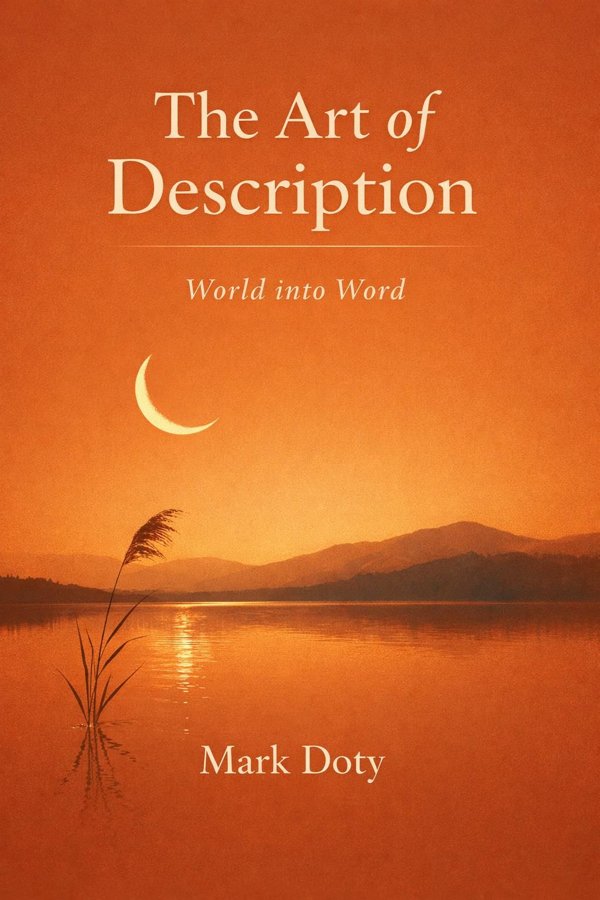
The Art of Description: World into Word: Summary & Key Insights
by Mark Doty
 10 min10 chaptersAudio available
Key Takeaways from The Art of Description: World into Word
Before there can be language, there must be looking.
We do not automatically possess words for what we see.
No description is emotionally neutral.
Poetry matters to Doty not because description belongs only to poets, but because poetry reveals how concentrated language can alter perception.
To describe anything is to exercise power.
What Is The Art of Description: World into Word About?
The Art of Description: World into Word by Mark Doty is a writing book spanning 10 pages. What does it really mean to describe something well? In The Art of Description: World into Word, acclaimed poet and essayist Mark Doty argues that description is far more than decorative writing. It is an act of attention, interpretation, and care. To describe a thing—a shell, a room, a face, a patch of light—is not simply to list its visible traits, but to enter into relationship with it and discover what it means to a perceiving mind. Doty shows that the path from sight to language is never mechanical; it is shaped by feeling, memory, ethics, and imagination. Drawing on poetry, visual art, and close reading, Doty offers both a meditation on perception and a practical guide for writers who want to make their language more vivid and alive. His authority comes not only from his achievements as an award-winning poet, but from his rare ability to explain craft without reducing its mystery. This book matters because it teaches writers, readers, and artists how to see more fully—and how to transform that richer seeing into words that carry presence, beauty, and truth.
This FizzRead summary covers all 10 key chapters of The Art of Description: World into Word in approximately 10 minutes, distilling the most important ideas, arguments, and takeaways from Mark Doty's work. Also available as an audio summary and Key Quotes Podcast.
The Art of Description: World into Word
What does it really mean to describe something well? In The Art of Description: World into Word, acclaimed poet and essayist Mark Doty argues that description is far more than decorative writing. It is an act of attention, interpretation, and care. To describe a thing—a shell, a room, a face, a patch of light—is not simply to list its visible traits, but to enter into relationship with it and discover what it means to a perceiving mind. Doty shows that the path from sight to language is never mechanical; it is shaped by feeling, memory, ethics, and imagination.
Drawing on poetry, visual art, and close reading, Doty offers both a meditation on perception and a practical guide for writers who want to make their language more vivid and alive. His authority comes not only from his achievements as an award-winning poet, but from his rare ability to explain craft without reducing its mystery. This book matters because it teaches writers, readers, and artists how to see more fully—and how to transform that richer seeing into words that carry presence, beauty, and truth.
Who Should Read The Art of Description: World into Word?
This book is perfect for anyone interested in writing and looking to gain actionable insights in a short read. Whether you're a student, professional, or lifelong learner, the key ideas from The Art of Description: World into Word by Mark Doty will help you think differently.
- ✓Readers who enjoy writing and want practical takeaways
- ✓Professionals looking to apply new ideas to their work and life
- ✓Anyone who wants the core insights of The Art of Description: World into Word in just 10 minutes
Want the full summary?
Get instant access to this book summary and 100K+ more with Fizz Moment.
Get Free SummaryAvailable on App Store • Free to download
Key Chapters
Before there can be language, there must be looking. One of Doty’s central insights is that description begins not with vocabulary, but with attention. Most of us move through the world naming things too quickly: tree, chair, stranger, evening. But writing starts when naming stops being enough. The writer lingers. He notices the streak of rust on the chair leg, the way the stranger’s mouth tightens before speaking, the particular blue-gray of evening just before rain. Description is born from this deeper level of encounter.
Doty treats attention as both a craft skill and a moral gesture. To truly notice something is to grant it significance. It means resisting cliché, habit, and impatience. This is why great descriptive writing often feels revelatory: it restores the world to freshness. The object described has not changed, but our mode of seeing has. A shell becomes a record of pressure and time. A room becomes an emotional map. A body becomes a site of vulnerability, history, and presence.
For writers, this means that stronger description rarely comes from reaching for fancier adjectives. It comes from staying with the thing longer. Ask: What have I not yet seen? What shape does the light make? What texture contradicts the first impression? What emotion does this object awaken, and why?
A practical exercise might be to choose one ordinary object—a mug, a shoe, a leaf—and write about it for ten minutes without using generic labels like pretty, old, nice, or strange. Instead, record color, shape, weight, associations, and change over time.
Actionable takeaway: Slow down your seeing. Spend more time observing before you begin writing, because precise attention is the true foundation of memorable description.
We do not automatically possess words for what we see. Doty emphasizes that the distance between perception and language is where writing happens. The eye takes in forms, textures, movement, and light all at once, but language must unfold in sequence. A sentence cannot capture everything simultaneously. It chooses, arranges, and shapes. Description, then, is not transcription; it is transformation.
This idea is liberating for writers. Many people assume that if they cannot immediately express what they see, they have failed. Doty suggests the opposite: the struggle to find words is the creative process itself. The challenge is not to reproduce reality exactly, which language can never fully do, but to discover a verbal structure that conveys the felt experience of encountering it. A good description creates an equivalent, not a duplicate.
Consider the difference between writing “The garden was beautiful” and writing “Tomato vines leaned against their stakes like tired dancers, and the basil gave off a peppery sweetness each time the wind lifted.” The second version does more than report beauty. It shows the mind actively translating sight, smell, and motion into an experience for the reader. The writer has chosen what matters and how it should arrive.
This also explains why different writers can describe the same scene in radically different ways. One may focus on geometry, another on atmosphere, another on memory. Each description reflects not just the object, but the perceiving consciousness behind it.
Actionable takeaway: When a scene feels impossible to describe, stop trying to capture everything. Choose the few details that best recreate the experience of seeing, and let language build a bridge rather than a mirror.
No description is emotionally neutral. Even the most apparently objective portrayal reveals a point of view, because choosing what to notice is already an expression of feeling. Doty shows that description does not sit outside emotion; it is one of the primary ways emotion becomes visible on the page. We learn what matters to a speaker by what that speaker sees, how long they dwell on it, and what comparisons they make.
A grieving writer might describe a room in terms of absence: the indentation left on a pillow, the dust settling on a glass no one lifts anymore. A joyful writer may notice brightness, motion, abundance. The world described becomes a register of inner life. This is why description can carry so much psychological power without ever announcing emotion directly. Instead of saying “she was lonely,” a writer might describe the refrigerator’s hum as the loudest voice in the apartment. The emotional truth arrives through the scene.
Doty’s own sensibility as a poet makes this point especially vivid. He is interested in how physical detail can hold feeling without collapsing into sentimentality. Rather than telling the reader what to feel, effective description invites feeling by making the world concrete. This approach is useful in poetry, fiction, memoir, and even nonfiction, where emotional resonance often depends on observed detail rather than summary statement.
To apply this, writers can revise descriptive passages by asking what emotional energy is already present. Which details intensify that emotion? Which dilute it? If a scene is meant to feel anxious, are the details too soft and decorative? If it is meant to feel tender, are the images too abstract?
Actionable takeaway: Let emotion shape what you notice. Instead of explaining feeling directly, select details that allow the reader to sense it through the described world.
Poetry matters to Doty not because description belongs only to poets, but because poetry reveals how concentrated language can alter perception. Poems often work through compression, exactness, rhythm, and image, making them ideal laboratories for studying description. In a few lines, a poet can make an object shimmer with presence, reveal an emotional undertow, or change the scale at which we perceive the world.
Doty draws on poetic examples to show that strong description depends on precise choices. A single verb can animate a scene more powerfully than a string of adjectives. A surprising image can make a familiar object newly visible. Rhythm can slow the reader down, giving the language the same attentive pace with which the writer first observed the thing described. Poetry teaches that description is not just about information. It is about arrangement, pressure, and music.
For prose writers, this lesson is invaluable. You do not need to write verse to benefit from poetic technique. If a sentence about weather feels flat, examine the verbs. If a paragraph describing a person feels generic, look for one image that reveals essence rather than inventory. Instead of listing features mechanically, find the detail that opens into meaning. A child’s shoelaces dragging untied may say more than a complete catalog of clothing.
Reading poems also trains the ear to hear when language becomes stale. It helps writers distinguish between conventional description and language that feels necessary. A strong image does not merely decorate a passage; it discovers something.
Actionable takeaway: Read poetry as a craft tool. Borrow its lessons in compression, image, and rhythm to make your prose descriptions more exact, vivid, and surprising.
To describe anything is to exercise power. Doty is alert to the ethical dimension of representation: when a writer portrays a person, place, or community, that portrayal is never innocent. Description can honor complexity, or it can flatten. It can reveal, or it can appropriate. It can make room for another reality, or it can force that reality into the writer’s preconceived frame.
This is especially important when writing about people unlike oneself, about intimate subjects, or about suffering. Doty suggests that attention must be paired with humility. Seeing closely does not mean owning what one sees. A writer must recognize the limits of their perspective and remain aware that any act of description is also an act of selection and interpretation. The question is not only “What do I see?” but also “What assumptions am I bringing to what I see?”
Ethical description avoids reducing people to symbols or using them merely to enrich the writer’s aesthetic project. For instance, depicting poverty through picturesque detail may produce striking prose while erasing human dignity. Likewise, describing someone solely through surface features can turn them into an object rather than a presence. Responsible writing seeks specificity without exploitation and beauty without domination.
In practice, this may mean asking whether a passage grants its subject interiority, whether it relies on stereotypes, or whether its beauty depends on another’s pain. It may also mean acknowledging uncertainty: perhaps what matters is not to claim total understanding, but to write from honest partial knowledge.
Actionable takeaway: Treat description as an ethical act. Before finalizing a portrayal, ask whether your language respects complexity, avoids stereotype, and remains honest about the limits of your perspective.
Description does not merely record reality; it actively reshapes it through comparison. Doty gives metaphor a central role because metaphor is one of the mind’s primary tools for making meaning. When we say the sea is hammered silver or that a hallway feels like a throat, we are not just embellishing an image. We are revealing a way of understanding one thing through another. Metaphor transforms perception into thought.
This matters because literal observation alone often cannot convey the full charge of an experience. A scene may be visually clear but emotionally or conceptually incomplete. Metaphor extends the reach of description, connecting sensory detail to feeling, memory, and idea. It is one of the main ways language moves from surface to significance.
Yet Doty’s approach also implies that metaphor must grow organically from attentive seeing. Forced comparisons can feel ornamental or self-conscious. Effective metaphor arises when a writer notices an actual resonance between things: the folds of fabric echoing waves, frost resembling lace, traffic sounding like a restless animal. The comparison should deepen perception, not distract from it.
Writers can practice this by observing a scene and asking what else it resembles—not in the most obvious way, but in the most revealing one. If a city street at dusk feels like a stage after rehearsal, what does that suggest about incompletion, residue, or waiting? The right metaphor does more than add beauty; it discloses relationship.
Actionable takeaway: Use metaphor to discover meaning, not just decorate language. Choose comparisons that emerge from genuine observation and that help the reader understand the scene more deeply.
Doty’s work repeatedly returns to beauty, but not in a shallow or sentimental sense. For him, beauty is not the same as pleasantness. It is an experience of heightened recognition, a moment when the world appears intensely itself and worthy of our sustained regard. Description participates in beauty by helping us encounter things fully—not only what is graceful and luminous, but also what is damaged, transient, or difficult.
This broader understanding is crucial for writers. If beauty is mistaken for prettiness, description becomes decorative and evasive. It avoids complexity in favor of polish. But if beauty includes depth, mortality, strangeness, and vulnerability, then a rusting fence, a bruised piece of fruit, or a tired face can all become beautiful in writing when seen truthfully. Doty shows that description can dignify reality without falsifying it.
Such beauty often arises from exactness. The writer does not impose a glow on the object; he reveals its particular form of presence. A cracked teacup may be beautiful because the crack records use and time. A bleak winter landscape may be beautiful because its spare forms sharpen perception. In this sense, beauty is tied to attention and honesty.
For readers and writers alike, this is freeing. You do not need grand scenery or ideal subjects to write compelling description. The ordinary world is already full of aesthetic possibility if approached with patience and openness. The task is not to make things prettier than they are, but to perceive the depth of what is there.
Actionable takeaway: Seek beauty in truth rather than polish. Describe things as they are, with enough care and precision that their complexity becomes visible.
Every description contains a hidden self-portrait. Doty argues that when we describe the world, we inevitably disclose the perceiver. Our fascinations, fears, longings, and histories shape what stands out to us. Two people can stand in the same room, yet one notices the peeling wallpaper while another notices the silence after an argument. The scene is shared, but the descriptions differ because identity is always involved in perception.
This insight gives description unusual autobiographical power. In memoir, it is obvious: the objects one remembers from childhood often reveal emotional truth more effectively than direct confession. But the same principle applies in fiction and essay as well. The narrator’s descriptive habits become part of characterization. A speaker who sees everything in terms of edges, shadows, and fractures creates a different self than one who notices warmth, abundance, and pattern.
Doty suggests that writers should pay attention not only to what they describe, but to their own recurring descriptive tendencies. What kinds of images do you reach for? What textures, colors, or environments recur in your writing? What do you habitually ignore? These patterns may reveal themes at the heart of your imagination.
This is also a useful revision tool. If a narrator’s voice feels vague, make the description more specific to that consciousness. How would this person, with this history and mood, see this place? The answer will sharpen both scene and character.
Actionable takeaway: Study your descriptive habits. Notice what your choices reveal about your sensibility, and use that awareness to create more distinct voices and more psychologically rich writing.
One of the paradoxes at the heart of Doty’s book is that description matters precisely because language is limited. Words can evoke, suggest, and shape experience, but they can never completely contain the world. A real object has dimensionality, texture, history, and changing context that exceed any sentence. Rather than treating this as failure, Doty sees it as the generative tension of writing.
Because language is incomplete, the writer must choose. That necessity creates art. A description does not succeed by including everything, but by creating enough verbal presence that the reader feels the pressure of what lies beyond the words. In this way, the strongest descriptive writing often includes an awareness of mystery. It knows the object is more than can be said, and that very unsayability gives the prose humility and depth.
This is especially important for writers who over-explain. In trying to pin down every aspect of a subject, they may drain it of vitality. Doty points toward a more suggestive approach, where implication, rhythm, and carefully chosen details allow the reader’s imagination to participate. A few exact images can sometimes create more reality than exhaustive inventory.
This limit also means writers should not wait for perfect expression before writing. There is no final, total description. There is only the attempt to speak faithfully from one angle, at one moment, in one voice. Accepting that frees the writer to experiment and revise.
Actionable takeaway: Embrace the incompleteness of language. Aim not for total capture, but for vivid evocation through selective, meaningful detail and a willingness to leave some mystery intact.
Description may involve mystery, but it is still a craft that can be trained. Doty treats descriptive power not as a gift reserved for a few naturally lyrical writers, but as a discipline built through practice. Seeing can be sharpened. Language can become more flexible. The gap between perception and expression can be narrowed by returning again and again to the work of observation and revision.
A useful implication of Doty’s approach is that practice should happen at two levels: noticing and phrasing. First, writers need exercises that train attention: describing the same object at different times of day, focusing on one sense at a time, or recording ten details before interpreting any of them. Second, they need exercises that train language: rewriting a description with different tonal goals, replacing weak verbs, cutting generic modifiers, or experimenting with metaphor.
Revision is especially important. First drafts often state what we think something is. Revision helps us discover what is actually there. A sentence like “The alley was creepy” can evolve into something far more charged when the writer asks what specifically creates the feeling: the overturned shopping cart, the smell of wet cardboard, the security light blinking without illuminating anything. Precision grows through this process.
Writers can also learn by imitation. Taking a paragraph from a poet or prose stylist and analyzing its syntax, imagery, and pacing can reveal techniques to adapt in one’s own work. The goal is not to copy surface flair, but to understand how descriptive effects are made.
Actionable takeaway: Build a regular description practice. Observe closely, draft freely, revise for precision, and study strong models until vivid description becomes a habit rather than an occasional accident.
All Chapters in The Art of Description: World into Word
About the Author
Mark Doty is an American poet, essayist, and memoirist widely recognized for the elegance, emotional intelligence, and sensory precision of his writing. Born in 1953, he has published numerous collections of poetry as well as acclaimed works of nonfiction, often exploring themes of beauty, grief, desire, memory, and identity. Doty received the National Book Award for Poetry and has also been honored with major literary prizes including the T.S. Eliot Prize. His work is admired for its ability to join close observation with philosophical depth, making ordinary objects and moments feel luminous and emotionally resonant. In addition to his literary career, he has taught creative writing and influenced many emerging writers. The Art of Description reflects both his gifts as a poet and his insight as a teacher of craft.
Get This Summary in Your Preferred Format
Read or listen to the The Art of Description: World into Word summary by Mark Doty anytime, anywhere. FizzRead offers multiple formats so you can learn on your terms — all free.
Available formats: App · Audio · PDF · EPUB — All included free with FizzRead
Download The Art of Description: World into Word PDF and EPUB Summary
Key Quotes from The Art of Description: World into Word
“Before there can be language, there must be looking.”
“We do not automatically possess words for what we see.”
“Even the most apparently objective portrayal reveals a point of view, because choosing what to notice is already an expression of feeling.”
“Poetry matters to Doty not because description belongs only to poets, but because poetry reveals how concentrated language can alter perception.”
“To describe anything is to exercise power.”
Frequently Asked Questions about The Art of Description: World into Word
The Art of Description: World into Word by Mark Doty is a writing book that explores key ideas across 10 chapters. What does it really mean to describe something well? In The Art of Description: World into Word, acclaimed poet and essayist Mark Doty argues that description is far more than decorative writing. It is an act of attention, interpretation, and care. To describe a thing—a shell, a room, a face, a patch of light—is not simply to list its visible traits, but to enter into relationship with it and discover what it means to a perceiving mind. Doty shows that the path from sight to language is never mechanical; it is shaped by feeling, memory, ethics, and imagination. Drawing on poetry, visual art, and close reading, Doty offers both a meditation on perception and a practical guide for writers who want to make their language more vivid and alive. His authority comes not only from his achievements as an award-winning poet, but from his rare ability to explain craft without reducing its mystery. This book matters because it teaches writers, readers, and artists how to see more fully—and how to transform that richer seeing into words that carry presence, beauty, and truth.
You Might Also Like
The Art of Perspective
Christopher Castellani
10 min
Making a Point: The Persnickety Story of English Punctuation
David Crystal
10 min
The Elements Of Eloquence: How To Turn The Perfect English Phrase
Mark Forsyth
10 min
The Pocket Muse: Ideas and Inspirations for Writing
Monica Wood
10 min
A Little Book on Form: An Exploration into the Formal Imagination of Poetry
Robert Hass
10 min
Adventures In The Screen Trade: A Personal View Of Hollywood And Screenwriting
William Goldman
10 minBrowse by Category
Ready to read The Art of Description: World into Word?
Get the full summary and 100K+ more books with Fizz Moment.