
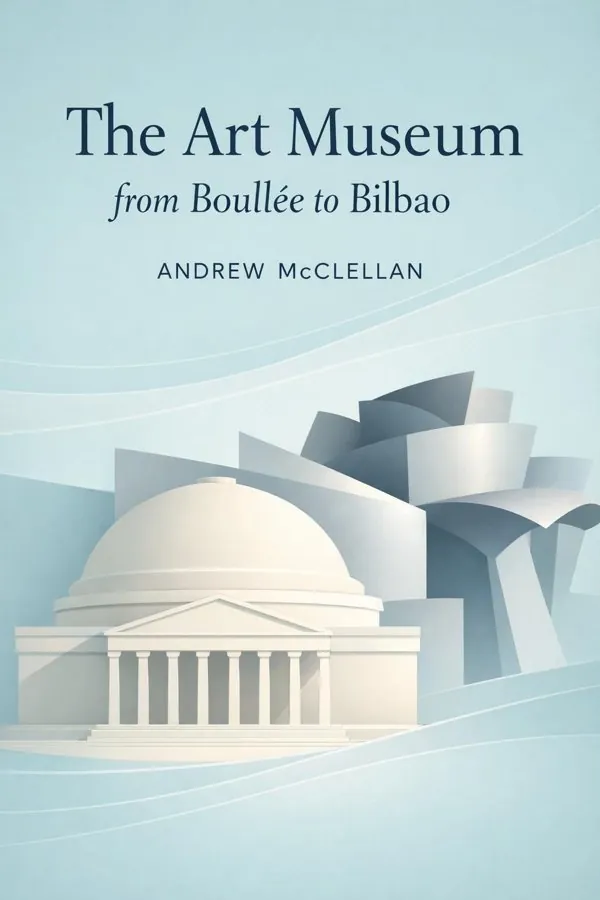
The Art Museum from Boullée to Bilbao: Summary & Key Insights
 10 min9 chaptersAudio available
Key Takeaways from The Art Museum from Boullée to Bilbao
A museum is never just a building full of objects; it is a theory about who knowledge belongs to.
Sometimes the most influential museums were never built.
A revolution can turn a palace into a public classroom.
Once museums were accepted as public institutions, they multiplied quickly.
Every museum faces a basic tension: should it inspire reverence or encourage conversation?
What Is The Art Museum from Boullée to Bilbao About?
The Art Museum from Boullée to Bilbao by Andrew McClellan is a civilization book spanning 9 pages. Art museums often present themselves as quiet, neutral spaces devoted to beauty and preservation. Andrew McClellan shows that they are anything but neutral. In The Art Museum from Boullée to Bilbao, he traces how the museum evolved from an Enlightenment dream of public education into one of the most powerful cultural institutions of the modern world. Across more than two centuries, museums have reflected changing ideas about citizenship, nationhood, class, taste, spectacle, and the very meaning of art. McClellan moves from the visionary designs of Étienne-Louis Boullée to the iconic Guggenheim Bilbao, showing that museum buildings are arguments in stone, glass, and steel. Their layouts, facades, collections, and public rituals all communicate values about who belongs, what deserves attention, and how culture should be organized. The book matters because museums shape collective memory while also influencing urban development, tourism, and public life. As a leading art historian and museum scholar, McClellan brings rare authority to this subject. His deep knowledge of the Louvre, the history of collecting, and museum theory allows him to connect architecture, politics, and cultural history into one clear, compelling narrative.
This FizzRead summary covers all 9 key chapters of The Art Museum from Boullée to Bilbao in approximately 10 minutes, distilling the most important ideas, arguments, and takeaways from Andrew McClellan's work. Also available as an audio summary and Key Quotes Podcast.
The Art Museum from Boullée to Bilbao
Art museums often present themselves as quiet, neutral spaces devoted to beauty and preservation. Andrew McClellan shows that they are anything but neutral. In The Art Museum from Boullée to Bilbao, he traces how the museum evolved from an Enlightenment dream of public education into one of the most powerful cultural institutions of the modern world. Across more than two centuries, museums have reflected changing ideas about citizenship, nationhood, class, taste, spectacle, and the very meaning of art.
McClellan moves from the visionary designs of Étienne-Louis Boullée to the iconic Guggenheim Bilbao, showing that museum buildings are arguments in stone, glass, and steel. Their layouts, facades, collections, and public rituals all communicate values about who belongs, what deserves attention, and how culture should be organized. The book matters because museums shape collective memory while also influencing urban development, tourism, and public life.
As a leading art historian and museum scholar, McClellan brings rare authority to this subject. His deep knowledge of the Louvre, the history of collecting, and museum theory allows him to connect architecture, politics, and cultural history into one clear, compelling narrative.
Who Should Read The Art Museum from Boullée to Bilbao?
This book is perfect for anyone interested in civilization and looking to gain actionable insights in a short read. Whether you're a student, professional, or lifelong learner, the key ideas from The Art Museum from Boullée to Bilbao by Andrew McClellan will help you think differently.
- ✓Readers who enjoy civilization and want practical takeaways
- ✓Professionals looking to apply new ideas to their work and life
- ✓Anyone who wants the core insights of The Art Museum from Boullée to Bilbao in just 10 minutes
Want the full summary?
Get instant access to this book summary and 100K+ more with Fizz Moment.
Get Free SummaryAvailable on App Store • Free to download
Key Chapters
A museum is never just a building full of objects; it is a theory about who knowledge belongs to. McClellan begins with the Enlightenment, when European thinkers increasingly challenged the idea that art, science, and learning should remain hidden in royal palaces, aristocratic collections, or church treasuries. The new ideal was public access. If reason was universal, then cultural treasures should help educate citizens rather than flatter private owners.
This was a profound shift. Earlier collections, such as cabinets of curiosity, displayed power through rarity and possession. The emerging public museum instead claimed to serve society. It promised order, instruction, and improvement. Paintings and sculptures would no longer be scattered signs of wealth; they would be arranged to tell a story about civilization, taste, and progress. In that sense, the museum was born alongside modern ideas of citizenship.
McClellan shows that this ideal was never purely democratic. Access remained limited by class, education, etiquette, and geography. Still, the principle mattered: once art entered the public sphere, governments and cities could justify museums as civic institutions. That legacy remains visible today in free-admission debates, educational programming, and public funding arguments.
A practical way to apply this insight is to stop seeing museums as timeless institutions. When you visit one, ask what version of “the public” it imagines. Who was invited in historically, and who was excluded? The actionable takeaway: whenever you enter a museum, treat its existence as a political achievement—not a natural fact—and pay attention to how it defines public culture.
Sometimes the most influential museums were never built. McClellan uses the visionary architect Étienne-Louis Boullée to show how museum design became an intellectual project in its own right. Boullée’s drawings imagined monumental structures of vast scale, geometric purity, and emotional intensity. They were not merely containers for art; they were symbolic statements about reason, order, and collective enlightenment.
In Boullée’s hands, architecture became a language of public aspiration. The museum was imagined as a secular temple for knowledge, a place where design itself elevated the visitor. Monumentality mattered because it dramatized the importance of art to society. Symmetry and clarity mattered because they suggested rational organization. Even though many of these schemes remained unrealized, they shaped later expectations about what museums should look and feel like: dignified, imposing, and morally serious.
McClellan’s larger point is that museums do cultural work before a visitor sees a single object. Facades, staircases, domes, circulation paths, and lighting all frame interpretation. A museum building can humble, welcome, confuse, or inspire. Boullée understood this early. He recognized that architecture is not neutral packaging but part of the museum’s message.
You can apply this insight in any cultural space, from national museums to small local galleries. Notice how the architecture prepares you emotionally. Does it suggest reverence, accessibility, exclusivity, or spectacle? The actionable takeaway: next time you visit a museum, evaluate the building as carefully as the collection, because the architecture is already telling you how art should be understood.
A revolution can turn a palace into a public classroom. McClellan treats the Louvre as the foundational model of the modern national museum because it transformed royal possession into public heritage. During the French Revolution, the Louvre was recast from a symbol of monarchy into a repository for the nation’s artistic legacy. That transformation mattered far beyond France. It established the idea that a state could use art museums to define collective identity, historical continuity, and civic legitimacy.
The Louvre did more than display masterpieces. It organized art into narratives. Schools, periods, and civilizations were classified in ways that taught visitors how to see history as a structured progression. This arrangement made the museum a pedagogical machine. Citizens were not simply looking at paintings; they were being trained in taste, national pride, and cultural memory.
McClellan also highlights the paradox. National museums claim to belong to everyone, yet they often emerge from seizure, war, conquest, or centralized power. The Louvre’s collections grew through revolutionary confiscation and Napoleonic appropriation. So while the museum embodied public ideals, it also exposed the political struggles behind ownership and display.
This insight remains relevant in debates about repatriation, contested heritage, and state-sponsored culture. Major museums still function as symbols of national prestige, even when they claim universal values. The actionable takeaway: when you encounter a national museum, ask not only what treasures it displays, but how those treasures were gathered and what story of the nation the institution is trying to teach.
Once museums were accepted as public institutions, they multiplied quickly. McClellan shows that the nineteenth century turned the museum from an elite experiment into a standard feature of urban life. Industrializing cities, rising middle classes, and expanding municipal governments all contributed to this growth. Museums were built not only in capitals but in provincial centers, often as statements that a city possessed refinement, ambition, and moral seriousness.
These museums served several overlapping purposes. They were educational spaces for workers and students, symbols of local pride, and instruments for shaping respectable public behavior. Their collections often reflected civic aspirations: local antiquities, national schools of painting, or industrial design objects that could elevate manufacturing standards. In this period, the museum became part of a broader network of libraries, parks, schools, and concert halls designed to civilize urban populations.
Architecture reinforced this role. Grand staircases, orderly galleries, and classical facades signaled permanence and authority. At the same time, museums became increasingly bureaucratic, with curators, catalogues, taxonomies, and acquisition policies. The institution matured administratively as well as physically.
McClellan helps readers see that museums grew alongside modern city-making. Even today, towns and cities invest in museums to improve education, attract visitors, and project cultural legitimacy. A practical application is to look at your own city’s museums as part of its social infrastructure rather than as optional luxuries. The actionable takeaway: evaluate museums the way you would parks or libraries—by asking how they contribute to civic life, local identity, and public opportunity.
Every museum faces a basic tension: should it inspire reverence or encourage conversation? McClellan captures this enduring dilemma in the idea of the museum as both temple and forum. As temple, the museum is a place of contemplation, authority, silence, and elevated experience. As forum, it is a site of debate, education, participation, and public exchange. The history of the art museum can be read as a long negotiation between these two models.
The temple model appears in neoclassical facades, hushed galleries, and curatorial voices that present art as timeless and transcendent. This approach can produce focus and seriousness, helping visitors attend closely to objects. But it can also feel intimidating, exclusive, or detached from lived experience. The forum model, by contrast, invites dialogue through labels, lectures, public programming, community curation, and interactive interpretation. It can democratize access, but it also risks reducing art to entertainment or opinion.
McClellan does not argue that one model should replace the other. Instead, he shows that museums are strongest when they recognize the value and limits of both. A museum that is only a temple may alienate broad audiences; one that is only a forum may lose interpretive depth and aesthetic intensity.
This is highly useful for anyone designing exhibitions, educational programs, or even personal museum visits. Ask whether a space helps people both reflect and engage. The actionable takeaway: when you assess a museum, judge it by how well it combines seriousness with openness—creating room for wonder without shutting down discussion.
One of the most powerful museum inventions is a room that tries to disappear. McClellan explains how modernism reshaped the art museum through the ideal of the “white cube”: neutral walls, controlled lighting, minimal ornament, and a stripped-down environment meant to isolate the artwork from distraction. This setting reflected a modern belief that art should be experienced as autonomous, formal, and universal.
The white cube did not emerge by accident. It answered earlier museum problems. Dense salon-style hangs and heavily decorated interiors competed with the art itself. Modern curators and architects instead sought clarity, spacing, and visual discipline. Visitors would confront each work more directly, without historical clutter. This helped modern art gain legitimacy by giving abstract and experimental works a purified environment suited to close attention.
But McClellan also reveals the ideology hidden inside this apparent neutrality. White walls are not neutral; they promote a specific way of seeing. They encourage aesthetic contemplation over social context, and they often mask the institutional choices behind selection and display. The white cube can make museums seem objective when they are actually framing interpretation very carefully.
You can see this today in galleries around the world, from major museums to commercial art spaces. The format remains dominant because it works, but it also shapes expectations. A practical application is to ask what kinds of art benefit from this setting and what kinds are diminished by it. The actionable takeaway: whenever a museum feels “neutral,” question the design choices that created that effect and consider what contexts have been deliberately removed.
Late twentieth-century museums learned that buildings themselves could become star attractions. McClellan shows how postmodernism shifted the art museum away from restrained neutrality toward architectural drama, branding, and media visibility. In this new environment, the museum was not simply a place to see art; it was an event, an image, and often a tool for urban reinvention.
This change had several causes. Cultural institutions faced competition for public attention, cities sought tourism and investment, and architects gained celebrity status. Museums began commissioning striking, photogenic buildings that could symbolize renewal and global relevance. The result was the “spectacle museum,” where architecture, retail, public relations, and blockbuster exhibitions became central to institutional strategy.
McClellan does not dismiss this development outright. Spectacular museums can energize cities, expand audiences, and create memorable experiences. Yet they also raise questions. Does architecture overshadow the collection? Does visitor traffic replace sustained looking? Does the museum become a branded leisure destination rather than a critical cultural institution? These tensions define much of contemporary museum culture.
The pattern extends beyond iconic museums. Smaller institutions now think in terms of audience experience, image-making, and cultural competition. That can be productive, but it can also distort priorities. The actionable takeaway: when you encounter a highly designed museum, ask whether the spectacle deepens your encounter with art or mainly markets the institution itself. A successful museum should use excitement to support meaning, not substitute for it.
Few buildings have altered museum thinking as dramatically as Frank Gehry’s Guggenheim Museum Bilbao. For McClellan, Bilbao serves as a case study in how architecture, economics, and cultural policy converged at the end of the twentieth century. The museum’s titanium curves, sculptural form, and global publicity made it an instant landmark. More importantly, it demonstrated that a museum could help transform the image and fortunes of an entire city.
The so-called “Bilbao effect” quickly entered planning vocabulary. Civic leaders around the world hoped that one iconic museum could attract tourists, stimulate development, and reposition postindustrial cities in the global economy. In that sense, the museum became an engine of place-branding as much as a home for art. McClellan encourages readers to take this seriously: museums are now entangled with finance, infrastructure, real estate, and international competition.
Yet Bilbao also reveals the limits of imitation. Not every city can reproduce its success, and not every spectacular building creates durable cultural value. A museum cannot thrive on architecture alone. Its programming, collections, local integration, and long-term public purpose still matter. The danger is treating culture as a quick economic fix.
This idea remains practical for policymakers, donors, and museum professionals. Before celebrating a landmark project, ask what social and cultural goals it serves beyond visibility. The actionable takeaway: use Bilbao as a lesson in both ambition and caution—iconic design can amplify a museum’s impact, but lasting success depends on meaningful public engagement, not just visual fame.
As art circulates globally, museums can no longer pretend that culture fits neatly inside national borders. McClellan argues that globalization has transformed the mission of the art museum by expanding audiences, collecting practices, and institutional ambitions. Museums once organized themselves largely around national schools and Western canons. Increasingly, they must confront transnational histories, diasporic cultures, and global inequalities in visibility and authority.
This shift affects everything from acquisitions to exhibition design. Museums now face pressure to diversify collections, rethink colonial legacies, and include artists and traditions long marginalized by Euro-American narratives. International biennials, traveling exhibitions, and global museum brands have also changed the museum’s audience. Visitors may arrive with very different cultural assumptions, and institutions must decide whether they are representing a nation, a city, a civilization, or a global public.
McClellan suggests that globalization creates both opportunity and instability. On one hand, museums can become more inclusive and intellectually honest. On the other, they risk flattening differences into a generic global culture or using diversity as branding. The challenge is to broaden perspective without abandoning historical specificity.
This is especially relevant for readers interested in decolonization, representation, and cultural policy. When you visit a museum, notice whose stories are centered and whose remain peripheral. The actionable takeaway: judge museums not by how international they claim to be, but by whether they meaningfully rethink their collections, narratives, and responsibilities in a connected yet unequal world.
All Chapters in The Art Museum from Boullée to Bilbao
About the Author
Andrew McClellan is an American art historian and leading scholar of museum history and theory. He has served as a professor of art history at Tufts University, where his teaching and research have focused on the history of museums, eighteenth- and nineteenth-century European art, and cultural heritage. McClellan is especially well known for his work on the Louvre and the rise of the public art museum as a modern institution. His scholarship combines architectural analysis, political history, and curatorial theory, helping readers see museums as active participants in shaping public culture. Through books, essays, and academic leadership, he has become an influential voice in museum studies, particularly in debates about public access, national identity, and the evolving social role of art institutions.
Get This Summary in Your Preferred Format
Read or listen to the The Art Museum from Boullée to Bilbao summary by Andrew McClellan anytime, anywhere. FizzRead offers multiple formats so you can learn on your terms — all free.
Available formats: App · Audio · PDF · EPUB — All included free with FizzRead
Download The Art Museum from Boullée to Bilbao PDF and EPUB Summary
Key Quotes from The Art Museum from Boullée to Bilbao
“A museum is never just a building full of objects; it is a theory about who knowledge belongs to.”
“Sometimes the most influential museums were never built.”
“A revolution can turn a palace into a public classroom.”
“Once museums were accepted as public institutions, they multiplied quickly.”
“Every museum faces a basic tension: should it inspire reverence or encourage conversation?”
Frequently Asked Questions about The Art Museum from Boullée to Bilbao
The Art Museum from Boullée to Bilbao by Andrew McClellan is a civilization book that explores key ideas across 9 chapters. Art museums often present themselves as quiet, neutral spaces devoted to beauty and preservation. Andrew McClellan shows that they are anything but neutral. In The Art Museum from Boullée to Bilbao, he traces how the museum evolved from an Enlightenment dream of public education into one of the most powerful cultural institutions of the modern world. Across more than two centuries, museums have reflected changing ideas about citizenship, nationhood, class, taste, spectacle, and the very meaning of art. McClellan moves from the visionary designs of Étienne-Louis Boullée to the iconic Guggenheim Bilbao, showing that museum buildings are arguments in stone, glass, and steel. Their layouts, facades, collections, and public rituals all communicate values about who belongs, what deserves attention, and how culture should be organized. The book matters because museums shape collective memory while also influencing urban development, tourism, and public life. As a leading art historian and museum scholar, McClellan brings rare authority to this subject. His deep knowledge of the Louvre, the history of collecting, and museum theory allows him to connect architecture, politics, and cultural history into one clear, compelling narrative.
You Might Also Like
The Structure of Scientific Revolutions
Thomas S. Kuhn
10 min
Genius
Harold Bloom
10 min
A Cultural History of the Medieval Age
Various Editors
10 min
A History of God: The 4,000-Year Quest of Judaism, Christianity and Islam
Karen Armstrong
10 min
A History of the World in 10½ Chapters
Julian Barnes
10 min
A Short History of Progress
Ronald Wright
10 minBrowse by Category
Ready to read The Art Museum from Boullée to Bilbao?
Get the full summary and 100K+ more books with Fizz Moment.