
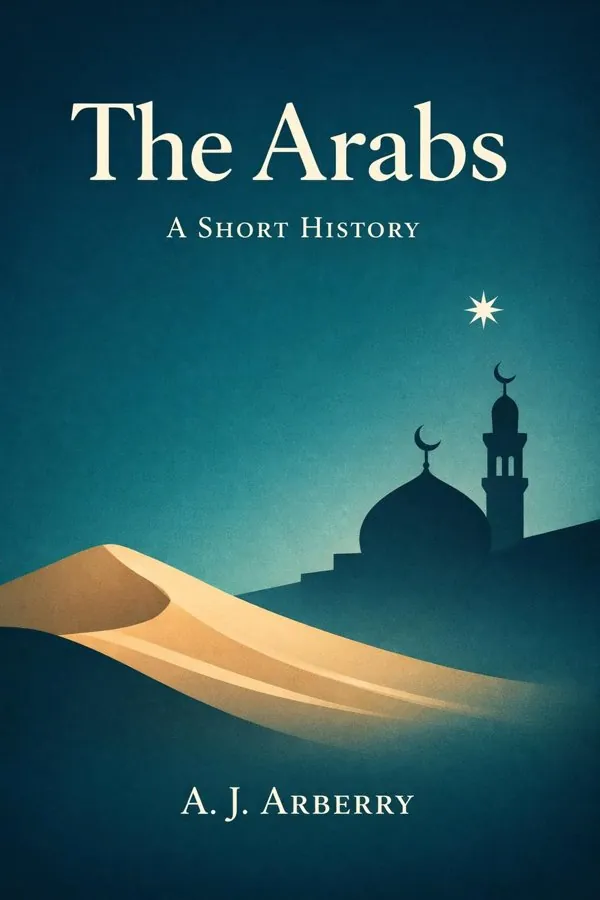
The Arabs: A Short History: Summary & Key Insights
 10 min9 chaptersAudio available
Key Takeaways from The Arabs: A Short History
Great civilizations rarely emerge from emptiness; they rise from landscapes already rich in tensions, traditions, and social habits.
The most transformative ideas in history do more than inspire belief; they reorganize society.
Empires do not endure through military momentum alone; they last when conquest is followed by organization.
A people’s deepest influence often travels through language before it travels through armies.
History is often distorted when societies are remembered only for political conflict and not for what they created.
What Is The Arabs: A Short History About?
The Arabs: A Short History by A. J. Arberry is a world_history book spanning 6 pages. A civilization is never defined only by its conquests or beliefs; it is also shaped by the language, memory, and imagination that hold its people together. In The Arabs: A Short History, A. J. Arberry offers a concise yet far-reaching account of Arab history, tracing the story of the Arabs from the tribal societies of pre-Islamic Arabia to the political complexities of the modern Middle East. Rather than reducing Arab history to a simple tale of empire or religion, Arberry presents it as a dynamic cultural journey in which poetry, faith, scholarship, trade, and political ambition all play central roles. The book matters because it helps readers see the Arab world not as a distant abstraction, but as one of the foundational forces in world civilization. Arberry was exceptionally qualified to write such a study. One of the twentieth century’s leading British scholars of Arabic and Persian literature, he brought to the subject both deep linguistic expertise and a serious respect for Islamic intellectual traditions. His history remains valuable for readers seeking a clear, thoughtful introduction to Arab identity, achievement, and historical change.
This FizzRead summary covers all 9 key chapters of The Arabs: A Short History in approximately 10 minutes, distilling the most important ideas, arguments, and takeaways from A. J. Arberry's work. Also available as an audio summary and Key Quotes Podcast.
The Arabs: A Short History
A civilization is never defined only by its conquests or beliefs; it is also shaped by the language, memory, and imagination that hold its people together. In The Arabs: A Short History, A. J. Arberry offers a concise yet far-reaching account of Arab history, tracing the story of the Arabs from the tribal societies of pre-Islamic Arabia to the political complexities of the modern Middle East. Rather than reducing Arab history to a simple tale of empire or religion, Arberry presents it as a dynamic cultural journey in which poetry, faith, scholarship, trade, and political ambition all play central roles. The book matters because it helps readers see the Arab world not as a distant abstraction, but as one of the foundational forces in world civilization. Arberry was exceptionally qualified to write such a study. One of the twentieth century’s leading British scholars of Arabic and Persian literature, he brought to the subject both deep linguistic expertise and a serious respect for Islamic intellectual traditions. His history remains valuable for readers seeking a clear, thoughtful introduction to Arab identity, achievement, and historical change.
Who Should Read The Arabs: A Short History?
This book is perfect for anyone interested in world_history and looking to gain actionable insights in a short read. Whether you're a student, professional, or lifelong learner, the key ideas from The Arabs: A Short History by A. J. Arberry will help you think differently.
- ✓Readers who enjoy world_history and want practical takeaways
- ✓Professionals looking to apply new ideas to their work and life
- ✓Anyone who wants the core insights of The Arabs: A Short History in just 10 minutes
Want the full summary?
Get instant access to this book summary and 100K+ more with Fizz Moment.
Get Free SummaryAvailable on App Store • Free to download
Key Chapters
Great civilizations rarely emerge from emptiness; they rise from landscapes already rich in tensions, traditions, and social habits. Arberry begins by showing that pre-Islamic Arabia was not a cultural void waiting for history to begin. It was a region of deserts, caravan routes, market towns, oasis settlements, and fiercely independent tribes. Life was organized through kinship, honor, and survival. Tribal alliances offered protection, while feuds over pasture, trade, and water could last for generations. In this environment, poetry became more than art: it preserved memory, celebrated courage, mocked enemies, and established reputation. The poet was often as important as the warrior.
At the same time, Arabia was not isolated from the wider world. Mecca stood at the intersection of trade and pilgrimage. Jewish, Christian, and other religious influences circulated across the peninsula, especially in border regions connected to Byzantium and Persia. This meant that when Islam appeared, it entered a society already engaged with commerce, spirituality, and political rivalry.
A practical way to understand this period is to compare it to any fragmented society where local loyalty is stronger than national identity. In such settings, stories, symbols, and shared rituals become powerful tools of cohesion. Pre-Islamic Arabia teaches that social order can exist without centralized states, but it also reveals the limits of tribal fragmentation.
Actionable takeaway: When studying any major historical transformation, first examine the social world that existed before the change. Revolutions succeed not because they erase the past, but because they reshape what was already there.
The most transformative ideas in history do more than inspire belief; they reorganize society. Arberry presents the rise of Islam as exactly this kind of turning point. Muhammad emerged in Mecca not simply as a preacher of private piety, but as a leader whose message challenged the moral and social assumptions of his time. He proclaimed the unity of God, the urgency of judgment, the responsibility of charity, and the equality of believers before divine law. These teachings spoke to spiritual concerns, but they also addressed concrete social problems such as injustice, tribal arrogance, and the exclusion of the weak.
The Hijra, the migration from Mecca to Medina, marked a decisive shift. Islam became not only a faith but also a community organized by shared belief rather than bloodline alone. In Medina, Muhammad helped create a new political and moral order that linked religious practice with governance, law, and collective responsibility. This fusion gave early Islam unusual strength. It could bind scattered tribes into a wider community while preserving discipline and purpose.
In modern terms, Islam succeeded partly because it offered both identity and structure. Many movements can criticize an old order; fewer can replace it with a coherent system of values and institutions. Arberry’s account shows why Islam spread so rapidly in Arabia: it gave people a larger belonging without leaving them morally unanchored.
Actionable takeaway: If you want to understand lasting change, look for ideas that connect personal conviction with shared institutions. Belief becomes historically powerful when it reshapes how people live together.
Empires do not endure through military momentum alone; they last when conquest is followed by organization. After Muhammad’s death, the early caliphs faced an enormous test: could the unity he created survive him? Arberry explains how the Rashidun and later Umayyad rulers transformed a newly consolidated Arabian community into a vast political power stretching across the Middle East, North Africa, and beyond. This expansion was astonishingly rapid, but it was not merely a wave of battlefield victories. It depended on leadership, taxation, legal structures, military discipline, and the ability to govern diverse peoples.
The caliphate inherited and adapted systems from the lands it conquered. Rather than destroying everything they found, Arab rulers often worked through existing bureaucracies and local elites. Arabic gradually became a language of administration and culture, helping create a broader civilizational identity. Yet Arberry also notes the tensions within this growth. Questions of succession, legitimacy, and ethnic hierarchy shaped the political life of the early Islamic world from the beginning.
A useful application of this idea is to recognize how institutions stabilize success. In business, politics, or social movements, early victories can collapse without administrative follow-through. The caliphate’s history shows that identity and bureaucracy are not opposites; they often reinforce each other.
Arberry’s treatment encourages readers to see Arab expansion as historically complex: inspired by religion, enabled by military skill, and sustained by practical governance. The Arab world became historically central not only because it conquered territory, but because it built systems capable of holding a vast and varied world together.
Actionable takeaway: Whenever you evaluate growth, ask what administrative framework made it possible. Expansion without organization is usually temporary.
A people’s deepest influence often travels through language before it travels through armies. One of Arberry’s most important insights is that Arabic became far more than the speech of the Arabian Peninsula. With the spread of Islam and the consolidation of Arab power, Arabic developed into a language of revelation, law, scholarship, administration, and literature. This gave the Arab world a unifying medium that connected regions as different as Iraq, Syria, Egypt, North Africa, and later Muslim Spain.
Because the Qur'an was in Arabic, the language carried sacred prestige. But its importance did not stop there. Scholars used Arabic to debate theology, record history, codify grammar, preserve poetry, and translate scientific and philosophical works. In this sense, Arabic functioned as Latin once did in medieval Europe, but with even broader cultural vitality. It allowed widely dispersed peoples to participate in a shared intellectual world.
This matters today because language is still one of the strongest engines of identity. A common language does not erase local differences, but it makes possible a larger conversation. Arberry implicitly reminds readers that Arab identity has always involved more than ethnicity; language and literary inheritance are central to it. A person entering Arab history must therefore pay attention not only to rulers and wars, but to texts, recitation, rhetoric, and the transmission of knowledge.
In practical terms, this idea can shape how we think about culture in our own lives. Communities become durable when they build strong institutions of communication, education, and memory.
Actionable takeaway: To understand any civilization deeply, study the language in which it thinks, argues, and remembers itself. Language is often the hidden architecture of history.
History is often distorted when societies are remembered only for political conflict and not for what they created. Arberry strongly emphasizes the cultural and scientific flourishing of the Arab-Islamic world, especially under the Abbasids and in other major centers of learning. Baghdad, Cairo, Cordoba, and other cities became hubs of scholarship where medicine, astronomy, mathematics, philosophy, geography, and literary criticism advanced through sustained study. Arab and Islamicate civilization did not merely preserve knowledge from Greece, Persia, and India; it transformed and extended it.
This flourishing emerged from several conditions: urban prosperity, patronage from rulers, respect for learning, and a civilization-wide language that allowed ideas to circulate. Scholars translated major works into Arabic, then argued with them, corrected them, and developed new fields of inquiry. In literature, poetry and prose reached remarkable sophistication. In religion, theology, jurisprudence, and mysticism deepened intellectual life. Arberry, as a literary scholar, was especially alert to the elegance and seriousness of this tradition.
The practical lesson here is that intellectual excellence thrives where curiosity, institutions, and cultural confidence meet. Societies produce breakthroughs when they are open enough to absorb outside influences and disciplined enough to refine them. The Arab world’s golden ages show that borrowing and originality are not opposites; often the second grows from the first.
For modern readers, this chapter corrects simplistic narratives of East versus West. Much of what later shaped Europe passed through Arab and Islamic hands. The global history of ideas is interconnected, not isolated.
Actionable takeaway: Seek out the intellectual intermediaries of history. Progress often comes from cultures that translate, connect, and build across traditions.
Civilizations are most vulnerable not only when attacked from outside, but when internal cohesion begins to fracture. Arberry traces how the early unity of the Arab-Islamic world gradually gave way to political fragmentation. Dynasties rose and fell, regional rulers asserted independence, and the caliphate increasingly became a symbol of legitimacy rather than an undisputed center of power. The Abbasid period, despite its brilliance, also revealed how difficult it was to govern a vast and diverse empire over time.
This fragmentation did not mean immediate collapse. In many regions, local courts remained culturally vibrant and politically capable. But the weakening of central authority made the Arab world more exposed to outside pressures, including Crusader invasions, Turkic military dominance, and later Mongol destruction. Arberry’s narrative suggests that decline is rarely a single event. It is usually a long process in which institutional weakening, elite rivalry, military dependency, and regional competition slowly erode resilience.
A modern application is easy to see. Organizations, nations, and movements often continue to look impressive from the outside even as their internal coordination decays. Strong symbols can conceal weak systems. Arberry invites readers to distinguish between cultural vitality and political solidity; the two do not always rise and fall together.
This idea also complicates the notion of “decline.” Arab civilization did not simply disappear after its political fragmentation. It changed form, redistributed authority, and persisted through language, religion, and scholarship even when centralized Arab political dominance faded.
Actionable takeaway: Do not judge strength by prestige alone. Pay attention to whether institutions can still coordinate power, succession, and loyalty over time.
No civilization develops in isolation; its identity is sharpened by the powers it resists, absorbs, and negotiates with. Arberry shows that Arab history after its great expansion was deeply affected by encounters with external forces, especially the Crusaders, Mongols, Ottoman Turks, and eventually European imperial powers. These encounters were military and political, but they were also cultural and psychological. They changed how Arab societies viewed themselves and how they imagined their place in the world.
The Crusades, though often remembered in European terms, also became part of Arab historical memory as a story of invasion and resistance. The Mongol sack of Baghdad in 1258 was a traumatic rupture, symbolizing the destruction of a major center of Islamic civilization. Ottoman rule later brought both continuity and subordination, preserving Islamic structures while reducing specifically Arab political centrality. In the modern era, European intervention introduced new technologies, institutions, and ideologies, but also colonial domination and the fragmentation of Arab lands into states shaped by foreign interests.
Practically, Arberry’s account teaches that contact with outside power can trigger both loss and renewal. Pressure from abroad often forces societies to reinterpret their traditions, revive neglected strengths, or adopt selective reforms. The Arab world’s modern condition cannot be understood without this long history of encounter.
This is relevant today whenever people debate modernization, globalization, or cultural authenticity. Identity is rarely preserved by rejecting all outside influence; nor is it strengthened by imitation without self-awareness.
Actionable takeaway: When evaluating cultural change, ask not only what was imposed from outside, but how local societies responded, adapted, and redefined themselves in return.
The modern Arab world is often discussed as though it were either one nation or many unrelated states, but Arberry suggests the truth lies in the tension between these two realities. Arab identity in the contemporary period is shaped by a shared language, historical memory, and religious inheritance, yet it is also divided by geography, class, sect, colonial borders, and political regimes. This duality helps explain both the power and the difficulty of Arab nationalism in the nineteenth and twentieth centuries.
As Ottoman rule weakened and European influence expanded, Arab intellectuals and reformers began asking new questions: What does it mean to be Arab in the modern age? How should Islamic tradition relate to modern education, science, and politics? Can political unity be built on cultural commonality? These questions animated movements for reform, independence, and national self-definition. Yet after colonial withdrawal, many Arab states struggled with authoritarian rule, regional rivalry, and the gap between popular aspirations and political institutions.
A practical insight here is that shared identity does not automatically produce effective unity. Many communities today face the same challenge: they possess common values or heritage but lack trust, institutions, or leadership capable of turning sentiment into durable cooperation. Arberry’s treatment helps readers appreciate why the Arab world remains emotionally interconnected even when politically fragmented.
This perspective is useful for anyone trying to understand current events. Modern conflicts in the Arab world cannot be explained only by religion or foreign intervention; they are also rooted in unresolved debates over identity, sovereignty, and historical continuity.
Actionable takeaway: When thinking about modern nations or regions, separate cultural solidarity from political integration. A shared identity can be real even when common governance remains elusive.
Perhaps the deepest lesson of Arberry’s book is that the Arabs cannot be reduced to a stereotype. Too often, Arab history is flattened into a few familiar images: desert tribes, Islamic conquest, oil wealth, or political crisis. Arberry resists this reduction by presenting Arab civilization as historically layered and internally varied. The Arabs are at once a linguistic community, a cultural tradition, a religiously significant people, and a set of societies transformed by empire, scholarship, colonialism, and modern statehood.
This broader view has practical value. It challenges the habit of treating the Arab world as static or monolithic. For example, the same historical tradition includes nomadic life and urban sophistication, theological conservatism and philosophical inquiry, local loyalties and universal visions. It includes triumph, fracture, adaptation, and renewal. Arberry’s method encourages readers to hold these contrasts together instead of choosing one image and mistaking it for the whole.
In everyday life, this insight applies to how we approach any culture different from our own. Simplification feels efficient, but it distorts reality and weakens judgment. Better understanding begins when we replace slogans with history, and assumptions with context. Arberry models this approach by writing with scholarly discipline and civilizational respect.
For readers today, this may be the book’s most enduring gift. It does not merely provide facts about the Arabs; it trains the reader to think historically rather than react superficially.
Actionable takeaway: When confronted with a culture often discussed in clichés, pause and ask what historical layers those clichés ignore. Complexity is not a distraction from understanding; it is the path to it.
All Chapters in The Arabs: A Short History
About the Author
Arthur John Arberry (1905–1969) was a distinguished British scholar of Arabic, Persian, and Islamic literature. Educated at Cambridge, he went on to become one of the twentieth century’s most influential interpreters of the Islamic world for English-speaking readers. He taught at the School of Oriental and African Studies and later served as Professor of Arabic at the University of Cambridge. Arberry produced major translations of the Qur'an, Persian poetry, and Sufi classics, combining philological precision with literary sensitivity. Unlike many writers who treated the Middle East from a distance, he approached its traditions with deep respect and close textual knowledge. His work helped generations of readers encounter Islamic civilization as a rich intellectual and artistic tradition. The Arabs: A Short History reflects his gift for making complex history accessible without sacrificing scholarly seriousness.
Get This Summary in Your Preferred Format
Read or listen to the The Arabs: A Short History summary by A. J. Arberry anytime, anywhere. FizzRead offers multiple formats so you can learn on your terms — all free.
Available formats: App · Audio · PDF · EPUB — All included free with FizzRead
Download The Arabs: A Short History PDF and EPUB Summary
Key Quotes from The Arabs: A Short History
“Great civilizations rarely emerge from emptiness; they rise from landscapes already rich in tensions, traditions, and social habits.”
“The most transformative ideas in history do more than inspire belief; they reorganize society.”
“Empires do not endure through military momentum alone; they last when conquest is followed by organization.”
“A people’s deepest influence often travels through language before it travels through armies.”
“History is often distorted when societies are remembered only for political conflict and not for what they created.”
Frequently Asked Questions about The Arabs: A Short History
The Arabs: A Short History by A. J. Arberry is a world_history book that explores key ideas across 9 chapters. A civilization is never defined only by its conquests or beliefs; it is also shaped by the language, memory, and imagination that hold its people together. In The Arabs: A Short History, A. J. Arberry offers a concise yet far-reaching account of Arab history, tracing the story of the Arabs from the tribal societies of pre-Islamic Arabia to the political complexities of the modern Middle East. Rather than reducing Arab history to a simple tale of empire or religion, Arberry presents it as a dynamic cultural journey in which poetry, faith, scholarship, trade, and political ambition all play central roles. The book matters because it helps readers see the Arab world not as a distant abstraction, but as one of the foundational forces in world civilization. Arberry was exceptionally qualified to write such a study. One of the twentieth century’s leading British scholars of Arabic and Persian literature, he brought to the subject both deep linguistic expertise and a serious respect for Islamic intellectual traditions. His history remains valuable for readers seeking a clear, thoughtful introduction to Arab identity, achievement, and historical change.
You Might Also Like
The Age of Capital
Eric Hobsbawm
10 min
The Gulag Archipelago
Aleksandr Solzhenitsyn
10 min
Jerusalem: The Biography
Simon Sebag Montefiore
10 min
The Anglo-Saxons
James Campbell
10 min
The Boer War
Thomas Pakenham
10 min
The Industrial Revolutionaries: The Making of the Modern World 1776–1914
Gavin Weightman
10 minBrowse by Category
Ready to read The Arabs: A Short History?
Get the full summary and 100K+ more books with Fizz Moment.