
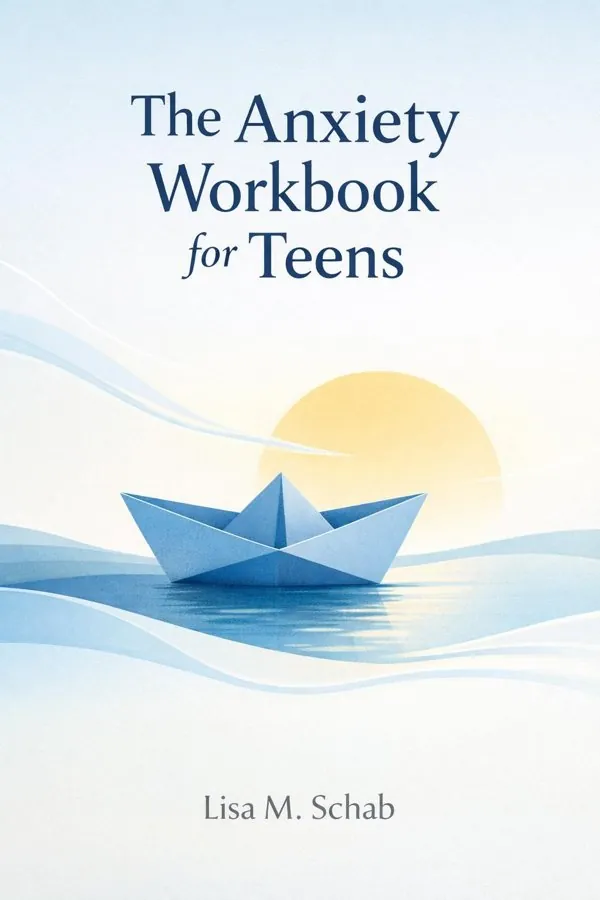
The Anxiety Workbook for Teens: Activities to Help You Deal with Anxiety and Worry: Summary & Key Insights
 10 min8 chaptersAudio available
Key Takeaways from The Anxiety Workbook for Teens: Activities to Help You Deal with Anxiety and Worry
Anxiety rarely appears out of nowhere; it usually grows from a combination of temperament, experience, stress, and habit.
Thoughts can feel like facts, especially when anxiety is loud.
Anxiety is not just something you think; it is something you feel in your body.
Avoidance offers immediate relief, but it quietly strengthens anxiety over time.
What feels chaotic often becomes manageable once it is named.
What Is The Anxiety Workbook for Teens: Activities to Help You Deal with Anxiety and Worry About?
The Anxiety Workbook for Teens: Activities to Help You Deal with Anxiety and Worry by Lisa M. Schab is a mental_health book spanning 4 pages. Anxiety can make ordinary teenage life feel exhausting. A class presentation becomes a disaster in your mind before it happens, a text left unanswered turns into rejection, and one mistake can spiral into hours of worry. In The Anxiety Workbook for Teens, Lisa M. Schab offers a practical, compassionate guide for young people who want to understand what anxiety is, why it happens, and how to manage it without feeling broken or alone. Rather than offering abstract advice, the book uses hands-on exercises, reflection prompts, and cognitive-behavioral tools that teens can actually use in daily life. What makes this workbook especially valuable is its tone: reassuring, direct, and empowering. Schab treats anxiety as a real challenge, but not as an identity or life sentence. She helps readers recognize triggers, challenge distorted thoughts, calm the body, and build confidence step by step. As a licensed clinical social worker and psychotherapist who specializes in working with children, adolescents, and families, Schab brings both professional expertise and practical wisdom. The result is a workbook that speaks clearly to teens while giving them skills they can carry into adulthood.
This FizzRead summary covers all 8 key chapters of The Anxiety Workbook for Teens: Activities to Help You Deal with Anxiety and Worry in approximately 10 minutes, distilling the most important ideas, arguments, and takeaways from Lisa M. Schab's work. Also available as an audio summary and Key Quotes Podcast.
The Anxiety Workbook for Teens: Activities to Help You Deal with Anxiety and Worry
Anxiety can make ordinary teenage life feel exhausting. A class presentation becomes a disaster in your mind before it happens, a text left unanswered turns into rejection, and one mistake can spiral into hours of worry. In The Anxiety Workbook for Teens, Lisa M. Schab offers a practical, compassionate guide for young people who want to understand what anxiety is, why it happens, and how to manage it without feeling broken or alone. Rather than offering abstract advice, the book uses hands-on exercises, reflection prompts, and cognitive-behavioral tools that teens can actually use in daily life.
What makes this workbook especially valuable is its tone: reassuring, direct, and empowering. Schab treats anxiety as a real challenge, but not as an identity or life sentence. She helps readers recognize triggers, challenge distorted thoughts, calm the body, and build confidence step by step. As a licensed clinical social worker and psychotherapist who specializes in working with children, adolescents, and families, Schab brings both professional expertise and practical wisdom. The result is a workbook that speaks clearly to teens while giving them skills they can carry into adulthood.
Who Should Read The Anxiety Workbook for Teens: Activities to Help You Deal with Anxiety and Worry?
This book is perfect for anyone interested in mental_health and looking to gain actionable insights in a short read. Whether you're a student, professional, or lifelong learner, the key ideas from The Anxiety Workbook for Teens: Activities to Help You Deal with Anxiety and Worry by Lisa M. Schab will help you think differently.
- ✓Readers who enjoy mental_health and want practical takeaways
- ✓Professionals looking to apply new ideas to their work and life
- ✓Anyone who wants the core insights of The Anxiety Workbook for Teens: Activities to Help You Deal with Anxiety and Worry in just 10 minutes
Want the full summary?
Get instant access to this book summary and 100K+ more with Fizz Moment.
Get Free SummaryAvailable on App Store • Free to download
Key Chapters
Anxiety rarely appears out of nowhere; it usually grows from a combination of temperament, experience, stress, and habit. One of the workbook’s most helpful messages is that anxious feelings are not proof that something is wrong with you. They are signals produced by a nervous system that is trying, often clumsily, to protect you. Lisa M. Schab encourages teens to look at anxiety through a wider lens so they can stop blaming themselves and start understanding the forces that shape their reactions.
She explains that anxiety can have biological roots, such as being naturally more sensitive, more reactive to stress, or having a family history of anxiety. Psychological factors matter too. Perfectionism, fear of embarrassment, harsh self-criticism, and a tendency to imagine worst-case scenarios can all keep anxiety alive. Environmental influences also play a major role. Family conflict, school pressure, social media comparison, bullying, unstable routines, and big life changes can increase the sense that the world is unsafe or unpredictable.
This broader understanding matters because it replaces shame with curiosity. A teen who says, “I’m weak because I panic before tests,” can begin to say, “My body reacts strongly to pressure, and I’ve learned to expect failure even when I’m prepared.” That shift opens the door to change. Instead of fighting anxiety blindly, teens can identify patterns: when it started, what makes it worse, and what situations trigger it.
Schab’s approach invites readers to become investigators of their own experience. By tracking events, thoughts, body sensations, and behaviors, teens can see that anxiety is influenced by specific conditions rather than being a permanent mystery. Actionable takeaway: make a simple anxiety map listing your triggers, thoughts, body reactions, and common situations so you can begin targeting the real sources of your worry.
Thoughts can feel like facts, especially when anxiety is loud. One of the core lessons of the workbook is that anxious thinking often sounds convincing precisely because it is immediate, repetitive, and emotionally intense. Teens may assume, “If I feel scared, something bad must be about to happen,” but Schab shows that emotions do not always tell the truth. They often reflect habits of interpretation.
The book introduces common cognitive distortions in teen-friendly language. Catastrophizing turns a small problem into a disaster: one awkward comment becomes social ruin. Mind reading assumes others are judging you harshly without real evidence. Fortune-telling predicts failure before anything has happened. Black-and-white thinking makes a less-than-perfect performance seem like total defeat. Personalization causes teens to take excessive responsibility for events they do not control.
Schab does not simply tell readers to “think positive.” Instead, she teaches them to question anxious thoughts carefully and realistically. A useful example might be a teen thinking, “If I answer wrong in class, everyone will think I’m stupid.” When challenged, that thought becomes more balanced: “Some people might not notice, some might forget quickly, and answering wrong once does not define my intelligence.” This kind of reframing is not fake optimism; it is more accurate thinking.
The workbook’s exercises help teens write down their anxious thoughts, look for evidence, consider alternative explanations, and create more grounded responses. Over time, this builds mental flexibility. Instead of automatically believing every fearful thought, teens learn to pause and evaluate it.
Actionable takeaway: the next time anxiety spikes, write down the exact thought in your head and ask three questions: What is the evidence, what is another possible explanation, and what would I say to a friend who thought this?
Anxiety is not just something you think; it is something you feel in your body. A racing heart, tight chest, shaky hands, nausea, headaches, muscle tension, and restlessness can make anxiety seem even more dangerous than it is. One of the workbook’s most practical contributions is its focus on physical coping skills. Schab helps teens understand that when the body is activated, the mind often follows, and when the body is soothed, anxious thinking becomes easier to manage.
This is why relaxation is not a luxury in the book; it is a tool. Schab introduces methods such as deep breathing, progressive muscle relaxation, guided imagery, grounding techniques, and mindfulness-based awareness. Deep breathing slows the body’s alarm response. Progressive muscle relaxation teaches the difference between tension and release. Grounding exercises pull attention away from spiraling fears and back into the present moment. Visualization can help teens mentally rehearse calm and safety rather than danger.
These tools are especially useful because they can be applied in real situations. Before a presentation, a teen might do slow exhale-focused breathing. During a panic spike in the cafeteria, they might ground themselves by noticing five things they can see, four they can feel, and three they can hear. Before bed, they might use muscle relaxation to reduce nighttime worry.
Schab also emphasizes practice. Relaxation skills work best when teens build them during calmer moments, not only during crises. The more familiar the body becomes with calming routines, the easier it is to interrupt anxiety early.
Actionable takeaway: choose one physical calming skill, practice it for five minutes every day for a week, and use it intentionally in one stressful situation so your body learns a new response to fear.
Avoidance offers immediate relief, but it quietly strengthens anxiety over time. This is one of the workbook’s most important truths. When teens avoid feared situations, such as speaking in class, going to a party, asking for help, or trying something unfamiliar, they momentarily feel safer. But the brain learns the wrong lesson: “That situation really was dangerous, and escape was necessary.” Schab helps readers break this cycle by replacing avoidance with gradual, manageable action.
The book supports the idea that confidence is not something you wait to feel before acting. Confidence grows after repeated experiences of doing hard things and surviving them. That is why Schab encourages small brave steps instead of dramatic leaps. A teen with social anxiety does not need to suddenly become the life of the party. They might begin by making eye contact, then saying hello, then joining a short conversation, then attending a gathering for fifteen minutes.
This process, often called gradual exposure, teaches the nervous system that fear can rise and fall without catastrophe. It also helps teens collect real evidence against their anxious beliefs. A student who fears giving the wrong answer may discover that embarrassment is brief, that classmates are not paying close attention, or that making mistakes is normal.
Schab’s approach is empowering because it turns growth into a series of achievable experiments. Each success, even a small one, challenges the idea that anxiety is in control. The goal is not to eliminate fear completely but to prove that fear does not have to make decisions.
Actionable takeaway: identify one situation you have been avoiding, break it into three easier steps, and complete the first step this week so you begin building confidence through action rather than waiting for anxiety to disappear.
What feels chaotic often becomes manageable once it is named. Schab uses writing exercises throughout the workbook because journaling helps teens slow down their experience and see anxiety more clearly. Instead of getting lost in a blur of fear, readers learn to capture specific patterns: what happened, what they thought, what they felt in their bodies, how they reacted, and what happened afterward.
This kind of self-observation is powerful because anxiety thrives on vagueness. A teen may say, “I’m anxious all the time,” but a journal can reveal more detail: anxiety spikes most before tests, after social media scrolling, during conflict at home, or late at night when they are exhausted. Once those patterns become visible, coping becomes more targeted. The problem is no longer an invisible fog; it is a set of triggers and responses that can be worked with.
Journaling also creates distance from anxious thoughts. Writing “I’m having the thought that everyone hates me” feels different from simply believing it. It allows room for reflection rather than instant reaction. Teens can track which coping skills help, which situations are improving, and which thoughts keep repeating. Over time, this can be deeply encouraging. Progress that feels invisible day to day often becomes obvious on paper.
Schab’s workbook approach makes journaling practical rather than literary. Readers do not need to be good writers. Short bullet points, simple mood scales, or quick thought records are enough. The goal is awareness, not perfection.
Actionable takeaway: for the next seven days, spend five minutes each evening recording one anxious moment, including the trigger, the thought, the body sensation, and how you responded, so you can begin spotting patterns that anxiety hides.
Anxiety may feel purely emotional, but daily habits can either fuel it or soften it. Schab helps teens see that mental health is connected to routine, sleep, movement, nutrition, stimulation, and balance. This matters because many anxious teens focus only on crisis moments while ignoring the lifestyle patterns that keep their nervous systems on edge.
For example, poor sleep can make worries feel more intense, concentration weaker, and emotions harder to regulate. Too much caffeine can mimic anxiety symptoms like shakiness and racing thoughts. Constant screen time, especially late at night, can overstimulate the brain and amplify comparison, insecurity, and fear of missing out. On the other hand, regular exercise, enough rest, nourishing meals, and downtime can make the body more resilient under stress.
Schab’s message is not perfectionism in disguise. She does not suggest that healthy habits magically erase anxiety. Instead, she frames them as supportive conditions that make coping easier. A teen who sleeps consistently, takes short walks, and limits overwhelming input may still feel anxious, but they are less likely to be operating at full overload.
This perspective also gives teens a sense of agency. Some stressors cannot be controlled, but everyday habits often can. Building structure can be especially helpful during emotionally chaotic periods. Morning routines, scheduled study blocks, relaxation breaks, and screen-free wind-down time can all create predictability, which anxiety tends to crave.
Actionable takeaway: choose one habit that most affects your stress, such as sleep, caffeine, or late-night scrolling, and make one realistic change for the next week to support a calmer, steadier nervous system.
Anxiety often tells teens to hide. It says, “No one will understand,” “You will be judged,” or “You should handle this on your own.” Schab pushes back against that isolation by showing that support is not a sign of weakness but a key part of recovery. Healing is easier when anxiety is spoken about rather than silently carried.
The workbook encourages teens to identify safe, supportive people in their lives: a parent, sibling, school counselor, therapist, teacher, coach, or trusted friend. These people do not need to solve everything. Sometimes their most important role is to listen, help reality-check anxious thoughts, or remind the teen to use coping tools. In more serious cases, professional support may be essential, especially if anxiety is interfering with school, sleep, eating, relationships, or daily functioning.
Schab also helps readers think about how to communicate their needs clearly. Instead of vague statements like “I’m stressed,” teens can learn to say, “I get really anxious before presentations and I need help practicing,” or “I’ve been worrying so much at night that I can’t sleep.” Naming the issue makes support more effective.
The book normalizes the fact that many people need guidance to manage anxiety. Therapy, counseling, and family conversations are not admissions of failure. They are forms of skill-building and care. Asking for help interrupts the loneliness that makes anxious thoughts louder.
Actionable takeaway: write down the name of one trusted person you can talk to this week and one sentence you can use to start the conversation, because support becomes more available once you ask for it directly.
Many anxious teens are not only afraid of failure; they are harsh with themselves long before anything goes wrong. Schab’s workbook helps readers notice that anxiety is often intensified by an inner voice that is demanding, impatient, and unforgiving. Thoughts like “I’m so stupid,” “I should be over this,” or “Everyone else can handle life better than I can” add shame to fear, making emotional recovery much harder.
Self-compassion offers a healthier alternative. It does not mean making excuses or giving up on growth. It means responding to struggle the way a wise, caring person would: with honesty, patience, and encouragement. A compassionate response to anxiety might sound like, “This is hard right now, but I’m learning,” or “Being nervous does not mean I’m incapable.”
This shift matters because self-criticism usually increases avoidance and hopelessness. If a teen believes every anxious moment proves they are weak, they are less likely to keep trying. But if they see anxiety as a challenge they can work with, they become more resilient. Schab’s exercises encourage readers to challenge negative self-labels, recognize strengths, and treat mistakes as part of learning rather than proof of worthlessness.
A practical example might be a teen who freezes during a presentation. A self-critical reaction says, “I’m embarrassing and terrible at this.” A compassionate reaction says, “That was uncomfortable, but I got through it, and next time I can prepare differently.” The second response supports progress instead of paralysis.
Actionable takeaway: notice one self-critical phrase you repeat often and rewrite it into a kinder, more accurate statement you can practice whenever anxiety makes you turn against yourself.
All Chapters in The Anxiety Workbook for Teens: Activities to Help You Deal with Anxiety and Worry
About the Author
Lisa M. Schab, LCSW, is a licensed clinical social worker and psychotherapist who specializes in working with children, adolescents, and families. She is widely known for writing practical, accessible self-help books that translate therapeutic concepts into exercises readers can apply in everyday life. Her work often focuses on anxiety, depression, self-esteem, emotional regulation, and personal growth, with a particular emphasis on helping young people build coping skills early. Schab’s writing style combines clinical insight with warmth and clarity, making complex mental health topics approachable for teens and adults alike. Through her books and counseling background, she has helped many readers develop healthier thinking patterns, stronger emotional resilience, and greater confidence in managing life’s challenges.
Get This Summary in Your Preferred Format
Read or listen to the The Anxiety Workbook for Teens: Activities to Help You Deal with Anxiety and Worry summary by Lisa M. Schab anytime, anywhere. FizzRead offers multiple formats so you can learn on your terms — all free.
Available formats: App · Audio · PDF · EPUB — All included free with FizzRead
Download The Anxiety Workbook for Teens: Activities to Help You Deal with Anxiety and Worry PDF and EPUB Summary
Key Quotes from The Anxiety Workbook for Teens: Activities to Help You Deal with Anxiety and Worry
“Anxiety rarely appears out of nowhere; it usually grows from a combination of temperament, experience, stress, and habit.”
“Thoughts can feel like facts, especially when anxiety is loud.”
“Anxiety is not just something you think; it is something you feel in your body.”
“Avoidance offers immediate relief, but it quietly strengthens anxiety over time.”
“What feels chaotic often becomes manageable once it is named.”
Frequently Asked Questions about The Anxiety Workbook for Teens: Activities to Help You Deal with Anxiety and Worry
The Anxiety Workbook for Teens: Activities to Help You Deal with Anxiety and Worry by Lisa M. Schab is a mental_health book that explores key ideas across 8 chapters. Anxiety can make ordinary teenage life feel exhausting. A class presentation becomes a disaster in your mind before it happens, a text left unanswered turns into rejection, and one mistake can spiral into hours of worry. In The Anxiety Workbook for Teens, Lisa M. Schab offers a practical, compassionate guide for young people who want to understand what anxiety is, why it happens, and how to manage it without feeling broken or alone. Rather than offering abstract advice, the book uses hands-on exercises, reflection prompts, and cognitive-behavioral tools that teens can actually use in daily life. What makes this workbook especially valuable is its tone: reassuring, direct, and empowering. Schab treats anxiety as a real challenge, but not as an identity or life sentence. She helps readers recognize triggers, challenge distorted thoughts, calm the body, and build confidence step by step. As a licensed clinical social worker and psychotherapist who specializes in working with children, adolescents, and families, Schab brings both professional expertise and practical wisdom. The result is a workbook that speaks clearly to teens while giving them skills they can carry into adulthood.
You Might Also Like
Big Feelings: How to Be Okay When Things Are Not Okay
Liz Fosslien, Mollie West Duffy
10 min
Creative Arts Therapies Handbook: Art, Music and Dance Therapy Practices for Wellbeing
Susan I. Buchalter
10 min
Emotional First Aid: Healing Rejection, Guilt, Failure, and Other Everyday Hurts
Guy Winch
10 min
Lost Connections: Why You're Depressed and How to Find Hope
Johann Hari
10 min
No Time to Panic: How to Stop Worrying and Embrace Life
Matt Gutman
10 min
Overcoming Mobbing: A Recovery Guide for Workplace Aggression and Bullying
Maureen Duffy, Len Sperry
10 minBrowse by Category
Ready to read The Anxiety Workbook for Teens: Activities to Help You Deal with Anxiety and Worry?
Get the full summary and 100K+ more books with Fizz Moment.