
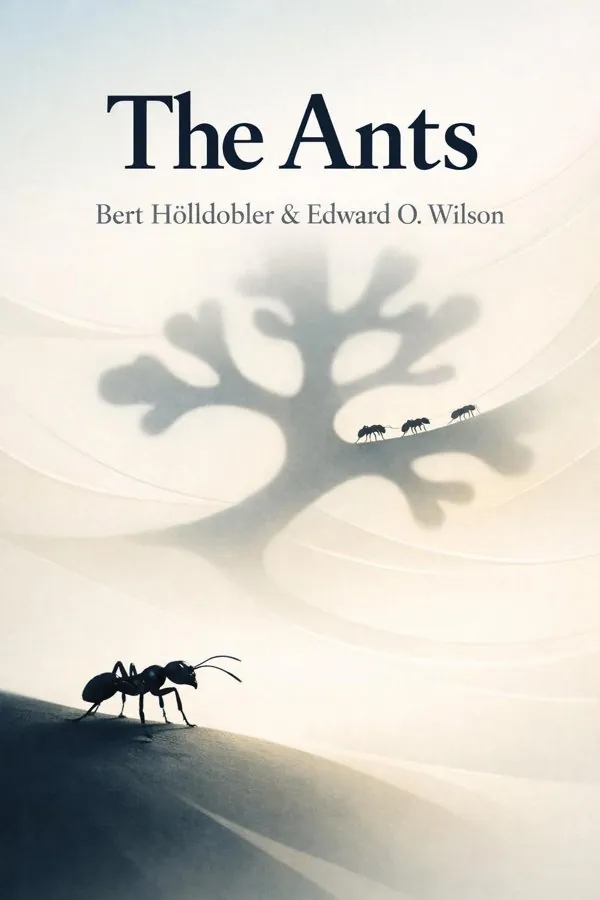
The Ants: Summary & Key Insights
by Bert Hölldobler, Edward O. Wilson
 10 min9 chaptersAudio available
Key Takeaways from The Ants
The success of ants begins with a paradox: some of the smallest creatures on land became dominant not through individual power, but through social organization.
An ant’s body is not just built for survival; it is built for society.
The most radical idea in The Ants is that a colony behaves less like a crowd and more like a single living body.
What looks like instinctive chaos in an ant trail is often a form of distributed intelligence.
Ants are not just residents of ecosystems; they are engineers of them.
What Is The Ants About?
The Ants by Bert Hölldobler & Edward O. Wilson is a life_science book spanning 8 pages. What looks like a tiny insect crossing the ground is, in fact, part of one of the most advanced social systems on Earth. In The Ants, Bert Hölldobler and Edward O. Wilson deliver a monumental exploration of ant life, combining anatomy, behavior, ecology, evolution, and social organization into a single, deeply researched portrait. This is not simply a book about insects. It is a study of how complex societies emerge, regulate themselves, adapt to changing environments, and thrive through cooperation. The book matters because ants are among the planet’s most successful organisms. They dominate many terrestrial ecosystems, shape soils, disperse seeds, protect and exploit other species, and reveal how division of labor can scale into extraordinary collective intelligence. By studying ants, we learn not only about biology but also about communication systems, conflict management, resilience, and the evolution of social life. Hölldobler, one of the world’s leading myrmecologists, and Wilson, a pioneering biologist and founder of sociobiology, write with unmatched authority. Their synthesis of decades of observation and experiment makes The Ants both a scientific landmark and an enduring guide to nature’s most disciplined societies.
This FizzRead summary covers all 9 key chapters of The Ants in approximately 10 minutes, distilling the most important ideas, arguments, and takeaways from Bert Hölldobler & Edward O. Wilson's work. Also available as an audio summary and Key Quotes Podcast.
The Ants
What looks like a tiny insect crossing the ground is, in fact, part of one of the most advanced social systems on Earth. In The Ants, Bert Hölldobler and Edward O. Wilson deliver a monumental exploration of ant life, combining anatomy, behavior, ecology, evolution, and social organization into a single, deeply researched portrait. This is not simply a book about insects. It is a study of how complex societies emerge, regulate themselves, adapt to changing environments, and thrive through cooperation.
The book matters because ants are among the planet’s most successful organisms. They dominate many terrestrial ecosystems, shape soils, disperse seeds, protect and exploit other species, and reveal how division of labor can scale into extraordinary collective intelligence. By studying ants, we learn not only about biology but also about communication systems, conflict management, resilience, and the evolution of social life.
Hölldobler, one of the world’s leading myrmecologists, and Wilson, a pioneering biologist and founder of sociobiology, write with unmatched authority. Their synthesis of decades of observation and experiment makes The Ants both a scientific landmark and an enduring guide to nature’s most disciplined societies.
Who Should Read The Ants?
This book is perfect for anyone interested in life_science and looking to gain actionable insights in a short read. Whether you're a student, professional, or lifelong learner, the key ideas from The Ants by Bert Hölldobler & Edward O. Wilson will help you think differently.
- ✓Readers who enjoy life_science and want practical takeaways
- ✓Professionals looking to apply new ideas to their work and life
- ✓Anyone who wants the core insights of The Ants in just 10 minutes
Want the full summary?
Get instant access to this book summary and 100K+ more with Fizz Moment.
Get Free SummaryAvailable on App Store • Free to download
Key Chapters
The most radical idea in The Ants is that a colony behaves less like a crowd and more like a single living body. This is the superorganism concept: queens, workers, brood, and soldiers operate as interdependent parts of one larger biological entity. No single ant understands the whole system, yet the colony displays coherent behavior in reproduction, defense, construction, and adaptation.
The authors explain how caste systems make this possible. Reproductive queens focus on laying eggs, while workers perform nursing, cleaning, foraging, nest maintenance, and defense. In some species, workers themselves are divided by age or morphology, with younger ants tending brood and older ants moving into riskier outside tasks. This division of labor is not rigid everywhere, but it dramatically increases efficiency.
Reproduction is carefully regulated. Most individuals in a colony do not reproduce, an extraordinary arrangement from the perspective of traditional individualism. Instead, the colony channels energy into a small reproductive core while the majority support the collective. This can happen because kinship ties make indirect genetic success possible: workers help relatives pass on shared genes.
A practical example appears in task allocation. If brood need attention, more workers shift inward. If food is scarce, foraging intensifies. The colony adjusts through local cues rather than top-down command.
This idea has broad implications. Many successful systems are decentralized yet highly integrated. Teams, businesses, and even cities can perform better when roles are clear, information is local and timely, and the whole system is valued over isolated prestige. Actionable takeaway: build environments where each member knows their role, can respond to local signals, and contributes to the health of the larger whole.
What looks like instinctive chaos in an ant trail is often a form of distributed intelligence. Hölldobler and Wilson show that ants communicate primarily through chemicals, and from these simple signals emerges astonishingly sophisticated collective behavior. A forager that finds food may lay a pheromone trail back to the nest. Other ants follow it, reinforce it if the food source is valuable, or let it fade if it is not. Without any planner overseeing the process, the colony identifies efficient routes and reallocates labor.
This is one of the clearest examples of how simple rules can create smart outcomes. Ants use alarm pheromones to mobilize defenders, recruitment signals to gather workers, and recognition chemicals to distinguish nestmates from outsiders. In some species, tactile signals and sound also play supporting roles, but chemistry remains the central language.
Foraging itself becomes a lesson in adaptive cooperation. Colonies balance exploration and exploitation: some ants search broadly, while others concentrate on known resources. This prevents both wasteful overcommitment and dangerous passivity. Army ants take coordination to an extreme, forming massive raiding fronts that behave like living machines. Leaf-cutter ants organize harvest lines and transport networks with similar precision.
Modern applications of these ideas are everywhere, from optimization algorithms to robotics and supply-chain design. Engineers have borrowed ant-inspired principles to solve routing problems because ant systems are robust, flexible, and scalable.
The deeper lesson is that intelligence does not always sit at the top. It can emerge from repeated local interactions governed by clear feedback. Actionable takeaway: when managing complexity, create simple rules and strong feedback loops instead of relying solely on centralized control.
Ants are not just residents of ecosystems; they are engineers of them. The book demonstrates that ant colonies alter soils, move nutrients, disperse seeds, regulate other insect populations, and form mutualistic relationships with plants and animals. Their ecological influence is often disproportionate to their size. To understand a landscape, you often need to understand its ants.
Nest building is one major form of ecological impact. By tunneling and moving earth, ants aerate soil, redistribute minerals, and affect water flow. This can improve plant growth and alter microbial communities. Some species disperse seeds by carrying them to nests, consuming attached nutrient bodies, and leaving the seeds in protected places where germination becomes more likely. In this way, ants help shape plant communities.
The authors also examine mutualisms. Ants may protect aphids in exchange for honeydew, defend plants that provide nectar or shelter, and engage in highly specialized partnerships that blur the line between cooperation and exploitation. Leaf-cutter ants go even further by farming fungus, creating one of nature’s most impressive examples of nonhuman agriculture. Here, ants gather leaf fragments not to eat directly, but to cultivate a crop.
These examples matter beyond entomology. They show that small, repeated actions can transform entire systems. Conservation biology, agriculture, and habitat restoration all benefit from recognizing ants as key ecological actors rather than background insects.
If you want to read an environment well, pay attention to its hidden workers. Actionable takeaway: in any ecosystem or organization, identify the seemingly minor agents that perform foundational maintenance, because supporting them may produce the greatest long-term impact.
Ants matter not only because they are fascinating in themselves, but because they help answer one of biology’s biggest questions: how can extreme cooperation evolve? Hölldobler and Wilson use ant societies to explore broader themes in sociobiology, especially kin selection, caste evolution, altruism, and the balance between individual and group interests. Ants offer a powerful testing ground because their colonies make these abstract ideas visible.
A worker ant may never reproduce, yet she spends her life feeding larvae, defending the nest, and supporting the queen. From a narrow individual perspective, this seems self-defeating. But when workers help raise close relatives, their genes can still spread indirectly. The colony becomes the arena in which natural selection shapes behavior. This does not eliminate conflict, but it changes how success is measured.
The book also invites comparison with termites, bees, wasps, and even human societies. The authors are careful not to make simplistic one-to-one analogies, yet they show that certain evolutionary principles recur wherever social life becomes complex: specialization, communication, role differentiation, and conflict regulation. Ants represent one of the clearest nonhuman examples of how selection can produce integrated social systems.
For readers outside biology, this chapter offers a conceptual payoff. It suggests that cooperation is not a moral accident added to nature, but one of nature’s recurring solutions to survival under certain conditions. Actionable takeaway: when studying any social system, ask what evolutionary or structural incentives make cooperation stable, rather than assuming cohesion appears by default.
One reason The Ants remains so important is that it does not simply present conclusions; it shows how knowledge about social insects is built. Hölldobler and Wilson draw on fieldwork, controlled experiments, taxonomy, comparative anatomy, and long-term behavioral observation. Their methods reveal that ant societies can only be understood by combining close attention to detail with broad evolutionary thinking.
Myrmecologists observe foraging trails, excavate nests, map territories, identify species, analyze pheromones, and track life cycles across seasons. Small differences matter. Two species may look similar but differ dramatically in mating systems, colony structure, or ecological role. A researcher who watches a nest over time can discover shifts in labor, conflict, or reproductive output that a short snapshot would miss.
Experimental work is equally crucial. By altering chemical trails, introducing foreign ants, isolating queens, or changing food availability, scientists can infer how colonies make decisions and regulate behavior. These methods transformed ant study from natural history alone into a rigorous science of social organization.
There is a broader intellectual lesson here. Complex systems rarely reveal themselves through quick impressions. They require repeated observation, multiple methods, and a willingness to revise assumptions. Whether in science, business, or personal decision-making, patient evidence gathering often beats fast certainty.
The book models scientific humility alongside scientific ambition. Actionable takeaway: when trying to understand a complicated system, spend longer observing than judging, use more than one method of inquiry, and let patterns emerge before forcing conclusions.
Perhaps the most enduring value of The Ants is that it turns a familiar creature into a masterclass on complexity. By the end of the book, ants are no longer just insects underfoot; they become a lens for understanding organization itself. Their societies demonstrate how enormous achievements can emerge from modest individuals following reliable rules in shared environments.
The authors show that ant colonies succeed through several recurring principles: division of labor, efficient communication, adaptive feedback, role flexibility within constraints, and relentless alignment around survival and reproduction. These principles help explain why colonies can build nests, manage food systems, defend territory, raise young, and respond to threats without needing leaders who issue detailed commands.
This does not mean human institutions should imitate ants literally. Human beings have consciousness, culture, ethics, and individual aspirations that make our societies fundamentally different. Still, the comparison is useful. Ants reveal what robust systems tend to require: clear signaling, specialized functions, shared incentives, and mechanisms for correction when things go wrong. In an age preoccupied with complexity, their example is unexpectedly modern.
Readers can apply this perspective to teamwork, education, urban design, technology, and ecology. If a tiny colony can coordinate thousands through local interactions, then many human coordination failures are not problems of intelligence but of system design.
Actionable takeaway: whenever a group feels disorganized, stop blaming individuals first and instead inspect the underlying architecture—roles, signals, incentives, and feedback loops—because better systems often produce better behavior.
All Chapters in The Ants
About the Authors
Bert Hölldobler is a German behavioral biologist internationally recognized for his pioneering research on ants and other social insects. His work has focused on communication, colony organization, and the evolution of social behavior, helping establish him as one of the leading myrmecologists of the modern era. Edward O. Wilson was an American biologist, naturalist, and prolific author whose influence extended across sociobiology, biodiversity, conservation, and evolutionary theory. He was also one of the most important science writers of the twentieth century. Together, Hölldobler and Wilson brought unmatched expertise to the study of ants, combining meticulous field observation with broad theoretical insight. Their collaboration on The Ants produced one of the most authoritative and celebrated works ever written on insect societies and the biological foundations of cooperation.
Get This Summary in Your Preferred Format
Read or listen to the The Ants summary by Bert Hölldobler & Edward O. Wilson anytime, anywhere. FizzRead offers multiple formats so you can learn on your terms — all free.
Available formats: App · Audio · PDF · EPUB — All included free with FizzRead
Download The Ants PDF and EPUB Summary
Key Quotes from The Ants
“The success of ants begins with a paradox: some of the smallest creatures on land became dominant not through individual power, but through social organization.”
“An ant’s body is not just built for survival; it is built for society.”
“The most radical idea in The Ants is that a colony behaves less like a crowd and more like a single living body.”
“What looks like instinctive chaos in an ant trail is often a form of distributed intelligence.”
“Ants are not just residents of ecosystems; they are engineers of them.”
Frequently Asked Questions about The Ants
The Ants by Bert Hölldobler & Edward O. Wilson is a life_science book that explores key ideas across 9 chapters. What looks like a tiny insect crossing the ground is, in fact, part of one of the most advanced social systems on Earth. In The Ants, Bert Hölldobler and Edward O. Wilson deliver a monumental exploration of ant life, combining anatomy, behavior, ecology, evolution, and social organization into a single, deeply researched portrait. This is not simply a book about insects. It is a study of how complex societies emerge, regulate themselves, adapt to changing environments, and thrive through cooperation. The book matters because ants are among the planet’s most successful organisms. They dominate many terrestrial ecosystems, shape soils, disperse seeds, protect and exploit other species, and reveal how division of labor can scale into extraordinary collective intelligence. By studying ants, we learn not only about biology but also about communication systems, conflict management, resilience, and the evolution of social life. Hölldobler, one of the world’s leading myrmecologists, and Wilson, a pioneering biologist and founder of sociobiology, write with unmatched authority. Their synthesis of decades of observation and experiment makes The Ants both a scientific landmark and an enduring guide to nature’s most disciplined societies.
More by Bert Hölldobler & Edward O. Wilson
You Might Also Like
The Selfish Gene
Richard Dawkins
10 min
Awakenings
Oliver Sacks
10 min
Parasite Rex: Inside the Bizarre World of Nature's Most Dangerous Creatures
Carl Zimmer
10 min
The Atlas of Life on Earth
Various
10 min
The Book of Humans: The Story of How We Became Us
Adam Rutherford
10 min
The Horse
Wendy Williams
10 minBrowse by Category
Ready to read The Ants?
Get the full summary and 100K+ more books with Fizz Moment.