
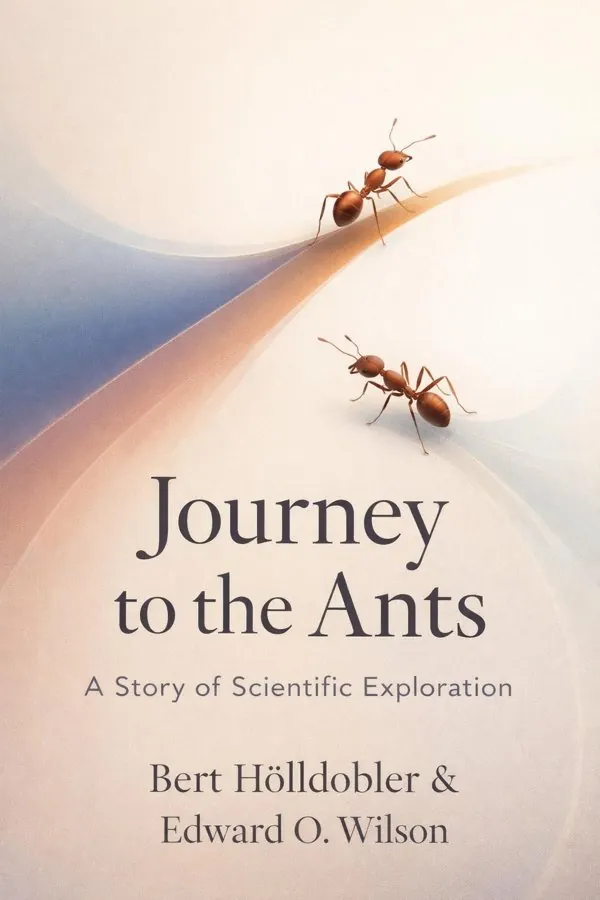
Journey to the Ants: A Story of Scientific Exploration: Summary & Key Insights
by Bert Hölldobler, Edward O. Wilson
 10 min9 chaptersAudio available
Key Takeaways from Journey to the Ants: A Story of Scientific Exploration
The most important creatures in many ecosystems are not the largest, smartest, or most visible, but the ones that organize best.
A single ant is limited; a colony is extraordinary.
Ant societies run on an invisible language, and that language is chemical.
Every ant colony is built around a profound biological tradeoff: most members give up direct reproduction so the colony can reproduce more effectively as a whole.
Nature is not peaceful efficiency alone; it is also competition, risk, and organized violence.
What Is Journey to the Ants: A Story of Scientific Exploration About?
Journey to the Ants: A Story of Scientific Exploration by Bert Hölldobler & Edward O. Wilson is a life_science book spanning 11 pages. Journey to the Ants: A Story of Scientific Exploration is far more than a nature book about tiny insects. It is an invitation into one of the most sophisticated societies on Earth, told by two of the world’s leading ant scientists, Bert Hölldobler and Edward O. Wilson. Drawing on decades of fieldwork across deserts, forests, and tropical ecosystems, the authors reveal how ants build cities, wage wars, communicate through chemistry, divide labor, reproduce, farm other organisms, and shape entire habitats. What makes the book especially powerful is its blend of scientific rigor and personal wonder: readers do not just learn facts about ants, they experience the thrill of discovery alongside the researchers themselves. The book matters because ants offer a window into some of biology’s biggest questions, including cooperation, conflict, adaptation, evolution, and the organization of complex societies. Hölldobler and Wilson write with unmatched authority, having transformed modern myrmecology through pioneering research on ant behavior and social systems. Their book shows that by studying creatures beneath our feet, we can better understand nature, science, and even ourselves.
This FizzRead summary covers all 9 key chapters of Journey to the Ants: A Story of Scientific Exploration in approximately 10 minutes, distilling the most important ideas, arguments, and takeaways from Bert Hölldobler & Edward O. Wilson's work. Also available as an audio summary and Key Quotes Podcast.
Journey to the Ants: A Story of Scientific Exploration
Journey to the Ants: A Story of Scientific Exploration is far more than a nature book about tiny insects. It is an invitation into one of the most sophisticated societies on Earth, told by two of the world’s leading ant scientists, Bert Hölldobler and Edward O. Wilson. Drawing on decades of fieldwork across deserts, forests, and tropical ecosystems, the authors reveal how ants build cities, wage wars, communicate through chemistry, divide labor, reproduce, farm other organisms, and shape entire habitats. What makes the book especially powerful is its blend of scientific rigor and personal wonder: readers do not just learn facts about ants, they experience the thrill of discovery alongside the researchers themselves. The book matters because ants offer a window into some of biology’s biggest questions, including cooperation, conflict, adaptation, evolution, and the organization of complex societies. Hölldobler and Wilson write with unmatched authority, having transformed modern myrmecology through pioneering research on ant behavior and social systems. Their book shows that by studying creatures beneath our feet, we can better understand nature, science, and even ourselves.
Who Should Read Journey to the Ants: A Story of Scientific Exploration?
This book is perfect for anyone interested in life_science and looking to gain actionable insights in a short read. Whether you're a student, professional, or lifelong learner, the key ideas from Journey to the Ants: A Story of Scientific Exploration by Bert Hölldobler & Edward O. Wilson will help you think differently.
- ✓Readers who enjoy life_science and want practical takeaways
- ✓Professionals looking to apply new ideas to their work and life
- ✓Anyone who wants the core insights of Journey to the Ants: A Story of Scientific Exploration in just 10 minutes
Want the full summary?
Get instant access to this book summary and 100K+ more with Fizz Moment.
Get Free SummaryAvailable on App Store • Free to download
Key Chapters
The most important creatures in many ecosystems are not the largest, smartest, or most visible, but the ones that organize best. That is the opening revelation of Journey to the Ants. Ants are among the most abundant and ecologically successful animals on the planet, occupying habitats from scorched deserts to humid rainforests. Their total biomass in some regions rivals or exceeds that of vertebrates, and their activity shapes soils, nutrient cycles, plant communities, and food webs.
Hölldobler and Wilson show that ants matter not just because there are many of them, but because they are ecological engineers. They dig tunnels that aerate the soil, disperse seeds, prey on pests, scavenge dead organisms, and influence the survival of countless plants and animals. A forest floor is not simply a passive backdrop; it is often an ant-managed landscape. Once you begin to look closely, ants appear not as background insects but as dominant organizers of terrestrial life.
The authors also stress diversity. There is no single “ant lifestyle.” Some species are hunters, some farmers, some raiders, some architects, and some live in astonishing mutual partnerships with plants or insects. This diversity makes ants a model for studying how evolution generates many solutions to survival.
Practically, this changes how we think about nature around us. A garden, park, or hiking trail becomes a living laboratory. Watching which ants appear, where they travel, and what they carry can reveal hidden ecological relationships.
Actionable takeaway: Spend fifteen minutes observing ants outdoors this week. Instead of seeing a nuisance, ask what ecological job they are performing and what that says about the environment around you.
A single ant is limited; a colony is extraordinary. One of the book’s central ideas is that an ant colony behaves like a superorganism, a highly integrated entity in which individuals function much like cells in a body. No ant understands the whole system, yet together they create nests, allocate labor, defend territory, care for brood, and respond to threats with remarkable efficiency.
The queen is not a ruler issuing commands. Her primary role is reproduction. Worker ants perform specialized tasks depending on age, anatomy, and local need. Some clean and nurse larvae, others build and repair, others forage, and still others fight. This distributed organization is what makes the colony so resilient. If some workers die, others can often shift roles. The system depends less on central control than on patterns of interaction.
Hölldobler and Wilson use this to illuminate a broader scientific principle: complex order can emerge from simple rules followed by many participants. That idea has implications far beyond entomology. It informs computer science, robotics, organizational theory, and the study of human systems. Ant colonies demonstrate that coordination does not always require a leader with a master plan; it can arise from local signals, feedback loops, and repeated behavior.
A practical example is project teamwork. In effective groups, members do not wait for constant top-down instruction. Clear roles, quick information exchange, and adaptation to immediate needs often outperform rigid hierarchy.
Actionable takeaway: In your next team task, identify one way to improve local coordination rather than central oversight, such as clearer role-switching, faster feedback, or better task visibility.
Ant societies run on an invisible language, and that language is chemical. One of the most fascinating sections of the book explains how ants communicate primarily through pheromones and other chemical cues. These substances guide nestmates to food, signal alarm, mark territory, identify colony membership, regulate reproduction, and help organize work. To humans, an ant trail may look like a random line. To ants, it is a richly coded information highway.
This chemical communication allows colonies to operate without spoken instructions or centralized planning. A worker that finds food may lay a pheromone trail on the return trip. If the food is worthwhile, other workers reinforce that trail, and recruitment grows. If the source is depleted, the signal fades. In other words, the colony stores information in the environment itself. This is a brilliant low-cost solution to coordination.
The authors also reveal how subtle chemistry underlies identity and conflict. Ants distinguish nestmates from outsiders through colony-specific chemical signatures. This helps maintain social cohesion while triggering aggression toward intruders. Chemical language is therefore both a glue and a defense system.
This concept has useful analogies in human life. Many organizations rely on “signal systems” that are not formal speeches or long documents but short cues, dashboards, tags, habits, or routines that guide collective behavior. Good systems make the next action obvious.
Actionable takeaway: Examine the signals in your own environment. What visible or invisible cues shape your behavior each day, and how could you redesign them to make good actions easier and bad ones less likely?
Every ant colony is built around a profound biological tradeoff: most members give up direct reproduction so the colony can reproduce more effectively as a whole. Hölldobler and Wilson explain how queens, males, workers, and brood fit into a life cycle that is at once elegant and ruthless. Queens specialize in egg laying. Males often exist mainly to mate. Workers, usually sterile females, invest their labor in raising siblings rather than offspring of their own.
The result is a social system shaped by kinship, natural selection, and timing. Nuptial flights disperse winged queens and males to mate and found new colonies. Colony growth then depends on early survival, brood care, and the gradual accumulation of workers. Some species begin with a single queen struggling alone; others use multiple queens or budding strategies in which groups split off and establish new nests nearby.
This life cycle is not just reproduction in a narrow sense. It determines social structure, territorial behavior, and survival strategy. A young colony must be cautious and growth-oriented. A mature colony may invest in defense, territorial expansion, or massive reproductive output. Understanding a colony means understanding what stage of life it occupies.
The broader lesson is that long-term systems often make sense only when seen developmentally. A startup, family, institution, or ecosystem cannot be judged by the same expectations at every stage.
Actionable takeaway: When evaluating a group, project, or habit, ask what life stage it is in. Then match your expectations and strategy to that stage rather than applying one standard to every situation.
Nature is not peaceful efficiency alone; it is also competition, risk, and organized violence. Ants, the authors show, are masters not only of cooperation within the colony but of conflict between colonies and species. Foraging can resemble military logistics. Some ants scout individually, others recruit in waves, and still others form massive columns that overwhelm prey through sheer numbers. Army ants are perhaps the most dramatic example, moving like living machines and flushing entire communities of insects and small animals before them.
Warfare among ants can involve raids, territorial patrols, ambushes, chemical attacks, and slave-making behavior, in which one species steals brood from another to build its workforce. These behaviors may seem extreme, but they arise from ecological pressure. Colonies compete for food, nesting sites, and reproductive success. Because a colony is a superorganism, defense of collective resources becomes an evolutionary imperative.
The book makes an important scientific point here: the same mechanisms that create extraordinary cooperation inside a group can intensify aggression toward outsiders. Ants reveal both sides of social living. This duality has deep relevance for understanding conflict in all complex societies.
Practically, the chapter teaches strategic thinking. Successful foragers do not move at random. They balance exploration and exploitation, sending scouts to find opportunities while mobilizing workers to harvest known resources efficiently.
Actionable takeaway: In your own work, separate “scouting” from “harvesting.” Dedicate some time to exploring new opportunities and some time to fully exploiting proven ones, rather than mixing both poorly.
No species lives alone for long, and ants may be among the best examples of how survival depends on partnership. Hölldobler and Wilson describe a stunning range of symbioses: ants protect aphids and harvest their honeydew, guard certain plants in exchange for nectar or shelter, disperse seeds that plants have evolved to make attractive, and in some species cultivate fungi as a food source. These relationships are not side notes. They are central to how ecosystems function.
What makes these examples so striking is their precision. Some ants “milk” sap-feeding insects by stroking them to stimulate honeydew release. Some plants produce special structures or food bodies specifically to reward ant defenders. Leaf-cutter ants, among the most famous, do not eat the leaves they collect; they use them to feed the fungus gardens on which the colony depends. In turn, the ants weed, fertilize, and protect the fungus as if maintaining a highly specialized farm.
The lesson is that evolution often favors cooperation as much as competition. Mutual benefit can become so strong that species reshape one another over time. Ecology is therefore not only a map of who eats whom, but also of who supports whom.
This idea has practical relevance in how we think about networks, from business ecosystems to community life. Strength often comes not from independence but from reciprocal value exchange.
Actionable takeaway: Identify one mutually beneficial relationship in your life or work that could be strengthened. Ask what resource, protection, or support you can offer that would make the partnership more durable for both sides.
Evolution does not produce a generic winner. It produces specialists that solve particular problems in particular places. Throughout Journey to the Ants, the authors emphasize behavioral ecology: the study of how behavior fits environmental pressures. Ants offer case after case of adaptation shaped by climate, predators, food availability, competition, and habitat structure.
Desert ants navigate blistering terrain and avoid lethal heat with astonishing timing and orientation abilities. Arboreal ants exploit tree canopies with nest structures and defensive behaviors suited to life above ground. Predator species evolve jaws, stings, venoms, or ambush strategies matched to their prey. Seed-harvesting ants develop routines tuned to seasonal abundance. What appears at first like endless variation turns out to be a vast catalogue of evolutionary solutions.
The deeper message is that behavior is not random personality; it is often a fit between organism and environment. To understand why a species acts as it does, you must ask what problem that behavior solves. This perspective helps readers move from description to explanation.
The same logic can be applied to human systems. Before judging a habit, rule, or organizational practice as inefficient, ask what problem it originally evolved to solve. Some practices may be outdated, but others persist because they quietly work under real constraints.
Actionable takeaway: When faced with a puzzling behavior in nature, work, or your own routines, ask a behavioral ecology question: what environmental challenge might this behavior be helping to solve?
Great science is rarely a straight line from question to answer. One of the most inspiring dimensions of this book is its portrait of scientific exploration as a human adventure filled with persistence, observation, failure, luck, and delight. Hölldobler and Wilson do not present myrmecology as a stack of dry conclusions. They tell the story of crawling through difficult terrain, following small clues, devising experiments, and slowly building understanding across years of work.
This matters because it demystifies science. Discovery is not magic and not merely laboratory abstraction. It often begins with noticing something others overlook: a trail pattern, a strange interaction near a nest, an unusual defensive posture. Questions emerge from immersion in the natural world. Then comes the disciplined effort to test ideas, compare species, repeat observations, and revise assumptions.
The authors’ field experiences also show why direct contact with nature remains essential. Models and theories are powerful, but organisms continually surprise us. The world resists simplification, and that is precisely what makes science productive.
For readers, this chapter offers a practical lesson in curiosity. Whether in research, business, art, or personal growth, insight often comes from long attention to real conditions, not quick opinions. Mastery grows through repeated encounters with reality.
Actionable takeaway: Adopt one fieldwork habit in your own life. Observe a recurring system closely for a week, take notes without forcing conclusions, and let better questions emerge before rushing to answers.
The smallest societies can teach the largest lessons. In the final arc of the book, ants become more than a subject of fascination; they become a lens for understanding humanity’s place in nature. Hölldobler and Wilson use ants to explore cooperation, division of labor, collective intelligence, social conflict, and the evolutionary roots of organization. While humans are not ants and should not be reduced to insect analogies, ant societies show how complex systems can emerge from biological principles.
The book also points beyond social theory to conservation. Ants are both indicators and maintainers of biodiversity. Because they respond to habitat change and affect many other species, shifts in ant communities can reveal ecological damage early. Studying ants therefore helps scientists understand the health of ecosystems more broadly. If these foundational organisms are disrupted by deforestation, climate shifts, pollution, or fragmentation, the effects may cascade across entire landscapes.
The authors’ larger message is one of humility and urgency. Human beings often overlook the creatures that sustain the world’s basic processes. Yet biodiversity is not decorative. It is the living infrastructure of the planet. To understand and protect life, we must value even the organisms that seem ordinary.
This perspective can reshape everyday awareness. Conservation begins not only with grand policy but with learning to see the hidden systems that make environments resilient.
Actionable takeaway: The next time you think about environmental protection, include the small and common species. Ask not only what is charismatic, but what is foundational.
All Chapters in Journey to the Ants: A Story of Scientific Exploration
About the Authors
Bert Hölldobler and Edward O. Wilson were among the most influential biologists ever to study social insects. Hölldobler, a German behavioral biologist and sociobiologist, built his reputation through groundbreaking research on ant communication, colony organization, and chemical signaling. Edward O. Wilson, an American biologist, naturalist, and writer, became internationally known for his work on ants, sociobiology, biodiversity, and conservation. Wilson was also one of the century’s great science communicators, bringing complex ideas to wide audiences. Together, they formed a legendary partnership in myrmecology, combining deep field expertise with elegant explanation. Their collaborative work includes The Ants, which won the Pulitzer Prize, and Journey to the Ants, a more accessible introduction to the remarkable world of ant societies and scientific discovery.
Get This Summary in Your Preferred Format
Read or listen to the Journey to the Ants: A Story of Scientific Exploration summary by Bert Hölldobler & Edward O. Wilson anytime, anywhere. FizzRead offers multiple formats so you can learn on your terms — all free.
Available formats: App · Audio · PDF · EPUB — All included free with FizzRead
Download Journey to the Ants: A Story of Scientific Exploration PDF and EPUB Summary
Key Quotes from Journey to the Ants: A Story of Scientific Exploration
“The most important creatures in many ecosystems are not the largest, smartest, or most visible, but the ones that organize best.”
“A single ant is limited; a colony is extraordinary.”
“Ant societies run on an invisible language, and that language is chemical.”
“Every ant colony is built around a profound biological tradeoff: most members give up direct reproduction so the colony can reproduce more effectively as a whole.”
“Nature is not peaceful efficiency alone; it is also competition, risk, and organized violence.”
Frequently Asked Questions about Journey to the Ants: A Story of Scientific Exploration
Journey to the Ants: A Story of Scientific Exploration by Bert Hölldobler & Edward O. Wilson is a life_science book that explores key ideas across 9 chapters. Journey to the Ants: A Story of Scientific Exploration is far more than a nature book about tiny insects. It is an invitation into one of the most sophisticated societies on Earth, told by two of the world’s leading ant scientists, Bert Hölldobler and Edward O. Wilson. Drawing on decades of fieldwork across deserts, forests, and tropical ecosystems, the authors reveal how ants build cities, wage wars, communicate through chemistry, divide labor, reproduce, farm other organisms, and shape entire habitats. What makes the book especially powerful is its blend of scientific rigor and personal wonder: readers do not just learn facts about ants, they experience the thrill of discovery alongside the researchers themselves. The book matters because ants offer a window into some of biology’s biggest questions, including cooperation, conflict, adaptation, evolution, and the organization of complex societies. Hölldobler and Wilson write with unmatched authority, having transformed modern myrmecology through pioneering research on ant behavior and social systems. Their book shows that by studying creatures beneath our feet, we can better understand nature, science, and even ourselves.
More by Bert Hölldobler & Edward O. Wilson
You Might Also Like
The Selfish Gene
Richard Dawkins
10 min
Awakenings
Oliver Sacks
10 min
Parasite Rex: Inside the Bizarre World of Nature's Most Dangerous Creatures
Carl Zimmer
10 min
The Atlas of Life on Earth
Various
10 min
The Book of Humans: The Story of How We Became Us
Adam Rutherford
10 min
The Horse
Wendy Williams
10 minBrowse by Category
Ready to read Journey to the Ants: A Story of Scientific Exploration?
Get the full summary and 100K+ more books with Fizz Moment.