
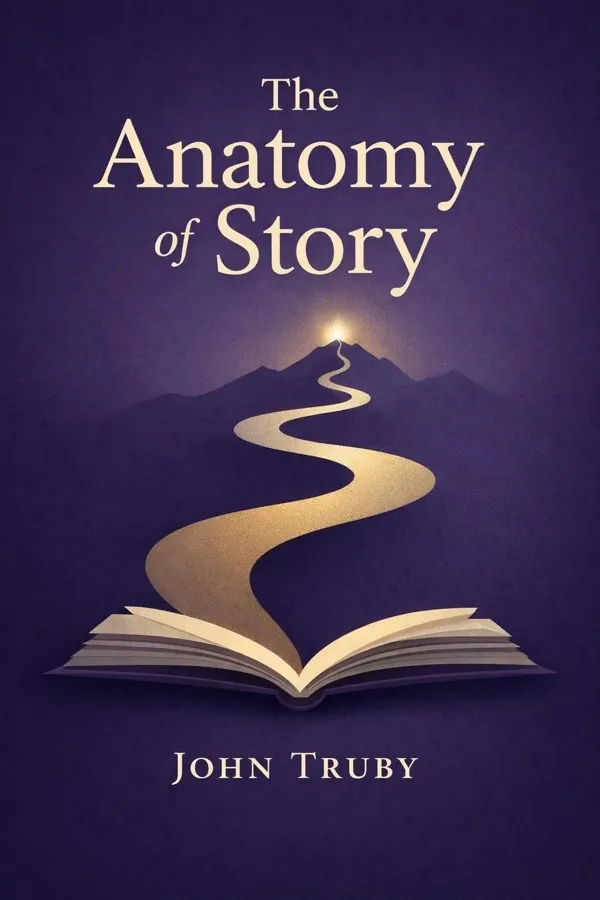
The Anatomy of Story: 22 Steps to Becoming a Master Storyteller: Summary & Key Insights
by John Truby
 10 min9 chaptersAudio available
Key Takeaways from The Anatomy of Story: 22 Steps to Becoming a Master Storyteller
A powerful story does not begin with events; it begins with a meaningful idea under pressure.
The audience follows plot because it cares about the person moving through it.
Every memorable story teaches something, even when it never sounds preachy.
A story world is never just a backdrop; it is the physical expression of the drama.
Plot is not a formula of numbered beats dropped onto any idea.
What Is The Anatomy of Story: 22 Steps to Becoming a Master Storyteller About?
The Anatomy of Story: 22 Steps to Becoming a Master Storyteller by John Truby is a writing book spanning 8 pages. The Anatomy of Story is John Truby’s deeply influential guide to building stories that feel alive from the inside out. Rather than treating storytelling as a rigid formula, Truby argues that great narratives grow organically from a central design: a character with a deep weakness, a pressing desire, a morally charged struggle, and a series of revelations that transform both plot and meaning. His famous 22-step framework helps writers connect premise, character, world, theme, and structure into one unified whole. What makes this book matter is its rejection of mechanical storytelling. Truby shows that audiences respond most strongly not to recycled plot beats, but to stories in which every element supports a larger emotional and moral journey. Drawing on examples from film, fiction, and drama, he explains how to create compelling opponents, symbolic worlds, resonant scenes, and endings that feel both surprising and inevitable. As a longtime story consultant for writers, filmmakers, and major studios, Truby brings unusual authority to the craft. This is not just a book about plotting better; it is a masterclass in designing stories that endure.
This FizzRead summary covers all 9 key chapters of The Anatomy of Story: 22 Steps to Becoming a Master Storyteller in approximately 10 minutes, distilling the most important ideas, arguments, and takeaways from John Truby's work. Also available as an audio summary and Key Quotes Podcast.
The Anatomy of Story: 22 Steps to Becoming a Master Storyteller
The Anatomy of Story is John Truby’s deeply influential guide to building stories that feel alive from the inside out. Rather than treating storytelling as a rigid formula, Truby argues that great narratives grow organically from a central design: a character with a deep weakness, a pressing desire, a morally charged struggle, and a series of revelations that transform both plot and meaning. His famous 22-step framework helps writers connect premise, character, world, theme, and structure into one unified whole.
What makes this book matter is its rejection of mechanical storytelling. Truby shows that audiences respond most strongly not to recycled plot beats, but to stories in which every element supports a larger emotional and moral journey. Drawing on examples from film, fiction, and drama, he explains how to create compelling opponents, symbolic worlds, resonant scenes, and endings that feel both surprising and inevitable.
As a longtime story consultant for writers, filmmakers, and major studios, Truby brings unusual authority to the craft. This is not just a book about plotting better; it is a masterclass in designing stories that endure.
Who Should Read The Anatomy of Story: 22 Steps to Becoming a Master Storyteller?
This book is perfect for anyone interested in writing and looking to gain actionable insights in a short read. Whether you're a student, professional, or lifelong learner, the key ideas from The Anatomy of Story: 22 Steps to Becoming a Master Storyteller by John Truby will help you think differently.
- ✓Readers who enjoy writing and want practical takeaways
- ✓Professionals looking to apply new ideas to their work and life
- ✓Anyone who wants the core insights of The Anatomy of Story: 22 Steps to Becoming a Master Storyteller in just 10 minutes
Want the full summary?
Get instant access to this book summary and 100K+ more with Fizz Moment.
Get Free SummaryAvailable on App Store • Free to download
Key Chapters
A powerful story does not begin with events; it begins with a meaningful idea under pressure. Truby argues that the premise is more than a catchy concept or marketable setup. It is the seed of the entire narrative, containing both the dramatic conflict and the moral problem the story will explore. If your premise is shallow, the story may produce movement but not meaning. If it is strong, every scene can grow naturally from it.
For Truby, the best premise includes a protagonist, a situation of conflict, and an implied moral tension. A revenge story, for example, becomes richer when it asks whether the pursuit of justice can corrupt the seeker. A romance becomes more compelling when it is not only about union, but about vulnerability, pride, or sacrifice. The writer’s task is to identify what human truth lies underneath the concept.
This matters because the premise acts like a compass. It guides decisions about character design, opponents, plot turns, and ending. If a story is about ambition destroying intimacy, then side plots, symbols, and reversals should all sharpen that conflict. Without this unity, stories often feel episodic or thematically confused.
In practice, Truby encourages writers to test a premise by asking: what is the protagonist’s central flaw, what moral choice will define the ending, and what fresh angle makes the story distinct? A detective story about solving a crime is ordinary. A detective story in which the investigator must confront his own addiction to control is potentially memorable.
Actionable takeaway: Write your premise in one sentence, then add the moral tension underneath it. If you cannot express what human conflict the story is truly examining, the premise is not ready yet.
The audience follows plot because it cares about the person moving through it. Truby’s central claim is that character is not separate from structure; character generates structure. A protagonist becomes compelling when three forces are clearly defined: desire, weakness, and need. Desire is what the character consciously wants. Weakness is the inner limitation that distorts behavior. Need is the deeper change required for the character to become whole.
This distinction is crucial. Many stories give protagonists strong goals but weak inner design. A character may want to win a case, escape a town, or defeat an enemy, but unless that external pursuit connects to a personal weakness, the story remains surface-level. The best narratives trap the protagonist in a conflict that exposes what is broken inside. A brilliant lawyer who craves victory may need humility. A lonely adventurer who seeks treasure may need trust. The external journey is gripping because it forces an internal reckoning.
Truby also stresses that weakness should not be cosmetic. It should be the very trait that creates the central problem. Pride, cowardice, selfishness, naivete, emotional repression, and moral blindness all generate action. Need, in turn, is not merely self-improvement. It is the difficult truth the character resists until the story makes avoidance impossible.
Writers can apply this by designing scenes that repeatedly pressure the weakness. If your protagonist fears intimacy, do not simply mention it in backstory; build confrontations in which openness would solve the problem, yet the character keeps choosing control or distance. That pattern creates emotional momentum.
Actionable takeaway: For your protagonist, define one clear desire, one core weakness, and one deeper need. Then make sure the plot forces a collision between all three.
Every memorable story teaches something, even when it never sounds preachy. Truby calls this the moral argument: the chain of actions through which the audience sees what way of living is better and what way is destructive. The moral argument is not a lecture delivered by the author. It is embedded in choices, consequences, and relationships. In strong storytelling, the plot itself becomes the proof.
This idea helps explain why some technically competent stories feel empty. They may have suspense, twists, and spectacle, but they never clarify what is truly at stake in human terms. A story becomes meaningful when the protagonist’s actions reveal a moral problem and the ending resolves that problem through earned change, failure, or tragic insight. If a hero begins by believing power brings respect, the story may demonstrate that love, honesty, or self-knowledge matters more. If a hero refuses that truth, tragedy follows.
Importantly, Truby does not recommend simplistic good-versus-evil themes. He prefers moral complexity. The opponent should often embody an alternative value system that is partly persuasive. This tension deepens the drama because the audience sees why the wrong path attracts the protagonist. In a political thriller, for example, security and freedom may both appear valid until events reveal the cost of choosing one without restraint.
Writers can strengthen the moral argument by tracking how each major character represents a variation on the same ethical question. A generous friend, a cynical rival, and an ambitious mentor can each mirror the protagonist’s possible future. This gives the story philosophical shape without sacrificing drama.
Actionable takeaway: State your story’s moral problem in a sentence beginning with “The protagonist must learn...” Then revise key scenes so the consequences of each choice make that lesson visible.
A story world is never just a backdrop; it is the physical expression of the drama. Truby emphasizes that setting should intensify the protagonist’s conflict and embody the story’s values. Great worlds are not random collections of details. They create pressure, reveal theme, and provide a visual or sensory language that gives the narrative depth. In this sense, world-building is not decoration. It is structural storytelling.
The most effective worlds have opposition built into them. A decaying mansion can mirror family rot. A rigid military academy can embody control, hierarchy, and suppressed emotion. A glittering city of opportunity may hide exploitation and loneliness. When the world reflects the protagonist’s inner state or moral challenge, scenes gain resonance before anyone speaks. The audience feels meaning through space.
Truby also highlights symbolism as a way to make the invisible visible. Symbols can be objects, landscapes, repeated actions, or patterns of movement. A locked garden may symbolize lost innocence. A bridge can represent transition or reconciliation. Water may suggest cleansing, danger, or emotional surrender depending on context. The key is consistency. Symbols should evolve as the protagonist changes.
For writers, this means asking whether every major location advances the dramatic design. If your story is about confinement, choose spaces that compress, surveil, or limit escape. If it is about ambition, build vertical worlds: towers, staircases, rooftops, high offices. In a family drama, the dinner table, hallway, and childhood bedroom may do more thematic work than elaborate exotic settings.
Actionable takeaway: List your three most important locations and write down what each symbolizes. If a setting does not heighten conflict or reinforce theme, redesign it so the world itself tells part of the story.
Plot is not a formula of numbered beats dropped onto any idea. Truby’s 22-step system is meant to show how stories grow organically from character and conflict. The steps track the protagonist’s movement from weakness through desire, opposition, plan, battle, self-revelation, and a new equilibrium. Unlike rigid templates, the steps are flexible. Their purpose is not to standardize stories, but to ensure that narrative events arise from deeper dramatic logic.
At the heart of the system is progression. The protagonist begins with a problem rooted in weakness. A desire sets the story in motion. Opponents block progress, forcing strategy and adaptation. Revelations change the character’s understanding of the situation. Pressure mounts toward a final battle where external victory and internal truth collide. Then comes self-revelation, moral decision, and the audience’s sense of what has changed.
What makes this framework valuable is that it connects plot turns to human transformation. A midpoint twist only matters if it challenges the hero’s assumptions. A final battle only matters if it tests whether the protagonist has truly changed. This keeps story movement from becoming empty escalation.
Writers can use the 22 steps as a diagnosis tool. If a draft feels flat, ask whether the opponent is strong enough, whether the plan becomes increasingly desperate, whether revelations truly reshape the conflict, and whether the ending forces a moral choice. Many weak stories fail not from lack of events, but from lack of progressive design.
Actionable takeaway: Outline your story using the 22-step sequence, but for each step ask one question: how does this moment force the protagonist to confront weakness, desire, or need? If it does none of the three, it probably needs revision.
Stories become richer when characters are designed as a web, not as isolated individuals. Truby argues that supporting characters should not exist merely to help or hinder the protagonist on cue. Each important character should represent a different response to the same core problem. In this way, relationships generate meaning. The story’s theme becomes visible through interaction, contrast, and conflict.
The opponent is especially important. Truby rejects the idea of a villain as a simple obstacle. The best opponent is often the person best equipped to exploit the hero’s weakness and challenge the hero’s worldview. A dishonest entrepreneur is more interesting when opposed by a rival who shares the same ambition but is more ruthless. A family caretaker becomes more compelling when paired with a sibling who exposes how control can masquerade as love. The opponent clarifies the protagonist.
Allies, mentors, love interests, and subplots should also serve the design. A mentor might model wisdom or embody the protagonist’s false ideal. A friend can reveal the cost of the hero’s flaw. A lover may offer what the hero needs emotionally, making the internal change concrete. Even minor characters can sharpen theme by presenting alternate outcomes.
This relational design helps writers avoid flat archetypes. Instead of asking, “What role does this character play in the plot?” Truby would ask, “What aspect of the moral argument does this character embody?” That shift creates ensembles with depth and tension.
Actionable takeaway: For each major supporting character, write one sentence answering: how does this person challenge, tempt, mirror, or complete the protagonist? If you cannot answer clearly, the character likely needs stronger design.
A story succeeds or fails moment by moment. Truby emphasizes that scenes are not filler between big plot points; they are the living units where character, conflict, and revelation take form. Every strong scene should have a clear objective, opposition, emotional turn, and new information. If nothing changes, the scene likely does not belong.
Dialogue, in Truby’s view, should never simply transmit facts. People speak in pursuit of desire. They conceal, provoke, defend, seduce, attack, and test. Great dialogue therefore contains subtext: what characters mean but do not fully say. A line becomes powerful when it carries competing layers of intention. “I’m happy for you” can express affection, envy, resignation, or threat depending on context.
Genre also affects scene design. In comedy, conflict often emerges from social embarrassment, status shifts, and escalating misunderstanding. In thriller, scenes may revolve around hidden danger, partial information, and tactical maneuvering. In drama, the emphasis may fall on emotional exposure and irreversible statements. Truby urges writers to understand genre conventions not as cages, but as opportunities to heighten pleasure for the audience while still serving the story’s unique design.
Practically, writers can improve scenes by asking: who wants what right now, who blocks it, what changes by the end, and what is left unsaid? If the answer is vague, the scene probably lacks dramatic spine. Often a scene becomes stronger by reducing explanation and increasing strategic interaction.
Actionable takeaway: Revise one important scene by identifying each character’s immediate desire and hidden agenda. Then cut any dialogue that explains what the audience can instead infer from conflict, silence, or reversal.
The strongest stories feel unified because every strand eventually converges. Truby shows that subplots, revelations, and endings should not function as separate tricks added late in the process. They should deepen the central moral and emotional movement. A subplot matters when it reflects, complicates, or contrasts the protagonist’s journey. A revelation matters when it changes how the audience understands both the plot and the character. The ending matters when all those lines fuse into one final statement.
Subplots are especially powerful when they broaden the story’s thematic range. A professional conflict can mirror a romantic one. A parent-child subplot can expose the roots of the protagonist’s weakness. A secondary character’s failure can foreshadow the hero’s possible future. Used well, subplots do not distract from the main line; they amplify it.
Revelations should also escalate in significance. Early revelations may change tactics. Later ones should alter identity, motive, or moral understanding. A detective learns who committed the crime; later he learns he helped create the conditions for it; finally he learns the case reflects his own corruption. This progression makes discovery transformative rather than merely informational.
By the climax, Truby wants all major elements to merge. The external battle, the internal self-revelation, and the moral decision should happen in close relationship. The audience should feel that the story could not end any other way, even if it remained unpredictable.
Actionable takeaway: Map your main plot and each subplot to the same central question. If a subplot does not intensify the protagonist’s weakness, need, or moral choice, either reshape it or remove it.
Originality in storytelling rarely means inventing a genre from scratch. More often, it means understanding what pleasure a genre promises and then fulfilling that promise in a fresh way. Truby treats genre as one of the writer’s most important strategic tools. Mystery offers the pleasure of discovery. Action provides excitement through force and pursuit. Horror externalizes fear. Love stories promise intimacy and transformation. The writer’s challenge is to use genre conventions consciously rather than copy them mechanically.
This matters because genre shapes audience expectation from the first pages or scenes. If you signal a thriller, readers expect danger, urgency, and strategic conflict. If you signal comedy, they expect social friction and surprising reversals. Problems arise when writers borrow the surface elements of a genre but ignore its emotional engine. A mystery without compelling revelation, or a romance without vulnerability, will feel hollow no matter how polished the prose.
Truby also encourages blending genres when it serves the premise. A crime story with family drama can gain emotional depth. A fantasy with political satire can become more intellectually sharp. But successful blending requires clarity. One genre may dominate while others enrich it, and all should support the same core moral design.
For writers, genre becomes a tool for invention when they ask not only “What happens?” but “What specific experience am I promising the audience?” That question leads to sharper choices in pacing, scene construction, stakes, and tone.
Actionable takeaway: Name your story’s primary genre and the main pleasure it should deliver. Then list three conventions of that genre and three ways you can twist or deepen them without betraying audience expectations.
All Chapters in The Anatomy of Story: 22 Steps to Becoming a Master Storyteller
About the Author
John Truby is an American screenwriter, director, and story consultant widely recognized for his influential work on narrative structure. Over several decades, he has taught story development to professional writers, filmmakers, producers, and creative teams in Hollywood and internationally. Truby is best known for his emphasis on organic storytelling, arguing that plot, character, theme, and world must function as an integrated whole rather than as separate checklists. His seminars and consulting work have helped shape scripts for major studios as well as independent projects, and his teaching has earned a strong following among novelists and screenwriters alike. Through The Anatomy of Story, he became one of the most respected modern voices in story theory, offering a rigorous yet practical method for crafting stories that are structurally sound and emotionally lasting.
Get This Summary in Your Preferred Format
Read or listen to the The Anatomy of Story: 22 Steps to Becoming a Master Storyteller summary by John Truby anytime, anywhere. FizzRead offers multiple formats so you can learn on your terms — all free.
Available formats: App · Audio · PDF · EPUB — All included free with FizzRead
Download The Anatomy of Story: 22 Steps to Becoming a Master Storyteller PDF and EPUB Summary
Key Quotes from The Anatomy of Story: 22 Steps to Becoming a Master Storyteller
“A powerful story does not begin with events; it begins with a meaningful idea under pressure.”
“The audience follows plot because it cares about the person moving through it.”
“Every memorable story teaches something, even when it never sounds preachy.”
“A story world is never just a backdrop; it is the physical expression of the drama.”
“Plot is not a formula of numbered beats dropped onto any idea.”
Frequently Asked Questions about The Anatomy of Story: 22 Steps to Becoming a Master Storyteller
The Anatomy of Story: 22 Steps to Becoming a Master Storyteller by John Truby is a writing book that explores key ideas across 9 chapters. The Anatomy of Story is John Truby’s deeply influential guide to building stories that feel alive from the inside out. Rather than treating storytelling as a rigid formula, Truby argues that great narratives grow organically from a central design: a character with a deep weakness, a pressing desire, a morally charged struggle, and a series of revelations that transform both plot and meaning. His famous 22-step framework helps writers connect premise, character, world, theme, and structure into one unified whole. What makes this book matter is its rejection of mechanical storytelling. Truby shows that audiences respond most strongly not to recycled plot beats, but to stories in which every element supports a larger emotional and moral journey. Drawing on examples from film, fiction, and drama, he explains how to create compelling opponents, symbolic worlds, resonant scenes, and endings that feel both surprising and inevitable. As a longtime story consultant for writers, filmmakers, and major studios, Truby brings unusual authority to the craft. This is not just a book about plotting better; it is a masterclass in designing stories that endure.
You Might Also Like
The Art of Perspective
Christopher Castellani
10 min
Making a Point: The Persnickety Story of English Punctuation
David Crystal
10 min
The Elements Of Eloquence: How To Turn The Perfect English Phrase
Mark Forsyth
10 min
The Pocket Muse: Ideas and Inspirations for Writing
Monica Wood
10 min
A Little Book on Form: An Exploration into the Formal Imagination of Poetry
Robert Hass
10 min
Adventures In The Screen Trade: A Personal View Of Hollywood And Screenwriting
William Goldman
10 minBrowse by Category
Ready to read The Anatomy of Story: 22 Steps to Becoming a Master Storyteller?
Get the full summary and 100K+ more books with Fizz Moment.