
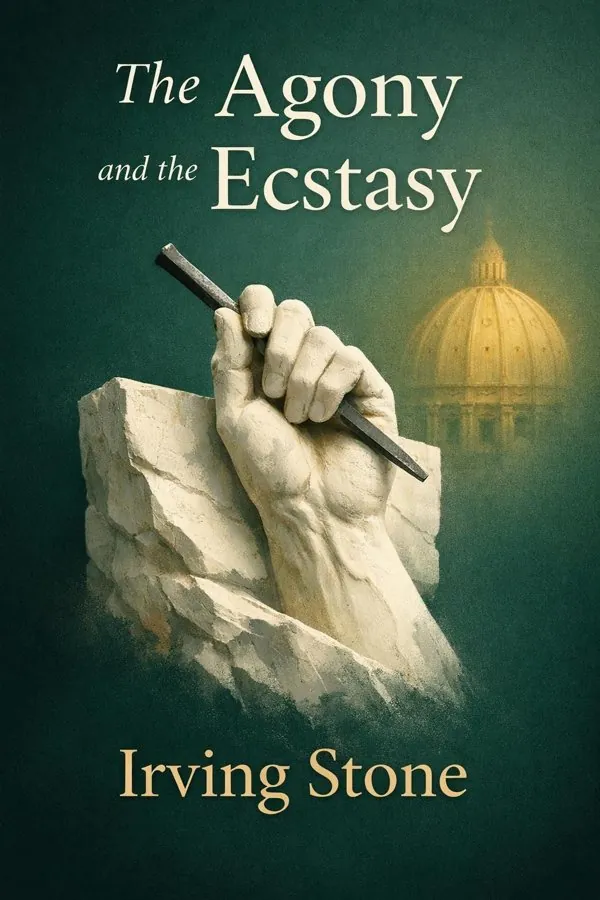
The Agony and the Ecstasy: A Biographical Novel of Michelangelo: Summary & Key Insights
by Irving Stone
 10 min9 chaptersAudio available
Key Takeaways from The Agony and the Ecstasy: A Biographical Novel of Michelangelo
Greatness rarely begins in glory; it begins in disciplined exposure to difficult work.
Creative freedom often depends on people who can limit it.
A masterpiece does more than display skill; it can embody the spirit of an entire people.
Competition is not always pleasant, but it often reveals who we are.
Some of the most important work of a life is never completed as first imagined.
What Is The Agony and the Ecstasy: A Biographical Novel of Michelangelo About?
The Agony and the Ecstasy: A Biographical Novel of Michelangelo by Irving Stone is a biographies book spanning 7 pages. Irving Stone’s The Agony and the Ecstasy transforms the life of Michelangelo Buonarroti into a sweeping, deeply human portrait of artistic obsession, spiritual struggle, and relentless discipline. More than a historical novel, it dramatizes the making of genius: the years of apprenticeship, the battles for patronage, the rivalries with other masters, the torment of unfinished commissions, and the physical and emotional cost of creating immortal art. Stone traces Michelangelo from his youth in Renaissance Florence to his work for powerful popes in Rome, showing how each sculpture, fresco, and architectural project emerged from conflict as much as inspiration. The book matters because it treats art not as a decorative luxury but as a force shaped by politics, faith, ambition, and sacrifice. Michelangelo appears not as a distant icon, but as a stubborn, vulnerable, fiercely principled worker determined to release truth from stone. Stone was uniquely suited to tell this story: famous for rigorously researched biographical novels, he combined historical detail with narrative energy, making the Renaissance vivid and immediate. The result is both a compelling novel and an illuminating meditation on what it costs to devote a life to greatness.
This FizzRead summary covers all 9 key chapters of The Agony and the Ecstasy: A Biographical Novel of Michelangelo in approximately 10 minutes, distilling the most important ideas, arguments, and takeaways from Irving Stone's work. Also available as an audio summary and Key Quotes Podcast.
The Agony and the Ecstasy: A Biographical Novel of Michelangelo
Irving Stone’s The Agony and the Ecstasy transforms the life of Michelangelo Buonarroti into a sweeping, deeply human portrait of artistic obsession, spiritual struggle, and relentless discipline. More than a historical novel, it dramatizes the making of genius: the years of apprenticeship, the battles for patronage, the rivalries with other masters, the torment of unfinished commissions, and the physical and emotional cost of creating immortal art. Stone traces Michelangelo from his youth in Renaissance Florence to his work for powerful popes in Rome, showing how each sculpture, fresco, and architectural project emerged from conflict as much as inspiration.
The book matters because it treats art not as a decorative luxury but as a force shaped by politics, faith, ambition, and sacrifice. Michelangelo appears not as a distant icon, but as a stubborn, vulnerable, fiercely principled worker determined to release truth from stone. Stone was uniquely suited to tell this story: famous for rigorously researched biographical novels, he combined historical detail with narrative energy, making the Renaissance vivid and immediate. The result is both a compelling novel and an illuminating meditation on what it costs to devote a life to greatness.
Who Should Read The Agony and the Ecstasy: A Biographical Novel of Michelangelo?
This book is perfect for anyone interested in biographies and looking to gain actionable insights in a short read. Whether you're a student, professional, or lifelong learner, the key ideas from The Agony and the Ecstasy: A Biographical Novel of Michelangelo by Irving Stone will help you think differently.
- ✓Readers who enjoy biographies and want practical takeaways
- ✓Professionals looking to apply new ideas to their work and life
- ✓Anyone who wants the core insights of The Agony and the Ecstasy: A Biographical Novel of Michelangelo in just 10 minutes
Want the full summary?
Get instant access to this book summary and 100K+ more with Fizz Moment.
Get Free SummaryAvailable on App Store • Free to download
Key Chapters
Greatness rarely begins in glory; it begins in disciplined exposure to difficult work. In The Agony and the Ecstasy, Michelangelo’s early life in Caprese and Florence is not romanticized as the predestined rise of a prodigy. Instead, Irving Stone shows a boy drawn toward form, craft, and beauty long before the world recognized him. His apprenticeship under Domenico Ghirlandaio and his immersion in the Medici circle give him something more valuable than comfort: direct contact with technique, classical ideals, intellectual debate, and serious expectations.
Stone makes clear that Michelangelo’s education is as much self-made as formally taught. He studies sculpture obsessively, learns by observing the body, and develops his taste in an environment where art is tied to philosophy and civic identity. Florence becomes more than a setting; it is a living school. Under Lorenzo de’ Medici’s patronage, Michelangelo encounters poets, humanists, and ancient statuary, all of which sharpen his sense that art should reveal inner truth, not merely imitate surface appearance.
This section matters because it challenges the myth that talent alone creates mastery. Michelangelo’s gifts are undeniable, but Stone emphasizes the structures that develop them: mentors, workshops, competition, and relentless practice. In modern terms, whether you are an artist, founder, writer, or craftsperson, the lesson is clear: put yourself where excellence is normal, not exceptional. Seek environments that stretch your standards, and treat your early years as a time to absorb methods, not chase applause.
Actionable takeaway: Identify the workshop, mentor, or community that can sharpen your craft, and commit to learning through disciplined repetition rather than waiting for inspiration.
Creative freedom often depends on people who can limit it. One of Stone’s sharpest insights is that Michelangelo’s career advances not in isolation but through uneasy dependence on patrons whose money, politics, and vanity shape the conditions of art. After Lorenzo de’ Medici’s death, the fragile stability that nurtured Michelangelo disappears, and with it goes the illusion that genius protects anyone from insecurity. He must navigate shifting alliances, unstable governments, and powerful men who want masterpieces on their own terms.
Stone presents patronage as both opportunity and trap. Without commissions, marble remains uncut and visions remain private. Yet every commission carries pressure: deadlines, changing demands, financial uncertainty, and the constant possibility of cancellation. Michelangelo’s struggle is not simply to be funded, but to preserve integrity while accepting dependence. He resists becoming a court ornament, even as he must work for rulers, church leaders, and political factions. His fierce independence, often interpreted as arrogance, emerges in the novel as a survival mechanism.
This dynamic remains relevant today. Many professionals work under versions of patronage: investors, clients, boards, audiences, or institutions. The challenge is not to avoid dependency altogether, which is rarely possible, but to develop a core standard that does not collapse under external pressure. Stone shows that Michelangelo succeeds because he negotiates from conviction. He may compromise on circumstances, but he fights to protect the quality and meaning of the work itself.
Actionable takeaway: Define your non-negotiables before entering any high-stakes collaboration, so that external support strengthens your work instead of quietly reshaping your values.
A masterpiece does more than display skill; it can embody the spirit of an entire people. Stone’s treatment of David shows Michelangelo at a crucial point in his development, where technical brilliance meets public meaning. The colossal statue is not just an artistic challenge carved from damaged marble. It becomes a symbol of Florence itself: defiant, intelligent, exposed to danger, yet unwilling to surrender. Michelangelo’s David is tense before action, not triumphant after it, and that distinction captures the psychology of a republic under pressure.
Stone highlights the extraordinary daring of this achievement. Michelangelo sees possibility where others see a flawed block abandoned by previous sculptors. He imagines form trapped inside imperfection and commits himself to releasing it. That act mirrors a larger theme of the novel: true creators do not wait for ideal conditions. They work with resistance, limitation, and inherited difficulty. David therefore represents more than biblical heroism; it demonstrates how vision can transform compromised material into enduring power.
The practical lesson extends beyond art. In leadership, strategy, and personal growth, there are many “damaged blocks” people dismiss as unusable: neglected projects, awkward careers, troubled institutions, or personal weaknesses. Michelangelo’s example suggests that excellence often begins with a reinterpretation of what others have already judged impossible. He also reminds us that meaningful work resonates most when it speaks to a larger human or communal need.
Actionable takeaway: Revisit one neglected challenge in your life or work and ask not, “Why is this flawed?” but, “What hidden possibility does this flaw contain if I approach it with greater vision and patience?”
Competition is not always pleasant, but it often reveals who we are. In Stone’s novel, Michelangelo’s rivalries, especially within the charged artistic world of Renaissance Italy, serve as catalysts for self-definition. Tensions with Leonardo da Vinci, friction with contemporaries, and recurring clashes with patrons and officials force Michelangelo to clarify his values. He is not content to be admired; he wants the work itself to stand beyond fashion, rhetoric, and courtly diplomacy.
Stone does not reduce rivalry to gossip or ego. Instead, he shows how competition can sharpen standards. Michelangelo is fiercely aware of other artists’ gifts, but he channels comparison into labor rather than imitation. He distrusts superficial elegance and prefers intensity, anatomical truth, spiritual force, and the rough honesty of struggle. His differences from Leonardo become symbolic: one embodies refinement and versatility, the other severity and total commitment. Rivalry, then, becomes a mirror through which Michelangelo sees his own artistic nature more clearly.
This idea has modern applications in any ambitious field. Healthy rivalry can expose complacency, reveal blind spots, and force deeper originality. The danger lies in becoming reactive, building your identity against others instead of through your own convictions. Stone suggests that Michelangelo’s greatness comes not from defeating rivals socially, but from using competition to intensify discipline.
For readers, the lesson is to stop fearing comparison while also refusing to be ruled by it. Notice who unsettles you professionally or creatively. The discomfort may point toward an undeveloped strength or an unclaimed standard within yourself.
Actionable takeaway: Identify one competitor or peer who challenges you, then translate envy or irritation into a concrete improvement plan centered on craft, not comparison.
Some of the most important work of a life is never completed as first imagined. Few episodes in The Agony and the Ecstasy better capture the frustration of ambition than Michelangelo’s long, painful struggle with the tomb of Pope Julius II. What begins as a monumental commission full of promise turns into decades of interruption, redesign, political conflict, and emotional exhaustion. Stone presents the tomb not merely as an art project, but as a symbol of the artist’s war against contingency itself.
Michelangelo pours imagination and effort into the original conception, only to find his plans repeatedly derailed by shifting papal priorities, financial constraints, court intrigues, and the instability of power. The tomb haunts him because it represents both his grandest sculptural aspirations and the humiliating reality that even genius cannot control circumstances. Yet Stone also shows that this prolonged ordeal deepens Michelangelo. It teaches persistence without closure and commitment without guarantee.
This is a profoundly practical lesson. Many people assume meaningful work will proceed linearly if they are talented and dedicated enough. The novel insists otherwise. Important endeavors are often delayed, distorted, or fragmented by forces outside personal control. Careers stall. Institutions change. Long-term projects mutate. What matters is not preserving the fantasy of a perfect plan, but maintaining devotion through revision.
Michelangelo’s response is not passive acceptance. He argues, resists, adapts, and returns to the work again and again. That combination of stubbornness and flexibility is what keeps the project alive, even in altered form.
Actionable takeaway: Choose one long-delayed project and redefine success around sustained progress and adaptive persistence rather than the original idealized version of completion.
People often discover their fullest powers in tasks they never wanted. Stone’s account of the Sistine Chapel ceiling is one of the book’s most compelling sections because it shows Michelangelo pressed into a commission he initially resists. He thinks of himself as a sculptor, not a fresco painter, and suspects political motives behind the assignment. Yet what begins in reluctance becomes one of history’s greatest artistic achievements, born from physical torment, technical experimentation, and uncompromising imagination.
Stone vividly conveys the agony behind the ecstasy: the scaffolding, the strained body, the damaged eyes, the repeated revisions, the loneliness of responsibility, and the burden of translating theology into visual form. But he also captures the breakthrough. Michelangelo does not merely decorate a ceiling; he builds a cosmos of creation, fall, prophecy, and human destiny. The work enlarges what art can do. It unites anatomy, narrative, faith, and architecture into one overwhelming vision.
The practical significance is immense. We often define ourselves too narrowly, clinging to existing strengths and resisting unfamiliar challenges. Michelangelo’s experience suggests that the work we avoid may contain our next level of mastery. Reluctance is not always a sign that something is wrong; sometimes it signals that the demand is large enough to transform us.
For creators and professionals alike, the Sistine episode illustrates the value of learning in public, building competence under pressure, and turning doubt into rigor. Michelangelo succeeds not because the assignment becomes easy, but because he grows equal to it through obsessive engagement.
Actionable takeaway: Accept one difficult responsibility outside your usual identity, then approach it as an opportunity to expand your range rather than defend your comfort zone.
The deepest conflicts in life are often internal, not external. Throughout Stone’s novel, Michelangelo is torn not only by patrons and politics but by questions of faith, sin, mortality, and the moral purpose of art. He is intensely religious without being serene. His spirituality is searching, restless, and often burdened by the fear that beauty itself may be inadequate before divine judgment. This tension gives the novel emotional depth: Michelangelo is not just making objects, he is trying to reconcile earthly form with eternal truth.
Stone portrays art as a spiritual discipline as much as a profession. Sculpture and painting become ways of approaching mystery, order, suffering, and redemption. Michelangelo’s fascination with the human body is not presented as mere sensuality, but as reverence for embodied creation. At the same time, his piety never simplifies his life. He remains prone to guilt, severity, and loneliness. Faith comforts him, but it also intensifies his standards.
This struggle resonates beyond religious contexts. Many readers wrestle with questions of purpose, legacy, and whether their work serves something larger than ambition. Stone suggests that meaningful creation often emerges from tension rather than certainty. You do not need complete inner peace to produce honest work; sometimes your unanswered questions become the very source of depth.
In practical terms, this invites a reassessment of how values shape effort. Rather than asking only whether you are successful, ask what your work is ultimately for. Utility, recognition, and income matter, but they do not fully satisfy the human desire for significance.
Actionable takeaway: Write a short personal statement explaining what larger purpose your work serves, and use it to guide decisions when ambition and meaning come into conflict.
Maturity often means moving from singular masterpieces to systems that outlast personal presence. In the later stages of Stone’s narrative, Michelangelo turns increasingly toward architecture, most notably his work connected with St. Peter’s Basilica. This shift is not a retreat from sculpture or painting, but an expansion of artistic consciousness. Architecture demands a broader imagination: one must shape space, movement, structure, and public experience across time and across generations.
Stone shows an aging Michelangelo still driven, still difficult, and still unwilling to settle for mediocrity. But he is also more visibly engaged with legacy. Sculpture can embody an idea in one block of stone; architecture orders human life itself. It requires collaboration, long planning horizons, and acceptance that others may finish what one begins. For a man so fiercely individualistic, this is both a challenge and a final discipline.
The lesson here is especially relevant for leaders, builders, and anyone moving from individual performance to institutional impact. Early in a career, success may come from personal brilliance. Later, the question becomes whether you can design structures that continue working when you are absent. Michelangelo’s architectural work reflects this transition from maker to shaper of environments.
Stone suggests that greatness ripens when personal ambition widens into stewardship. The mature creator does not only ask, “What can I make?” but, “What can I build that enables enduring beauty, order, and meaning for others?”
Actionable takeaway: Look beyond your immediate output and identify one system, structure, or process you can improve so your contribution endures beyond your direct involvement.
History remembers finished masterpieces, but Stone insists that legacy is built through unglamorous repetition, sacrifice, and unfinished striving. By the end of The Agony and the Ecstasy, Michelangelo stands as a towering figure of the Renaissance, yet the novel refuses to portray him as effortlessly monumental. His legacy is inseparable from fatigue, disappointment, isolation, and continual self-demand. This is one of the book’s most enduring achievements: it replaces the myth of effortless genius with the reality of disciplined devotion.
Stone’s Michelangelo leaves behind sculptures, frescoes, poems, and buildings, but also an example of total commitment to vocation. He does not wait for favorable moods, perfect patrons, or complete certainty. He works through grief, conflict, political upheaval, and bodily decline. Even his imperfections become part of his legacy, because they reveal the scale of the struggle required to pursue excellence across a lifetime.
For modern readers, this is liberating. We often imagine that truly gifted people operate with greater ease than the rest of us. Stone argues the opposite: greatness may require a greater willingness to endure difficulty. Legacy is less about public image than accumulated fidelity to meaningful work.
This perspective can reshape how we measure our own progress. Instead of obsessing over breakthrough moments, we can ask whether our daily habits align with the kind of life and contribution we hope to leave behind. Enduring impact usually grows slowly, under conditions that feel ordinary while we are living them.
Actionable takeaway: Create a simple weekly practice that honors your deepest craft or calling, and protect it consistently, because legacy is formed through repeated acts of faithfulness rather than occasional bursts of brilliance.
All Chapters in The Agony and the Ecstasy: A Biographical Novel of Michelangelo
About the Author
Irving Stone (1903–1989) was an American writer celebrated for popularizing the biographical novel. Known for combining meticulous historical research with dramatic storytelling, he brought major cultural figures to life for general readers. His best-known works include Lust for Life, about Vincent van Gogh, and The Agony and the Ecstasy, about Michelangelo, both of which helped establish his reputation for portraying artists as passionate, flawed, and deeply human. Stone often spent years researching his subjects, visiting locations, studying letters, and immersing himself in historical context before writing. His books stand out for making complex lives accessible without losing emotional intensity. Through his work, Stone introduced generations of readers to the struggles behind great achievement in art, politics, and literature.
Get This Summary in Your Preferred Format
Read or listen to the The Agony and the Ecstasy: A Biographical Novel of Michelangelo summary by Irving Stone anytime, anywhere. FizzRead offers multiple formats so you can learn on your terms — all free.
Available formats: App · Audio · PDF · EPUB — All included free with FizzRead
Download The Agony and the Ecstasy: A Biographical Novel of Michelangelo PDF and EPUB Summary
Key Quotes from The Agony and the Ecstasy: A Biographical Novel of Michelangelo
“Greatness rarely begins in glory; it begins in disciplined exposure to difficult work.”
“Creative freedom often depends on people who can limit it.”
“A masterpiece does more than display skill; it can embody the spirit of an entire people.”
“Competition is not always pleasant, but it often reveals who we are.”
“Some of the most important work of a life is never completed as first imagined.”
Frequently Asked Questions about The Agony and the Ecstasy: A Biographical Novel of Michelangelo
The Agony and the Ecstasy: A Biographical Novel of Michelangelo by Irving Stone is a biographies book that explores key ideas across 9 chapters. Irving Stone’s The Agony and the Ecstasy transforms the life of Michelangelo Buonarroti into a sweeping, deeply human portrait of artistic obsession, spiritual struggle, and relentless discipline. More than a historical novel, it dramatizes the making of genius: the years of apprenticeship, the battles for patronage, the rivalries with other masters, the torment of unfinished commissions, and the physical and emotional cost of creating immortal art. Stone traces Michelangelo from his youth in Renaissance Florence to his work for powerful popes in Rome, showing how each sculpture, fresco, and architectural project emerged from conflict as much as inspiration. The book matters because it treats art not as a decorative luxury but as a force shaped by politics, faith, ambition, and sacrifice. Michelangelo appears not as a distant icon, but as a stubborn, vulnerable, fiercely principled worker determined to release truth from stone. Stone was uniquely suited to tell this story: famous for rigorously researched biographical novels, he combined historical detail with narrative energy, making the Renaissance vivid and immediate. The result is both a compelling novel and an illuminating meditation on what it costs to devote a life to greatness.
You Might Also Like

An American Marriage
Tayari Jones
10 min
Benjamin Franklin: An American Life
Walter Isaacson
10 min
I Know Why The Caged Bird Sings
Maya Angelou
10 min
Long Walk to Freedom
Nelson Mandela
10 min
Persepolis
Marjane Satrapi
10 min
Surely You're Joking, Mr. Feynman!
Richard P. Feynman
10 minBrowse by Category
Ready to read The Agony and the Ecstasy: A Biographical Novel of Michelangelo?
Get the full summary and 100K+ more books with Fizz Moment.