
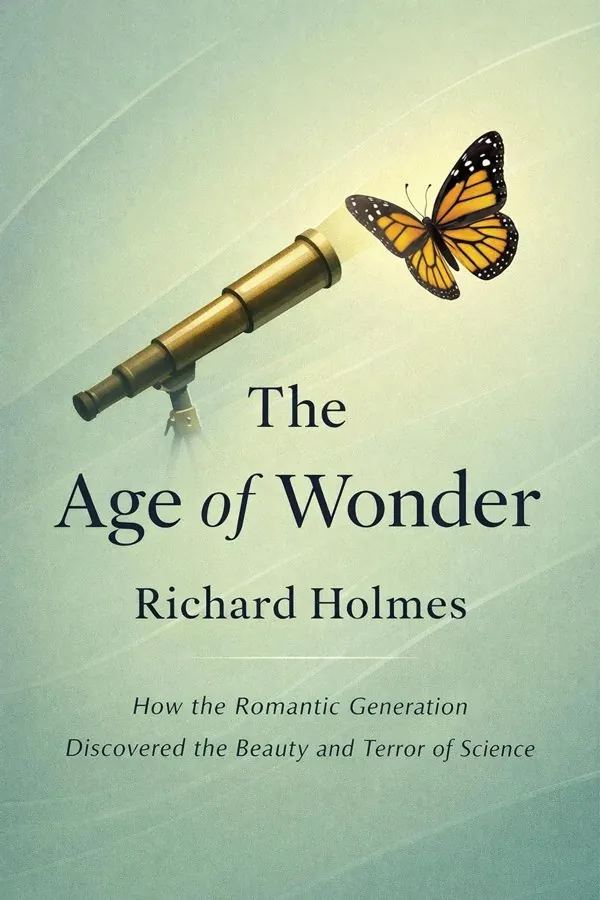
The Age of Wonder: How the Romantic Generation Discovered the Beauty and Terror of Science: Summary & Key Insights
 10 min9 chaptersAudio available
What Is The Age of Wonder: How the Romantic Generation Discovered the Beauty and Terror of Science About?
The Age of Wonder: How the Romantic Generation Discovered the Beauty and Terror of Science by Richard Holmes is a world_history book spanning 9 pages. The Age of Wonder explores the scientific ferment of the late eighteenth and early nineteenth centuries, when a generation of British scientists and poets shared a sense of awe and curiosity about the natural world. Richard Holmes traces the lives and discoveries of figures such as Joseph Banks, William Herschel, and Humphry Davy, showing how their work transformed both science and the imagination, bridging the Enlightenment and Romanticism.
This FizzRead summary covers all 9 key chapters of The Age of Wonder: How the Romantic Generation Discovered the Beauty and Terror of Science in approximately 10 minutes, distilling the most important ideas, arguments, and takeaways from Richard Holmes's work. Also available as an audio summary and Key Quotes Podcast.
The Age of Wonder: How the Romantic Generation Discovered the Beauty and Terror of Science
The Age of Wonder explores the scientific ferment of the late eighteenth and early nineteenth centuries, when a generation of British scientists and poets shared a sense of awe and curiosity about the natural world. Richard Holmes traces the lives and discoveries of figures such as Joseph Banks, William Herschel, and Humphry Davy, showing how their work transformed both science and the imagination, bridging the Enlightenment and Romanticism.
Who Should Read The Age of Wonder: How the Romantic Generation Discovered the Beauty and Terror of Science?
This book is perfect for anyone interested in world_history and looking to gain actionable insights in a short read. Whether you're a student, professional, or lifelong learner, the key ideas from The Age of Wonder: How the Romantic Generation Discovered the Beauty and Terror of Science by Richard Holmes will help you think differently.
- ✓Readers who enjoy world_history and want practical takeaways
- ✓Professionals looking to apply new ideas to their work and life
- ✓Anyone who wants the core insights of The Age of Wonder: How the Romantic Generation Discovered the Beauty and Terror of Science in just 10 minutes
Want the full summary?
Get instant access to this book summary and 100K+ more with Fizz Moment.
Get Free SummaryAvailable on App Store • Free to download
Key Chapters
When Joseph Banks first set sail with Captain Cook on the Endeavour in 1768, he carried not only instruments and notebooks but also a powerful sense of adventure. He embodied the figure of the 'gentleman naturalist' — a man for whom science was both exploration and self-expression. Their voyage to Tahiti and the South Seas was about cataloguing plants and animals, yet it also confronted them with the immensity of the Earth’s unknown places.
Through Banks’s eyes, we see how discovery expands not just the map but the mind. His encounters with the people of Tahiti, his collection of exotic specimens, and his reflections on nature’s abundance revealed science as a human pursuit, not merely a technical one. He was moved by beauty, astounded by diversity, and changed by experience.
This voyage created a model for Romantic science: passionate, empathetic, and imaginative. It showed that knowledge could arise from wonder, and that the pursuit of truth required both courage and sensitivity. Banks returned to Britain carrying seeds of scientific awakening — not just literal botanical specimens, but a new vision of human curiosity entwined with the larger world.
Years after his voyage, Banks rose to become the President of the Royal Society, and with that came a new phase of influence. He transformed the Society from a cluster of individuals into a network — a vibrant web connecting explorers, astronomers, and chemists across continents. Under his leadership, discovery became an institutional enterprise, yet the spirit of Romantic wonder persisted.
Banks believed organization did not diminish passion. He saw the Royal Society as a community bound by shared curiosity. Through his guidance, British science stretched outward: voyages were commissioned, telescopes funded, chemical labs established. He recognized that knowledge needed both freedom and structure, an interplay of imagination and collaboration.
What mattered most was connectivity — bringing together minds that otherwise would have remained isolated. In this sense, Banks curated an age of correspondence, where letters carried not only data but enthusiasm, encouragement, and the poetry of inquiry. Through him, the dream of discovery gained permanence, rooted in shared vision and institutional continuity.
+ 7 more chapters — available in the FizzRead app
All Chapters in The Age of Wonder: How the Romantic Generation Discovered the Beauty and Terror of Science
About the Author
Richard Holmes is a British biographer and historian known for his works on Romantic and scientific figures, including biographies of Samuel Taylor Coleridge and Percy Bysshe Shelley. His writing combines literary scholarship with narrative storytelling, illuminating the human side of discovery and creativity.
Get This Summary in Your Preferred Format
Read or listen to the The Age of Wonder: How the Romantic Generation Discovered the Beauty and Terror of Science summary by Richard Holmes anytime, anywhere. FizzRead offers multiple formats so you can learn on your terms — all free.
Available formats: App · Audio · PDF · EPUB — All included free with FizzRead
Download The Age of Wonder: How the Romantic Generation Discovered the Beauty and Terror of Science PDF and EPUB Summary
Key Quotes from The Age of Wonder: How the Romantic Generation Discovered the Beauty and Terror of Science
“When Joseph Banks first set sail with Captain Cook on the Endeavour in 1768, he carried not only instruments and notebooks but also a powerful sense of adventure.”
“Years after his voyage, Banks rose to become the President of the Royal Society, and with that came a new phase of influence.”
Frequently Asked Questions about The Age of Wonder: How the Romantic Generation Discovered the Beauty and Terror of Science
The Age of Wonder: How the Romantic Generation Discovered the Beauty and Terror of Science by Richard Holmes is a world_history book that explores key ideas across 9 chapters. The Age of Wonder explores the scientific ferment of the late eighteenth and early nineteenth centuries, when a generation of British scientists and poets shared a sense of awe and curiosity about the natural world. Richard Holmes traces the lives and discoveries of figures such as Joseph Banks, William Herschel, and Humphry Davy, showing how their work transformed both science and the imagination, bridging the Enlightenment and Romanticism.
More by Richard Holmes
You Might Also Like
The Age of Capital
Eric Hobsbawm
10 min
The Gulag Archipelago
Aleksandr Solzhenitsyn
10 min
Jerusalem: The Biography
Simon Sebag Montefiore
10 min
The Anglo-Saxons
James Campbell
10 min
The Boer War
Thomas Pakenham
10 min
The Industrial Revolutionaries: The Making of the Modern World 1776–1914
Gavin Weightman
10 minBrowse by Category
Ready to read The Age of Wonder: How the Romantic Generation Discovered the Beauty and Terror of Science?
Get the full summary and 100K+ more books with Fizz Moment.