
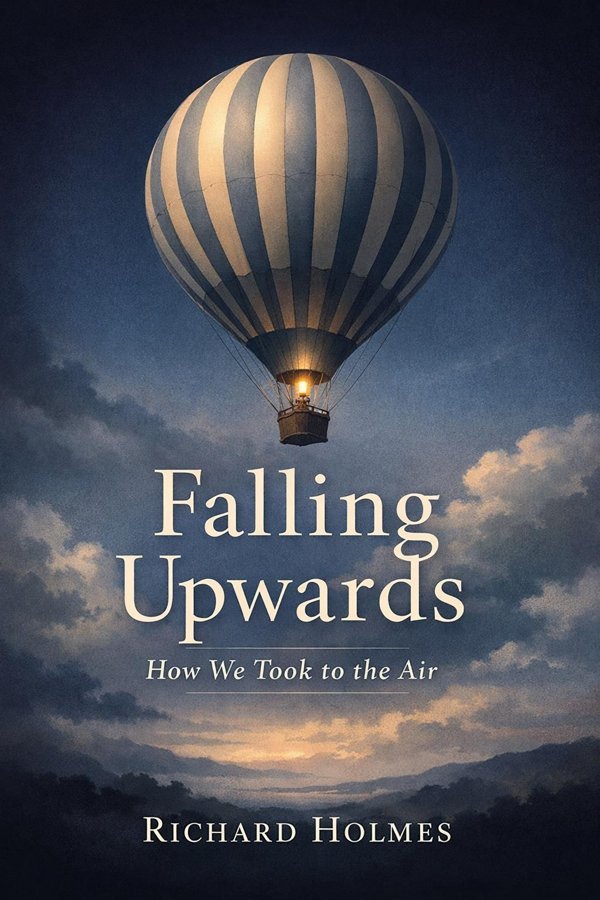
Falling Upwards: How We Took to the Air: Summary & Key Insights
 10 min8 chaptersAudio available
What Is Falling Upwards: How We Took to the Air About?
Falling Upwards: How We Took to the Air by Richard Holmes is a world_history book spanning 8 pages. Falling Upwards: How We Took to the Air is a historical and literary account of the golden age of ballooning. Richard Holmes explores how the first balloon flights, from the late eighteenth to the nineteenth century, transformed science, exploration, and human imagination. Through stories of adventurers, scientists, and dreamers, the book shows how the desire to fly changed our view of the world and the sky.
This FizzRead summary covers all 8 key chapters of Falling Upwards: How We Took to the Air in approximately 10 minutes, distilling the most important ideas, arguments, and takeaways from Richard Holmes's work. Also available as an audio summary and Key Quotes Podcast.
Falling Upwards: How We Took to the Air
Falling Upwards: How We Took to the Air is a historical and literary account of the golden age of ballooning. Richard Holmes explores how the first balloon flights, from the late eighteenth to the nineteenth century, transformed science, exploration, and human imagination. Through stories of adventurers, scientists, and dreamers, the book shows how the desire to fly changed our view of the world and the sky.
Who Should Read Falling Upwards: How We Took to the Air?
This book is perfect for anyone interested in world_history and looking to gain actionable insights in a short read. Whether you're a student, professional, or lifelong learner, the key ideas from Falling Upwards: How We Took to the Air by Richard Holmes will help you think differently.
- ✓Readers who enjoy world_history and want practical takeaways
- ✓Professionals looking to apply new ideas to their work and life
- ✓Anyone who wants the core insights of Falling Upwards: How We Took to the Air in just 10 minutes
Want the full summary?
Get instant access to this book summary and 100K+ more with Fizz Moment.
Get Free SummaryAvailable on App Store • Free to download
Key Chapters
Every great transformation begins with a small act of daring. For flight, that act belonged to Joseph and Étienne Montgolfier, two papermakers from a small French town who watched smoke rise from their fires and began to speculate whether that simple phenomenon could elevate a vessel—and a person—into the sky. When they first tested their balloon of linen and paper, heated by burning straw, the crowd was both exhilarated and terrified. It was June 1783, and history felt suspended between disbelief and awe.
Their experiments quickly outgrew the countryside and demanded a stage worthy of revolution. With royal patronage, they demonstrated their balloon’s ascent at Versailles, sending a sheep, a duck, and a rooster aloft before the astonished eyes of King Louis XVI and Marie Antoinette. Within months, human flight followed, and Paris declared it a miracle of science and spectacle. The Montgolfiers’ balloon became a symbol of illumination—the literal elevation of man through the fire of reason.
As I studied their papers and letters, I saw how their imagination was as critical as their engineering. They worked not from formulae but from intuition, from an almost mystical belief that air itself could carry us. Their creation united philosophy and experiment, placing them at the precise hinge between Enlightenment rationalism and Romantic wonder. They had no idea what dangers lay aloft, but they were willing to risk the unknown for the sake of discovery. That risk—beautiful and terrible—marked the dawn of our aerial age.
The age of ballooning was born in a crucible of intellectual fervor. The Enlightenment had already taught Europe to question gravity—literally and metaphorically. By the early 1780s, chemistry, physics, and meteorology were reshaping human understanding of nature’s invisible forces. Balloons became instruments for probing those mysteries: their ascent served both as demonstration and experiment. In France, scientists measured temperature, pressure, and atmospheric composition for the first time, revealing a layered sky that had never been imagined in detail.
But every ascent was also political. To float above one’s nation was to lay claim to its skies, a gesture that resonated deeply in revolutionary France. Balloons were paraded through streets and painted onto banners as emblems of liberation. They symbolized elevation—literally escaping the pull of an old order. The aristocrats, the scientists, and the people all saw something of their dreams reflected in those fragile globes.
I was struck, while reviewing revolutionary pamphlets and journals, by how ballooning stood as both science and spectacle. It required meticulous calculation, yet it depended on public enthusiasm. The Enlightenment’s promise—that reason could lift humanity—found physical expression in every ascent. Balloonists were citizens of two realms: empirical experimenters and dreamers of infinity. To write their history is to trace the moment when human intellect and imagination truly joined forces against gravity itself.
+ 6 more chapters — available in the FizzRead app
All Chapters in Falling Upwards: How We Took to the Air
About the Author
Richard Holmes is a British biographer and literary historian known for his works on Romantic figures such as Coleridge and Shelley. His style combines rigorous research with passionate narrative, and he has received multiple literary awards, including the Somerset Maugham Award and the Whitbread Prize.
Get This Summary in Your Preferred Format
Read or listen to the Falling Upwards: How We Took to the Air summary by Richard Holmes anytime, anywhere. FizzRead offers multiple formats so you can learn on your terms — all free.
Available formats: App · Audio · PDF · EPUB — All included free with FizzRead
Download Falling Upwards: How We Took to the Air PDF and EPUB Summary
Key Quotes from Falling Upwards: How We Took to the Air
“Every great transformation begins with a small act of daring.”
“The age of ballooning was born in a crucible of intellectual fervor.”
Frequently Asked Questions about Falling Upwards: How We Took to the Air
Falling Upwards: How We Took to the Air by Richard Holmes is a world_history book that explores key ideas across 8 chapters. Falling Upwards: How We Took to the Air is a historical and literary account of the golden age of ballooning. Richard Holmes explores how the first balloon flights, from the late eighteenth to the nineteenth century, transformed science, exploration, and human imagination. Through stories of adventurers, scientists, and dreamers, the book shows how the desire to fly changed our view of the world and the sky.
More by Richard Holmes
You Might Also Like
The Age of Capital
Eric Hobsbawm
10 min
The Gulag Archipelago
Aleksandr Solzhenitsyn
10 min
Jerusalem: The Biography
Simon Sebag Montefiore
10 min
The Anglo-Saxons
James Campbell
10 min
The Boer War
Thomas Pakenham
10 min
The Industrial Revolutionaries: The Making of the Modern World 1776–1914
Gavin Weightman
10 minBrowse by Category
Ready to read Falling Upwards: How We Took to the Air?
Get the full summary and 100K+ more books with Fizz Moment.