
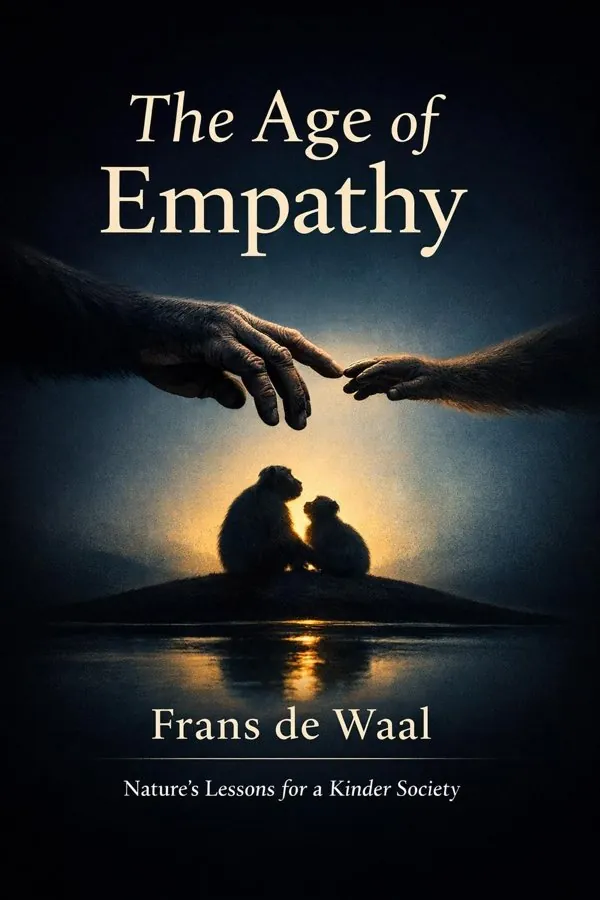
The Age of Empathy: Nature's Lessons for a Kinder Society: Summary & Key Insights
 10 min10 chaptersAudio available
What Is The Age of Empathy: Nature's Lessons for a Kinder Society About?
The Age of Empathy: Nature's Lessons for a Kinder Society by Frans de Waal is a popular_sci book spanning 10 pages. In this book, primatologist Frans de Waal explores the biological roots of empathy and cooperation, arguing that kindness and social connection are deeply ingrained in human and animal nature. Drawing on decades of research with primates, he demonstrates that empathy is not a cultural invention but an evolutionary trait that has shaped societies and moral behavior.
This FizzRead summary covers all 10 key chapters of The Age of Empathy: Nature's Lessons for a Kinder Society in approximately 10 minutes, distilling the most important ideas, arguments, and takeaways from Frans de Waal's work. Also available as an audio summary and Key Quotes Podcast.
The Age of Empathy: Nature's Lessons for a Kinder Society
In this book, primatologist Frans de Waal explores the biological roots of empathy and cooperation, arguing that kindness and social connection are deeply ingrained in human and animal nature. Drawing on decades of research with primates, he demonstrates that empathy is not a cultural invention but an evolutionary trait that has shaped societies and moral behavior.
Who Should Read The Age of Empathy: Nature's Lessons for a Kinder Society?
This book is perfect for anyone interested in popular_sci and looking to gain actionable insights in a short read. Whether you're a student, professional, or lifelong learner, the key ideas from The Age of Empathy: Nature's Lessons for a Kinder Society by Frans de Waal will help you think differently.
- ✓Readers who enjoy popular_sci and want practical takeaways
- ✓Professionals looking to apply new ideas to their work and life
- ✓Anyone who wants the core insights of The Age of Empathy: Nature's Lessons for a Kinder Society in just 10 minutes
Want the full summary?
Get instant access to this book summary and 100K+ more with Fizz Moment.
Get Free SummaryAvailable on App Store • Free to download
Key Chapters
Empathy begins with emotional contagion—the simplest form of shared feeling. If a baby cries and another baby starts crying too, we are witnessing the first spark of empathy. Among animals, such contagion is widespread. Rats freeze when their cage-mates receive shocks; elephants touch and trumpet around a suffering peer; primates run to comfort victims of aggression. These reactions are not learned—they are instinctive, deeply rooted in the emotional architecture of social species.
Over decades of studying primates, I came to realize that biological empathy emerges in stages. First comes mimicry—one individual responds to another’s emotion. Then comes concern—seeking proximity, touching or grooming the distressed one. Finally, in humans and some higher primates, emerges full perspective-taking: the ability to understand another’s situation and act according to that understanding. This progression is not a leap from instinct to intellect; it is a continuum along which social evolution unfolded.
Empathy has survival value. In social species, maintaining harmony and cohesion improves overall fitness. A group that tears itself apart in constant aggression will lose against one that settles disputes and protects the vulnerable. This is why the biological roots of empathy are not accidental—they are adaptive. Cooperation is every bit as natural as competition. And when we grasp that emotional responsiveness has evolved to serve life itself, we can stop viewing kindness as weakness.
+ 8 more chapters — available in the FizzRead app
All Chapters in The Age of Empathy: Nature's Lessons for a Kinder Society
About the Author
Frans de Waal is a Dutch-American primatologist and ethologist known for his pioneering work on the social intelligence and emotional lives of primates. He is a professor at Emory University and the author of several influential books on animal behavior and morality.
Get This Summary in Your Preferred Format
Read or listen to the The Age of Empathy: Nature's Lessons for a Kinder Society summary by Frans de Waal anytime, anywhere. FizzRead offers multiple formats so you can learn on your terms — all free.
Available formats: App · Audio · PDF · EPUB — All included free with FizzRead
Download The Age of Empathy: Nature's Lessons for a Kinder Society PDF and EPUB Summary
Key Quotes from The Age of Empathy: Nature's Lessons for a Kinder Society
“Empathy begins with emotional contagion—the simplest form of shared feeling.”
“Human culture often exalts self-interest, as though cooperation were a fragile afterthought.”
Frequently Asked Questions about The Age of Empathy: Nature's Lessons for a Kinder Society
The Age of Empathy: Nature's Lessons for a Kinder Society by Frans de Waal is a popular_sci book that explores key ideas across 10 chapters. In this book, primatologist Frans de Waal explores the biological roots of empathy and cooperation, arguing that kindness and social connection are deeply ingrained in human and animal nature. Drawing on decades of research with primates, he demonstrates that empathy is not a cultural invention but an evolutionary trait that has shaped societies and moral behavior.
More by Frans de Waal
You Might Also Like

Structures: Or Why Things Don"t Fall Down
J.E. Gordon
10 min
The Road to Wigan Pier
George Orwell
10 min
Bonk: The Curious Coupling of Science and Sex
Mary Roach
10 min
First Bite: How We Learn to Eat
Bee Wilson
10 min
In Pursuit Of The Unknown: 17 Equations That Changed The World
Ian Stewart
10 min
Napoleon's Buttons: 17 Molecules That Changed History
Penny Le Couteur and Jay Burreson
10 minBrowse by Category
Ready to read The Age of Empathy: Nature's Lessons for a Kinder Society?
Get the full summary and 100K+ more books with Fizz Moment.