
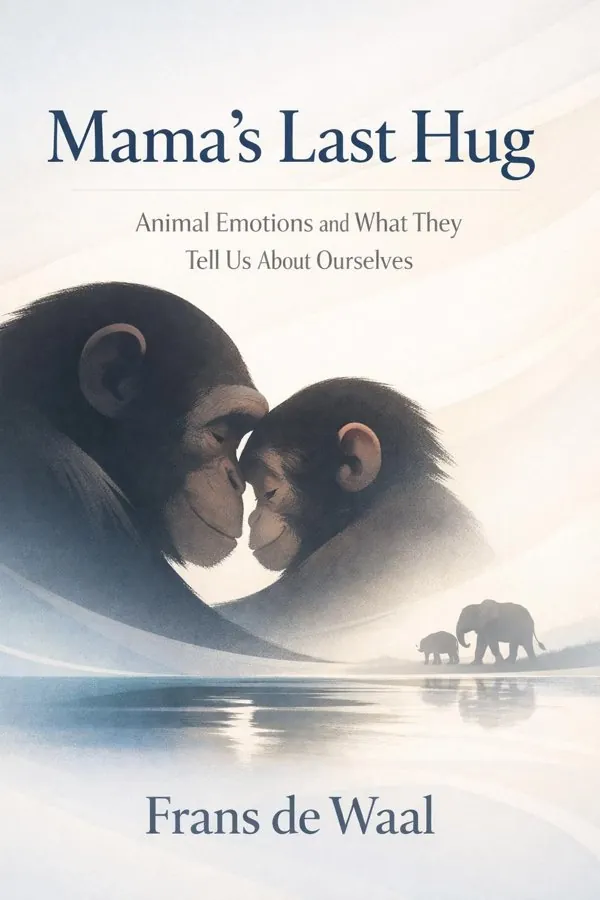
Mama’s Last Hug: Animal Emotions and What They Tell Us About Ourselves: Summary & Key Insights
 10 min8 chaptersAudio available
What Is Mama’s Last Hug: Animal Emotions and What They Tell Us About Ourselves About?
Mama’s Last Hug: Animal Emotions and What They Tell Us About Ourselves by Frans de Waal is a life_science book spanning 8 pages. In this groundbreaking work, primatologist Frans de Waal explores the rich emotional lives of animals, showing that emotions are not uniquely human but deeply rooted in our evolutionary past. Through vivid stories of chimpanzees, elephants, and other species, de Waal reveals how empathy, grief, and even moral behavior are shared across the animal kingdom, challenging our understanding of what it means to be human.
This FizzRead summary covers all 8 key chapters of Mama’s Last Hug: Animal Emotions and What They Tell Us About Ourselves in approximately 10 minutes, distilling the most important ideas, arguments, and takeaways from Frans de Waal's work. Also available as an audio summary and Key Quotes Podcast.
Mama’s Last Hug: Animal Emotions and What They Tell Us About Ourselves
In this groundbreaking work, primatologist Frans de Waal explores the rich emotional lives of animals, showing that emotions are not uniquely human but deeply rooted in our evolutionary past. Through vivid stories of chimpanzees, elephants, and other species, de Waal reveals how empathy, grief, and even moral behavior are shared across the animal kingdom, challenging our understanding of what it means to be human.
Who Should Read Mama’s Last Hug: Animal Emotions and What They Tell Us About Ourselves?
This book is perfect for anyone interested in life_science and looking to gain actionable insights in a short read. Whether you're a student, professional, or lifelong learner, the key ideas from Mama’s Last Hug: Animal Emotions and What They Tell Us About Ourselves by Frans de Waal will help you think differently.
- ✓Readers who enjoy life_science and want practical takeaways
- ✓Professionals looking to apply new ideas to their work and life
- ✓Anyone who wants the core insights of Mama’s Last Hug: Animal Emotions and What They Tell Us About Ourselves in just 10 minutes
Want the full summary?
Get instant access to this book summary and 100K+ more with Fizz Moment.
Get Free SummaryAvailable on App Store • Free to download
Key Chapters
Before we can explore the emotional lives of animals, we must be clear about what we mean by emotion. Too often, scientists have dismissed talk of animal feelings as anthropomorphic, as if recognizing emotion in animals were a sentimental projection. But this caution, while well-intentioned, has also blinded us to what is right before our eyes.
In this book, I distinguish between feelings and emotions. Feelings are private—subjective experiences we cannot measure directly. Emotions, however, leave traces in the body. They can be detected through facial expressions, neural responses, hormone levels, heart rates, and behaviors. When a chimpanzee’s hair stands on end, when an elephant trumpets in distress, or when a dog wags its tail at seeing its owner, we are observing emotional expressions that serve specific adaptive functions.
To recognize emotion in animals is not to project human traits onto them. It’s to appreciate the continuity of evolution. Just as bones and genes evolve, so too do brains and the emotional circuits within them. From reptiles to mammals, emotional mechanisms serve to regulate survival behaviors—fear to avoid danger, affection to maintain bonds, empathy to nurture young.
When we reduce emotions to mechanical reflexes or deny them altogether in animals, we impoverish our understanding of nature. My plea throughout this work is to bring empathy back into science, not as a sentimental indulgence, but as a tool for deeper comprehension. Because our emotional parallels with other species are not coincidences; they are evolutionary echoes of a shared past.
+ 6 more chapters — available in the FizzRead app
All Chapters in Mama’s Last Hug: Animal Emotions and What They Tell Us About Ourselves
About the Author
Frans de Waal is a Dutch-American primatologist and ethologist known for his pioneering research on the social intelligence and emotional lives of primates. He is a professor at Emory University and the author of several influential books on animal behavior and empathy.
Get This Summary in Your Preferred Format
Read or listen to the Mama’s Last Hug: Animal Emotions and What They Tell Us About Ourselves summary by Frans de Waal anytime, anywhere. FizzRead offers multiple formats so you can learn on your terms — all free.
Available formats: App · Audio · PDF · EPUB — All included free with FizzRead
Download Mama’s Last Hug: Animal Emotions and What They Tell Us About Ourselves PDF and EPUB Summary
Key Quotes from Mama’s Last Hug: Animal Emotions and What They Tell Us About Ourselves
“Before we can explore the emotional lives of animals, we must be clear about what we mean by emotion.”
“To understand emotion, we must look backward—to the long evolutionary history that shaped its function.”
Frequently Asked Questions about Mama’s Last Hug: Animal Emotions and What They Tell Us About Ourselves
Mama’s Last Hug: Animal Emotions and What They Tell Us About Ourselves by Frans de Waal is a life_science book that explores key ideas across 8 chapters. In this groundbreaking work, primatologist Frans de Waal explores the rich emotional lives of animals, showing that emotions are not uniquely human but deeply rooted in our evolutionary past. Through vivid stories of chimpanzees, elephants, and other species, de Waal reveals how empathy, grief, and even moral behavior are shared across the animal kingdom, challenging our understanding of what it means to be human.
More by Frans de Waal
You Might Also Like
The Selfish Gene
Richard Dawkins
10 min
Awakenings
Oliver Sacks
10 min
Parasite Rex: Inside the Bizarre World of Nature's Most Dangerous Creatures
Carl Zimmer
10 min
The Atlas of Life on Earth
Various
10 min
The Book of Humans: The Story of How We Became Us
Adam Rutherford
10 min
The Horse
Wendy Williams
10 minBrowse by Category
Ready to read Mama’s Last Hug: Animal Emotions and What They Tell Us About Ourselves?
Get the full summary and 100K+ more books with Fizz Moment.