
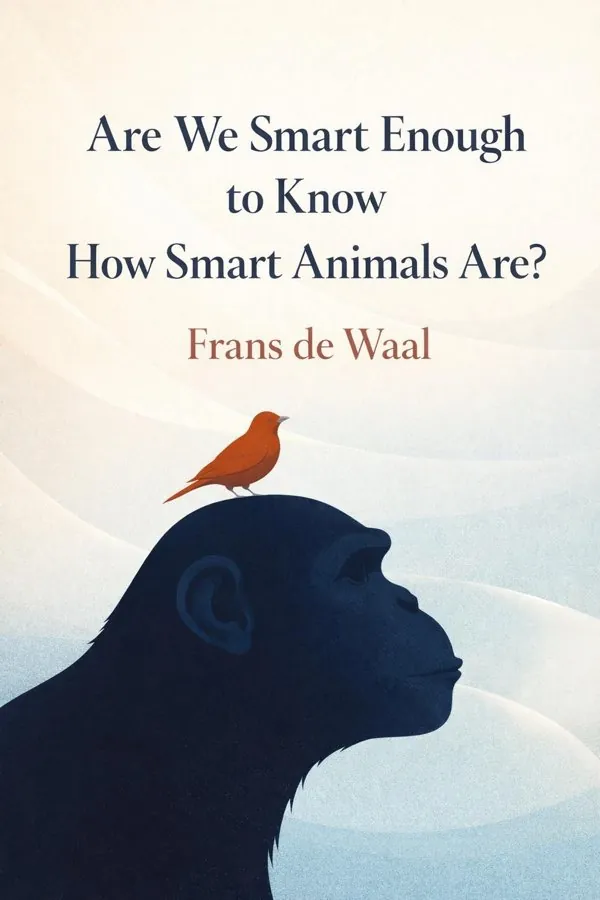
Are We Smart Enough to Know How Smart Animals Are?: Summary & Key Insights
 10 min10 chaptersAudio available
What Is Are We Smart Enough to Know How Smart Animals Are? About?
Are We Smart Enough to Know How Smart Animals Are? by Frans de Waal is a life_science book spanning 10 pages. In this groundbreaking work, primatologist Frans de Waal explores the intelligence of animals and challenges the long-held assumption that human cognition is the pinnacle of evolution. Drawing on decades of research with primates and other species, de Waal demonstrates that animals possess remarkable problem-solving abilities, empathy, and self-awareness. The book invites readers to reconsider what it means to be 'smart' and to appreciate the diverse forms of intelligence found throughout the animal kingdom.
This FizzRead summary covers all 10 key chapters of Are We Smart Enough to Know How Smart Animals Are? in approximately 10 minutes, distilling the most important ideas, arguments, and takeaways from Frans de Waal's work. Also available as an audio summary and Key Quotes Podcast.
Are We Smart Enough to Know How Smart Animals Are?
In this groundbreaking work, primatologist Frans de Waal explores the intelligence of animals and challenges the long-held assumption that human cognition is the pinnacle of evolution. Drawing on decades of research with primates and other species, de Waal demonstrates that animals possess remarkable problem-solving abilities, empathy, and self-awareness. The book invites readers to reconsider what it means to be 'smart' and to appreciate the diverse forms of intelligence found throughout the animal kingdom.
Who Should Read Are We Smart Enough to Know How Smart Animals Are??
This book is perfect for anyone interested in life_science and looking to gain actionable insights in a short read. Whether you're a student, professional, or lifelong learner, the key ideas from Are We Smart Enough to Know How Smart Animals Are? by Frans de Waal will help you think differently.
- ✓Readers who enjoy life_science and want practical takeaways
- ✓Professionals looking to apply new ideas to their work and life
- ✓Anyone who wants the core insights of Are We Smart Enough to Know How Smart Animals Are? in just 10 minutes
Want the full summary?
Get instant access to this book summary and 100K+ more with Fizz Moment.
Get Free SummaryAvailable on App Store • Free to download
Key Chapters
In the early decades of the twentieth century, psychology was dominated by behaviorism—the doctrine that animals were black boxes driven by stimulus and response, their inner lives off-limits to serious science. Figures like B. F. Skinner revolutionized experimental control, but at the cost of stripping animals of any mental life. They became mere automatons. Yet, those of us working closely with animals knew otherwise. Anyone who has watched a chimpanzee carefully stack boxes to reach a banana, or seen an octopus solve a puzzle, recognizes purposeful behavior that transcends mechanical conditioning.
The counter-movement came through ethology, led by pioneers such as Konrad Lorenz, Nikolaas Tinbergen, and Karl von Frisch. They restored context—observing animals where they live, in the ecological niches shaped by evolution. Ethology reawakened our ability to speak of perception, intention, and even emotion. Later, figures like Donald Griffin advocated for the study of animal consciousness itself, coining the term 'cognitive ethology.' The shift was monumental. We began to see cognition not as a human monopoly but as a spectrum—complex, multifaceted, species-specific.
Understanding this history is vital: every assumption about animal cognition is built atop decades of debate about what we are allowed to infer. By the time I entered the field, the question was no longer *if* animals think, but *how* they think, and *how we can know*.
As new tools emerged—video recordings, touch-screen tasks, statistical analyses—we could finally begin testing cognition across species. No longer constrained by the sterile boxes of behaviorism, we brought the lab to the field and the field to the lab. I’ve often said that animals reveal themselves best when their natural behaviors are respected. This insight fuels cognitive ethology: the direct study of how minds operate within the ecological and social environments that shaped them.
Chimpanzees using sticks to fish termites, scrub jays hiding food in strategic caches, or capuchins understanding fairness when denied equal treats—each of these observations opened new questions about perception, memory, and planning. These were not random acts; they were expressions of intelligence tuned to survival. The rise of cognitive ethology overturned our anthropocentric mindset. Instead of asking 'how human are animals?', we began asking 'how does this species make sense of its world?'. This change in question changed everything—it reframed intelligence as adaptation, not approximation.
+ 8 more chapters — available in the FizzRead app
All Chapters in Are We Smart Enough to Know How Smart Animals Are?
About the Author
Frans de Waal is a Dutch-American primatologist and ethologist known for his pioneering research on the social intelligence of primates. He is a professor at Emory University and the author of numerous influential books on animal behavior, empathy, and morality. His work has significantly shaped our understanding of the evolutionary roots of human behavior.
Get This Summary in Your Preferred Format
Read or listen to the Are We Smart Enough to Know How Smart Animals Are? summary by Frans de Waal anytime, anywhere. FizzRead offers multiple formats so you can learn on your terms — all free.
Available formats: App · Audio · PDF · EPUB — All included free with FizzRead
Download Are We Smart Enough to Know How Smart Animals Are? PDF and EPUB Summary
Key Quotes from Are We Smart Enough to Know How Smart Animals Are?
“As new tools emerged—video recordings, touch-screen tasks, statistical analyses—we could finally begin testing cognition across species.”
Frequently Asked Questions about Are We Smart Enough to Know How Smart Animals Are?
Are We Smart Enough to Know How Smart Animals Are? by Frans de Waal is a life_science book that explores key ideas across 10 chapters. In this groundbreaking work, primatologist Frans de Waal explores the intelligence of animals and challenges the long-held assumption that human cognition is the pinnacle of evolution. Drawing on decades of research with primates and other species, de Waal demonstrates that animals possess remarkable problem-solving abilities, empathy, and self-awareness. The book invites readers to reconsider what it means to be 'smart' and to appreciate the diverse forms of intelligence found throughout the animal kingdom.
More by Frans de Waal
You Might Also Like
The Selfish Gene
Richard Dawkins
10 min
Awakenings
Oliver Sacks
10 min
Parasite Rex: Inside the Bizarre World of Nature's Most Dangerous Creatures
Carl Zimmer
10 min
The Atlas of Life on Earth
Various
10 min
The Book of Humans: The Story of How We Became Us
Adam Rutherford
10 min
The Horse
Wendy Williams
10 minBrowse by Category
Ready to read Are We Smart Enough to Know How Smart Animals Are??
Get the full summary and 100K+ more books with Fizz Moment.