
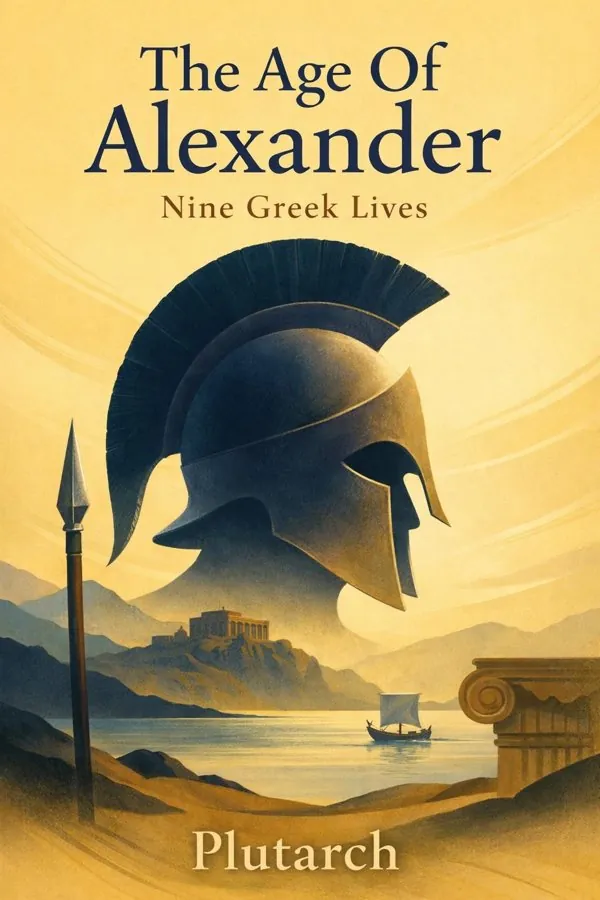
The Age Of Alexander: Nine Greek Lives: Summary & Key Insights
by Plutarch
 10 min9 chaptersAudio available
Key Takeaways from The Age Of Alexander: Nine Greek Lives
Discipline can build greatness, but when discipline hardens into narrowness, it can also trap a leader in old habits.
Political liberation rarely begins with systems; it begins with people willing to risk themselves for one another.
Ideas sound noble in exile; they become truly meaningful only when exposed to power.
A broken political community can recover, but only when leadership serves restoration rather than self-glorification.
Words can be a form of action when they awaken a people to dangers they would rather ignore.
What Is The Age Of Alexander: Nine Greek Lives About?
The Age Of Alexander: Nine Greek Lives by Plutarch is a world_history book spanning 9 pages. The Age Of Alexander: Nine Greek Lives brings together some of Plutarch’s most compelling biographies from the Greek world, tracing the political, moral, and military upheavals that shaped the age of Macedonian expansion and its aftermath. Rather than offering a straightforward chronological history, Plutarch studies nine remarkable individuals—Agesilaus, Pelopidas, Dion, Timoleon, Demosthenes, Phocion, Alexander, Eumenes, and Artaxerxes—to ask a deeper question: what kind of character creates greatness, and what kind destroys it? Through kings, generals, statesmen, and orators, the book examines ambition, integrity, courage, self-mastery, and the corrupting pressures of power. What makes this work endure is Plutarch’s distinctive method. He is less interested in military detail for its own sake than in the habits, choices, and moral temperament revealed through action. A witty remark, an act of restraint, or a moment of reckless pride may matter more than the outcome of a battle. Plutarch, a Greek intellectual and moral philosopher writing under Rome, had both historical distance and philosophical purpose. The result is a classic that reads as biography, political reflection, and ethical instruction all at once—an essential window into leadership and the human costs of power.
This FizzRead summary covers all 9 key chapters of The Age Of Alexander: Nine Greek Lives in approximately 10 minutes, distilling the most important ideas, arguments, and takeaways from Plutarch's work. Also available as an audio summary and Key Quotes Podcast.
The Age Of Alexander: Nine Greek Lives
The Age Of Alexander: Nine Greek Lives brings together some of Plutarch’s most compelling biographies from the Greek world, tracing the political, moral, and military upheavals that shaped the age of Macedonian expansion and its aftermath. Rather than offering a straightforward chronological history, Plutarch studies nine remarkable individuals—Agesilaus, Pelopidas, Dion, Timoleon, Demosthenes, Phocion, Alexander, Eumenes, and Artaxerxes—to ask a deeper question: what kind of character creates greatness, and what kind destroys it? Through kings, generals, statesmen, and orators, the book examines ambition, integrity, courage, self-mastery, and the corrupting pressures of power.
What makes this work endure is Plutarch’s distinctive method. He is less interested in military detail for its own sake than in the habits, choices, and moral temperament revealed through action. A witty remark, an act of restraint, or a moment of reckless pride may matter more than the outcome of a battle. Plutarch, a Greek intellectual and moral philosopher writing under Rome, had both historical distance and philosophical purpose. The result is a classic that reads as biography, political reflection, and ethical instruction all at once—an essential window into leadership and the human costs of power.
Who Should Read The Age Of Alexander: Nine Greek Lives?
This book is perfect for anyone interested in world_history and looking to gain actionable insights in a short read. Whether you're a student, professional, or lifelong learner, the key ideas from The Age Of Alexander: Nine Greek Lives by Plutarch will help you think differently.
- ✓Readers who enjoy world_history and want practical takeaways
- ✓Professionals looking to apply new ideas to their work and life
- ✓Anyone who wants the core insights of The Age Of Alexander: Nine Greek Lives in just 10 minutes
Want the full summary?
Get instant access to this book summary and 100K+ more with Fizz Moment.
Get Free SummaryAvailable on App Store • Free to download
Key Chapters
Discipline can build greatness, but when discipline hardens into narrowness, it can also trap a leader in old habits. That tension lies at the heart of Plutarch’s portrait of Agesilaus, the Spartan king who seems at first to embody every admired civic virtue: endurance, simplicity, courage, obedience to law, and devotion to his city. Raised in the austere Spartan system, Agesilaus learned to despise luxury and to prize action over display. Plutarch respects these qualities deeply, and he presents Agesilaus as a man of real ability and seriousness.
Yet the Life also shows the limits of the Spartan ideal. Agesilaus’s strengths are inseparable from his blind spots. His patriotism can become partiality; his toughness can turn into inflexibility; his devotion to Sparta can prevent him from seeing wider Greek interests. Plutarch suggests that a virtue, when pursued without balance, may become a vice in practice. Agesilaus is not ruined by softness or corruption but by the inability to adapt his values to changing political realities.
This makes the portrait surprisingly modern. In institutions today, leaders often rise because of traits that later become liabilities: decisiveness turns into stubbornness, loyalty into favoritism, frugality into pettiness. Agesilaus reminds us that admirable habits are not self-justifying. They must be judged by consequences as well as intentions.
Plutarch’s deeper lesson is that character is never simple. Even a disciplined and honorable life may fail if it lacks breadth of judgment. Great leadership requires more than consistency; it requires proportion, timing, and the humility to see when old models no longer fit new circumstances.
Actionable takeaway: examine your strongest trait and ask where, under pressure, it might become a weakness if left unbalanced.
Political liberation rarely begins with systems; it begins with people willing to risk themselves for one another. In Plutarch’s Life of Pelopidas, courage is inseparable from friendship, loyalty, and a shared sense of civic duty. Pelopidas emerges as a man of ardent action, bold enough to challenge Spartan domination of Thebes and warm-hearted enough to inspire trust. Alongside Epaminondas, he helps restore Theban independence, showing how personal bonds can become the foundation of public renewal.
Plutarch contrasts Pelopidas’s energetic temperament with the more reflective cast of his friend and ally. This balance matters. Pelopidas is brave not because he is reckless in the abstract, but because he channels his daring toward a common good. His willingness to act in dangerous circumstances helps catalyze collective resistance. Theban freedom, in Plutarch’s telling, is not only a military achievement but a moral one: it depends on citizens whose private loyalty strengthens public courage.
The practical force of this idea is clear. In modern organizations, communities, and political movements, trust often matters more than formal hierarchy. Teams hold together under pressure when people believe their colleagues will share risk rather than shift blame. Pelopidas shows that leadership is not merely command; it is mutual commitment made visible through action.
Plutarch also warns us that courage without prudence courts disaster. Pelopidas is admirable because his boldness serves liberation, yet the very intensity that makes him effective also makes him vulnerable. Heroism can win decisive moments, but enduring stability requires institutions capable of outliving heroic individuals.
Actionable takeaway: strengthen one important partnership in your life or work, because durable achievements often begin with loyal collaboration rather than solitary brilliance.
Ideas sound noble in exile; they become truly meaningful only when exposed to power. That is the challenge at the center of Plutarch’s Life of Dion. A student of philosophy and an associate of Plato, Dion enters politics believing that reason, education, and moral discipline can reform Syracuse. He opposes tyranny not merely because it is unjust, but because it deforms the soul of ruler and city alike. For Plutarch, Dion represents the rare statesman who tries to bring philosophical principles into public life.
But the Life is not a simple celebration of idealism. Dion’s struggle reveals how hard it is to convert wisdom into workable government. He has integrity, seriousness, and a genuine desire for justice, yet he can appear distant, proud, and politically awkward. He underestimates the emotional volatility of the people and the entrenched interests surrounding power. Plutarch shows that philosophy may elevate ambition, but it does not automatically supply flexibility, persuasion, or the ability to manage competing factions.
This is one of the book’s most enduring insights: moral seriousness alone is insufficient for political success. In contemporary terms, experts, reformers, and principled leaders often fail not because their goals are wrong, but because they cannot communicate, compromise, or build legitimacy. Dion’s fate illustrates the gap between being right in principle and being effective in practice.
Yet Plutarch does not dismiss philosophy. He suggests instead that public life needs thought disciplined by reality. Good intentions must be joined to patience, timing, and a realistic understanding of human motives. Philosophy remains necessary, but it must descend from abstraction into the rough terrain of institutions and personalities.
Actionable takeaway: before trying to reform a system, pair your ideals with a practical plan for trust-building, communication, and long-term execution.
A broken political community can recover, but only when leadership serves restoration rather than self-glorification. In Timoleon, Plutarch presents one of his clearest portraits of healing statesmanship. Timoleon enters Sicily at a moment of exhaustion: tyranny, civil conflict, and foreign pressure have worn down public life. His achievement lies not simply in defeating enemies, but in rebuilding conditions under which civic order, law, and confidence can return.
Plutarch admires Timoleon because he combines military effectiveness with unusual modesty. He acts decisively when force is required, yet he does not cling to power for its own sake. Instead, he helps restore functioning institutions and then recedes from domination. This restraint matters. In many Lives, victory becomes the prelude to arrogance or revenge. Timoleon stands out because he understands that the goal of politics is not the perpetual prominence of the liberator, but the flourishing of the city.
The portrait offers a practical lesson in post-crisis leadership. Whether in a company emerging from scandal, a community recovering from conflict, or a government after upheaval, the task is not merely to remove bad actors. It is to rebuild trust, norms, and structures that make stability possible. Timoleon succeeds because he is not intoxicated by his own necessity.
Plutarch also acknowledges the complexity of Timoleon’s moral life, especially the lingering burden of having acted against his own brother for political reasons. That shadow gives the Life depth. Renewal is often costly; public virtue can require painful sacrifices that are never entirely erased.
Actionable takeaway: when helping to fix a damaged institution, focus not on being seen as the savior but on leaving behind stronger rules, healthier culture, and less dependence on any one person.
Words can be a form of action when they awaken a people to dangers they would rather ignore. Plutarch’s Demosthenes is not merely an orator of technical brilliance; he is the voice of a threatened political freedom. Rising through effort rather than natural advantage, Demosthenes trains himself relentlessly, overcoming physical and rhetorical obstacles to become Athens’ most powerful public speaker. His speeches against Philip of Macedon express a larger theme in Plutarch: the difficulty of preserving liberty once comfort, hesitation, and self-interest have weakened civic resolve.
Demosthenes matters because he shows how leadership can operate through persuasion instead of command. He lacks the battlefield prestige of a general, yet he fights with arguments, warnings, and appeals to memory and honor. Plutarch admires the labor behind his eloquence. Great speech is not spontaneous magic; it is disciplined preparation directed toward public purpose.
At the same time, the Life carries a note of tragedy. Demosthenes can diagnose Athens’ weakness, but he cannot fully cure it. Insight does not guarantee victory. A society may applaud truth and still fail to act on it. This makes his story painfully relevant in any age when institutions perceive danger too late—whether in politics, business, or civic life.
For modern readers, Demosthenes offers a practical model of cultivated communication. Influence grows from preparation, moral clarity, and persistence, especially for those who begin without natural ease. But Plutarch also warns that rhetoric must connect with timely action; eloquence alone cannot save a passive community.
Actionable takeaway: if an issue matters, do the hard work to speak clearly and persuasively about it—then pair your words with concrete steps and coalition-building.
Sometimes the most radical public act is simply remaining honest when everyone else is bargaining away principle. In Phocion, Plutarch offers one of antiquity’s sharpest studies of integrity under political decay. Phocion is austere, plainspoken, and resistant to flattery. He cannot be bought, and he refuses to tailor his judgment to the crowd. In an Athens weakened by faction, demagoguery, and external pressure, his sobriety makes him both indispensable and deeply unpopular.
Plutarch values Phocion because he embodies the old idea that character should govern decision-making. He is cautious where others are impulsive, severe where others are theatrical, and loyal to the city even when the city treats him unjustly. Yet the Life is not simplistic. Integrity does not shield him from miscalculation, and prudence can look like passivity to those who crave bold gestures. Plutarch invites readers to wrestle with a difficult question: how should a decent person act in a political environment where every choice is compromised?
This is one of the book’s most mature lessons. Virtue in corrupt conditions rarely appears heroic. It may look slow, unpopular, or overly restrained. In workplaces and institutions today, ethical people are often criticized not because they are wrong, but because they refuse to play by the prevailing rules of vanity, panic, or convenience.
Phocion’s fate also reveals that public judgment is unstable. Crowds may turn on those who served them best. Moral seriousness therefore cannot depend on applause. It requires an internal standard stronger than reputation.
Actionable takeaway: decide in advance which principles you will not trade away under pressure, because integrity is hardest to invent in the moment of crisis.
The same force that lifts a person above ordinary limits can also drive him beyond the boundaries of justice and self-command. Plutarch’s Alexander is the clearest example of this tragic duality. He is dazzlingly gifted: courageous in battle, intellectually curious, charismatic, generous, and capable of inspiring devotion across vast distances. He does not merely inherit a kingdom; he imagines and enacts a world-transforming ambition. For Plutarch, Alexander’s greatness is real, not a literary exaggeration.
Yet the Life never lets admiration become worship. Alexander’s energy is shadowed by anger, pride, excess, and a growing inability to restrain himself. Success magnifies flaws as much as strengths. As victories accumulate, so do signs of moral deterioration: suspicion deepens, flatterers gain influence, and personal impulses increasingly shape public decisions. Plutarch is especially interested in how power alters character from within. Conquest is not only an outward expansion of empire; it is a test of whether the ruler can govern himself.
This portrait remains compelling because it captures a universal pattern. High performers in any field—politics, business, the arts—may be propelled by ambition, confidence, and intensity. Those same traits, unchecked, can become cruelty, vanity, and isolation. Plutarch asks us not simply to admire achievement, but to examine its human cost.
Alexander’s enduring fascination lies in this contradiction: he is both heroic and dangerous, civilizing and destructive, magnanimous and impulsive. Plutarch refuses to reduce him to one moral label. Greatness, in this account, is inseparable from the burden of self-mastery.
Actionable takeaway: when success increases your influence, increase your practices of restraint, honest feedback, and reflection even more deliberately.
When institutions collapse, loyalty becomes both more valuable and more ambiguous. Plutarch’s Eumenes lives in the chaotic aftermath of Alexander’s death, when the empire splinters and former allies become rivals. Unlike many of the Macedonian commanders around him, Eumenes is not bound by the same ethnic or aristocratic ties; he is an outsider of exceptional intelligence, administrative skill, and strategic ability. This position makes his career precarious but also revealing. He must rely on merit, adaptability, and an unusual steadiness of purpose.
Plutarch emphasizes Eumenes’s fidelity to the royal cause, yet that loyalty operates in a world where legitimacy itself is contested. He serves an ideal of order amid accelerating fragmentation. The tragedy of his situation is that virtue does not simplify politics. Eumenes may be honorable and capable, but he is surrounded by opportunists, shifting alliances, and soldiers whose allegiance depends on immediate advantage. In such a world, character matters greatly—but it does not guarantee security.
Modern readers can recognize this problem in moments of organizational upheaval, succession battles, or institutional transition. During uncertainty, talented outsiders often carry the burden of preserving standards while lacking the informal networks that protect insiders. Eumenes shows both the dignity and the danger of principled service in a fractured system.
Plutarch’s deeper point is subtle: loyalty must be thoughtful, not naive. One can serve a legitimate cause and still be undone by the instability of the environment. The challenge is to hold fast without becoming blind to changing realities.
Actionable takeaway: in uncertain times, clarify what you are loyal to—a person, a mission, or a principle—and build alliances strong enough to support that loyalty in practice.
Monarchy is never only about power; it is also about the character required to hold together a court, a family, and an empire. In Artaxerxes, Plutarch turns from Greek civic life to Persian kingship, widening the book’s moral and political range. Artaxerxes is presented as a ruler operating within a world of palace rivalry, dynastic suspicion, ceremonial grandeur, and immense administrative complexity. The result is not a simple contrast between Greek freedom and eastern despotism, but a nuanced study of what rule looks like when authority is concentrated in one person.
Plutarch is attentive to the king’s personal qualities—clemency, patience, weakness, vanity, prudence—and to how these traits shape the regime. Court politics magnify everything. Family conflict becomes public danger; private indulgence becomes imperial instability. Artaxerxes’s story reveals that a monarchy depends less on abstract majesty than on the ruler’s ability to manage competing ambitions without being consumed by them.
This Life serves as a mirror for leadership more generally. Executives, founders, political heads, and public figures often occupy environments where information is filtered, flattery is common, and personal relationships distort institutional judgment. Artaxerxes shows how difficult it is to remain balanced under such conditions. Power isolates, and isolation invites manipulation.
Plutarch’s treatment is valuable because it resists caricature. He neither idealizes nor demonizes kingship outright. Instead, he studies the moral strain built into concentrated authority. The ruler’s inner life becomes a public issue because so much depends on it.
Actionable takeaway: if you hold concentrated authority, create structures that counter flattery, expose you to honest advice, and separate personal emotion from institutional decision-making.
All Chapters in The Age Of Alexander: Nine Greek Lives
About the Author
Plutarch (c. 46-120 CE) was a Greek writer, philosopher, priest, and moralist born in Chaeronea in Boeotia. Educated in philosophy and deeply engaged in public and religious life, he wrote during the early Roman Empire while remaining profoundly attached to Greek culture and ethical thought. He is best known for Parallel Lives, his series of biographies comparing Greek and Roman statesmen, generals, and lawgivers, and for the Moralia, a large collection of essays on virtue, politics, religion, and daily conduct. Plutarch’s distinctive gift was to combine historical storytelling with moral reflection, using individual lives to explore character, leadership, and the uses of power. His works shaped Western biography for centuries and influenced readers from Renaissance humanists to modern historians.
Get This Summary in Your Preferred Format
Read or listen to the The Age Of Alexander: Nine Greek Lives summary by Plutarch anytime, anywhere. FizzRead offers multiple formats so you can learn on your terms — all free.
Available formats: App · Audio · PDF · EPUB — All included free with FizzRead
Download The Age Of Alexander: Nine Greek Lives PDF and EPUB Summary
Key Quotes from The Age Of Alexander: Nine Greek Lives
“Discipline can build greatness, but when discipline hardens into narrowness, it can also trap a leader in old habits.”
“Political liberation rarely begins with systems; it begins with people willing to risk themselves for one another.”
“Ideas sound noble in exile; they become truly meaningful only when exposed to power.”
“A broken political community can recover, but only when leadership serves restoration rather than self-glorification.”
“Words can be a form of action when they awaken a people to dangers they would rather ignore.”
Frequently Asked Questions about The Age Of Alexander: Nine Greek Lives
The Age Of Alexander: Nine Greek Lives by Plutarch is a world_history book that explores key ideas across 9 chapters. The Age Of Alexander: Nine Greek Lives brings together some of Plutarch’s most compelling biographies from the Greek world, tracing the political, moral, and military upheavals that shaped the age of Macedonian expansion and its aftermath. Rather than offering a straightforward chronological history, Plutarch studies nine remarkable individuals—Agesilaus, Pelopidas, Dion, Timoleon, Demosthenes, Phocion, Alexander, Eumenes, and Artaxerxes—to ask a deeper question: what kind of character creates greatness, and what kind destroys it? Through kings, generals, statesmen, and orators, the book examines ambition, integrity, courage, self-mastery, and the corrupting pressures of power. What makes this work endure is Plutarch’s distinctive method. He is less interested in military detail for its own sake than in the habits, choices, and moral temperament revealed through action. A witty remark, an act of restraint, or a moment of reckless pride may matter more than the outcome of a battle. Plutarch, a Greek intellectual and moral philosopher writing under Rome, had both historical distance and philosophical purpose. The result is a classic that reads as biography, political reflection, and ethical instruction all at once—an essential window into leadership and the human costs of power.
You Might Also Like
The Age of Capital
Eric Hobsbawm
10 min
The Gulag Archipelago
Aleksandr Solzhenitsyn
10 min
Jerusalem: The Biography
Simon Sebag Montefiore
10 min
The Anglo-Saxons
James Campbell
10 min
The Boer War
Thomas Pakenham
10 min
The Industrial Revolutionaries: The Making of the Modern World 1776–1914
Gavin Weightman
10 minBrowse by Category
Ready to read The Age Of Alexander: Nine Greek Lives?
Get the full summary and 100K+ more books with Fizz Moment.