
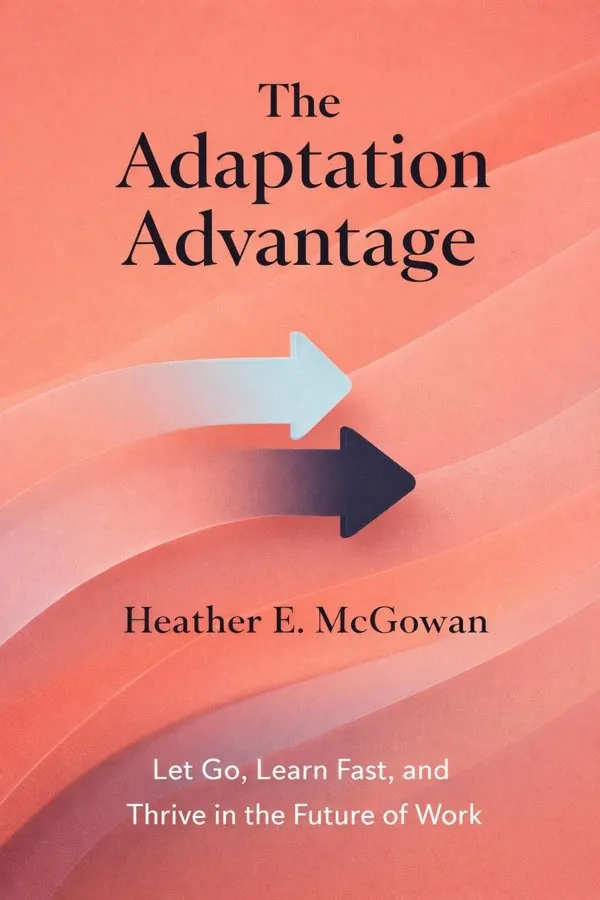
The Adaptation Advantage: Let Go, Learn Fast, and Thrive in the Future of Work: Summary & Key Insights
 10 min8 chaptersAudio available
What Is The Adaptation Advantage: Let Go, Learn Fast, and Thrive in the Future of Work About?
The Adaptation Advantage: Let Go, Learn Fast, and Thrive in the Future of Work by Heather E. McGowan is a future_trends book spanning 8 pages. The Adaptation Advantage explores how individuals and organizations can thrive amid rapid technological and societal change by embracing adaptability as the key skill for the future of work. Heather E. McGowan and co-author Chris Shipley argue that success in the modern economy depends less on what we know and more on how quickly we can learn, unlearn, and relearn. The book provides frameworks for cultivating resilience, curiosity, and continuous learning to stay relevant in an era of automation and disruption.
This FizzRead summary covers all 8 key chapters of The Adaptation Advantage: Let Go, Learn Fast, and Thrive in the Future of Work in approximately 10 minutes, distilling the most important ideas, arguments, and takeaways from Heather E. McGowan's work. Also available as an audio summary and Key Quotes Podcast.
The Adaptation Advantage: Let Go, Learn Fast, and Thrive in the Future of Work
The Adaptation Advantage explores how individuals and organizations can thrive amid rapid technological and societal change by embracing adaptability as the key skill for the future of work. Heather E. McGowan and co-author Chris Shipley argue that success in the modern economy depends less on what we know and more on how quickly we can learn, unlearn, and relearn. The book provides frameworks for cultivating resilience, curiosity, and continuous learning to stay relevant in an era of automation and disruption.
Who Should Read The Adaptation Advantage: Let Go, Learn Fast, and Thrive in the Future of Work?
This book is perfect for anyone interested in future_trends and looking to gain actionable insights in a short read. Whether you're a student, professional, or lifelong learner, the key ideas from The Adaptation Advantage: Let Go, Learn Fast, and Thrive in the Future of Work by Heather E. McGowan will help you think differently.
- ✓Readers who enjoy future_trends and want practical takeaways
- ✓Professionals looking to apply new ideas to their work and life
- ✓Anyone who wants the core insights of The Adaptation Advantage: Let Go, Learn Fast, and Thrive in the Future of Work in just 10 minutes
Want the full summary?
Get instant access to this book summary and 100K+ more with Fizz Moment.
Get Free SummaryAvailable on App Store • Free to download
Key Chapters
For centuries, education prepared people to perform predictable jobs. Knowledge was the scarce resource; learning was front-loaded into youth and applied for the rest of one’s career. But the world no longer rewards what you already know; it rewards how quickly you can learn something new. The collapse of the knowledge economy into a learning economy is the defining shift of our time.
We have entered an age where information is abundant but context and discernment are scarce. Machines can now memorize, calculate, and even simulate reasoning faster than humans. What remains uniquely human is our capacity to synthesize ideas, connect dots, and adapt behavior in unfamiliar circumstances. The implication is profound: education itself must become continuous, not a single event but a lifelong loop of learning, applying, and relearning.
As I explain in the book, society’s model of value creation used to look like this: *learn → do → retire.* Now, it’s *learn → do → unlearn → relearn → repeat.* The burden of learning has shifted from institutions to individuals, and organizations must reinvent themselves as platforms that enable this ongoing transformation. When we build our sense of identity around being learners rather than experts, we become antifragile—able not only to survive disruption but to thrive within it.
Automation, artificial intelligence, and machine learning have absorbed the repetitive and analytical aspects of work that humans once performed. As I have observed, what’s left—the domain of genuine human value—resides in our emotional and creative capacities. Empathy, curiosity, intuition, moral reasoning, and storytelling are the differentiators that machines cannot replicate. The irony of the digital revolution is that it has made us more aware of what makes us human.
In *The Adaptation Advantage*, I describe this as the rehumanization of work. When technology assumes routine tasks, we reclaim the power to imagine, connect, and innovate. Yet, this shift also compels us to cultivate new literacies: emotional literacy, entrepreneurial thinking, and systems awareness. These are not soft skills—they are power skills, enabling adaptability through relationships and imagination.
For organizations, this means rethinking value measurement. Instead of optimizing for efficiency, we must design for creativity, inclusion, and resilience. The new human value proposition, then, is not about working harder but about contributing more meaningfully, drawing from empathy as our competitive advantage.
+ 6 more chapters — available in the FizzRead app
All Chapters in The Adaptation Advantage: Let Go, Learn Fast, and Thrive in the Future of Work
About the Author
Heather E. McGowan is a future-of-work strategist, keynote speaker, and author known for her insights on workforce transformation and adaptability. She advises leaders and organizations on how to prepare for the evolving nature of work and learning in the digital age.
Get This Summary in Your Preferred Format
Read or listen to the The Adaptation Advantage: Let Go, Learn Fast, and Thrive in the Future of Work summary by Heather E. McGowan anytime, anywhere. FizzRead offers multiple formats so you can learn on your terms — all free.
Available formats: App · Audio · PDF · EPUB — All included free with FizzRead
Download The Adaptation Advantage: Let Go, Learn Fast, and Thrive in the Future of Work PDF and EPUB Summary
Key Quotes from The Adaptation Advantage: Let Go, Learn Fast, and Thrive in the Future of Work
“For centuries, education prepared people to perform predictable jobs.”
“Automation, artificial intelligence, and machine learning have absorbed the repetitive and analytical aspects of work that humans once performed.”
Frequently Asked Questions about The Adaptation Advantage: Let Go, Learn Fast, and Thrive in the Future of Work
The Adaptation Advantage: Let Go, Learn Fast, and Thrive in the Future of Work by Heather E. McGowan is a future_trends book that explores key ideas across 8 chapters. The Adaptation Advantage explores how individuals and organizations can thrive amid rapid technological and societal change by embracing adaptability as the key skill for the future of work. Heather E. McGowan and co-author Chris Shipley argue that success in the modern economy depends less on what we know and more on how quickly we can learn, unlearn, and relearn. The book provides frameworks for cultivating resilience, curiosity, and continuous learning to stay relevant in an era of automation and disruption.
You Might Also Like
Futureproof: 9 Rules for Humans in the Age of Automation
Kevin Roose
10 min
The Third Wave
Alvin Toffler
10 min
2030: How Today's Biggest Trends Will Collide and Reshape the Future of Everything
Mauro F. Guillén
10 min
A Very Human Future: Enriching Humanity in a Digitized World
Rohit Talwar, Steve Wells, Alexandra Whittington
10 min
AI 2041: Ten Visions for Our Future
Kai-Fu Lee, Chen Qiufan
10 min
Abundance: The Future Is Better Than You Think
Peter H. Diamandis, Steven Kotler
10 minBrowse by Category
Ready to read The Adaptation Advantage: Let Go, Learn Fast, and Thrive in the Future of Work?
Get the full summary and 100K+ more books with Fizz Moment.