
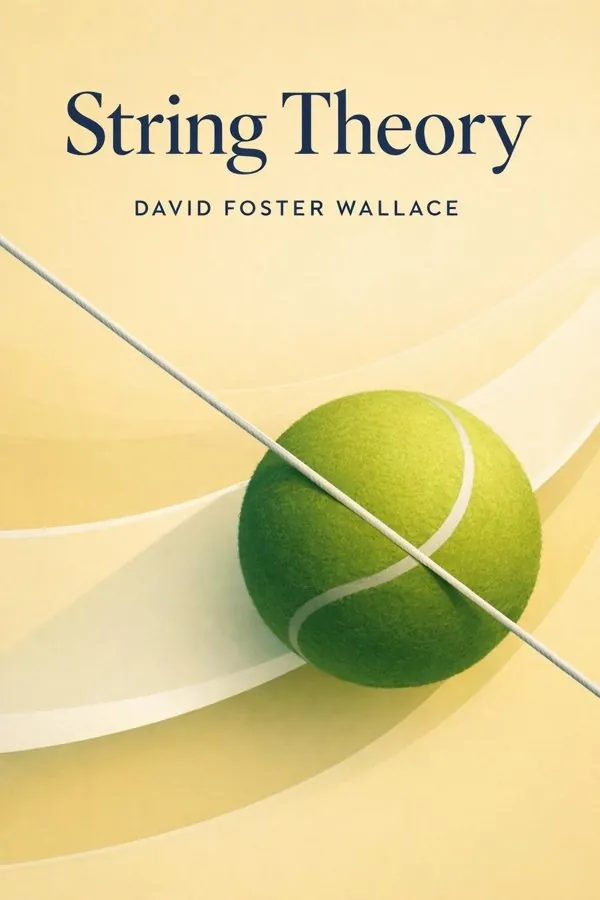
String Theory: The Essays of David Foster Wallace on Tennis: Summary & Key Insights
 10 min8 chaptersAudio available
Key Takeaways from String Theory: The Essays of David Foster Wallace on Tennis
The most interesting thing about tennis is that no teammate can hide you.
Great performers are not always great interpreters of themselves.
Freedom is often imagined as the absence of constraint, but Wallace argues the opposite: real freedom is built through discipline.
What spectators call talent is usually only the visible tip of a buried structure.
Some excellence is so complete that language struggles to catch up with it.
What Is String Theory: The Essays of David Foster Wallace on Tennis About?
String Theory: The Essays of David Foster Wallace on Tennis by David Foster Wallace is a biographies book spanning 5 pages. String Theory is a brilliant collection of tennis essays by David Foster Wallace, but calling it a sports book alone misses what makes it exceptional. Across five pieces written over many years, Wallace uses tennis as a way to think about talent, discipline, beauty, frustration, class, geography, and the strange gap between what people do and what they can explain about doing it. He writes about his own youth as a gifted junior player in the windy Midwest, about the limits of sports autobiography, about the grueling life of a lower-ranked professional, and about the near-miraculous grace of Roger Federer. The result is not just commentary on matches and players, but a study of human excellence under pressure. Wallace’s authority comes from both experience and intellect: he was once a serious competitive junior player, and he brought to journalism the precision, humor, and philosophical depth that made him one of America’s most distinctive writers. This book matters because it shows how closely sport mirrors life. In Wallace’s hands, tennis becomes a language for talking about freedom, effort, attention, and the difficult pursuit of mastery.
This FizzRead summary covers all 8 key chapters of String Theory: The Essays of David Foster Wallace on Tennis in approximately 10 minutes, distilling the most important ideas, arguments, and takeaways from David Foster Wallace's work. Also available as an audio summary and Key Quotes Podcast.
String Theory: The Essays of David Foster Wallace on Tennis
String Theory is a brilliant collection of tennis essays by David Foster Wallace, but calling it a sports book alone misses what makes it exceptional. Across five pieces written over many years, Wallace uses tennis as a way to think about talent, discipline, beauty, frustration, class, geography, and the strange gap between what people do and what they can explain about doing it. He writes about his own youth as a gifted junior player in the windy Midwest, about the limits of sports autobiography, about the grueling life of a lower-ranked professional, and about the near-miraculous grace of Roger Federer. The result is not just commentary on matches and players, but a study of human excellence under pressure. Wallace’s authority comes from both experience and intellect: he was once a serious competitive junior player, and he brought to journalism the precision, humor, and philosophical depth that made him one of America’s most distinctive writers. This book matters because it shows how closely sport mirrors life. In Wallace’s hands, tennis becomes a language for talking about freedom, effort, attention, and the difficult pursuit of mastery.
Who Should Read String Theory: The Essays of David Foster Wallace on Tennis?
This book is perfect for anyone interested in biographies and looking to gain actionable insights in a short read. Whether you're a student, professional, or lifelong learner, the key ideas from String Theory: The Essays of David Foster Wallace on Tennis by David Foster Wallace will help you think differently.
- ✓Readers who enjoy biographies and want practical takeaways
- ✓Professionals looking to apply new ideas to their work and life
- ✓Anyone who wants the core insights of String Theory: The Essays of David Foster Wallace on Tennis in just 10 minutes
Want the full summary?
Get instant access to this book summary and 100K+ more with Fizz Moment.
Get Free SummaryAvailable on App Store • Free to download
Key Chapters
The most interesting thing about tennis is that no teammate can hide you. Wallace’s essay "Derivative Sport in Tornado Alley" begins with a seemingly local story—growing up in the American Midwest, learning to play in brutal winds, on imperfect courts, under ordinary conditions—but it expands into a larger truth about character. Tennis, as Wallace presents it, is a sport of exposure. Every weakness is yours. Every adjustment is yours. Every mental lapse shows up immediately in the score.
Wallace recalls being a strong junior player not because he possessed overwhelming gifts, but because he learned how to survive conditions others hated. Windy Midwestern courts created a different kind of athlete: one less dependent on textbook beauty and more dependent on adaptation, patience, and strategic intelligence. In that sense, the environment shaped identity. You became the kind of player your conditions required.
This idea applies far beyond sport. Difficult environments often produce unusual strengths. A person working with fewer resources may develop sharper judgment. A team facing uncertainty may become more resilient than one used to comfort. Wallace suggests that excellence is not just raw talent expressed cleanly; it is talent modified by circumstance, pressure, and repeated acts of adjustment.
He also captures the solitude of tennis. On court, there is no place to outsource emotion. You must regulate frustration, rethink tactics, and continue performing while your mind tries to sabotage you. That is why tennis becomes, in Wallace’s hands, a laboratory of selfhood.
Actionable takeaway: Pay attention to the conditions that shaped your strengths. Instead of resenting difficulty, ask what specific abilities it trained into you—and use those deliberately.
Great performers are not always great interpreters of themselves. In "How Tracy Austin Broke My Heart," Wallace examines the disappointment of reading a champion’s autobiography and finding not deep insight but flat, mechanical language. He had hoped that a world-class player would reveal what elite consciousness feels like from the inside: what it means to react with impossible speed, to compete at a level where instinct and precision seem fused. Instead, he encounters clichés, generic positivity, and a voice that cannot articulate the mystery of its own excellence.
But Wallace’s point is subtler than simple criticism. The inability to explain greatness may be connected to greatness itself. Elite athletes often perform through automaticity. They do not narrate every movement; they execute. Their gift may depend on acting without self-conscious verbal analysis. The very reflective distance required to explain performance elegantly may interfere with performance itself.
This insight matters in everyday life. We often assume that the best practitioner will also be the best teacher, manager, or memoirist. Yet expertise and explanation are different skills. A brilliant coder may not teach coding well. A gifted salesperson may struggle to describe how trust is built. A musician may feel rhythm more deeply than they can discuss it.
Wallace also exposes our desire for access. We want language to bridge the gap between ordinary and extraordinary ability. When it fails, we feel cheated. But the failure itself is informative: some forms of mastery are embodied before they are verbal.
Actionable takeaway: When learning from excellence, do not rely only on people’s explanations. Study behavior, habits, routines, and decision patterns, because expertise is often more visible in action than in words.
Freedom is often imagined as the absence of constraint, but Wallace argues the opposite: real freedom is built through discipline. In his long essay on professional player Michael Joyce, Wallace turns attention away from superstars and toward the punishing life of a highly skilled but not iconic athlete. Joyce is not glamorized as a celebrity. Instead, he becomes a case study in what sustained commitment looks like when rewards are uncertain, pain is routine, and success is relative.
Wallace watches Joyce train, travel, prepare, recover, and compete, revealing how professional sport depends on endless choices that look small in isolation but become life-defining in accumulation. Sleep instead of nightlife. Repetition instead of novelty. Diet instead of indulgence. Focus instead of drift. Joyce’s artistry lies not merely in striking a ball well, but in choosing, day after day, the difficult behaviors that make high-level performance possible.
This is where Wallace broadens the essay into philosophy. Human completeness, he suggests, may come less from dramatic moments of self-expression than from submitting oneself to forms, structures, and standards that initially feel restrictive. The disciplined life narrows options in the short term but expands capability in the long term.
That lesson applies to writing, business, fitness, parenting, and creative work. People often wait to "feel free" before committing. Wallace shows that commitment itself is what creates meaningful freedom: the freedom that comes from competence, readiness, and earned confidence.
Actionable takeaway: Identify one area where you want more freedom—health, money, creativity, or skill—and ask what discipline would produce it. Then commit to a repeatable system rather than a motivational mood.
What spectators call talent is usually only the visible tip of a buried structure. One of Wallace’s finest contributions in String Theory is his insistence on making readers see the hidden labor inside elite performance. Watching tennis from the outside, it is easy to notice elegance, speed, and nerve. What is harder to see is the years of drilling, the bodily maintenance, the travel exhaustion, the tactical study, and the psychological wear that make even one clean point possible.
His portrait of Michael Joyce is especially powerful because it refuses the fantasy that professional sport is glamorous all the way down. Lower-ranked players live in a world of hotels, coaches, injuries, small margins, and constant uncertainty. They are astonishingly good—far better than ordinary spectators can grasp—yet they remain vulnerable to rankings, bad draws, and the brutal economics of the tour. The distance between being world-class and being celebrated is enormous.
This has implications outside athletics. In nearly every field, we overvalue visible outcomes and undervalue the maintenance systems that support them. We praise a confident presentation without seeing the revisions behind it. We admire a thriving company without seeing the years of operational discipline. We notice the published book, not the rejected drafts.
Wallace asks readers to become better observers. The point is not to demystify excellence into something dull, but to appreciate it more honestly. Wonder deepens when we understand what it costs.
Actionable takeaway: The next time you admire someone’s performance, list the likely invisible practices behind it. Then borrow one of those practices for your own work instead of envying the result.
Some excellence is so complete that language struggles to catch up with it. In "Federer Both Flesh and Not," Wallace tries to describe Roger Federer’s game and repeatedly arrives at the limits of ordinary sportswriting. Federer does not merely win points; he alters the spectator’s sense of what a human body can do. His movement, anticipation, balance, and timing create an experience that feels almost supernatural, as if physical law has become more permissive for one person than for everyone else.
Wallace is careful not to turn this into empty worship. His achievement is analytical as well as ecstatic. He explains that Federer’s beauty is not decorative. It emerges from efficiency, improvisation, control, and the ability to perform shots that combine tactical intelligence with astonishing motor skill. What looks effortless is the highest form of effort mastered so thoroughly that strain disappears from view.
This essay matters because it shows that beauty and utility are not opposites. In many domains, the most elegant solution is also the most effective. A master teacher makes complexity feel simple. A superb surgeon moves with calm precision. A brilliant designer removes friction so completely that the result feels natural. Federer becomes an example of practical beauty: grace as function fulfilled at the highest level.
Wallace also reminds us that awe is a serious intellectual response. To be overwhelmed by excellence is not naive. It is a form of recognition.
Actionable takeaway: When you encounter someone whose work feels effortless, do not dismiss it as "natural." Study the structure of that elegance. Ask what hidden efficiencies make their performance so beautiful.
The difference between watching and really seeing is one of Wallace’s central themes. Across these essays, tennis becomes meaningful because Wallace observes it with unusual patience and precision. He notices footwork, wind patterns, facial expressions, timing, posture, crowd psychology, and the subtle shifts in confidence that alter a match without any obvious dramatic event. From those details he builds larger reflections on choice, suffering, beauty, ego, and attention.
This is why String Theory appeals even to many readers who care little about tennis. Wallace uses sport as a method of thought. A tennis match is never just a sequence of points. It is a setting in which human beings confront limits, respond to stress, improvise under pressure, and reveal themselves through action. The essays reward close attention because Wallace demonstrates that the world is more legible than most of us assume if we learn how to look.
In practical terms, this idea has wide application. Better managers observe process instead of reacting only to outcomes. Better teachers notice where confusion first appears rather than waiting for failure. Better friends detect patterns in tone and behavior instead of relying on explicit declarations. Observation is not passive; it is an active moral and intellectual skill.
Wallace’s writing style models this discipline. He lingers where others summarize. He follows implications where others stop at description. In doing so, he makes readers more attentive not only to tennis but to life itself.
Actionable takeaway: Choose one ordinary activity this week—conversation, commuting, exercise, or work meetings—and observe it with Wallace-like precision. Ask what hidden dynamics become visible when you slow down and truly pay attention.
In tennis, technique is never only mechanical. Wallace repeatedly shows that every shot contains a mental component: anticipation, fear, confidence, pattern recognition, strategic memory, and emotional control. Because players stand alone and must restart after every point, tennis magnifies the relationship between thought and action. A match can turn not because someone suddenly loses physical ability, but because concentration narrows, panic intrudes, or self-consciousness interrupts instinct.
This is one reason Wallace finds tennis so philosophically rich. The game dramatizes a familiar human problem: how to perform well while being aware of ourselves. Too little awareness, and we become careless. Too much awareness, and we lock up. Elite players inhabit a rare balance where intelligence informs action without clogging it.
That balance appears in ordinary life as well. Public speaking, interviewing, negotiating, parenting, and creative work all demand the same dance between preparation and release. You train deliberately so that, in the crucial moment, execution feels fluid rather than forced. Wallace understands that composure is not the absence of pressure but a practiced relationship to it.
His essays also highlight the emotional afterlife of mistakes. In tennis, one bad point can infect the next five if a player keeps replaying it mentally. The same happens in work and relationships. People lose the present because they remain trapped in the previous error.
Actionable takeaway: Before any high-pressure task, separate preparation from performance. Train thoroughly beforehand, then enter the moment with one simple cue—breathe, watch, or commit—so your mind supports action rather than interfering with it.
Tennis is elegant from a distance and punishing up close. Wallace never lets readers settle for the romantic version of sport alone. Yes, there is beauty in movement, geometry, and timing. But there is also loneliness, repetitive strain, status anxiety, travel fatigue, and the cruel arithmetic of rankings. To love tennis honestly, he suggests, is to hold both truths at once.
This tension gives String Theory much of its emotional force. Wallace is not a detached critic or a blind fan. He is a lover of the game who knows its costs. That dual perspective allows him to write about tennis with unusual moral seriousness. Competition creates moments of transcendence, but it also consumes bodies and narrows lives. The same disciplined routines that make excellence possible can become exhausting forms of sacrifice.
This paradox extends beyond sport. Many meaningful pursuits contain both fulfillment and damage. Ambitious careers can create purpose while straining relationships. Artistic devotion can produce beauty while generating instability. Parenting can bring profound love while demanding relentless self-denial. Mature understanding requires us to stop asking whether a pursuit is purely good or bad and start asking what tradeoffs it entails.
Wallace’s honesty deepens rather than diminishes admiration. By acknowledging the brutality inside beauty, he makes achievement more real and more moving. We respect excellence differently when we see the friction beneath the grace.
Actionable takeaway: When evaluating any demanding goal, write down both sides: what it gives you and what it asks from you. Better choices come from seeing aspiration and cost together.
All Chapters in String Theory: The Essays of David Foster Wallace on Tennis
About the Author
David Foster Wallace (1962–2008) was an American novelist, essayist, and short-story writer whose work combined philosophical depth, formal inventiveness, and sharp social observation. He became one of the most influential literary voices of his generation through books such as Infinite Jest, Consider the Lobster, Brief Interviews with Hideous Men, and A Supposedly Fun Thing I'll Never Do Again. Wallace was celebrated for prose that could be funny, analytical, digressive, and deeply humane all at once. Before his literary career, he was also a highly competitive junior tennis player, an experience that informed his unusually perceptive sports writing. In String Theory, his love of tennis meets his gift for close observation, producing essays that are as insightful about human nature as they are about the game itself.
Get This Summary in Your Preferred Format
Read or listen to the String Theory: The Essays of David Foster Wallace on Tennis summary by David Foster Wallace anytime, anywhere. FizzRead offers multiple formats so you can learn on your terms — all free.
Available formats: App · Audio · PDF · EPUB — All included free with FizzRead
Download String Theory: The Essays of David Foster Wallace on Tennis PDF and EPUB Summary
Key Quotes from String Theory: The Essays of David Foster Wallace on Tennis
“The most interesting thing about tennis is that no teammate can hide you.”
“Great performers are not always great interpreters of themselves.”
“Freedom is often imagined as the absence of constraint, but Wallace argues the opposite: real freedom is built through discipline.”
“What spectators call talent is usually only the visible tip of a buried structure.”
“Some excellence is so complete that language struggles to catch up with it.”
Frequently Asked Questions about String Theory: The Essays of David Foster Wallace on Tennis
String Theory: The Essays of David Foster Wallace on Tennis by David Foster Wallace is a biographies book that explores key ideas across 8 chapters. String Theory is a brilliant collection of tennis essays by David Foster Wallace, but calling it a sports book alone misses what makes it exceptional. Across five pieces written over many years, Wallace uses tennis as a way to think about talent, discipline, beauty, frustration, class, geography, and the strange gap between what people do and what they can explain about doing it. He writes about his own youth as a gifted junior player in the windy Midwest, about the limits of sports autobiography, about the grueling life of a lower-ranked professional, and about the near-miraculous grace of Roger Federer. The result is not just commentary on matches and players, but a study of human excellence under pressure. Wallace’s authority comes from both experience and intellect: he was once a serious competitive junior player, and he brought to journalism the precision, humor, and philosophical depth that made him one of America’s most distinctive writers. This book matters because it shows how closely sport mirrors life. In Wallace’s hands, tennis becomes a language for talking about freedom, effort, attention, and the difficult pursuit of mastery.
More by David Foster Wallace
You Might Also Like

An American Marriage
Tayari Jones
10 min
Benjamin Franklin: An American Life
Walter Isaacson
10 min
I Know Why The Caged Bird Sings
Maya Angelou
10 min
Long Walk to Freedom
Nelson Mandela
10 min
Persepolis
Marjane Satrapi
10 min
Surely You're Joking, Mr. Feynman!
Richard P. Feynman
10 minBrowse by Category
Ready to read String Theory: The Essays of David Foster Wallace on Tennis?
Get the full summary and 100K+ more books with Fizz Moment.