
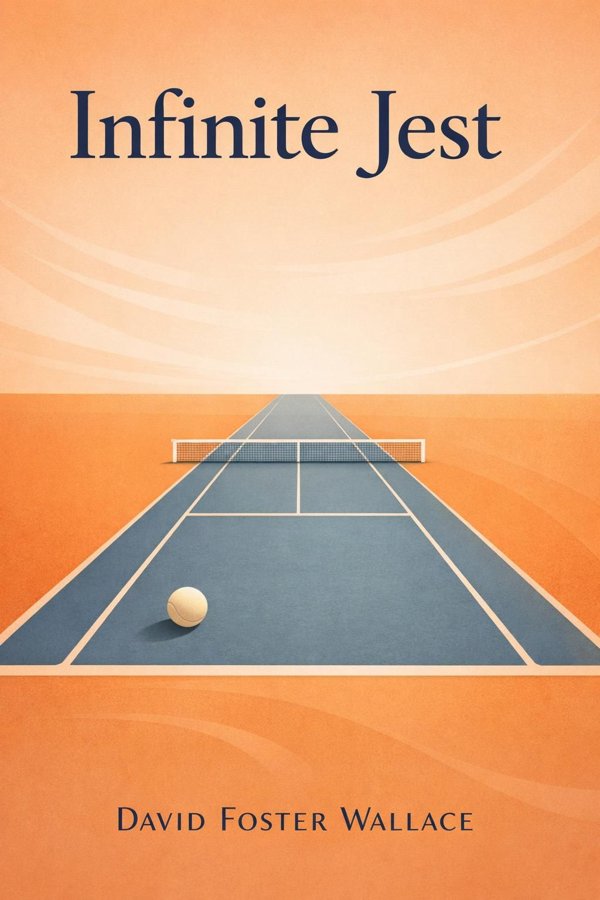
Infinite Jest: Summary & Key Insights
 10 min9 chaptersAudio available
Key Takeaways from Infinite Jest
A society reveals its values by what it sells, and in Infinite Jest even time itself is for sale.
Families often pass down wounds disguised as gifts, and the Incandenzas embody that paradox.
One of the novel’s most haunting ideas is that intelligence can become a prison.
Real heroism, Infinite Jest suggests, may look less like brilliance than endurance.
Wallace uses tennis not merely as a sport but as a philosophy of modern striving.
What Is Infinite Jest About?
Infinite Jest by David Foster Wallace is a fiction book published in 1996 spanning 10 pages. David Foster Wallace’s Infinite Jest is one of the most ambitious novels of the late twentieth century: a vast, funny, intimidating, heartbreaking work about what happens when a culture built on pleasure loses its ability to choose wisely. Set in an alternate near-future North America, the novel moves between Enfield Tennis Academy, a halfway house for recovering addicts, and the geopolitical absurdity of O.N.A.N., where even calendar years are sold to corporate sponsors. At its center are the Incandenza family, the residents of Ennet House, and a deadly piece of entertainment so pleasurable that viewers lose all desire for anything else. From that premise, Wallace explores addiction, ambition, loneliness, family damage, performance, and the hunger for meaning in a distracted age. The book matters because it turns satire into moral inquiry: beneath its jokes, footnotes, and verbal fireworks lies a deeply serious question about freedom and dependency. Wallace writes with rare authority not because he offers easy answers, but because he understands how intelligence, suffering, and self-deception can coexist in the same person.
This FizzRead summary covers all 9 key chapters of Infinite Jest in approximately 10 minutes, distilling the most important ideas, arguments, and takeaways from David Foster Wallace's work. Also available as an audio summary and Key Quotes Podcast.
Infinite Jest
David Foster Wallace’s Infinite Jest is one of the most ambitious novels of the late twentieth century: a vast, funny, intimidating, heartbreaking work about what happens when a culture built on pleasure loses its ability to choose wisely. Set in an alternate near-future North America, the novel moves between Enfield Tennis Academy, a halfway house for recovering addicts, and the geopolitical absurdity of O.N.A.N., where even calendar years are sold to corporate sponsors. At its center are the Incandenza family, the residents of Ennet House, and a deadly piece of entertainment so pleasurable that viewers lose all desire for anything else. From that premise, Wallace explores addiction, ambition, loneliness, family damage, performance, and the hunger for meaning in a distracted age. The book matters because it turns satire into moral inquiry: beneath its jokes, footnotes, and verbal fireworks lies a deeply serious question about freedom and dependency. Wallace writes with rare authority not because he offers easy answers, but because he understands how intelligence, suffering, and self-deception can coexist in the same person.
Who Should Read Infinite Jest?
This book is perfect for anyone interested in fiction and looking to gain actionable insights in a short read. Whether you're a student, professional, or lifelong learner, the key ideas from Infinite Jest by David Foster Wallace will help you think differently.
- ✓Readers who enjoy fiction and want practical takeaways
- ✓Professionals looking to apply new ideas to their work and life
- ✓Anyone who wants the core insights of Infinite Jest in just 10 minutes
Want the full summary?
Get instant access to this book summary and 100K+ more with Fizz Moment.
Get Free SummaryAvailable on App Store • Free to download
Key Chapters
A society reveals its values by what it sells, and in Infinite Jest even time itself is for sale. Wallace imagines a North America reorganized into O.N.A.N., the Organization of North American Nations, where calendar years are no longer numbered but branded: the Year of the Whopper, the Year of the Depend Adult Undergarment, the Year of Dairy Products from the American Heartland. The joke is absurd, but it also feels disturbingly plausible. By turning time into advertising space, Wallace suggests that consumer culture does not merely shape taste; it colonizes reality itself.
This setting is more than decorative satire. Subsidized Time establishes the novel’s moral atmosphere: people live inside systems designed to monetize attention, desire, and identity. Political life becomes spectacle, ecological disaster is relocated rather than solved, and citizens are trained to accept convenience as wisdom. The result is a world that feels futuristic and yet intensely familiar, because Wallace is exaggerating tendencies already present in modern life.
The idea has practical relevance beyond the novel. We live amid branded experiences, algorithmic distraction, and relentless competition for attention. Infinite Jest asks us to notice how often our habits are chosen for us. What seems like harmless entertainment or convenience may quietly narrow our capacity for patience, depth, and self-command.
Actionable takeaway: audit the forces that organize your time. Ask what in your daily routine serves your values and what merely captures your attention.
Families often pass down wounds disguised as gifts, and the Incandenzas embody that paradox. At the center of Infinite Jest stands James O. Incandenza: optical scientist, avant-garde filmmaker, founder of Enfield Tennis Academy, alcoholic, and brilliant failure. Around him orbit his wife Avril and their sons Orin, Mario, and Hal, each marked by talent, pressure, and emotional distance. This is a family overflowing with intellect and achievement yet starving for plain, human connection.
James creates films that are technically dazzling and emotionally elusive. He also leaves behind the mysterious entertainment cartridge known as Infinite Jest, a work so compelling it destroys the viewer’s will. The film functions as both plot device and symbol: the father’s final artistic legacy is also a weaponized form of desire. His genius cannot save him from addiction, nor can it protect his children from confusion. Avril, organized and imposing, sustains the family structure but also intensifies its anxieties. The brothers respond differently: Orin flees into seduction and performance, Mario radiates unusual sincerity, and Hal retreats into hyper-articulate inner isolation.
Wallace uses the family to show that brilliance does not cancel dysfunction. High achievement can coexist with emotional illiteracy. Many readers recognize this dynamic in less extreme forms: households where expectations are clear but love is difficult to feel, or where communication is replaced by analysis.
Actionable takeaway: pay attention to the emotional patterns you inherited. Naming a family script is often the first step toward not repeating it.
One of the novel’s most haunting ideas is that intelligence can become a prison. Hal Incandenza is a gifted tennis player, a linguistic prodigy, and one of the most intellectually agile characters in contemporary fiction. Yet from the beginning, he is split. Inside, he experiences himself as lucid, articulate, and observant; outside, others increasingly perceive him as empty, incomprehensible, or feral. His crisis is not simple madness but a terrifying gap between interior life and social legibility.
Hal’s condition embodies several of the book’s major concerns. He is pressured by elite competition, damaged by family opacity, numbed by substance use, and trained to perform competence rather than inhabit a stable self. At Enfield Tennis Academy, discipline and excellence are everything, but emotional vocabulary is scarce. Hal can parse dictionaries and tennis strategy with ease, yet struggles to speak plainly about fear, grief, or need. Wallace suggests that verbal mastery is not the same as self-knowledge.
This makes Hal deeply relevant to modern readers. Many high-functioning people know the sensation of sounding capable while feeling internally fragmented. Professional polish can conceal disorientation. Social success can hide a failure of connection, especially in environments that reward performance over honesty.
Hal’s story warns that suppression does not produce strength; it often produces estrangement. The self cannot remain indefinitely divided between what it experiences and what it expresses.
Actionable takeaway: practice saying one true, unpolished thing to someone you trust. Clarity of feeling matters as much as clarity of thought.
Real heroism, Infinite Jest suggests, may look less like brilliance than endurance. Don Gately, a former burglar and addict working at Ennet House Drug and Alcohol Recovery House, becomes the novel’s moral center not because he is refined or intellectually dazzling, but because he keeps choosing the next right action under brutal conditions. His life has been shaped by violence, shame, compulsion, and poor judgment. What makes him remarkable is his gradual commitment to responsibility.
In contrast to the elegant abstractions surrounding the Incandenzas, Gately’s world is concrete. Recovery is not a theory; it is getting through the night without using, listening to clichés he hates, making coffee, cleaning up other people’s messes, telling the truth, and accepting that he cannot trust his own impulses. Wallace treats twelve-step culture with both satire and respect. Its slogans can sound banal, but they work because addiction is not defeated by sophistication. It is countered through repetition, humility, and community.
Gately’s struggle broadens the novel’s argument. Freedom is not simply doing what one wants. For the addict, desire itself has become tyrannical. Recovery means submitting to structures that restore agency slowly, one day at a time. That lesson extends beyond substance abuse to any destructive habit, from compulsive scrolling to workaholism.
Actionable takeaway: when facing a pattern you cannot outthink, shrink the problem. Commit to one concrete behavior today rather than solving your whole life at once.
Wallace uses tennis not merely as a sport but as a philosophy of modern striving. Enfield Tennis Academy is a machine for producing excellence, discipline, and ranked distinction. Its students train constantly, measure themselves against others, and internalize an unforgiving logic: your worth is legible in performance. The academy’s routines, hierarchies, and anxieties expose the emotional cost of elite competition.
Tennis is especially suited to Wallace’s themes because it is both intensely public and profoundly solitary. A player must confront an opponent, a crowd, and the self all at once. Success depends on technical repetition, bodily control, and psychological management under pressure. For young athletes like Hal and his peers, this environment creates a paradox. The academy teaches self-mastery, yet it also encourages self-objectification. Players learn to monitor every gesture, optimize every weakness, and treat their identities as projects.
This extends far beyond sports. Professional life often functions the same way. Students, workers, and creators are ranked, compared, and trained to brand themselves. The result can be a brittle kind of excellence: externally impressive, internally exhausting. Wallace understands the seduction of competence, but he also shows how relentless competition can hollow out joy and intimacy.
The academy also mirrors the larger culture of Infinite Jest. Everyone is practicing for some imagined moment of mastery, while fewer people know how to live without an audience or scoreboard.
Actionable takeaway: pursue standards that sharpen your craft, but protect spaces in life where you do not have to compete, perform, or be evaluated.
The novel’s most famous invention is also its most frightening: a film cartridge so pleasurable that anyone who watches it wants nothing else and eventually dies from total fixation. Known as Infinite Jest or the Entertainment, it becomes the object of political intrigue, espionage, and desperate pursuit. Yet its power lies not only in suspense. The Entertainment literalizes a cultural danger Wallace believed was already everywhere: amusement so perfectly tailored to desire that it overrides judgment, responsibility, and the will to live beyond consumption.
This is the book’s central metaphor. Addiction and entertainment are linked because both promise immediate relief without requiring growth. The Entertainment does not torture its viewers; it gives them exactly what they want. That is what makes it lethal. Wallace is less concerned with evil as overt coercion than with captivity through pleasure. A person can be destroyed by what feels good.
The idea resonates powerfully now. Bingeable media, personalized feeds, gambling-like apps, and endless digital stimuli all compete to keep us engaged for as long as possible. Most are not fatal in the novel’s extreme sense, but they can erode agency, concentration, and the ability to tolerate boredom. Infinite Jest asks whether a culture organized around frictionless pleasure can sustain adulthood.
The challenge is not to reject pleasure outright. It is to recognize the difference between nourishment and compulsion, between recreation that refreshes us and stimulation that empties us.
Actionable takeaway: identify one form of entertainment you use automatically, and set a deliberate boundary around it so pleasure remains chosen rather than controlling.
Even at its most comic, Infinite Jest never lets readers forget that private pain exists inside large, impersonal systems. The geopolitical backdrop involves O.N.A.N., forced ecological dumping in a toxic Concavity, and separatist Québécois militants seeking the master copy of the Entertainment. These plotlines can seem wild, but Wallace uses them to show how absurd institutions and desperate individuals shape one another.
Political life in the novel is grotesquely theatrical. Leaders repackage crises, nations merge without resolving conflict, and catastrophe is displaced geographically rather than morally confronted. The Concavity itself is a perfect image of modern problem-solving: move the waste elsewhere, then call the arrangement progress. Meanwhile, insurgent groups pursue the Entertainment as a strategic weapon, proving that desire can be militarized as effectively as force.
This strand of the novel matters because it prevents us from reading addiction only as a personal weakness. Systems profit from dependency. Governments manage appearances. Markets monetize craving. Even terrorism in the novel is tied to spectacle and symbolic power. Wallace suggests that the same culture that produces lonely, compulsive individuals also generates unstable political realities.
Readers can apply this lens today by asking not only what harms people, but what institutions benefit from those harms remaining unaddressed. Moral clarity improves when we connect private habits to public incentives.
Actionable takeaway: whenever confronting a personal or social problem, ask who profits from the current arrangement and what that reveals about the system behind it.
Infinite Jest is difficult on purpose. Its non-linear chronology, shifting viewpoints, dense references, and famous endnotes do not simply display Wallace’s intelligence; they enact the conditions the book describes. Readers experience interruption, overload, uncertainty, and delayed understanding because the characters live in a world shaped by the same forces. Form and theme mirror each other.
The novel demands active participation. You assemble timelines, infer missing links, revisit earlier scenes, and hold unresolved details in memory. This can feel frustrating, but that frustration is revealing. Wallace resists passive consumption. Unlike the Entertainment inside the story, the novel refuses to make itself effortlessly digestible. It asks for patience, attention, and tolerance for ambiguity. In this sense, reading Infinite Jest becomes an ethical exercise as much as an aesthetic one.
The fragmented structure also reflects how people actually experience life under pressure. Memory arrives unevenly. Trauma distorts sequence. Addiction narrows time to urgent cycles of craving and relief. Recovery, by contrast, often means learning to reconnect scattered pieces of the self into a story one can inhabit.
For readers, the practical lesson is that not all valuable experiences are smooth. Some works reward commitment precisely because they train capacities that convenience culture weakens: concentration, humility, and interpretive resilience.
Actionable takeaway: when a meaningful task feels difficult, resist the urge to abandon it immediately. Sometimes the work of making sense is part of the transformation.
Behind all its satire and technical brilliance, Infinite Jest is finally a novel about the human need to give oneself away to something. Wallace’s bleak insight is that people cannot avoid devotion; they can only choose its object badly or well. Some characters devote themselves to drugs, sex, prestige, entertainment, control, or talent. These substitutes promise transcendence but leave people emptier, lonelier, and less free. The alternative is not glamorous enlightenment. It is often something embarrassingly ordinary: service, honesty, ritual, fellowship, and endurance.
This is why the recovery scenes matter so much. At Ennet House, Wallace presents a battered form of communal wisdom. The slogans are cheesy, the stories repetitive, and the people damaged. Yet the program offers what the larger culture cannot: a way to live that does not depend on being exceptional. Recovery restores meaning through submission to reality, not escape from it.
The novel does not provide a clean redemption arc. Suffering remains, many mysteries stay unresolved, and people relapse, fail, and die. But Wallace insists that attention, compassion, and disciplined humility are real counterforces to despair. Mario’s innocence, Gately’s persistence, and even the possibility of sincere contact suggest that salvation may be partial, local, and unspectacular.
Actionable takeaway: build meaning through repeated, grounded practices—showing up, listening, helping, telling the truth—rather than waiting for a dramatic revelation to save you.
All Chapters in Infinite Jest
About the Author
David Foster Wallace (1962–2008) was an American novelist, essayist, and short story writer widely regarded as one of the most important literary voices of his era. Born in Ithaca, New York, and raised in Illinois, he studied philosophy and English, influences that shaped the precision and intellectual depth of his work. Wallace became internationally known with Infinite Jest in 1996, a novel celebrated for its ambition, humor, and searching examination of addiction, entertainment, and modern consciousness. He also wrote acclaimed nonfiction and short fiction, including Consider the Lobster and Brief Interviews with Hideous Men. Wallace’s writing is known for its stylistic daring, moral seriousness, and concern with loneliness, sincerity, and attention in contemporary life. His influence on modern literature remains profound.
Get This Summary in Your Preferred Format
Read or listen to the Infinite Jest summary by David Foster Wallace anytime, anywhere. FizzRead offers multiple formats so you can learn on your terms — all free.
Available formats: App · Audio · PDF · EPUB — All included free with FizzRead
Download Infinite Jest PDF and EPUB Summary
Key Quotes from Infinite Jest
“A society reveals its values by what it sells, and in Infinite Jest even time itself is for sale.”
“Families often pass down wounds disguised as gifts, and the Incandenzas embody that paradox.”
“One of the novel’s most haunting ideas is that intelligence can become a prison.”
“Real heroism, Infinite Jest suggests, may look less like brilliance than endurance.”
“Wallace uses tennis not merely as a sport but as a philosophy of modern striving.”
Frequently Asked Questions about Infinite Jest
Infinite Jest by David Foster Wallace is a fiction book that explores key ideas across 9 chapters. David Foster Wallace’s Infinite Jest is one of the most ambitious novels of the late twentieth century: a vast, funny, intimidating, heartbreaking work about what happens when a culture built on pleasure loses its ability to choose wisely. Set in an alternate near-future North America, the novel moves between Enfield Tennis Academy, a halfway house for recovering addicts, and the geopolitical absurdity of O.N.A.N., where even calendar years are sold to corporate sponsors. At its center are the Incandenza family, the residents of Ennet House, and a deadly piece of entertainment so pleasurable that viewers lose all desire for anything else. From that premise, Wallace explores addiction, ambition, loneliness, family damage, performance, and the hunger for meaning in a distracted age. The book matters because it turns satire into moral inquiry: beneath its jokes, footnotes, and verbal fireworks lies a deeply serious question about freedom and dependency. Wallace writes with rare authority not because he offers easy answers, but because he understands how intelligence, suffering, and self-deception can coexist in the same person.
More by David Foster Wallace
You Might Also Like
Browse by Category
Ready to read Infinite Jest?
Get the full summary and 100K+ more books with Fizz Moment.