
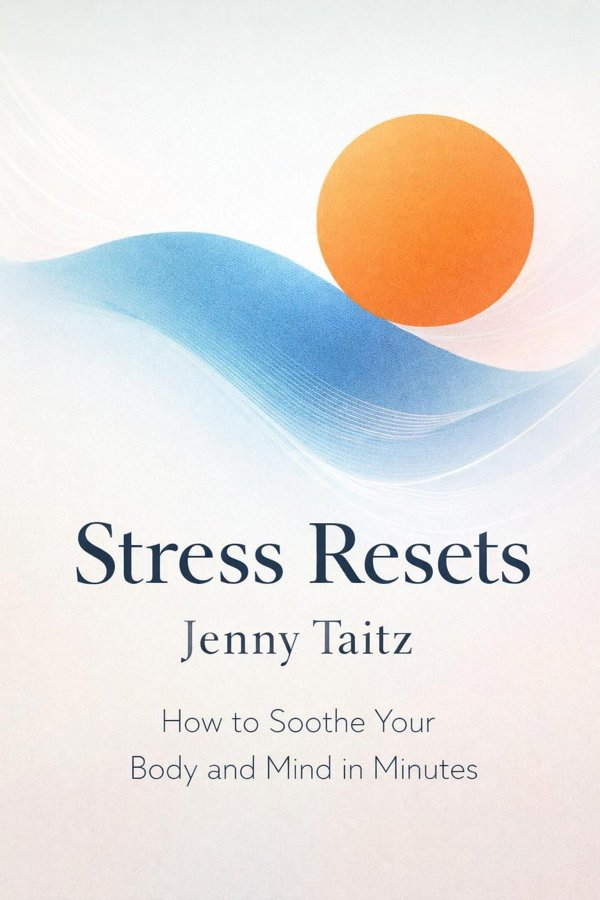
Stress Resets: How to Soothe Your Body and Mind in Minutes: Summary & Key Insights
by Jenny Taitz
 10 min9 chaptersAudio available
Key Takeaways from Stress Resets: How to Soothe Your Body and Mind in Minutes
One of the most liberating ideas in the book is that stress is not proof that something is wrong with you.
Stress almost always leaves clues before it becomes overwhelming.
When people are stressed, they often try to think their way out of it first.
Stress is not caused only by what happens to us, but also by how we interpret what happens.
A stressed mind is usually either reliving what already happened or rehearsing what might go wrong next.
What Is Stress Resets: How to Soothe Your Body and Mind in Minutes About?
Stress Resets: How to Soothe Your Body and Mind in Minutes by Jenny Taitz is a mental_health book spanning 6 pages. Stress rarely announces itself dramatically at first. More often, it builds quietly through clenched muscles, racing thoughts, irritability, sleeplessness, doom-scrolling, and the sense that your mind never fully powers down. In Stress Resets, clinical psychologist Jenny Taitz offers a practical answer to this modern condition: a toolbox of brief, evidence-based techniques that can calm the body, steady the mind, and help you recover your footing in minutes rather than hours. Instead of treating stress relief as something that requires a perfect morning routine, a long meditation retreat, or endless free time, Taitz focuses on what is realistic when life is messy and pressure is high. Drawing from cognitive behavioral therapy, mindfulness, somatic regulation, and affective science, she explains why stress happens, how to catch it early, and what to do in the moment before it spirals. The result is an accessible, compassionate guide for anyone who wants fast, effective ways to regulate emotions, interrupt overwhelm, and build resilience one small reset at a time.
This FizzRead summary covers all 9 key chapters of Stress Resets: How to Soothe Your Body and Mind in Minutes in approximately 10 minutes, distilling the most important ideas, arguments, and takeaways from Jenny Taitz's work. Also available as an audio summary and Key Quotes Podcast.
Stress Resets: How to Soothe Your Body and Mind in Minutes
Stress rarely announces itself dramatically at first. More often, it builds quietly through clenched muscles, racing thoughts, irritability, sleeplessness, doom-scrolling, and the sense that your mind never fully powers down. In Stress Resets, clinical psychologist Jenny Taitz offers a practical answer to this modern condition: a toolbox of brief, evidence-based techniques that can calm the body, steady the mind, and help you recover your footing in minutes rather than hours. Instead of treating stress relief as something that requires a perfect morning routine, a long meditation retreat, or endless free time, Taitz focuses on what is realistic when life is messy and pressure is high. Drawing from cognitive behavioral therapy, mindfulness, somatic regulation, and affective science, she explains why stress happens, how to catch it early, and what to do in the moment before it spirals. The result is an accessible, compassionate guide for anyone who wants fast, effective ways to regulate emotions, interrupt overwhelm, and build resilience one small reset at a time.
Who Should Read Stress Resets: How to Soothe Your Body and Mind in Minutes?
This book is perfect for anyone interested in mental_health and looking to gain actionable insights in a short read. Whether you're a student, professional, or lifelong learner, the key ideas from Stress Resets: How to Soothe Your Body and Mind in Minutes by Jenny Taitz will help you think differently.
- ✓Readers who enjoy mental_health and want practical takeaways
- ✓Professionals looking to apply new ideas to their work and life
- ✓Anyone who wants the core insights of Stress Resets: How to Soothe Your Body and Mind in Minutes in just 10 minutes
Want the full summary?
Get instant access to this book summary and 100K+ more with Fizz Moment.
Get Free SummaryAvailable on App Store • Free to download
Key Chapters
One of the most liberating ideas in the book is that stress is not proof that something is wrong with you. It is proof that your nervous system is trying to protect you. Taitz explains stress as the brain and body’s response to perceived demands that exceed available resources. That response evolved for survival: increased heart rate, narrowed attention, muscle tension, and heightened vigilance all prepare us to act. The problem is not stress itself, but when the alarm system stays switched on too long, misfires in low-stakes situations, or becomes our default mode.
This shift in perspective matters because many people layer self-judgment on top of stress. They feel anxious, then criticize themselves for being anxious, which creates a second wave of distress. Taitz encourages readers to replace shame with curiosity. Instead of asking, “What is wrong with me?” ask, “What is my stress response trying to tell me right now?” That subtle reframing creates space for regulation.
She also emphasizes that quick resets are not superficial hacks. They work because the mind and body are deeply interconnected. A change in breathing, posture, attention, or interpretation can send the nervous system new information: you are safe enough to slow down. This makes stress management less about becoming permanently calm and more about learning to recover more quickly.
In daily life, this might mean noticing your jaw clenching before a meeting, your chest tightening after reading an email, or your impulse to multitask when you feel behind. Those moments are not failures. They are invitations to intervene early.
Actionable takeaway: The next time stress rises, name it neutrally: “My alarm system is activated.” Then choose one small reset instead of criticizing yourself for having the reaction.
Stress almost always leaves clues before it becomes overwhelming. Taitz argues that one of the most powerful skills we can build is early detection. By the time we are snapping at loved ones, making impulsive decisions, or lying awake at 3 a.m., stress has already gathered momentum. But earlier signs are often visible in the body, thoughts, and habits: shallow breathing, tightened shoulders, scattered attention, irritability, craving sugar, compulsive phone use, catastrophizing, or procrastination.
The reason this matters is simple: stress is easier to interrupt at level three than at level nine. If you learn your personal warning signs, you can act while your brain is still relatively flexible. Taitz encourages readers to become students of their own patterns rather than passive recipients of their moods. Different people have different signatures. For one person, stress means overworking and rushing. For another, it means avoidance, numbness, or zoning out. Both are forms of dysregulation.
A practical strategy is to create a “stress profile.” Notice what happens in your body, what stories your mind tells, and what behaviors you drift toward when pressure rises. Maybe your first sign is checking email repeatedly. Maybe it is feeling unusually cold, speaking faster, or losing patience in traffic. Once identified, these cues become useful prompts for a reset.
Taitz’s broader point is that awareness itself is regulatory. When you can label what is happening, you reduce the chaos of feeling swept away by it. Naming an internal state helps engage the reflective part of the brain instead of staying trapped in pure reactivity.
Actionable takeaway: Write down three early signs that tell you stress is rising for you personally, and pair each one with a specific two-minute reset you can use immediately.
When people are stressed, they often try to think their way out of it first. Taitz shows why that approach can fail: an activated body makes it harder for the mind to reason clearly. If your nervous system believes there is danger, logic alone may not land. That is why physical resets are so effective. By changing what the body is doing, you can send a bottom-up signal of safety to the brain.
These resets include paced breathing, deliberate exhalation, unclenching muscles, stretching, shaking out tension, grounding through the feet, splashing cold water on the face, or using brief movement to discharge activation. None of these techniques are complicated, but they are powerful because they work with physiology rather than against it. For example, lengthening the exhale can stimulate the parasympathetic nervous system, which supports relaxation. Relaxing your hands and jaw can soften the body’s fight-or-flight posture. Looking around the room slowly can orient your brain to the present instead of a perceived threat.
Taitz makes the case that these strategies are especially useful when the mind feels too loud. During a difficult conversation, before public speaking, while sitting in traffic, or after reading upsetting news, a physical reset can interrupt escalation quickly. You do not need privacy or perfect conditions. Even placing a hand on your chest and taking three slower breaths can create a meaningful shift.
The deeper lesson is that stress regulation is embodied. We are not disembodied minds with inconvenient physical symptoms; the body is part of the solution. Learning to use it deliberately turns ordinary moments into opportunities for recovery.
Actionable takeaway: Choose one body-based reset you can perform anywhere, such as a slow exhale or shoulder release, and practice it daily before you need it under pressure.
Stress is not caused only by what happens to us, but also by how we interpret what happens. Taitz draws from cognitive behavioral therapy to show that thoughts can amplify physiological arousal and emotional pain. When the mind leaps from “I have a lot to do” to “I’ll never catch up,” or from “They seemed distracted” to “They must be upset with me,” the nervous system often reacts as though the imagined catastrophe is already underway.
This does not mean positive thinking is the answer. Taitz is not suggesting that readers deny reality or force cheerful affirmations. Instead, she promotes cognitive flexibility: the ability to notice a stressful thought, question whether it is the only possible interpretation, and replace it with something more accurate and useful. This creates a middle ground between panic and denial.
For instance, if you make a mistake at work, your first thought might be, “I’ve ruined everything.” A reset might involve asking: What are the facts? What would I say to a friend in this situation? What is one realistic next step? Similarly, if you are overwhelmed by uncertainty, you can distinguish between productive problem-solving and repetitive mental spinning. The goal is not to eliminate concern, but to reduce the extra suffering caused by distorted or extreme conclusions.
Taitz also highlights mindfulness-based skills that help readers step back from thoughts rather than fuse with them. You can notice, “I am having the thought that I can’t handle this,” instead of treating that thought as objective truth. That slight distance often lowers emotional intensity.
Actionable takeaway: The next time a stressful thought spikes your anxiety, write it down and ask, “Is this true, fully true, or just one possible story?” Then generate a more balanced alternative.
A stressed mind is usually either reliving what already happened or rehearsing what might go wrong next. Taitz presents mindfulness as a fast way to return to the only place where regulation is actually possible: the present moment. Mindfulness here is not portrayed as a lofty spiritual practice requiring silence and long sessions. It is a practical attentional skill that helps interrupt spirals of rumination, dread, and sensory overload.
The core idea is simple: when attention becomes anchored in present experience, the mind has less room to feed imagined threats. Taitz offers brief methods such as noticing five things you can see, listening carefully to surrounding sounds, feeling your feet against the floor, or taking one minute to observe your breath without trying to change it. These exercises reduce cognitive fusion and orient you toward what is happening now rather than what your fear predicts.
Importantly, mindfulness does not mean liking the moment or erasing difficult feelings. It means turning toward experience with less resistance. If you are anxious before a presentation, mindfulness might involve noticing the flutter in your stomach, the cool air in the room, and the sensation of standing upright, rather than fighting your nerves or mentally escaping into disaster scenarios. This acceptance often makes discomfort more manageable.
Taitz’s version of mindfulness is especially useful for busy people because it is woven into ordinary activities. You can drink coffee mindfully, wash dishes mindfully, walk to a meeting mindfully, or pause before answering a text. The cumulative effect is more steadiness and less automatic reactivity.
Actionable takeaway: Pick one routine activity you do every day and use it as a one-minute mindfulness practice by fully noticing sensations, sounds, and movements while you do it.
When stress rises, people often wait to feel better before taking constructive action. Taitz turns that assumption upside down. One of her key insights is that behavior can lead emotion, not just follow it. Small actions can shift physiology, attention, and mood even when motivation is low. This is crucial because stress often pushes us toward habits that provide short-term relief but long-term costs: avoidance, procrastination, isolation, overchecking, overworking, or numbing out.
A behavioral reset interrupts that cycle by asking, “What action would move me one step closer to steadiness right now?” That action may be tiny: standing up, stepping outside, drinking water, tidying one surface, replying to one email, setting a timer for ten focused minutes, or putting your phone in another room. These actions reduce helplessness and restore a sense of agency.
Taitz also emphasizes the stress-relieving power of supportive connection. A brief text to a trusted friend, eye contact with a coworker, a quick hug, or asking for help can regulate the nervous system because humans are wired for co-regulation. Likewise, setting a boundary can be a behavioral reset. Saying no to one unnecessary commitment may reduce more stress than adding another meditation app ever could.
The broader lesson is that waiting passively for calm often keeps us stuck. Wise action can create the conditions in which calm becomes possible. This is not about productivity for its own sake. It is about choosing behaviors that align with your values rather than your panic.
Actionable takeaway: When overwhelmed, ask yourself, “What is the smallest helpful action I can take in the next two minutes?” Then do only that, not the whole problem.
Quick stress relief is valuable, but Taitz is equally concerned with what happens over time. Resilience is not a personality trait bestowed on a lucky few. It is something built through repeated, manageable practices that teach the nervous system how to recover. The book argues that small resets, used consistently, do more for long-term well-being than occasional dramatic self-care efforts.
This matters because many people treat stress management as an emergency-only activity. They wait until they are depleted, then attempt a total reset over a weekend or vacation. While rest helps, it does not replace daily regulation. Taitz encourages readers to scatter brief resets throughout the day so that stress never climbs as high in the first place. This may include a morning breathing practice, a pause between tasks, a mindful walk after lunch, a technology boundary in the evening, or a bedtime wind-down ritual.
She also highlights the value of stacking resets onto existing routines. If a strategy depends on ideal conditions, you are less likely to use it. But if you exhale slowly every time you wash your hands, unclench your jaw at red lights, or stretch after closing your laptop, regulation becomes automatic. Over time, these micro-practices can improve emotional awareness, sleep, concentration, and relationships.
The book’s long-term vision is empowering: you do not need to redesign your life overnight to become more resilient. Repetition matters more than intensity. The nervous system learns through experience, and every successful reset becomes evidence that you can return to balance.
Actionable takeaway: Attach one brief reset to an existing daily habit this week so stress regulation becomes part of your routine rather than a last resort.
A surprising source of stress is the way we react to our own distress. Taitz underscores that many people do not just experience anxiety, frustration, or sadness; they then judge themselves harshly for having those feelings. This creates secondary suffering. The original stressor may be a deadline, conflict, or uncertainty, but the inner commentary adds fuel: “I’m too sensitive,” “I should be handling this better,” or “Everyone else seems fine.”
Self-compassion is not indulgence or excuse-making. In Taitz’s framework, it is a practical regulatory skill. When you respond to yourself with understanding rather than contempt, your nervous system is less likely to stay activated. Compassion lowers defensiveness and makes constructive change more possible. Shame tends to narrow and freeze us; kindness helps us reengage.
This can look very simple in practice. Instead of saying, “I’m a mess,” you might say, “This is a hard moment, and I’m doing my best.” Instead of demanding instant perfection, you acknowledge that stress is part of being human. You can validate your pain without exaggerating it and encourage yourself without becoming rigid. Taitz suggests that the tone you use with yourself matters as much as the content of your thoughts.
Self-compassion also supports persistence. If a reset does not work instantly, a harsh mindset may lead you to quit. A compassionate mindset says, “That one didn’t help much. Let me try another.” This keeps you flexible and engaged rather than defeated.
Actionable takeaway: When stress spikes, ask, “What would be the kindest truthful thing I could say to myself right now?” Use that phrase as part of your reset.
Perhaps the book’s most practical message is that there is no single best way to calm down. Different stressors, environments, and nervous systems call for different tools. Taitz therefore encourages readers to develop a personalized reset toolkit rather than relying on one favorite technique. What helps before sleep may differ from what helps before a meeting. What works when you are angry may fail when you are shut down or numb.
A useful toolkit includes options across several categories: body-based strategies, cognitive reframes, mindfulness exercises, behavioral actions, and relational supports. For example, your list might include a 4-6 breath pattern, a grounding phrase, stepping outside for sunlight, texting one supportive person, doing ten squats, listening to one calming song, or writing a two-sentence reality check. The goal is variety and accessibility. In a high-stress moment, you do not want to invent a solution from scratch.
Taitz’s approach is experimental rather than prescriptive. Readers are invited to test what actually helps them. Maybe one breathing exercise feels frustrating, but another is effective. Maybe journaling helps in the evening but not midday. Personalization increases the odds that resets become usable in real life rather than admirable ideas you forget.
The deeper principle is self-trust. Building a toolkit teaches you that while you cannot always control external stressors, you can influence how you respond. This sense of agency is itself calming.
Actionable takeaway: Make a written list of five resets you can use in different situations, and save it on your phone so you can access it the moment stress begins to build.
All Chapters in Stress Resets: How to Soothe Your Body and Mind in Minutes
About the Author
Jenny Taitz, Psy.D., is a clinical psychologist, author, and assistant clinical professor in psychiatry at UCLA. She specializes in evidence-based treatments for anxiety, depression, stress, and emotional dysregulation, with particular expertise in cognitive behavioral therapy and mindfulness-informed approaches. Across her clinical work, teaching, and writing, Taitz focuses on helping people translate psychological science into practical daily habits that improve well-being. She has written multiple books on emotional health and resilience, earning a reputation for combining research-backed insight with warmth, clarity, and accessibility. In Stress Resets, she draws on that background to offer brief, realistic tools for calming the nervous system and managing modern stress. Her work is especially valued for making therapeutic strategies feel immediate, compassionate, and usable in everyday life.
Get This Summary in Your Preferred Format
Read or listen to the Stress Resets: How to Soothe Your Body and Mind in Minutes summary by Jenny Taitz anytime, anywhere. FizzRead offers multiple formats so you can learn on your terms — all free.
Available formats: App · Audio · PDF · EPUB — All included free with FizzRead
Download Stress Resets: How to Soothe Your Body and Mind in Minutes PDF and EPUB Summary
Key Quotes from Stress Resets: How to Soothe Your Body and Mind in Minutes
“One of the most liberating ideas in the book is that stress is not proof that something is wrong with you.”
“Stress almost always leaves clues before it becomes overwhelming.”
“When people are stressed, they often try to think their way out of it first.”
“Stress is not caused only by what happens to us, but also by how we interpret what happens.”
“A stressed mind is usually either reliving what already happened or rehearsing what might go wrong next.”
Frequently Asked Questions about Stress Resets: How to Soothe Your Body and Mind in Minutes
Stress Resets: How to Soothe Your Body and Mind in Minutes by Jenny Taitz is a mental_health book that explores key ideas across 9 chapters. Stress rarely announces itself dramatically at first. More often, it builds quietly through clenched muscles, racing thoughts, irritability, sleeplessness, doom-scrolling, and the sense that your mind never fully powers down. In Stress Resets, clinical psychologist Jenny Taitz offers a practical answer to this modern condition: a toolbox of brief, evidence-based techniques that can calm the body, steady the mind, and help you recover your footing in minutes rather than hours. Instead of treating stress relief as something that requires a perfect morning routine, a long meditation retreat, or endless free time, Taitz focuses on what is realistic when life is messy and pressure is high. Drawing from cognitive behavioral therapy, mindfulness, somatic regulation, and affective science, she explains why stress happens, how to catch it early, and what to do in the moment before it spirals. The result is an accessible, compassionate guide for anyone who wants fast, effective ways to regulate emotions, interrupt overwhelm, and build resilience one small reset at a time.
You Might Also Like
Big Feelings: How to Be Okay When Things Are Not Okay
Liz Fosslien, Mollie West Duffy
10 min
Creative Arts Therapies Handbook: Art, Music and Dance Therapy Practices for Wellbeing
Susan I. Buchalter
10 min
Emotional First Aid: Healing Rejection, Guilt, Failure, and Other Everyday Hurts
Guy Winch
10 min
Lost Connections: Why You're Depressed and How to Find Hope
Johann Hari
10 min
No Time to Panic: How to Stop Worrying and Embrace Life
Matt Gutman
10 min
Overcoming Mobbing: A Recovery Guide for Workplace Aggression and Bullying
Maureen Duffy, Len Sperry
10 minBrowse by Category
Ready to read Stress Resets: How to Soothe Your Body and Mind in Minutes?
Get the full summary and 100K+ more books with Fizz Moment.