
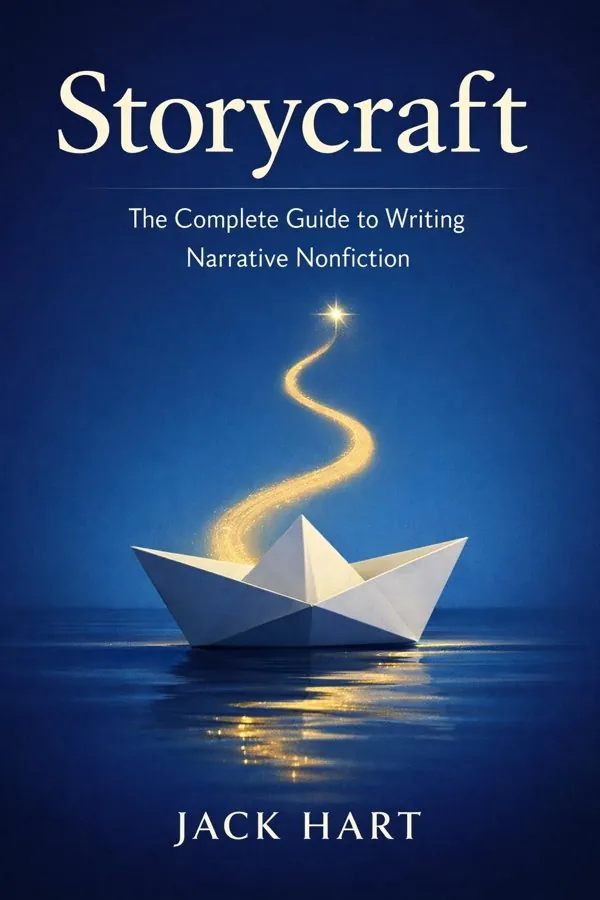
Storycraft: The Complete Guide to Writing Narrative Nonfiction: Summary & Key Insights
by Jack Hart
 10 min9 chaptersAudio available
Key Takeaways from Storycraft: The Complete Guide to Writing Narrative Nonfiction
A true story becomes compelling not when it merely presents information, but when it reveals a human struggle unfolding through time.
Readers rarely bond with issues; they bond with people.
A story that merely recounts events may entertain, but a story with theme resonates.
How a story sounds is inseparable from how it feels.
The more vivid a nonfiction story becomes, the more important trust becomes.
What Is Storycraft: The Complete Guide to Writing Narrative Nonfiction About?
Storycraft: The Complete Guide to Writing Narrative Nonfiction by Jack Hart is a writing book spanning 5 pages. Storycraft is a practical masterclass in turning factual reporting into stories readers cannot stop reading. In this influential guide, veteran editor and writing coach Jack Hart shows how narrative nonfiction can achieve the emotional force of a novel without compromising truth. His central premise is simple but powerful: facts alone rarely move readers, but facts shaped into scenes, driven by characters, and organized around tension can make reality feel urgent, vivid, and memorable. What makes the book especially valuable is Hart’s authority. After decades at The Oregonian, where he coached journalists and worked with Pulitzer Prize-winning reporters, he understands both the demands of rigorous reporting and the mechanics of compelling storytelling. He writes not as a theorist, but as an editor who has helped working writers solve real problems on deadline. Hart breaks down the essential elements of narrative craft—structure, character, scene, theme, voice, reporting, ethics, and revision—and explains how they work together in true stories. For journalists, essayists, biographers, podcasters, content writers, and anyone trying to make nonfiction more human and engaging, Storycraft remains one of the most useful guides to writing stories that are both accurate and unforgettable.
This FizzRead summary covers all 9 key chapters of Storycraft: The Complete Guide to Writing Narrative Nonfiction in approximately 10 minutes, distilling the most important ideas, arguments, and takeaways from Jack Hart's work. Also available as an audio summary and Key Quotes Podcast.
Storycraft: The Complete Guide to Writing Narrative Nonfiction
Storycraft is a practical masterclass in turning factual reporting into stories readers cannot stop reading. In this influential guide, veteran editor and writing coach Jack Hart shows how narrative nonfiction can achieve the emotional force of a novel without compromising truth. His central premise is simple but powerful: facts alone rarely move readers, but facts shaped into scenes, driven by characters, and organized around tension can make reality feel urgent, vivid, and memorable.
What makes the book especially valuable is Hart’s authority. After decades at The Oregonian, where he coached journalists and worked with Pulitzer Prize-winning reporters, he understands both the demands of rigorous reporting and the mechanics of compelling storytelling. He writes not as a theorist, but as an editor who has helped working writers solve real problems on deadline.
Hart breaks down the essential elements of narrative craft—structure, character, scene, theme, voice, reporting, ethics, and revision—and explains how they work together in true stories. For journalists, essayists, biographers, podcasters, content writers, and anyone trying to make nonfiction more human and engaging, Storycraft remains one of the most useful guides to writing stories that are both accurate and unforgettable.
Who Should Read Storycraft: The Complete Guide to Writing Narrative Nonfiction?
This book is perfect for anyone interested in writing and looking to gain actionable insights in a short read. Whether you're a student, professional, or lifelong learner, the key ideas from Storycraft: The Complete Guide to Writing Narrative Nonfiction by Jack Hart will help you think differently.
- ✓Readers who enjoy writing and want practical takeaways
- ✓Professionals looking to apply new ideas to their work and life
- ✓Anyone who wants the core insights of Storycraft: The Complete Guide to Writing Narrative Nonfiction in just 10 minutes
Want the full summary?
Get instant access to this book summary and 100K+ more with Fizz Moment.
Get Free SummaryAvailable on App Store • Free to download
Key Chapters
A true story becomes compelling not when it merely presents information, but when it reveals a human struggle unfolding through time. Hart argues that every strong narrative nonfiction piece has a core dramatic movement: someone wants something, something stands in the way, and events move toward a change, discovery, or resolution. This is not fictional manipulation. It is the writer’s disciplined effort to recognize and shape the natural story already present in reality.
Many nonfiction writers confuse importance with narrative power. They assume that if a topic matters socially or politically, readers will stay engaged. Hart warns that readers care most deeply when abstract issues are embodied in lived experience. A hospital policy becomes memorable when seen through a family waiting for test results. Economic decline becomes real when it is filtered through a shop owner deciding whether to close the doors. Narrative gives fact a human container.
To find this narrative core, the writer must identify the central tension early. What is unresolved? What question pulls the reader forward? What is at stake emotionally, materially, or morally? Once this is clear, reporting and structure become easier because the writer is no longer gathering random facts, but selecting details that support the unfolding dramatic line.
In practice, this means asking story-driven questions during reporting: Who is changing? What obstacle matters most? Where does the conflict intensify? Even explanatory or investigative pieces can benefit from this approach if they are grounded in a real journey rather than a pile of information.
Actionable takeaway: Before drafting, write one sentence that defines the story’s central tension—who wants what, what stands in the way, and why it matters.
Readers rarely bond with issues; they bond with people. Hart emphasizes that character and scene are the engines that convert information into emotion. A statistic may persuade the mind, but a person navigating a difficult moment captures the heart. In narrative nonfiction, real people are not decorative examples attached to a thesis. They are often the very means by which the truth becomes visible.
Strong character writing begins with close observation and deep reporting. Writers need to understand what a subject fears, desires, remembers, avoids, and values. This does not require psychologizing beyond the evidence. It requires attention to behavior, speech, decisions, habits, and the way others respond to that person. A compelling subject is rarely perfect or symbolic. Contradictions make people real.
Scene is equally important because it places readers inside time and space. Rather than summarizing that a firefighter faced a dangerous day, a writer reconstructs the station alert, the rush to the truck, the smell of smoke, the shouted instructions, and the split-second choices. Scenes create immediacy because they allow the story to happen before the reader’s eyes.
Hart’s lesson is that scenes must be earned through reporting. The writer cannot invent dialogue, gestures, or sensory details. Instead, scenes are built from interviews, notes, documents, observation, and corroboration. Done well, they provide both emotional force and factual credibility.
Actionable takeaway: In your next piece, choose one key person and one crucial moment, then report it deeply enough to render that moment as a fully grounded scene rather than a summary.
A story that merely recounts events may entertain, but a story with theme resonates. Hart shows that theme is the deeper idea or enduring question that gives narrative nonfiction significance beyond the immediate plot. It is what makes one person’s experience feel connected to larger truths about ambition, loss, injustice, resilience, identity, power, or belonging.
Theme should not be confused with a slogan or argument pasted onto the story. Hart’s approach is subtler. Theme emerges from the writer’s understanding of what the events ultimately mean, and it develops through selection, emphasis, pattern, and contrast. If a story follows a teacher in an underfunded school, the theme might concern the hidden cost of institutional neglect, the fragile heroism of ordinary labor, or the gap between policy rhetoric and lived reality. The writer does not need to announce this directly. The story can embody it.
One practical challenge is avoiding heavy-handedness. Readers resist feeling lectured. Hart suggests letting theme arise through recurring motifs, strategic juxtapositions, revealing quotes, and scenes that echo each other. The ending, in particular, often carries thematic weight by widening the lens from a specific episode to a broader implication.
Theme also helps with structure and revision. When writers know what their story is really about, they can cut vivid but irrelevant material. A beautifully reported anecdote that does not deepen the central meaning may still have to go.
Actionable takeaway: After reporting, ask yourself, “What larger truth does this story illuminate?” Use the answer to guide what you emphasize, what you cut, and how you shape the ending.
How a story sounds is inseparable from how it feels. Hart argues that narrative nonfiction succeeds not only because of what it says, but because of the voice, rhythm, and structure through which it is delivered. Readers experience prose physically: they feel the pace of sentences, the force of transitions, the pressure of withheld information, and the release of clarity. Craft at the sentence level influences the emotional arc of the whole.
Voice is the writer’s distinctive manner of seeing and telling. In nonfiction, it must serve the material rather than overpower it. A lyrical style may fit a meditative essay, while a spare, controlled voice may better suit investigative work. Hart encourages writers to develop a voice rooted in precision, authority, and tonal awareness, not ornament for its own sake.
Rhythm matters because prose can mimic action and mood. Short sentences can accelerate tension. Longer, more layered sentences can slow the pace for reflection or complexity. Paragraph breaks can create suspense, emphasis, or emotional breathing room. These choices are not cosmetic; they shape the reader’s journey through the narrative.
Structure, meanwhile, is the architecture of attention. Hart explores options such as chronological storytelling, braided narratives, delayed leads, and thematic organization. The key is not to be clever, but to choose the form that best serves the material. A strong structure guides readers effortlessly while preserving momentum.
Actionable takeaway: During revision, read your piece aloud and mark where the pace drags, the voice wobbles, or the structure confuses. Then revise for sound, flow, and narrative clarity—not just correctness.
The more vivid a nonfiction story becomes, the more important trust becomes. Hart insists that narrative power must never come at the expense of factual integrity. Because scenes, dialogue, and interiority can make nonfiction feel novelistic, writers must be especially disciplined about what they know, how they know it, and how they present it.
This means reporting beyond the obvious. To reconstruct scenes accurately, writers may need multiple interviews, timelines, public records, photographs, audio, contemporaneous notes, and corroborating witnesses. If a subject says, “I knew then my life was over,” the writer should understand whether that thought was recorded at the time or remembered later. Hart encourages skepticism not as cynicism, but as respect for reality.
Ethics also extend to framing and fairness. Writers make powerful choices about inclusion, omission, emphasis, and context. A scene may be true but misleading if stripped from the broader circumstances. A dramatic quote may distort if the speaker’s intention is not fully represented. Hart’s approach reminds writers that the goal is not maximum drama at any cost, but the truest possible account shaped for narrative clarity.
This is especially relevant in an era of blurred genre boundaries, performative personal essays, and highly produced narrative media. The more immersive the storytelling, the more careful the sourcing must be. Readers may forgive plainness; they will not forgive betrayal.
Actionable takeaway: Keep a clear reporting trail for every major scene and claim, and flag any detail you cannot verify. If you cannot support it, rewrite or remove it.
A narrative does not hold attention because events happen in order; it holds attention because each part creates a need to know what comes next. Hart treats structure as the management of curiosity. The writer’s task is to arrange material so that tension rises, information unfolds at the right moment, and the reader is always oriented yet eager.
This often begins with choosing the right opening. A story does not have to start at the beginning of a life or even at the beginning of the event. It should start where the narrative energy is strongest—at a moment of pressure, decision, disruption, or mystery. From there, the writer can move backward or outward as needed, as long as the reader never feels lost.
Hart also demonstrates the usefulness of complications, reversals, and revelations. If a profile simply catalogs admirable qualities, it goes flat. If an investigative narrative reveals all the findings immediately, the rest becomes summary. Structure should mirror discovery. Readers should experience the story as a sequence of meaningful turns.
A helpful practical method is to outline material in scenes or blocks, then identify the question each section raises and answers. If a section neither advances tension nor deepens meaning, it may belong elsewhere or not at all. Good structure is less about rigid templates than about purposeful progression.
Actionable takeaway: Create a scene-by-scene outline of your draft and write the central question of each section. If the chain of questions does not build momentum, reorder the piece until it does.
First drafts often reflect the order in which the writer learned the story, not the order in which readers should experience it. Hart treats revision as the real workshop of narrative nonfiction. It is where writers discover the story’s true shape, sharpen its meaning, and transform reporting into art.
Revision begins with distance. Instead of line-editing immediately, Hart encourages writers to reassess the piece at the structural level. Is the central tension clear? Does the lead launch the right story? Are the scenes placed for maximum impact? Is the ending earned? These questions matter more than sentence polish in early rounds.
Once the larger architecture works, the writer can refine scene construction, transitions, exposition, characterization, and pacing. Hart also stresses the importance of compression. Real life is sprawling; narrative must be selective. Revision is where writers remove throat-clearing, combine repetitive passages, sharpen dialogue, and tighten summary so that readers move through the story without friction.
Another crucial function of revision is checking alignment between intention and effect. A passage meant to be poignant may read sentimental. A scene intended as balanced may tilt unfairly. Reading aloud, soliciting feedback, and testing transitions can reveal these problems.
Ultimately, Hart frames revision not as punishment for imperfect drafting, but as the method by which truth becomes readable. Strong reporting gives you material. Strong revision gives it power.
Actionable takeaway: Separate revision into stages—first structure, then scene and pacing, then style and sentence work—so you improve the story in the order that matters most.
One of Hart’s most enduring contributions is showing that narrative craft is not limited to magazine features or literary journalism. Narrative thinking can strengthen nearly every form of nonfiction, including profiles, essays, memoir, investigative reporting, historical writing, longform audio, documentary scripting, and even brand storytelling when used responsibly.
At its heart, narrative thinking means asking better questions about human experience. Instead of merely asking what happened, the writer asks to whom it happened, what changed, what the stakes were, and how the events can be arranged to maximize meaning and attention. This mindset helps explanatory writing feel alive. It helps advocacy writing avoid abstraction. It helps educational material become memorable.
For example, a corporate case study is more persuasive when it follows a client confronting a real problem and moving through failed attempts toward a solution. A historical chapter becomes more gripping when it centers on decision points rather than chronology alone. A podcast episode lands more powerfully when exposition is interwoven with scenes, voices, and unresolved questions.
Hart does not suggest that every piece must become a dramatic saga. Rather, he offers a set of tools for making truth more accessible and affecting. In a crowded media environment, those tools matter. Readers and listeners have limited patience for inert information. They respond to movement, stakes, and human presence.
Actionable takeaway: Whatever kind of nonfiction you write, identify one place where you can replace abstract explanation with a person, a moment, and a clear tension.
All Chapters in Storycraft: The Complete Guide to Writing Narrative Nonfiction
About the Author
Jack Hart is an American editor, writing coach, and teacher widely recognized as one of the leading authorities on narrative nonfiction. He spent many years at The Oregonian, where he served in senior editorial roles, including managing editor, and became known for helping reporters shape deeply reported stories into compelling narratives. Over the course of his career, he coached numerous journalists, including Pulitzer Prize winners, and developed a reputation for making complex storytelling principles practical and teachable. Hart has also taught writing in academic and professional settings, influencing generations of nonfiction writers. His work stands out for combining literary sensibility with journalistic rigor, making him a trusted guide for writers who want to tell true stories with clarity, emotional force, and ethical precision.
Get This Summary in Your Preferred Format
Read or listen to the Storycraft: The Complete Guide to Writing Narrative Nonfiction summary by Jack Hart anytime, anywhere. FizzRead offers multiple formats so you can learn on your terms — all free.
Available formats: App · Audio · PDF · EPUB — All included free with FizzRead
Download Storycraft: The Complete Guide to Writing Narrative Nonfiction PDF and EPUB Summary
Key Quotes from Storycraft: The Complete Guide to Writing Narrative Nonfiction
“A true story becomes compelling not when it merely presents information, but when it reveals a human struggle unfolding through time.”
“Readers rarely bond with issues; they bond with people.”
“A story that merely recounts events may entertain, but a story with theme resonates.”
“How a story sounds is inseparable from how it feels.”
“The more vivid a nonfiction story becomes, the more important trust becomes.”
Frequently Asked Questions about Storycraft: The Complete Guide to Writing Narrative Nonfiction
Storycraft: The Complete Guide to Writing Narrative Nonfiction by Jack Hart is a writing book that explores key ideas across 9 chapters. Storycraft is a practical masterclass in turning factual reporting into stories readers cannot stop reading. In this influential guide, veteran editor and writing coach Jack Hart shows how narrative nonfiction can achieve the emotional force of a novel without compromising truth. His central premise is simple but powerful: facts alone rarely move readers, but facts shaped into scenes, driven by characters, and organized around tension can make reality feel urgent, vivid, and memorable. What makes the book especially valuable is Hart’s authority. After decades at The Oregonian, where he coached journalists and worked with Pulitzer Prize-winning reporters, he understands both the demands of rigorous reporting and the mechanics of compelling storytelling. He writes not as a theorist, but as an editor who has helped working writers solve real problems on deadline. Hart breaks down the essential elements of narrative craft—structure, character, scene, theme, voice, reporting, ethics, and revision—and explains how they work together in true stories. For journalists, essayists, biographers, podcasters, content writers, and anyone trying to make nonfiction more human and engaging, Storycraft remains one of the most useful guides to writing stories that are both accurate and unforgettable.
You Might Also Like
The Art of Perspective
Christopher Castellani
10 min
Making a Point: The Persnickety Story of English Punctuation
David Crystal
10 min
The Elements Of Eloquence: How To Turn The Perfect English Phrase
Mark Forsyth
10 min
The Pocket Muse: Ideas and Inspirations for Writing
Monica Wood
10 min
A Little Book on Form: An Exploration into the Formal Imagination of Poetry
Robert Hass
10 min
Adventures In The Screen Trade: A Personal View Of Hollywood And Screenwriting
William Goldman
10 minBrowse by Category
Ready to read Storycraft: The Complete Guide to Writing Narrative Nonfiction?
Get the full summary and 100K+ more books with Fizz Moment.