
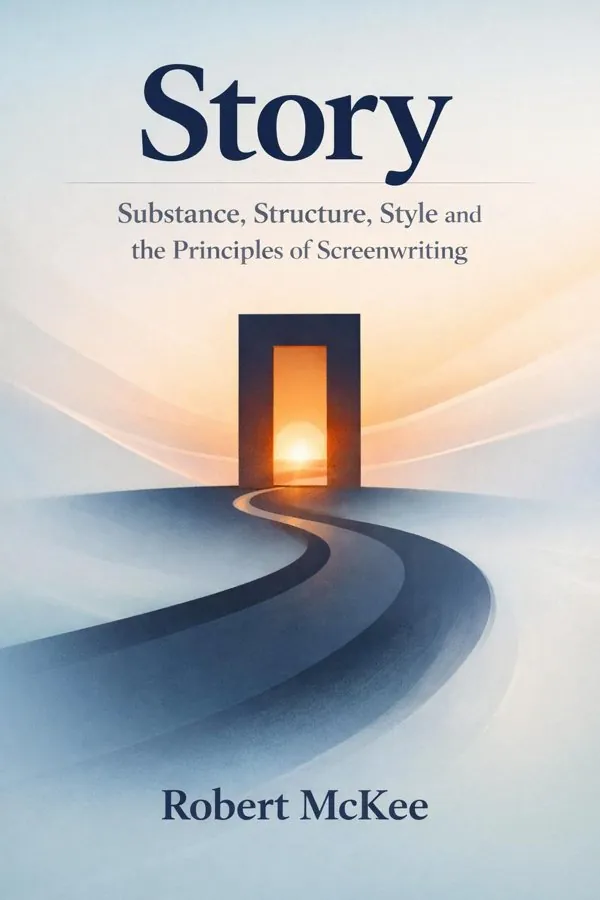
Story: Substance, Structure, Style and the Principles of Screenwriting: Summary & Key Insights
by Robert McKee
 10 min9 chaptersAudio available
Key Takeaways from Story: Substance, Structure, Style and the Principles of Screenwriting
Most weak scripts do not fail because the writer lacks talent; they fail because the writer mistakes inspiration for craft.
Story is not a copy of life; it is life shaped into meaningful form.
A setting is never just a backdrop; it is a pressure system that shapes behavior.
People do not truly reveal themselves when life is easy; they reveal themselves when forced to choose under pressure.
Not all stories follow the same shape, but all effective stories are designed.
What Is Story: Substance, Structure, Style and the Principles of Screenwriting About?
Story: Substance, Structure, Style and the Principles of Screenwriting by Robert McKee is a writing book spanning 11 pages. Great stories do not happen by accident. They are built through a disciplined understanding of structure, character, conflict, and change. In Story, Robert McKee offers one of the most influential and enduring guides to the craft of screenwriting, showing writers how to move beyond clever scenes and promising ideas to create narratives that truly work. Rather than treating storytelling as a formula, McKee examines the underlying principles that shape meaningful drama across film, television, and even fiction. What makes this book matter is its combination of artistic seriousness and practical precision. McKee argues that audiences do not respond to spectacle alone; they respond to stories that reveal human truth through action, choice, and consequence. He explores how scenes turn, how acts build, how characters are exposed under pressure, and how structure gives emotional power to theme. McKee’s authority comes from decades of teaching, consulting, and analyzing classic and contemporary films. His seminars have influenced generations of writers, directors, and producers. Story remains a foundational text because it does more than explain screenwriting mechanics: it teaches how to think like a storyteller.
This FizzRead summary covers all 9 key chapters of Story: Substance, Structure, Style and the Principles of Screenwriting in approximately 10 minutes, distilling the most important ideas, arguments, and takeaways from Robert McKee's work. Also available as an audio summary and Key Quotes Podcast.
Story: Substance, Structure, Style and the Principles of Screenwriting
Great stories do not happen by accident. They are built through a disciplined understanding of structure, character, conflict, and change. In Story, Robert McKee offers one of the most influential and enduring guides to the craft of screenwriting, showing writers how to move beyond clever scenes and promising ideas to create narratives that truly work. Rather than treating storytelling as a formula, McKee examines the underlying principles that shape meaningful drama across film, television, and even fiction.
What makes this book matter is its combination of artistic seriousness and practical precision. McKee argues that audiences do not respond to spectacle alone; they respond to stories that reveal human truth through action, choice, and consequence. He explores how scenes turn, how acts build, how characters are exposed under pressure, and how structure gives emotional power to theme.
McKee’s authority comes from decades of teaching, consulting, and analyzing classic and contemporary films. His seminars have influenced generations of writers, directors, and producers. Story remains a foundational text because it does more than explain screenwriting mechanics: it teaches how to think like a storyteller.
Who Should Read Story: Substance, Structure, Style and the Principles of Screenwriting?
This book is perfect for anyone interested in writing and looking to gain actionable insights in a short read. Whether you're a student, professional, or lifelong learner, the key ideas from Story: Substance, Structure, Style and the Principles of Screenwriting by Robert McKee will help you think differently.
- ✓Readers who enjoy writing and want practical takeaways
- ✓Professionals looking to apply new ideas to their work and life
- ✓Anyone who wants the core insights of Story: Substance, Structure, Style and the Principles of Screenwriting in just 10 minutes
Want the full summary?
Get instant access to this book summary and 100K+ more with Fizz Moment.
Get Free SummaryAvailable on App Store • Free to download
Key Chapters
Most weak scripts do not fail because the writer lacks talent; they fail because the writer mistakes inspiration for craft. McKee begins with a hard truth: many aspiring storytellers are rich in feeling, opinion, and imagination, yet poor in the technical understanding needed to shape those impulses into compelling drama. They may begin with a vivid premise, a fascinating setting, or a personal message, but without mastery of story design, the work collapses into cliché, confusion, or empty style.
McKee argues that modern culture often encourages writers to imitate surfaces rather than study causes. They copy dialogue rhythms, camera-friendly moments, or fashionable darkness, hoping the result will feel cinematic. But audiences are moved not by borrowed gestures. They are moved by stories that create meaningful change through escalating conflict and decisive turning points. A screenplay must do more than express a mood; it must organize experience into a dynamic chain of events.
A common example is the script built around “interesting characters” who talk beautifully but never truly face irreversible choices. Another is the plot-heavy script full of incident but empty of emotional logic. In both cases, the writer has mistaken pieces of story for story itself. McKee insists that craft is not the enemy of creativity. It is what allows creativity to reach the audience.
The practical lesson is simple: do not ask only, “What do I want to say?” Ask, “What is the form that will make an audience feel and understand it?” Study structure, causality, and turning points until instinct becomes skill. Actionable takeaway: diagnose your current project by identifying where genuine change occurs; if the answer is vague, the real problem is structural, not stylistic.
Story is not a copy of life; it is life shaped into meaningful form. McKee’s central principle is that storytelling creates a metaphor for human experience. Real life is sprawling, repetitive, and often unresolved. Story selects, compresses, and arranges events so that the audience can perceive pattern, causality, and value change. In this sense, story design is not falsification. It is clarification.
This idea matters because many writers chase realism in the wrong way. They fill scripts with ordinary behavior, fragmented conversation, and random incident, believing authenticity lies in raw imitation. McKee argues the opposite. The more closely a script mimics the shapelessness of everyday life, the less likely it is to reveal truth. Art finds truth through design. A strong narrative identifies what matters, removes what does not, and heightens moments of change so the audience can experience life with greater intensity and coherence.
Think of a family drama. In life, resentment may accumulate over decades through hundreds of small slights. In a screenplay, that emotional history must be embodied in a finite sequence of scenes that expose the relationship’s pressure points. The writer chooses events that turn values: trust to suspicion, intimacy to distance, shame to confrontation. Structure makes the invisible visible.
McKee also reminds writers that story is fundamentally about values in motion. A scene is not just “about a dinner” or “about a conversation.” It is about a shift in love, freedom, power, justice, hope, or self-respect. Once writers think in terms of value change, scenes gain purpose and shape.
Actionable takeaway: for every major scene in your draft, define the human value at stake and how it changes from beginning to end. If no value shifts, the scene likely belongs elsewhere or not at all.
A setting is never just a backdrop; it is a pressure system that shapes behavior. McKee emphasizes that structure and setting are deeply connected because the world of a story determines what kinds of conflicts are possible, what stakes feel urgent, and what choices reveal character most forcefully. Time period, social environment, geography, institutions, and cultural codes all influence the design of events.
Writers often treat setting as decoration: a historical era, a crime-ridden city, a suburban neighborhood, a newsroom, a spaceship. But a true story world does more than look distinctive. It generates conflict. A courtroom drama works because rules of procedure, status, evidence, and public judgment create a natural arena of pressure. A romantic story set in a rigid class system produces different complications than one set in contemporary urban life. The setting should not merely host the plot; it should actively shape it.
McKee also shows that structure emerges from limitations. When characters are embedded in a richly defined world, their choices become more consequential. A journalist in an authoritarian state, a soldier behind enemy lines, or a teenager in a reputation-driven high school all face distinct forms of antagonism. The world closes some doors and opens others, making action specific rather than generic.
This principle applies across media and genres. A thriller set in a hospital gains urgency from institutional hierarchy, ethics, physical vulnerability, and time pressure. A comedy set at a wedding gains energy from rituals, family tensions, and public performance. The writer’s task is to exploit the setting’s built-in contradictions.
Actionable takeaway: write a one-page “pressure map” of your story world listing its social rules, dangers, hierarchies, taboos, and resources. Then revise your plot so each major turn could only happen in that world, not in any interchangeable location.
People do not truly reveal themselves when life is easy; they reveal themselves when forced to choose under pressure. This is one of McKee’s most famous principles, and it sharply distinguishes genuine characterization from surface description. Character is not biography, likability, or a bundle of quirks. It is the deep nature of a person disclosed by the choices they make when the stakes are high and the alternatives are difficult.
Writers often confuse characterization with character. Characterization includes age, profession, speech pattern, wardrobe, habits, backstory, and psychology. These elements can enrich a script, but they do not by themselves create dramatic truth. A charming lawyer, a sarcastic detective, or a shy musician remains abstract until conflict demands action. If the lawyer betrays a client to save a child, if the detective plants evidence to secure justice, if the musician abandons a career to care for a rival, then we begin to know who they are.
McKee’s point is not that backstory is irrelevant. It is that backstory matters only insofar as it explains pressure and shapes present action. A screenplay must dramatize, not merely describe, a person’s moral and emotional core. This is why great stories place protagonists in increasingly difficult dilemmas. Each decision strips away pretense and exposes value systems.
In practical terms, a writer should build scenes around incompatible goods or painful tradeoffs, not trivial preferences. “Does the hero go left or right?” is rarely meaningful. “Does the hero protect the truth and lose the person they love, or lie and preserve the relationship?” reveals something essential. Such moments create both plot movement and emotional depth.
Actionable takeaway: identify your protagonist’s defining value, then design three escalating scenes that force them to choose between that value and something else they desperately want. Let the audience discover character through action, not explanation.
Not all stories follow the same shape, but all effective stories are designed. McKee introduces a spectrum of narrative forms to help writers understand classical design, minimalism, and anti-structure. His goal is not to trap writers inside formula, but to show that even unconventional storytelling gains power when the writer understands what conventions they are using, bending, or rejecting.
Classical design typically centers on a single active protagonist pursuing a desire through continuous time, consistent reality, and closed ending. This form dominates mainstream cinema because it creates clarity, momentum, and emotional payoff. Minimalism reduces or relaxes some of these features: a more passive protagonist, internal conflict, open endings, or looser causality. Anti-structure deliberately subverts linearity, coherence, or stable reality. McKee does not dismiss these alternatives; he simply warns that writers often imitate fragmented forms without earning them.
The key lesson is that form should arise from substance. A nonlinear story can deepen mystery, mirror trauma, or reveal theme by rearranging cause and effect. But if chronology is scrambled merely to appear sophisticated, the result is confusion. Similarly, an open ending can be profound when it reflects the story’s moral complexity, yet frustrating when it merely avoids resolution.
A writer choosing structure must ask what emotional experience the audience should have. A revenge thriller may benefit from classical escalation. A memory-driven drama may require selective fragmentation. The issue is not whether a film is traditional or experimental; it is whether its design intensifies meaning.
Actionable takeaway: define your story’s form consciously. Write a short note explaining why your project should be linear or nonlinear, closed or open, singular or multi-stranded. If you cannot justify the form in terms of audience effect and theme, reconsider your design choices.
A screenplay advances not because things happen, but because values change. McKee’s treatment of act design and scene design is one of the book’s most practical contributions. He argues that every scene should be built around conflict that turns a value at stake, and that acts are larger movements composed of these turning scenes. Structure is therefore not a rigid template of page counts. It is a progression of meaningful reversals.
A scene begins with a situation charged by expectation. Through action and reaction, conflict grows until an event creates a turning point. By the end of the scene, the value has shifted: confidence becomes doubt, control becomes chaos, affection becomes rejection. If the scene leaves the value unchanged, it may contain information, but it lacks dramatic necessity. The same principle scales upward. An act is not just a block of pages; it is a series of scenes that culminates in a major turning point, one that sends the story into a new and more difficult phase.
This is why exposition-heavy or repetitive scenes often feel dead. They may communicate facts, but they do not alter the story’s emotional or moral direction. By contrast, a well-designed scene can combine information, characterization, and plot movement in one turn. For example, a job interview scene can begin with hope and end in humiliation, while also revealing the protagonist’s flaw and launching the next action.
McKee also emphasizes rhythm: scenes should vary in length, texture, and intensity while contributing to a larger build. Acts should escalate pressure rather than repeat it. The audience must feel that each beat narrows options and increases consequences.
Actionable takeaway: outline your script as a chain of value turns. For each scene, write “from” and “to” labels, such as “trust to betrayal” or “safety to danger.” Then identify the act-ending turns that fundamentally alter the protagonist’s path.
The quality of a story depends on the quality of its opposition. McKee argues that conflict is not an optional spice added to plot; it is the engine that reveals character and drives meaning. More specifically, he introduces the principle of antagonism: a protagonist and their world should be matched by forces of opposition strong enough to compel deep commitment, difficult adaptation, and genuine transformation.
Many scripts weaken themselves by underestimating the antagonist. Writers create obstacles that are too convenient, too external, or too easily overcome. The hero wants something, encounters minor resistance, and proceeds without paying a serious price. But compelling drama requires progressively intensifying opposition. The protagonist should face resistance from every level of life: inner conflict, personal relationships, institutions, society, environment, and sometimes fate itself.
Importantly, antagonism does not mean a villain in every story. In a love story, the antagonist may be emotional fear, social expectation, or conflicting life goals. In a workplace drama, it may be bureaucracy, ethical compromise, or a rival system of values. The antagonist is whatever force best prevents the protagonist from attaining their object of desire.
McKee’s deeper insight is that meaningful choice emerges only under true pressure. If the hero can achieve their goal without sacrifice, their actions reveal little. But when opposition intensifies, the protagonist must take risks, abandon illusions, or redefine what success means. This is where theme comes alive: not in speeches, but in the clash between human desire and resistance.
Actionable takeaway: list the opposing forces in your story at the internal, interpersonal, and external levels. Then strengthen each one so that every major success by the protagonist creates a new complication, cost, or counterattack. Make the struggle worthy of the character you want to reveal.
What characters say is rarely the whole story; often, it is the least important part. McKee treats dialogue as one expressive tool among many, not a substitute for dramatic design. Strong dialogue grows out of situation, desire, conflict, and subtext. Weak dialogue exists to explain the plot, announce emotions, or decorate scenes with wit detached from dramatic purpose.
His view of exposition is especially useful. Information is necessary, but audiences resist feeling lectured. The writer’s challenge is to bury exposition within conflict so that facts emerge as part of pursuit, concealment, persuasion, or attack. Rather than having a detective calmly explain the case, place them in an argument with a superior where each revelation carries tactical value. Rather than having lovers confess their backstory directly, let details surface through misunderstanding, memory, and avoidance. Information becomes engaging when it is emotionally charged.
Subtext is equally central. People often speak indirectly because they fear vulnerability, seek leverage, protect themselves, or test others. A line like “You’re home late” may actually mean “I was afraid you’d leave me,” “I know you’re lying,” or “I need proof that I matter.” Good dialogue allows the audience to sense the hidden transaction beneath the words. This makes scenes richer and more active because speech becomes a form of strategy.
McKee also reminds writers that silence, gesture, pacing, interruption, and image can communicate more than explanation. A character who folds a resignation letter instead of delivering a speech may reveal more about fear and resolve than paragraphs of dialogue.
Actionable takeaway: revise any exposition-heavy scene by asking what each character wants in that moment. Then rewrite the exchange so information is revealed indirectly through conflict, omission, and subtext rather than direct explanation.
Technique alone does not create a memorable story; it must be joined to insight into human life. In McKee’s final emphasis on the writer’s method and the substance of story, he argues that craft serves content, and content emerges from the writer’s serious engagement with values, contradictions, and the hidden dynamics of experience. A script is not simply a machine of plot points. It is an expression of how the writer sees the world.
This does not mean preaching a message. McKee is wary of didactic writing, because audiences resist being instructed. Instead, he urges writers to explore questions dramatically. What is justice worth when truth destroys a family? What happens when ambition consumes love? Can forgiveness restore dignity after betrayal? These are not themes to be stated in abstract form and then illustrated mechanically. They are tensions to be embodied in characters and conflicts.
The writer’s method therefore includes research, observation, self-examination, and relentless rewriting. Writers must understand the worlds they depict, but they must also understand their own obsessions. Why this story? Why now? What value conflict compels you? McKee suggests that authentic energy enters a screenplay when the writer confronts material that matters personally while shaping it impersonally through craft.
He also stresses professionalism: drafting, testing, cutting, and refining. Inspiration may launch a project, but only disciplined revision discovers the most truthful arrangement of scenes. The writer must move back and forth between intuition and analysis, feeling and form.
Actionable takeaway: write a brief statement of the central value conflict in your story and why it matters to you personally. Then evaluate every major scene by asking whether it deepens that conflict. If a scene does not serve the story’s substance, no amount of polish will save it.
All Chapters in Story: Substance, Structure, Style and the Principles of Screenwriting
About the Author
Robert McKee is an American author, lecturer, and story consultant best known for his influential work on screenwriting and the craft of storytelling. He gained international recognition through his intensive story seminars, which have drawn writers, directors, producers, and creative professionals from across film, television, publishing, and advertising. McKee is respected for his rigorous approach to narrative structure, character, scene design, and dramatic principle, and his teachings have shaped generations of storytellers. His book Story became a landmark text in screenwriting education, valued for both its analytical depth and practical guidance. Although he is often associated with film, McKee’s ideas have reached far beyond Hollywood, influencing anyone interested in how compelling narratives are built and why stories matter so deeply to human experience.
Get This Summary in Your Preferred Format
Read or listen to the Story: Substance, Structure, Style and the Principles of Screenwriting summary by Robert McKee anytime, anywhere. FizzRead offers multiple formats so you can learn on your terms — all free.
Available formats: App · Audio · PDF · EPUB — All included free with FizzRead
Download Story: Substance, Structure, Style and the Principles of Screenwriting PDF and EPUB Summary
Key Quotes from Story: Substance, Structure, Style and the Principles of Screenwriting
“Most weak scripts do not fail because the writer lacks talent; they fail because the writer mistakes inspiration for craft.”
“Story is not a copy of life; it is life shaped into meaningful form.”
“A setting is never just a backdrop; it is a pressure system that shapes behavior.”
“People do not truly reveal themselves when life is easy; they reveal themselves when forced to choose under pressure.”
“Not all stories follow the same shape, but all effective stories are designed.”
Frequently Asked Questions about Story: Substance, Structure, Style and the Principles of Screenwriting
Story: Substance, Structure, Style and the Principles of Screenwriting by Robert McKee is a writing book that explores key ideas across 9 chapters. Great stories do not happen by accident. They are built through a disciplined understanding of structure, character, conflict, and change. In Story, Robert McKee offers one of the most influential and enduring guides to the craft of screenwriting, showing writers how to move beyond clever scenes and promising ideas to create narratives that truly work. Rather than treating storytelling as a formula, McKee examines the underlying principles that shape meaningful drama across film, television, and even fiction. What makes this book matter is its combination of artistic seriousness and practical precision. McKee argues that audiences do not respond to spectacle alone; they respond to stories that reveal human truth through action, choice, and consequence. He explores how scenes turn, how acts build, how characters are exposed under pressure, and how structure gives emotional power to theme. McKee’s authority comes from decades of teaching, consulting, and analyzing classic and contemporary films. His seminars have influenced generations of writers, directors, and producers. Story remains a foundational text because it does more than explain screenwriting mechanics: it teaches how to think like a storyteller.
You Might Also Like
The Art of Perspective
Christopher Castellani
10 min
Making a Point: The Persnickety Story of English Punctuation
David Crystal
10 min
The Elements Of Eloquence: How To Turn The Perfect English Phrase
Mark Forsyth
10 min
The Pocket Muse: Ideas and Inspirations for Writing
Monica Wood
10 min
A Little Book on Form: An Exploration into the Formal Imagination of Poetry
Robert Hass
10 min
Adventures In The Screen Trade: A Personal View Of Hollywood And Screenwriting
William Goldman
10 minBrowse by Category
Ready to read Story: Substance, Structure, Style and the Principles of Screenwriting?
Get the full summary and 100K+ more books with Fizz Moment.