
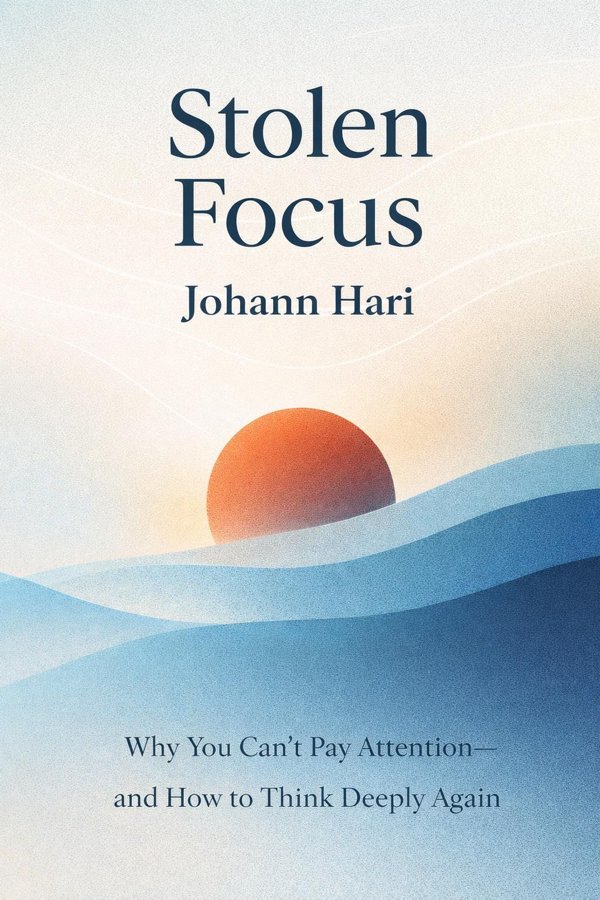
Stolen Focus: Why You Can't Pay Attention—and How to Think Deeply Again: Summary & Key Insights
by Johann Hari
 10 min10 chaptersAudio available
What Is Stolen Focus: Why You Can't Pay Attention—and How to Think Deeply Again About?
Stolen Focus: Why You Can't Pay Attention—and How to Think Deeply Again by Johann Hari is a psychology book spanning 10 pages. In this book, Johann Hari explores the modern crisis of attention and concentration. Drawing on scientific research and interviews with experts, he investigates how technology, stress, and societal changes have eroded our ability to focus. Hari offers insights into reclaiming deep thinking and living a more attentive life.
This FizzRead summary covers all 10 key chapters of Stolen Focus: Why You Can't Pay Attention—and How to Think Deeply Again in approximately 10 minutes, distilling the most important ideas, arguments, and takeaways from Johann Hari's work. Also available as an audio summary and Key Quotes Podcast.
Stolen Focus: Why You Can't Pay Attention—and How to Think Deeply Again
In this book, Johann Hari explores the modern crisis of attention and concentration. Drawing on scientific research and interviews with experts, he investigates how technology, stress, and societal changes have eroded our ability to focus. Hari offers insights into reclaiming deep thinking and living a more attentive life.
Who Should Read Stolen Focus: Why You Can't Pay Attention—and How to Think Deeply Again?
This book is perfect for anyone interested in psychology and looking to gain actionable insights in a short read. Whether you're a student, professional, or lifelong learner, the key ideas from Stolen Focus: Why You Can't Pay Attention—and How to Think Deeply Again by Johann Hari will help you think differently.
- ✓Readers who enjoy psychology and want practical takeaways
- ✓Professionals looking to apply new ideas to their work and life
- ✓Anyone who wants the core insights of Stolen Focus: Why You Can't Pay Attention—and How to Think Deeply Again in just 10 minutes
Want the full summary?
Get instant access to this book summary and 100K+ more with Fizz Moment.
Get Free SummaryAvailable on App Store • Free to download
Key Chapters
Everywhere I went, I found evidence that our ability to concentrate is disappearing. Studies show that collective attention spans are shrinking; children struggle to read books without flipping to another screen; adults switch tasks every few minutes. Neurologically, the circuits that sustain focus are being weakened by overstimulation. It’s not just anecdotal—it’s measurable.
I spoke with Professor Gloria Mark, who has spent years studying how people work in the digital age. Her research reveals that the average office worker now stays focused on one task for less than a minute before switching. The constant interruptions and micro-switches degrade the quality of thought. Deep focus, the kind that produces insight and creativity, requires sustained immersion—yet our current environment relentlessly undermines it.
I remember sitting in a café, trying to read a novel, when my phone lit up with alerts: messages, updates, news. Each time I reached for it, I felt a small spike of relief and guilt. Relief because I felt connected again; guilt because I couldn’t bear the silence that concentration demands. This pattern mirrored what millions experience daily—an invisible erosion of mental stamina.
The decline of deep focus isn’t just a personal issue—it’s cultural. When a society loses its collective ability to pay attention, truth becomes fragmented and public discourse shallow. We start mistaking speed for insight. If we hope to recover meaning, we must first admit the scale of this decline and rediscover what sustained attention feels like: slow, imperfect, but profoundly human.
The more I learned, the clearer it became that our devices aren’t neutral tools—they’re attention traps. Social media platforms and smartphones are engineered to exploit psychological vulnerabilities for profit. Every notification, every infinite scroll is designed to keep us hooked because your attention is worth billions.
I spoke with former Silicon Valley insiders, people who helped design these systems. They told me that apps are optimized to generate addiction. Algorithms learn exactly what will keep you online a few seconds longer, feeding you dopamine one small hit at a time. Our brains, trained by these mechanisms, start craving constant novelty. Nothing competes with that instant reward—not family dinners, not books, not silence.
We often think technology gives us choices, but in reality, it shapes them. When companies compete for engagement rather than truth or wellbeing, they flood our mental environment with noise. We don’t merely lose time—we lose agency over what we pay attention to.
Yet there’s hope in awareness. When we recognize that distraction is not a personal flaw but an engineered outcome, we can take back control. That doesn’t mean rejecting technology altogether. It means reclaiming the right to decide when and how we use it, learning to design our attention intentionally rather than surrendering it to algorithms that profit when we look away from our own lives.
+ 8 more chapters — available in the FizzRead app
All Chapters in Stolen Focus: Why You Can't Pay Attention—and How to Think Deeply Again
About the Author
Johann Hari is a British-Swiss writer and journalist known for his works on social and psychological issues. He has written for major publications and authored several bestselling books addressing addiction, depression, and attention in the modern world.
Get This Summary in Your Preferred Format
Read or listen to the Stolen Focus: Why You Can't Pay Attention—and How to Think Deeply Again summary by Johann Hari anytime, anywhere. FizzRead offers multiple formats so you can learn on your terms — all free.
Available formats: App · Audio · PDF · EPUB — All included free with FizzRead
Download Stolen Focus: Why You Can't Pay Attention—and How to Think Deeply Again PDF and EPUB Summary
Key Quotes from Stolen Focus: Why You Can't Pay Attention—and How to Think Deeply Again
“Everywhere I went, I found evidence that our ability to concentrate is disappearing.”
“The more I learned, the clearer it became that our devices aren’t neutral tools—they’re attention traps.”
Frequently Asked Questions about Stolen Focus: Why You Can't Pay Attention—and How to Think Deeply Again
Stolen Focus: Why You Can't Pay Attention—and How to Think Deeply Again by Johann Hari is a psychology book that explores key ideas across 10 chapters. In this book, Johann Hari explores the modern crisis of attention and concentration. Drawing on scientific research and interviews with experts, he investigates how technology, stress, and societal changes have eroded our ability to focus. Hari offers insights into reclaiming deep thinking and living a more attentive life.
More by Johann Hari
Stolen Focus
Johann Hari
10 min
Lost Connections: Why You're Depressed and How to Find Hope
Johann Hari
10 min
Stolen Focus: Why You Can't Pay Attention – and How to Think Deeply Again
Johann Hari
10 min
Lost Connections: Uncovering the Real Causes of Depression – and the Unexpected Solutions
Johann Hari
10 minYou Might Also Like

The Body Keeps the Score
Bessel van der Kolk
10 min
Surrounded by Idiots
Thomas Erikson
10 min
Emotional Intelligence
Daniel Goleman
10 min
Attached
Amir Levine
10 min
Why Does He Do That
Lundy Bancroft
10 min
Women Who Run with the Wolves
Clarissa Pinkola Estés
10 minBrowse by Category
Ready to read Stolen Focus: Why You Can't Pay Attention—and How to Think Deeply Again?
Get the full summary and 100K+ more books with Fizz Moment.