
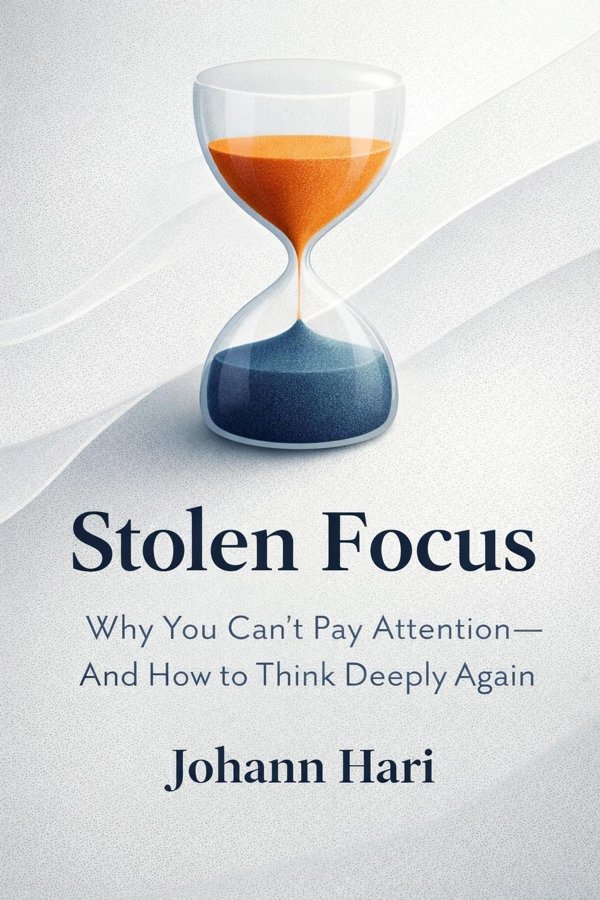
Stolen Focus: Summary & Key Insights
by Johann Hari
 10 min9 chaptersAudio available
Key Takeaways from Stolen Focus
One of the book’s most unsettling ideas is that your distracted mind may not be an individual defect at all.
The mind feels busy when it switches rapidly between tasks, but busy is not the same as effective.
If a product is free, your attention is often the real product.
A stressed mind is not an empty mind; it is an overcrowded one.
Many people try to solve attention problems while consistently depriving the brain of the one condition it needs most: rest.
What Is Stolen Focus About?
Stolen Focus by Johann Hari is a psychology book. What if your inability to concentrate is not a personal failure, but a symptom of a wider crisis? In Stolen Focus, journalist Johann Hari argues that our shrinking attention spans are not simply the result of weak willpower, bad habits, or too much scrolling. Instead, they are being systematically undermined by powerful social, technological, economic, and environmental forces. Hari blends investigative reporting, scientific research, interviews with experts, and personal experimentation to explore why so many people struggle to think deeply, read fully, and stay present. The book matters because attention is not a minor mental skill. It shapes learning, relationships, creativity, democracy, and even our sense of self. If we cannot focus, we cannot reflect, make wise choices, or build meaningful lives. Hari writes with urgency and empathy, connecting cutting-edge psychology and neuroscience with everyday experience. As an award-winning journalist known for turning complex research into vivid, human stories, he offers both diagnosis and hope. Stolen Focus is a powerful invitation to rethink modern life and reclaim the mental space needed for depth, calm, and real freedom.
This FizzRead summary covers all 9 key chapters of Stolen Focus in approximately 10 minutes, distilling the most important ideas, arguments, and takeaways from Johann Hari's work. Also available as an audio summary and Key Quotes Podcast.
Stolen Focus
What if your inability to concentrate is not a personal failure, but a symptom of a wider crisis? In Stolen Focus, journalist Johann Hari argues that our shrinking attention spans are not simply the result of weak willpower, bad habits, or too much scrolling. Instead, they are being systematically undermined by powerful social, technological, economic, and environmental forces. Hari blends investigative reporting, scientific research, interviews with experts, and personal experimentation to explore why so many people struggle to think deeply, read fully, and stay present.
The book matters because attention is not a minor mental skill. It shapes learning, relationships, creativity, democracy, and even our sense of self. If we cannot focus, we cannot reflect, make wise choices, or build meaningful lives. Hari writes with urgency and empathy, connecting cutting-edge psychology and neuroscience with everyday experience. As an award-winning journalist known for turning complex research into vivid, human stories, he offers both diagnosis and hope. Stolen Focus is a powerful invitation to rethink modern life and reclaim the mental space needed for depth, calm, and real freedom.
Who Should Read Stolen Focus?
This book is perfect for anyone interested in psychology and looking to gain actionable insights in a short read. Whether you're a student, professional, or lifelong learner, the key ideas from Stolen Focus by Johann Hari will help you think differently.
- ✓Readers who enjoy psychology and want practical takeaways
- ✓Professionals looking to apply new ideas to their work and life
- ✓Anyone who wants the core insights of Stolen Focus in just 10 minutes
Want the full summary?
Get instant access to this book summary and 100K+ more with Fizz Moment.
Get Free SummaryAvailable on App Store • Free to download
Key Chapters
One of the book’s most unsettling ideas is that your distracted mind may not be an individual defect at all. Hari argues that millions of people are losing the ability to focus for long periods because modern systems are actively designed to fragment attention. The problem is larger than personal discipline. It is built into the technologies we use, the workplaces we inhabit, and the pace of the culture around us.
He challenges the common belief that if people simply had more self-control, they could resist distraction. Instead, he shows how attention has become a resource that corporations compete to capture and monetize. Social media platforms, news apps, notifications, and endless feeds are engineered to pull us back again and again. The result is not occasional distraction, but a continual state of interruption that weakens our capacity for deep thought.
This insight matters because it changes the emotional frame. If distraction is treated only as a moral weakness, people feel guilt and shame. If it is understood as a structural issue, then better solutions become possible. A person trying to write, study, or even listen closely in conversation is not just fighting laziness; they are pushing against systems built to break concentration into profitable fragments.
In practical terms, this means focus should be protected the way we protect sleep, nutrition, or clean air. Turning off nonessential notifications, setting phone-free work blocks, and creating designated spaces for reading or thinking are not small lifestyle tricks. They are ways of defending a mental resource under constant pressure.
Actionable takeaway: Stop blaming yourself for every lapse in concentration and identify the external forces stealing your attention. Then remove at least three recurring sources of interruption from your daily environment this week.
The mind feels busy when it switches rapidly between tasks, but busy is not the same as effective. Hari explains that what people call multitasking is usually task-switching, and task-switching comes with a heavy cognitive cost. Each interruption forces the brain to reorient, reload context, and recover momentum. Over time, this process makes thought shallower, slower, and more exhausting.
The seductive myth of multitasking survives because it creates the illusion of productivity. Answering messages during meetings, checking email while writing, or scrolling during study sessions can feel efficient. Yet research discussed in the book suggests the opposite: fragmented work lowers accuracy, reduces creativity, and increases fatigue. Even brief interruptions can leave a residue in the mind, making it harder to return to demanding work.
Hari’s argument extends beyond the office. Children doing homework with open tabs, adults trying to read while checking their phones, and families dividing attention between loved ones and screens are all experiencing the same loss of depth. The ability to sustain a single line of thought is not old-fashioned; it is essential for comprehension, problem-solving, and emotional presence.
A practical example is reading. Many people find themselves rereading the same paragraph because their attention is split. The issue is not intelligence. It is that the brain has been trained to expect novelty and interruption. Deep engagement requires frictionless time, not constant switching.
To counter this, Hari points toward monotasking: doing one thing at a time with full attention. That may mean closing all tabs except the one you need, checking email at set intervals instead of continuously, or keeping your phone in another room during meaningful work.
Actionable takeaway: Choose one daily activity that matters, such as reading, writing, or conversation, and practice doing it for 25 uninterrupted minutes with all other devices and tabs closed.
If a product is free, your attention is often the real product. Hari examines how digital platforms are not neutral tools but systems intentionally designed to exploit psychological vulnerabilities. The goal is not simply to help users communicate or find information. The goal is to keep them engaged for as long as possible, because more engagement generates more data, more ad exposure, and more profit.
This design logic helps explain why people often use technology in ways they never consciously chose. Features such as infinite scroll, autoplay, variable rewards, algorithmic recommendations, and persistent notifications are not accidental conveniences. They are behavioral hooks. They train users to seek quick hits of novelty and emotional stimulation, often at the expense of calm, reflection, and self-direction.
Hari’s point is not that technology is evil or that everyone should disconnect completely. Rather, he asks readers to see clearly how digital environments shape behavior. A person may open an app for one purpose and emerge 40 minutes later without remembering what they intended to do. This is not just absentmindedness. It is the result of systems built to hijack curiosity and reward compulsion.
The practical implication is that healthier attention often requires changing the design conditions, not just increasing motivation. For example, removing social media from your phone and accessing it only through a browser creates friction. Disabling autoplay on video platforms interrupts passive consumption. Using grayscale mode can reduce the sensory pull of apps.
At a social level, Hari suggests the issue also demands regulation and public pressure. Individual defenses help, but they are limited when facing industries that spend billions optimizing for addiction-like engagement.
Actionable takeaway: Audit the top three apps that consume your time and change one design feature for each, such as turning off notifications, deleting the app, or adding friction before use.
A stressed mind is not an empty mind; it is an overcrowded one. Hari argues that chronic stress and insecurity are major, often overlooked reasons people struggle to focus. When the nervous system is stuck in survival mode, attention narrows toward immediate threats. Long-term thinking, creativity, patience, and deep concentration become far harder to access.
This is especially important because many modern societies normalize constant pressure. Financial precarity, overwork, lack of rest, unstable schedules, and endless digital demands create an environment in which many people are always bracing for the next problem. Under these conditions, losing focus is not surprising. The brain is prioritizing short-term vigilance over sustained reflection.
Hari links this to daily experiences people often misinterpret. A worker may assume they cannot focus because they are lazy, when in fact they are mentally depleted by economic anxiety. A student may think they lack discipline, when they are carrying the cognitive burden of stress, comparison, and sleep loss. Attention does not exist in isolation from the body’s broader state.
This reframing has practical value. Improving focus may require stress reduction before productivity techniques. That could include protecting sleep, reducing unnecessary commitments, taking walking breaks, setting realistic workloads, or building moments of recovery into the day. Even brief rituals such as deep breathing before work, transitions without screens, or ending the day with reflection instead of stimulation can create more mental stability.
On a wider level, Hari suggests societies should treat concentration as partly dependent on social conditions. Policies that reduce insecurity and burnout may do more for collective attention than motivational slogans ever could.
Actionable takeaway: Identify the biggest recurring source of stress that crowds your mind, and create one concrete buffer against it, such as a fixed shutdown time, a budgeting session, or a daily 20-minute recovery walk.
Many people try to solve attention problems while consistently depriving the brain of the one condition it needs most: rest. Hari highlights sleep as a foundational pillar of concentration, memory, mood regulation, and cognitive resilience. When sleep is shortened or disrupted, the mind becomes more distractible, less accurate, and less capable of sustained effort.
This matters because modern culture often treats exhaustion as normal or even admirable. People stay up late with screens, wake to alarms before their bodies are ready, and push through fatigue with caffeine and adrenaline. But sleep debt cannot be fully negotiated with willpower. A tired brain is biologically impaired. It struggles to encode information, maintain focus, regulate impulses, and distinguish what matters from what does not.
Hari also shows how technology and social habits worsen this cycle. Late-night scrolling, bright screens, notifications, and irregular routines make it harder to enter restorative sleep. Then the next day’s fatigue increases cravings for fast stimulation, which often means more impulsive digital consumption. The result is a feedback loop: poor sleep weakens attention, and weakened attention leads to habits that further damage sleep.
In practical terms, improving focus may begin at night, not at the desk. Consistent sleep and wake times, a dark cool room, reduced evening screen exposure, and a wind-down routine can all make a meaningful difference. Even readers who cannot overhaul their schedule can benefit from treating sleep as non-negotiable mental maintenance rather than optional downtime.
The larger lesson is that concentration is embodied. It is not just a mindset. It depends on biological rhythms that need protection.
Actionable takeaway: For the next seven nights, create a one-hour pre-sleep routine without social media or work, and track whether your focus improves the next day.
Not all unfocused states are harmful. Hari makes an important distinction between involuntary distraction and meaningful mental drift. In a world obsessed with constant stimulation and measurable productivity, people often forget that some of the mind’s best work happens when it is allowed to wander gently. Reflection, daydreaming, and quiet idleness can support creativity, emotional processing, and insight.
The problem is that many people no longer experience true mental wandering. Instead, every spare moment is filled by external input: checking messages in line, listening to content while walking, or grabbing the phone at the first hint of boredom. This constant occupation crowds out the inner spaciousness needed for synthesis and imagination.
Hari suggests that when attention is continuously captured from the outside, we lose contact with our own thoughts. That weakens not only concentration but self-understanding. Some of the most important human activities, such as forming values, making sense of grief, generating ideas, or noticing what is missing in our lives, require undirected time.
A practical example is the shower insight or the idea that arrives on a walk. These moments often emerge after the mind has been working beneath conscious awareness. But if every pause is colonized by a screen, the conditions for those insights shrink.
Reclaiming this space does not mean abandoning structure. It means creating intervals free from digital capture. Walking without headphones, sitting quietly after reading, taking notes by hand, or letting a commute happen without constant input can restore the mind’s capacity for reflection.
Actionable takeaway: Build one 15-minute period of input-free time into your day, such as a walk or silent break, and resist the urge to fill it with your phone, podcasts, or messages.
When children struggle to focus, adults often rush to judge, diagnose, or medicate before examining the environment surrounding them. Hari explores how children’s attention is shaped by schooling, screen exposure, stress, sleep, nutrition, and opportunities for free play. The key insight is that young minds are especially sensitive to the conditions adults create around them.
He raises concerns about educational systems that demand long periods of passive compliance while offering little room for curiosity, movement, or meaningful engagement. At the same time, children are increasingly immersed in digital ecosystems designed to capture attention from the earliest age. Add sleep disruption, pressure, and reduced outdoor time, and it becomes easier to see why sustained focus feels harder for many young people.
Hari does not deny that some children experience genuine attention disorders. Instead, he asks for a broader, more humane conversation. Before assuming the child is the problem, we should ask whether the environment supports healthy development. Does the child sleep enough? Have they been given opportunities to play deeply without screens? Are they overloaded with stimulation but deprived of autonomy and nature?
Parents and educators can apply this by creating predictable routines, limiting device use during key developmental hours, encouraging reading and imaginative play, and allowing periods of boredom that lead to self-directed activity. Even small shifts, like phone-free meals or bedtime without screens, can protect developing attention.
The larger message is compassionate and practical: children do not learn focus in isolation. They learn it in environments that either nourish or fragment the mind.
Actionable takeaway: Pick one daily screen-free ritual for the children in your life, such as meals, bedtime, or outdoor play, and protect it consistently for the next month.
Attention is often discussed as if it exists only in the brain, but Hari emphasizes that concentration is deeply connected to the body and the surrounding environment. What people eat, how often they move, and what they are exposed to physically can all influence mental clarity. In other words, focus is not just psychological or technological. It is also biological and ecological.
The book points to concerns such as highly processed diets, sedentary routines, and exposure to pollutants as contributors to cognitive difficulties. While no single factor explains every attention problem, the cumulative effect of poor nutrition, lack of exercise, and unhealthy environments can be significant. A brain trying to focus while the body is undernourished, inflamed, or inactive is working with reduced support.
This expands the conversation in useful ways. Someone struggling to concentrate at work might benefit not only from fewer notifications but also from stabilizing meals, getting outside in daylight, or adding movement throughout the day. A child who seems restless may not simply need stricter discipline; they may need more physical play, less sugar, or better sleep conditions.
Hari’s broader point is that concentration flourishes when human beings live in ways more aligned with their needs. Walking improves mood and cognitive flexibility. Time in nature reduces mental fatigue. Steadier nutrition can reduce crashes that mimic attention failure. Even the design of a room, such as noise levels, clutter, and light, can help or hurt the mind’s ability to settle.
Actionable takeaway: Support your attention physically by choosing one body-based change this week, such as a daily walk, a more balanced lunch, or a cleaner, quieter workspace.
Perhaps the book’s most important challenge is this: if the causes of distraction are systemic, then personal hacks will never be enough. Hari argues that while individual habits matter, the attention crisis cannot be solved only by buying planners, downloading mindfulness apps, or trying harder. Real improvement also requires collective action, cultural shifts, and institutional change.
This is a crucial insight because self-help can become another burden. If people are told to fix their focus alone while corporations engineer distraction and social systems intensify stress, they are set up to fail. Hari asks readers to think politically as well as personally. What would it mean to regulate manipulative tech design? To create schools that support curiosity? To build workplaces that value deep work instead of permanent availability? To reduce the insecurity that keeps minds in survival mode?
The practical application is not abstract. Citizens can support legislation around children’s digital safety, pressure companies to reduce harmful design practices, and advocate for healthier school and work norms. Teams can create meeting-free blocks and asynchronous communication expectations. Families can establish device boundaries that are shared rather than imposed unevenly.
The book ends up being more hopeful because of this broader lens. If attention loss were only a private weakness, change would depend entirely on individual struggle. But if the problem is partly structural, then societies can redesign conditions to support depth, presence, and real human flourishing.
Actionable takeaway: Make one collective move to protect attention this month, such as proposing a no-notification team norm, supporting digital wellbeing policies, or creating shared device-free time at home.
All Chapters in Stolen Focus
About the Author
Johann Hari is a British-Swiss journalist and bestselling author known for exploring psychology, mental health, addiction, and social change through deeply reported narrative nonfiction. He first gained prominence as a newspaper columnist and later became widely recognized for books such as Chasing the Scream, on drug policy and addiction, and Lost Connections, on depression and anxiety. Hari’s work is characterized by extensive interviews with researchers, lived-experience voices, and experts across multiple disciplines, combined with a clear and engaging writing style. In Stolen Focus, he turns his investigative attention to the growing crisis of distraction and declining concentration in modern life. His ability to connect scientific research with personal and social realities has made him an influential popular writer on some of the most urgent psychological issues of our time.
Get This Summary in Your Preferred Format
Read or listen to the Stolen Focus summary by Johann Hari anytime, anywhere. FizzRead offers multiple formats so you can learn on your terms — all free.
Available formats: App · Audio · PDF · EPUB — All included free with FizzRead
Download Stolen Focus PDF and EPUB Summary
Key Quotes from Stolen Focus
“One of the book’s most unsettling ideas is that your distracted mind may not be an individual defect at all.”
“The mind feels busy when it switches rapidly between tasks, but busy is not the same as effective.”
“If a product is free, your attention is often the real product.”
“A stressed mind is not an empty mind; it is an overcrowded one.”
“Many people try to solve attention problems while consistently depriving the brain of the one condition it needs most: rest.”
Frequently Asked Questions about Stolen Focus
Stolen Focus by Johann Hari is a psychology book that explores key ideas across 9 chapters. What if your inability to concentrate is not a personal failure, but a symptom of a wider crisis? In Stolen Focus, journalist Johann Hari argues that our shrinking attention spans are not simply the result of weak willpower, bad habits, or too much scrolling. Instead, they are being systematically undermined by powerful social, technological, economic, and environmental forces. Hari blends investigative reporting, scientific research, interviews with experts, and personal experimentation to explore why so many people struggle to think deeply, read fully, and stay present. The book matters because attention is not a minor mental skill. It shapes learning, relationships, creativity, democracy, and even our sense of self. If we cannot focus, we cannot reflect, make wise choices, or build meaningful lives. Hari writes with urgency and empathy, connecting cutting-edge psychology and neuroscience with everyday experience. As an award-winning journalist known for turning complex research into vivid, human stories, he offers both diagnosis and hope. Stolen Focus is a powerful invitation to rethink modern life and reclaim the mental space needed for depth, calm, and real freedom.
More by Johann Hari

Lost Connections: Why You're Depressed and How to Find Hope
Johann Hari
10 min
Stolen Focus: Why You Can't Pay Attention – and How to Think Deeply Again
Johann Hari
10 min
Lost Connections: Uncovering the Real Causes of Depression – and the Unexpected Solutions
Johann Hari
10 min
Chasing the Scream: The First and Last Days of the War on Drugs
Johann Hari
10 minYou Might Also Like

The Body Keeps the Score
Bessel van der Kolk
10 min
Surrounded by Idiots
Thomas Erikson
10 min
Emotional Intelligence
Daniel Goleman
10 min
Attached
Amir Levine
10 min
Why Does He Do That
Lundy Bancroft
10 min
Women Who Run with the Wolves
Clarissa Pinkola Estés
10 minBrowse by Category
Ready to read Stolen Focus?
Get the full summary and 100K+ more books with Fizz Moment.