
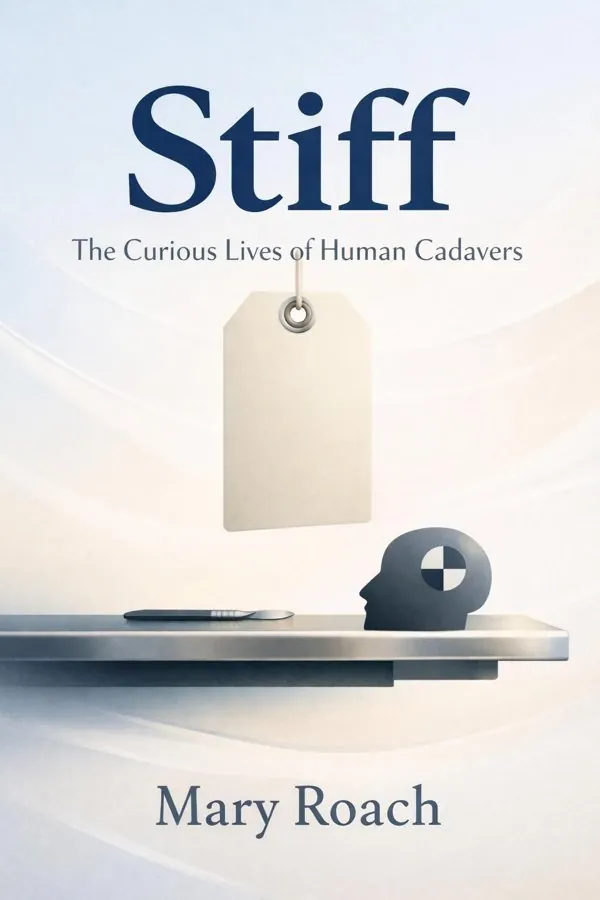
Stiff: The Curious Lives of Human Cadavers: Summary & Key Insights
by Mary Roach
 10 min8 chapters
Key Takeaways from Stiff: The Curious Lives of Human Cadavers
A human body does not stop being useful when life ends; in many cases, its social value actually begins a new chapter.
Much of what medicine knows about the human body was learned because someone was willing, or compelled, to cut into the dead.
Donating your body to science sounds straightforward, but Stiff makes clear that the reality is far more complicated than the slogan.
Death is not a single moment but a biological process, and forensic science must understand that process in detail.
Some lives are saved because dead bodies were subjected to impacts, explosions, or extreme conditions that living people never could be.
What Is Stiff: The Curious Lives of Human Cadavers About?
Stiff: The Curious Lives of Human Cadavers by Mary Roach is a popular_sci book. What happens to the human body after death is a subject most people avoid, yet it reveals an extraordinary story about science, ethics, medicine, and even human generosity. In Stiff: The Curious Lives of Human Cadavers, Mary Roach takes readers into anatomy labs, forensic research facilities, crash-test experiments, surgical training rooms, and cremation chambers to show how the dead continue to serve the living. With curiosity, wit, and unusual sensitivity, she explores the many practical uses of cadavers in medicine, criminal investigation, product testing, and historical study. What makes this book matter is not just its subject, but its perspective. Roach treats death neither as horror nor as taboo, but as an opportunity to ask better questions about what bodies mean once life has ended. She examines the ethics of body donation, the history of dissection, and the uncomfortable realities behind scientific progress. As a bestselling science writer known for making complex and awkward topics accessible, Roach brings journalistic rigor, humor, and empathy to a field few writers would dare enter. The result is a surprisingly enlightening book that turns mortality into a lens for understanding humanity itself.
This FizzRead summary covers all 8 key chapters of Stiff: The Curious Lives of Human Cadavers in approximately 10 minutes, distilling the most important ideas, arguments, and takeaways from Mary Roach's work.
Stiff: The Curious Lives of Human Cadavers
What happens to the human body after death is a subject most people avoid, yet it reveals an extraordinary story about science, ethics, medicine, and even human generosity. In Stiff: The Curious Lives of Human Cadavers, Mary Roach takes readers into anatomy labs, forensic research facilities, crash-test experiments, surgical training rooms, and cremation chambers to show how the dead continue to serve the living. With curiosity, wit, and unusual sensitivity, she explores the many practical uses of cadavers in medicine, criminal investigation, product testing, and historical study.
What makes this book matter is not just its subject, but its perspective. Roach treats death neither as horror nor as taboo, but as an opportunity to ask better questions about what bodies mean once life has ended. She examines the ethics of body donation, the history of dissection, and the uncomfortable realities behind scientific progress. As a bestselling science writer known for making complex and awkward topics accessible, Roach brings journalistic rigor, humor, and empathy to a field few writers would dare enter. The result is a surprisingly enlightening book that turns mortality into a lens for understanding humanity itself.
Who Should Read Stiff: The Curious Lives of Human Cadavers?
This book is perfect for anyone interested in popular_sci and looking to gain actionable insights in a short read. Whether you're a student, professional, or lifelong learner, the key ideas from Stiff: The Curious Lives of Human Cadavers by Mary Roach will help you think differently.
- ✓Readers who enjoy popular_sci and want practical takeaways
- ✓Professionals looking to apply new ideas to their work and life
- ✓Anyone who wants the core insights of Stiff: The Curious Lives of Human Cadavers in just 10 minutes
Want the full summary?
Get instant access to this book summary and 100K+ more with Fizz Moment.
Get Free SummaryAvailable on App Store • Free to download
Key Chapters
A human body does not stop being useful when life ends; in many cases, its social value actually begins a new chapter. One of the most striking ideas in Stiff is that cadavers are not merely remains to be buried or burned. They become teachers, test subjects, evidence, historical records, and instruments of medical progress. Roach shows that the dead help train surgeons, improve safety devices, advance forensic science, and answer questions living volunteers cannot ethically or practically address.
This insight reframes the meaning of body donation. Instead of viewing death as a hard endpoint, the book invites readers to see the body as a resource that can still contribute to society. In anatomy labs, medical students learn the architecture of the body from donors whose tissues reveal variations no textbook can capture. In research settings, cadavers are used to study blunt-force trauma, decomposition, and surgical techniques. Even in unexpected arenas such as aviation safety or automotive testing, donated bodies have informed design changes that save lives.
Roach’s genius lies in balancing scientific usefulness with respect. She never lets utility erase dignity. The body may become part of an experiment, but the human story behind it remains present. This tension between practical need and moral care runs through the entire book and forces readers to think more clearly about what respectful use really means.
In everyday life, this idea has practical implications for how we discuss wills, funerals, and donation decisions with family members. A person considering donation is not simply declining a traditional burial; they may be choosing to educate doctors, protect future passengers, or aid criminal investigations.
Actionable takeaway: Reflect on what you want your body to contribute after death, and communicate that choice clearly to your family while you are alive.
Much of what medicine knows about the human body was learned because someone was willing, or compelled, to cut into the dead. Roach traces the history of dissection and reveals how uneasy, controversial, and often morally compromised that history has been. For centuries, anatomy advanced through practices society publicly condemned yet privately relied upon. Medical education needed bodies, but legal and religious systems often restricted access to them, creating a gap that led to grave robbing, black markets, and exploitation of the poor.
This historical perspective matters because it exposes an uncomfortable truth: scientific progress is not always clean. The anatomy theater, the dissecting room, and the medical school lab all emerged within social systems shaped by class, power, and public fear. The wealthy were more likely to be protected in death, while marginalized people often became the raw material of medical learning. Roach does not reduce this history to scandal; she uses it to show how institutions evolve when necessity collides with taboo.
Today, body donation programs exist precisely because medicine learned from this troubled past. Consent has become central. Educational institutions now emphasize ethical procurement, donor recognition ceremonies, and formal procedures for handling remains. In practical terms, this means future doctors can learn anatomy without relying on coercive systems.
The broader application extends beyond medicine. Any field that depends on sensitive human material, data, or participation must ask how its resources are obtained. Innovation is not enough; legitimacy depends on ethical sourcing and transparent consent.
Actionable takeaway: When evaluating scientific or medical progress, ask not only what was discovered, but also how the materials, bodies, or data were ethically obtained.
Donating your body to science sounds straightforward, but Stiff makes clear that the reality is far more complicated than the slogan. Roach explores what actually happens after a person signs a donation form, and she uncovers a world of practical limitations, institutional needs, and emotional surprises. Not every donated body is accepted, not every body is used in the same way, and not every family fully understands what donation may involve.
This complexity is exactly why the topic deserves honest conversation. A donor may imagine helping future physicians in an anatomy lab, but the body could instead be used in surgical device testing, forensic decomposition studies, or other research settings. Institutions often decide placement based on current scientific needs, body condition, timing, and logistics. In some cases, remains are cremated and returned; in others, final disposition follows a different protocol.
Roach does not present this as a reason to distrust donation. Rather, she argues that genuine generosity requires informed consent. The more people understand the range of possible uses, the more meaningful their decision becomes. Families also need preparation. Grief can become more difficult when expectations are vague or idealized. Practical questions matter: Who transports the body? What costs are covered? How long will the process take? What happens to ashes afterward?
Beyond end-of-life planning, this chapter offers a lesson in decision-making under emotional pressure. Good intentions are not enough. Important choices become better when paired with specific knowledge, written instructions, and discussion with loved ones.
Actionable takeaway: If you are interested in body donation, request details from a specific program, read the consent terms carefully, and discuss the likely process with your family in advance.
Death is not a single moment but a biological process, and forensic science must understand that process in detail. One of the most memorable sections of Stiff examines decomposition research, including body farms where donated cadavers are studied in controlled outdoor settings. These facilities may seem unsettling, but their purpose is deeply practical: they help investigators estimate time since death, understand how weather and environment affect remains, and improve the accuracy of criminal inquiries.
Roach shows that decomposition is influenced by temperature, moisture, insects, burial conditions, clothing, scavengers, and geography. There is no universal schedule that neatly applies to all bodies. A corpse left in open heat decomposes differently from one submerged in water or buried in shade. Because of this variation, forensic investigators need empirical data from real human bodies, not just animal models or assumptions.
The significance extends beyond crime dramas. Accurate forensic knowledge can identify victims, refine search efforts, support court testimony, and prevent wrongful conclusions. It can also aid in disaster response, war-crime investigations, and missing-person cases. The dead, in this context, contribute to justice.
This idea also illustrates a broader principle: difficult truths often require difficult methods. Some kinds of knowledge cannot be gained in sanitized environments. If society wants accurate forensic science, it must support research that is uncomfortable but necessary.
Actionable takeaway: When considering scientific research that feels unsettling, evaluate it by its purpose, methods, and ethical safeguards rather than by discomfort alone.
Some lives are saved because dead bodies were subjected to impacts, explosions, or extreme conditions that living people never could be. Roach explores the use of cadavers in safety research, including car crashes and aviation testing, where the body’s physical response to force helps engineers understand injury mechanisms. Synthetic dummies and computer models are useful, but for many years they could not fully replicate the complexity of bones, tissues, and organ movement under real stress.
This is one of the book’s most surprising contributions: it reveals that respect for the dead can coexist with violent-seeming experiments when the aim is to protect the living. Researchers may study how the skull fractures in impact, how the spine responds to acceleration, or how soft tissues behave under compression. Such knowledge can lead to safer seat belts, better helmets, improved cockpit designs, and stronger protective equipment.
Roach also highlights an important tension. The public often accepts the benefits of safer technologies without wanting to know how they were developed. Yet mature citizenship requires understanding that many life-saving standards emerge from morally serious, carefully regulated testing.
The practical application is broader than body research. In product design, policy, and engineering, effective solutions come from confronting failure realistically rather than pretending idealized models are enough. Better systems are built when evidence beats intuition.
Actionable takeaway: In your own work or decisions, favor evidence from realistic testing over comforting assumptions, especially when health, safety, or public trust are at stake.
People often assume that serious topics must be discussed solemnly, but Stiff demonstrates that humor can be a tool for honesty rather than disrespect. Roach writes with wit, curiosity, and occasional absurdity, allowing readers to stay engaged with a subject many would otherwise avoid. Her tone does not trivialize death; it creates enough emotional room for people to think clearly about it.
This matters because taboo subjects often remain taboo not due to lack of importance but because they are too charged for ordinary conversation. Humor lowers defensiveness. It helps readers enter anatomy labs, cremation facilities, and forensic sites without shutting down. Instead of framing the cadaver as a source of horror, Roach presents it as a source of questions. That shift changes the entire experience of reading about death.
There is also a practical communication lesson here. Doctors, educators, journalists, and family members often need to discuss painful or awkward realities. A carefully chosen light touch can make those conversations more humane and more productive. The key is intention. Humor should ease access to truth, not hide it or mock those affected by it.
In everyday life, this approach is useful when discussing wills, funerals, organ donation, or aging with loved ones. People who avoid these topics may respond better to candor mixed with warmth than to grim seriousness. The goal is not to make death funny, but to make conversation possible.
Actionable takeaway: When addressing difficult subjects, use gentle humor or approachable language to reduce fear, while staying respectful of the emotional weight involved.
It is easy to say we respect the dead; it is harder to define what that respect actually requires. Stiff repeatedly challenges sentimental assumptions by showing that dignity is not preserved merely through ritual distance. Sometimes the most respectful treatment of a body is not untouched burial, but meaningful use in teaching, research, or investigation, handled with professionalism and care.
Roach’s reporting reveals that emotional reactions can be misleading. A dissection may look disturbing but be carried out with profound seriousness and gratitude. By contrast, a socially approved funeral practice may appear dignified while doing little beyond satisfying convention. The book encourages readers to separate optics from ethics. Respect is not only about appearance; it is about intention, consent, transparency, and stewardship.
This concept has broad application. In hospitals, universities, and laboratories, ethical culture is built through small practices: accurate record-keeping, proper handling procedures, donor acknowledgment, and language that recognizes humanity without obstructing scientific work. In personal life, respect similarly requires more than symbolic gestures. It involves following the wishes of the dead, communicating honestly with family, and resisting empty rituals that ignore actual values.
The deeper insight is that mature moral thinking asks what serves people best, not what feels most comfortable. A donated body used to train surgeons may embody respect more fully than one preserved only for social expectations.
Actionable takeaway: Define respect in practical terms—consent, care, honesty, and usefulness—rather than assuming that tradition alone determines what is dignified.
Behind every cadaver in Stiff is an act of trust. Whether explicitly donated by the deceased or permitted through family decisions and institutional systems, the use of human remains depends on people believing that science can serve a meaningful purpose. Roach makes clear that research is not powered only by laboratories and funding; it is powered by individuals willing to contribute something deeply personal.
This generosity often goes unnoticed because the public sees the outcomes but not the sources. We praise better surgical methods, more accurate forensic timelines, and improved safety engineering, yet we rarely think about the donors whose bodies made those improvements possible. By bringing those hidden contributions into view, Roach restores moral visibility to an essential part of scientific progress.
The lesson is not limited to body donation. Most knowledge systems rely on forms of contribution that are easy to overlook: research participants, patient volunteers, tissue donors, data contributors, or families who consent during moments of grief. Ethical science depends on honoring these contributions through transparency, gratitude, and responsible use.
On a personal level, this idea invites readers to think about legacy in practical rather than purely symbolic terms. A meaningful legacy may include what we give to future strangers. It also suggests that gratitude should extend beyond famous scientists to the ordinary people whose participation made discovery possible.
Actionable takeaway: Cultivate awareness of the unseen contributors behind the benefits you enjoy, and consider how your own choices—through donation, participation, or advocacy—might support future progress.
All Chapters in Stiff: The Curious Lives of Human Cadavers
About the Author
Mary Roach is a bestselling American author specializing in popular science and narrative nonfiction. She is known for exploring unusual, overlooked, or taboo topics with a signature blend of rigorous research, curiosity, and humor. Her books include Stiff, Gulp, Bonk, Packing for Mars, and Fuzz, each of which turns complex scientific or cultural subjects into accessible reading for general audiences. Roach’s work stands out for its journalistic depth and her willingness to visit labs, interview experts, and ask questions others might avoid. Rather than presenting science in dry academic terms, she makes it vivid, human, and often funny. Through her writing, Roach has become one of the most recognizable voices in contemporary science nonfiction, especially for readers who enjoy learning through storytelling.
Get This Summary in Your Preferred Format
Read or listen to the Stiff: The Curious Lives of Human Cadavers summary by Mary Roach anytime, anywhere. FizzRead offers multiple formats so you can learn on your terms — all free.
Available formats: App · Audio · PDF · EPUB — All included free with FizzRead
Download Stiff: The Curious Lives of Human Cadavers PDF and EPUB Summary
Key Quotes from Stiff: The Curious Lives of Human Cadavers
“A human body does not stop being useful when life ends; in many cases, its social value actually begins a new chapter.”
“Much of what medicine knows about the human body was learned because someone was willing, or compelled, to cut into the dead.”
“Donating your body to science sounds straightforward, but Stiff makes clear that the reality is far more complicated than the slogan.”
“Death is not a single moment but a biological process, and forensic science must understand that process in detail.”
“Some lives are saved because dead bodies were subjected to impacts, explosions, or extreme conditions that living people never could be.”
Frequently Asked Questions about Stiff: The Curious Lives of Human Cadavers
Stiff: The Curious Lives of Human Cadavers by Mary Roach is a popular_sci book that explores key ideas across 8 chapters. What happens to the human body after death is a subject most people avoid, yet it reveals an extraordinary story about science, ethics, medicine, and even human generosity. In Stiff: The Curious Lives of Human Cadavers, Mary Roach takes readers into anatomy labs, forensic research facilities, crash-test experiments, surgical training rooms, and cremation chambers to show how the dead continue to serve the living. With curiosity, wit, and unusual sensitivity, she explores the many practical uses of cadavers in medicine, criminal investigation, product testing, and historical study. What makes this book matter is not just its subject, but its perspective. Roach treats death neither as horror nor as taboo, but as an opportunity to ask better questions about what bodies mean once life has ended. She examines the ethics of body donation, the history of dissection, and the uncomfortable realities behind scientific progress. As a bestselling science writer known for making complex and awkward topics accessible, Roach brings journalistic rigor, humor, and empathy to a field few writers would dare enter. The result is a surprisingly enlightening book that turns mortality into a lens for understanding humanity itself.
More by Mary Roach
You Might Also Like
Structures: Or Why Things Don"t Fall Down
J.E. Gordon
10 min
The Road to Wigan Pier
George Orwell
10 min
Bonk: The Curious Coupling of Science and Sex
Mary Roach
10 min
First Bite: How We Learn to Eat
Bee Wilson
10 min
In Pursuit Of The Unknown: 17 Equations That Changed The World
Ian Stewart
10 min
Napoleon's Buttons: 17 Molecules That Changed History
Penny Le Couteur and Jay Burreson
10 minBrowse by Category
Ready to read Stiff: The Curious Lives of Human Cadavers?
Get the full summary and 100K+ more books with Fizz Moment.