
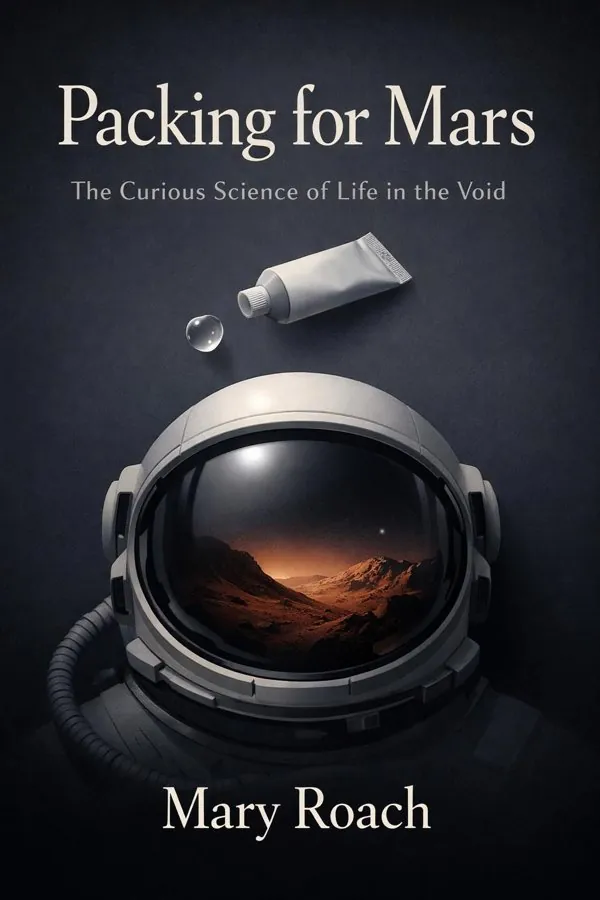
Packing for Mars: The Curious Science of Life in the Void: Summary & Key Insights
by Mary Roach
 10 min6 chaptersAudio available
What Is Packing for Mars: The Curious Science of Life in the Void About?
Packing for Mars: The Curious Science of Life in the Void by Mary Roach is a popular_sci book spanning 6 pages. Mary Roach explores the bizarre and fascinating world of space travel, delving into the scientific, psychological, and physiological challenges of living in zero gravity. With her trademark humor and curiosity, she investigates how astronauts eat, sleep, and even use the bathroom in space, revealing the human side of space exploration.
This FizzRead summary covers all 6 key chapters of Packing for Mars: The Curious Science of Life in the Void in approximately 10 minutes, distilling the most important ideas, arguments, and takeaways from Mary Roach's work. Also available as an audio summary and Key Quotes Podcast.
Packing for Mars: The Curious Science of Life in the Void
Mary Roach explores the bizarre and fascinating world of space travel, delving into the scientific, psychological, and physiological challenges of living in zero gravity. With her trademark humor and curiosity, she investigates how astronauts eat, sleep, and even use the bathroom in space, revealing the human side of space exploration.
Who Should Read Packing for Mars: The Curious Science of Life in the Void?
This book is perfect for anyone interested in popular_sci and looking to gain actionable insights in a short read. Whether you're a student, professional, or lifelong learner, the key ideas from Packing for Mars: The Curious Science of Life in the Void by Mary Roach will help you think differently.
- ✓Readers who enjoy popular_sci and want practical takeaways
- ✓Professionals looking to apply new ideas to their work and life
- ✓Anyone who wants the core insights of Packing for Mars: The Curious Science of Life in the Void in just 10 minutes
Want the full summary?
Get instant access to this book summary and 100K+ more with Fizz Moment.
Get Free SummaryAvailable on App Store • Free to download
Key Chapters
Every journey begins with history, and the story of space travel is one of relentless testing and boundless endurance. Before humans ever set foot beyond Earth, nations competed to prove their technological and physiological superiority. The early space programs, particularly those in the United States and Soviet Union, were less about exploration and more about survival—how much strain could a body endure before it broke?
I discovered that the first astronauts were often more test subjects than heroes. They were strapped into centrifuges, submerged in isolation chambers, and deprived of sensory input for hours—all to simulate the unpredictable environment of space. NASA’s early flights were experiments in human resistance: men floating in tanks for days, locked inside mock spacecrafts where their psychological limits were charted in meticulous detail. Behind the glamour of space travel were endless hours of scientific scrutiny, and a haunting question echoing through every lab: can the human body endure the absence of Earth?
As I dug into archives and interviewed researchers, I realized that space programs weren’t just testing machines—they were testing humanity itself. The astronauts’ training mirrored military toughness: endurance under pressure, composure in chaos. Yet, rather than bullets or explosions, their battlefield was the quiet and infinite void. This historical backdrop matters because it reveals a truth at the heart of space science: exploring space wasn’t about conquering distance. It was about conquering discomfort.
The first few days of any mission are an exercise in nausea. Space motion sickness is inevitable, caused by the inner ear’s confusion in microgravity. On Earth, your vestibular system—the balance center in the ear—relies on gravity to know which way is up. In orbit, those signals disappear. The body is left disoriented, drifting through an invisible chaos where every move can trigger dizziness or vomiting.
I’ve met astronauts who laughed about their first hours in space, but behind the humor lies science’s unnerving fascination with adaptation. NASA’s medical teams conduct extensive studies to understand how the body recalibrates its sense of direction. Some early tests involved volunteers lying in rotating chairs for hours while scientists measured their eye movements and nausea thresholds. Others involved parabolic flights—the infamous “vomit comet”—where subjects float for twenty seconds at a time, learning what it feels like to lose orientation while researchers eagerly monitor physiological responses.
What I learned is that the body, for all its fragility, is astonishingly adaptable. Within days, the brain learns to ignore conflicting sensory signals, redefining balance for a world without down. Yet even as physical adaptation occurs, the psychological strain persists: astronauts describe feeling disconnected from their own sense of location, their bodies suspended in timeless motion. The result is both wonder and vulnerability—a reminder that every achievement in space is bought by the body’s slow, uneasy negotiation with the unknown.
+ 4 more chapters — available in the FizzRead app
All Chapters in Packing for Mars: The Curious Science of Life in the Void
About the Author
Mary Roach is an American author known for her humorous and accessible approach to popular science. Her works often explore unusual scientific topics, including human cadavers, sex research, and the afterlife. She has written several bestsellers, including 'Stiff', 'Bonk', and 'Gulp'.
Get This Summary in Your Preferred Format
Read or listen to the Packing for Mars: The Curious Science of Life in the Void summary by Mary Roach anytime, anywhere. FizzRead offers multiple formats so you can learn on your terms — all free.
Available formats: App · Audio · PDF · EPUB — All included free with FizzRead
Download Packing for Mars: The Curious Science of Life in the Void PDF and EPUB Summary
Key Quotes from Packing for Mars: The Curious Science of Life in the Void
“Every journey begins with history, and the story of space travel is one of relentless testing and boundless endurance.”
“The first few days of any mission are an exercise in nausea.”
Frequently Asked Questions about Packing for Mars: The Curious Science of Life in the Void
Packing for Mars: The Curious Science of Life in the Void by Mary Roach is a popular_sci book that explores key ideas across 6 chapters. Mary Roach explores the bizarre and fascinating world of space travel, delving into the scientific, psychological, and physiological challenges of living in zero gravity. With her trademark humor and curiosity, she investigates how astronauts eat, sleep, and even use the bathroom in space, revealing the human side of space exploration.
More by Mary Roach



You Might Also Like

Structures: Or Why Things Don"t Fall Down
J.E. Gordon
10 min
The Road to Wigan Pier
George Orwell
10 min
Bonk: The Curious Coupling of Science and Sex
Mary Roach
10 min
First Bite: How We Learn to Eat
Bee Wilson
10 min
In Pursuit Of The Unknown: 17 Equations That Changed The World
Ian Stewart
10 min
Napoleon's Buttons: 17 Molecules That Changed History
Penny Le Couteur and Jay Burreson
10 minBrowse by Category
Ready to read Packing for Mars: The Curious Science of Life in the Void?
Get the full summary and 100K+ more books with Fizz Moment.