
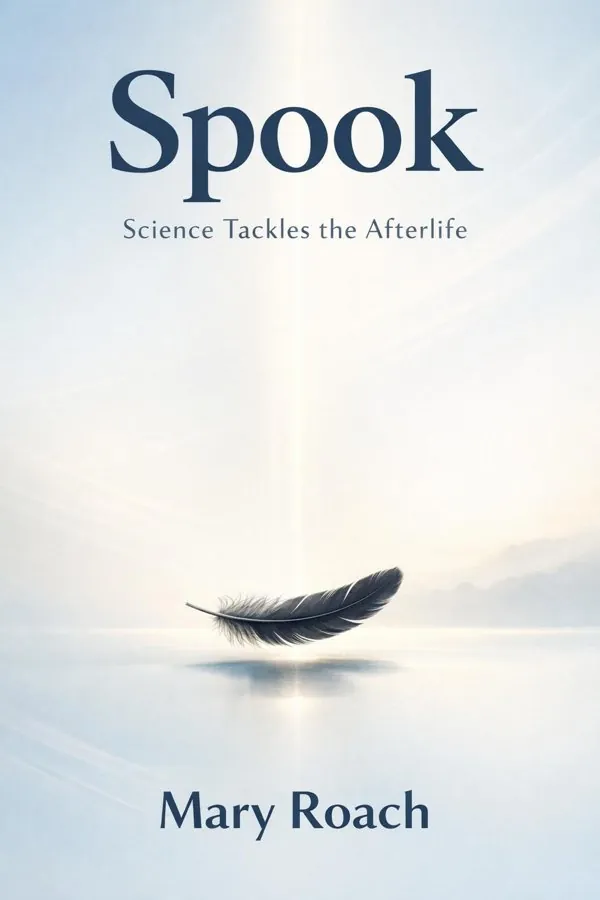
Spook: Science Tackles the Afterlife: Summary & Key Insights
by Mary Roach
 10 min10 chaptersAudio available
What Is Spook: Science Tackles the Afterlife About?
Spook: Science Tackles the Afterlife by Mary Roach is a popular_sci book spanning 10 pages. In this witty and inquisitive exploration, Mary Roach investigates what science has to say about the afterlife. From historical experiments attempting to weigh the soul to modern studies of near-death experiences, she examines how scientists, mediums, and skeptics have tried to understand what happens when we die. Blending humor with rigorous research, Roach offers a fascinating look at humanity’s enduring curiosity about life after death.
This FizzRead summary covers all 10 key chapters of Spook: Science Tackles the Afterlife in approximately 10 minutes, distilling the most important ideas, arguments, and takeaways from Mary Roach's work. Also available as an audio summary and Key Quotes Podcast.
Spook: Science Tackles the Afterlife
In this witty and inquisitive exploration, Mary Roach investigates what science has to say about the afterlife. From historical experiments attempting to weigh the soul to modern studies of near-death experiences, she examines how scientists, mediums, and skeptics have tried to understand what happens when we die. Blending humor with rigorous research, Roach offers a fascinating look at humanity’s enduring curiosity about life after death.
Who Should Read Spook: Science Tackles the Afterlife?
This book is perfect for anyone interested in popular_sci and looking to gain actionable insights in a short read. Whether you're a student, professional, or lifelong learner, the key ideas from Spook: Science Tackles the Afterlife by Mary Roach will help you think differently.
- ✓Readers who enjoy popular_sci and want practical takeaways
- ✓Professionals looking to apply new ideas to their work and life
- ✓Anyone who wants the core insights of Spook: Science Tackles the Afterlife in just 10 minutes
Want the full summary?
Get instant access to this book summary and 100K+ more with Fizz Moment.
Get Free SummaryAvailable on App Store • Free to download
Key Chapters
Before particle accelerators and MRI machines, there were scales and stopwatches—and with them, early scientists who believed the soul might leave measurable traces. In the early twentieth century, an American physician named Duncan MacDougall conducted one of the strangest experiments imaginable: he placed dying patients on specially constructed beds that could weigh them to the ounce, hoping to see a change at the moment of death. When a few of his measurements suggested a loss of 21 grams, newspapers proclaimed he had weighed the human soul.
What amazed me wasn’t the result—statistically meaningless, riddled with flaws—but the audacity of the question. These men weren’t charlatans, just scientists whose imagination outran their methods. They belonged to a period when physiology seemed capable of answering even metaphysical puzzles. If blood pressure and respiration could be measured, why not the passing of the soul?
Through dusty journals and forgotten reports, I found this period to be filled with a peculiar optimism. Electricity was new; X-rays had just shown invisible forces at play. Many believed death, too, was merely a transition mediated by measurable energy. The spiritual and scientific communities were not always at odds—they often overlapped, intertwined by a shared desire to convert mystery into data.
Looking back now with modern eyes, those early efforts may seem naïve. But they are also profoundly human. The urge to translate grief into experiment tells us something enduring about ourselves: we would rather build an apparatus than accept oblivion. In weighing the soul, those researchers enacted the same longing many of us feel—they wanted the unknown to yield to numbers.
Their legacy isn’t accuracy but curiosity, and that spirit carries through the entire evolution of scientific inquiry into the afterlife.
From the mid-nineteenth century onward, Spiritualism captivated a world hungry for communication beyond the grave. Séances became fashionable, and raps on tables or the movement of planchettes were taken seriously by people who otherwise trusted reason. When I immersed myself in that history, I met scientists who sat alongside mediums—William Crookes, for instance—hoping to record physical evidence of spirits.
This was the era when faith and scientific method shared the same candlelight. Crookes, a respected chemist, investigated the medium Florence Cook, whose spirit guide 'Katie King' materialized in semi-dark rooms. Photographs were taken; conditions supposedly controlled. Crookes believed he had verified authenticity. His colleagues thought he had been duped by wishful thinking.
In visiting archives of the British spiritualist movement, I found letters and records showing how deep that debate ran. Mediums were subjected to tests—fingerprints, seals, weights—but illusion and intimacy were hard to separate. Some of the most convincing performances later proved fraudulent, involving clever use of props and assistants. Yet not all observers dismissed Spiritualism outright; many found themselves unable to explain every event they witnessed.
What struck me most was the emotional dimension underlying the scientific facade. People didn’t crowd séances for entertainment; they came because someone they loved was gone. Scientists joined them not as believers but as people desperate to reconcile loss with law. The séances were laboratories of longing.
And though fraud eventually undermined much of that era’s credibility, its experiments laid groundwork for psychical research: an enduring dream that consciousness might project beyond death and leave measurable traces. The line between illusion and reality stayed blurred, but the desire to cross it built one of the oddest collaborations between science and spirit in modern history.
+ 8 more chapters — available in the FizzRead app
All Chapters in Spook: Science Tackles the Afterlife
About the Author
Mary Roach is an American author known for her humorous and accessible science writing. Her works, including 'Stiff', 'Bonk', and 'Gulp', explore unusual scientific topics with wit and curiosity. She has written for publications such as National Geographic and The New York Times Magazine.
Get This Summary in Your Preferred Format
Read or listen to the Spook: Science Tackles the Afterlife summary by Mary Roach anytime, anywhere. FizzRead offers multiple formats so you can learn on your terms — all free.
Available formats: App · Audio · PDF · EPUB — All included free with FizzRead
Download Spook: Science Tackles the Afterlife PDF and EPUB Summary
Key Quotes from Spook: Science Tackles the Afterlife
“Before particle accelerators and MRI machines, there were scales and stopwatches—and with them, early scientists who believed the soul might leave measurable traces.”
“From the mid-nineteenth century onward, Spiritualism captivated a world hungry for communication beyond the grave.”
Frequently Asked Questions about Spook: Science Tackles the Afterlife
Spook: Science Tackles the Afterlife by Mary Roach is a popular_sci book that explores key ideas across 10 chapters. In this witty and inquisitive exploration, Mary Roach investigates what science has to say about the afterlife. From historical experiments attempting to weigh the soul to modern studies of near-death experiences, she examines how scientists, mediums, and skeptics have tried to understand what happens when we die. Blending humor with rigorous research, Roach offers a fascinating look at humanity’s enduring curiosity about life after death.
More by Mary Roach
You Might Also Like
Structures: Or Why Things Don"t Fall Down
J.E. Gordon
10 min
The Road to Wigan Pier
George Orwell
10 min
Bonk: The Curious Coupling of Science and Sex
Mary Roach
10 min
First Bite: How We Learn to Eat
Bee Wilson
10 min
In Pursuit Of The Unknown: 17 Equations That Changed The World
Ian Stewart
10 min
Napoleon's Buttons: 17 Molecules That Changed History
Penny Le Couteur and Jay Burreson
10 minBrowse by Category
Ready to read Spook: Science Tackles the Afterlife?
Get the full summary and 100K+ more books with Fizz Moment.