
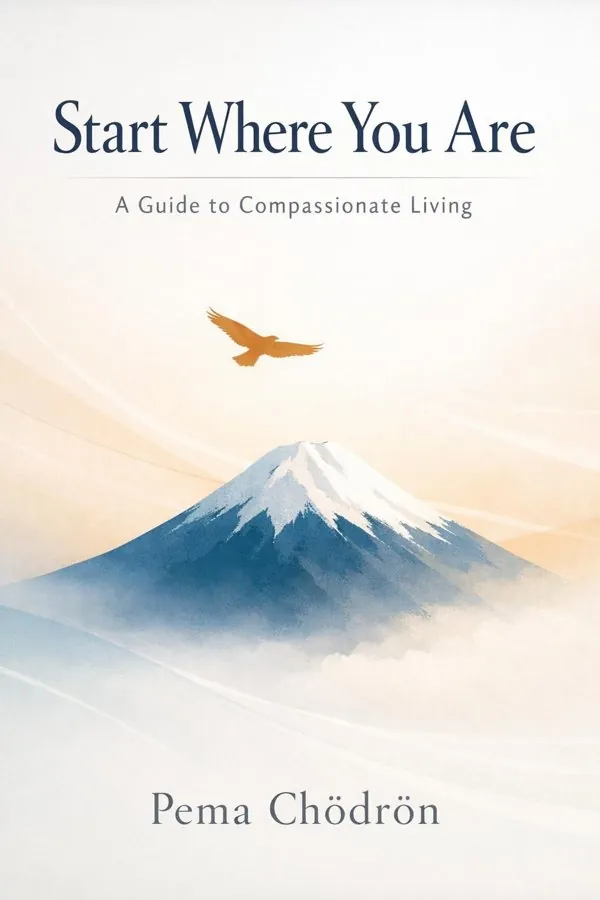
Start Where You Are: A Guide to Compassionate Living: Summary & Key Insights
by Pema Chödrön
 10 min11 chaptersAudio available
What Is Start Where You Are: A Guide to Compassionate Living About?
Start Where You Are: A Guide to Compassionate Living by Pema Chödrön is a eastern_wisdom book spanning 11 pages. In this book, American Buddhist nun Pema Chödrön offers practical teachings on cultivating compassion and fearlessness through the practice of lojong, a traditional Tibetan Buddhist mind-training technique. Drawing on her experience as a student of Chögyam Trungpa Rinpoche, she provides accessible guidance for transforming pain and difficulty into opportunities for awakening and kindness.
This FizzRead summary covers all 11 key chapters of Start Where You Are: A Guide to Compassionate Living in approximately 10 minutes, distilling the most important ideas, arguments, and takeaways from Pema Chödrön's work. Also available as an audio summary and Key Quotes Podcast.
Start Where You Are: A Guide to Compassionate Living
In this book, American Buddhist nun Pema Chödrön offers practical teachings on cultivating compassion and fearlessness through the practice of lojong, a traditional Tibetan Buddhist mind-training technique. Drawing on her experience as a student of Chögyam Trungpa Rinpoche, she provides accessible guidance for transforming pain and difficulty into opportunities for awakening and kindness.
Who Should Read Start Where You Are: A Guide to Compassionate Living?
This book is perfect for anyone interested in eastern_wisdom and looking to gain actionable insights in a short read. Whether you're a student, professional, or lifelong learner, the key ideas from Start Where You Are: A Guide to Compassionate Living by Pema Chödrön will help you think differently.
- ✓Readers who enjoy eastern_wisdom and want practical takeaways
- ✓Professionals looking to apply new ideas to their work and life
- ✓Anyone who wants the core insights of Start Where You Are: A Guide to Compassionate Living in just 10 minutes
Want the full summary?
Get instant access to this book summary and 100K+ more with Fizz Moment.
Get Free SummaryAvailable on App Store • Free to download
Key Chapters
The first step in compassionate living is radical acceptance of the present moment. When I say “start where you are,” I mean truly acknowledging the experience of now — without judging it, without trying to improve or escape it. Most of us spend our lives waiting for the right moment to begin, imagining that awakening happens when everything is neat and under control. But lojong teaches that awakening happens no other place than the confusion of our ordinary lives.
When you begin to notice your habitual patterns — the ways you defend, avoid, or grasp — you start to see how suffering is created. We suffer not because pain arises, but because we are constantly resisting it. The practice, then, is to soften the resistance. Instead of turning away, we lean in. This is the essence of courage in the Buddhist sense: not the elimination of fear, but willingness to experience fear directly.
In practice, starting where you are may look very simple. When you find yourself angry, you acknowledge, “This is anger.” When you feel lost, you recognize, “This is confusion.” You don’t need to understand it intellectually or get rid of it. You merely open to the full experience without adding a storyline. In this openness, the boundary between pain and compassion dissolves. Each time you rest in this direct awareness, tenderness grows.
The beauty of beginning from here is that transformation does not depend on perfect circumstances. Whether you are joyful or grieving, peaceful or disturbed, every state becomes workable ground. You learn to meet yourself with kindness, moment by moment. This acceptance of self naturally becomes acceptance of others. Gradually, you see that everyone is just like you — doing their best to be happy and free from pain — and that recognition opens the heart effortlessly.
To cultivate compassion, we must understand suffering not as an enemy but as the teacher that reveals the truth. The Buddha’s first teaching was that suffering exists. We experience it in countless forms — disappointment, fear, loneliness, and the subtle unease of wanting things to be different. Yet the moment we resist suffering, we intensify it. Our constant search for comfort keeps the cycle alive.
Lojong asks us to see this pattern clearly. The mind instinctively seeks security in habits – clinging to praise, avoiding blame, defending identity. We distract ourselves to escape pain, and in doing so, we deepen the sense of isolation. The courage of practice lies in turning toward this discomfort instead of concealing it. When we open to suffering, we begin to see its universality: everyone hurts, everyone longs for peace. This realization connects us rather than separates us.
There’s a profound shift that occurs when you stop viewing pain as proof of failure. Pain becomes a signpost, pointing toward what needs attention. It teaches humility and patience. When you allow pain to speak, you learn its texture and realize that it changes constantly. You see that it is not solid — like waves, it rises and falls. And in that realization, fear begins to dissolve.
Through meditation and awareness, we begin to uncover the layers of avoidance that form our identity. We recognize that holding to the self-image — being good, being right, being strong — keeps us trapped. Lojong encourages a kind of gentle disillusionment with these masks. As they fall away, compassion arises naturally, because there is nothing left to defend.
+ 9 more chapters — available in the FizzRead app
All Chapters in Start Where You Are: A Guide to Compassionate Living
About the Author
Pema Chödrön is an American Buddhist nun and one of the foremost students of Chögyam Trungpa Rinpoche. She is the resident teacher at Gampo Abbey in Nova Scotia, Canada, and the author of several influential works on Buddhist practice, including 'When Things Fall Apart' and 'The Places That Scare You.'
Get This Summary in Your Preferred Format
Read or listen to the Start Where You Are: A Guide to Compassionate Living summary by Pema Chödrön anytime, anywhere. FizzRead offers multiple formats so you can learn on your terms — all free.
Available formats: App · Audio · PDF · EPUB — All included free with FizzRead
Download Start Where You Are: A Guide to Compassionate Living PDF and EPUB Summary
Key Quotes from Start Where You Are: A Guide to Compassionate Living
“The first step in compassionate living is radical acceptance of the present moment.”
“To cultivate compassion, we must understand suffering not as an enemy but as the teacher that reveals the truth.”
Frequently Asked Questions about Start Where You Are: A Guide to Compassionate Living
Start Where You Are: A Guide to Compassionate Living by Pema Chödrön is a eastern_wisdom book that explores key ideas across 11 chapters. In this book, American Buddhist nun Pema Chödrön offers practical teachings on cultivating compassion and fearlessness through the practice of lojong, a traditional Tibetan Buddhist mind-training technique. Drawing on her experience as a student of Chögyam Trungpa Rinpoche, she provides accessible guidance for transforming pain and difficulty into opportunities for awakening and kindness.
More by Pema Chödrön

You Might Also Like
A New Earth
Eckhart Tolle
10 min
The Daily Stoic
Ryan Holiday, Stephen Hanselman
10 min
Buddhism: Plain and Simple
Steve Hagen
10 min
Enchiridion
Epictetus
10 min
The Book of Tea
Kakuzō Okakura
10 min
The Light We Give: How Sikh Wisdom Can Transform Your Life
Simran Jeet Singh
10 minBrowse by Category
Ready to read Start Where You Are: A Guide to Compassionate Living?
Get the full summary and 100K+ more books with Fizz Moment.