
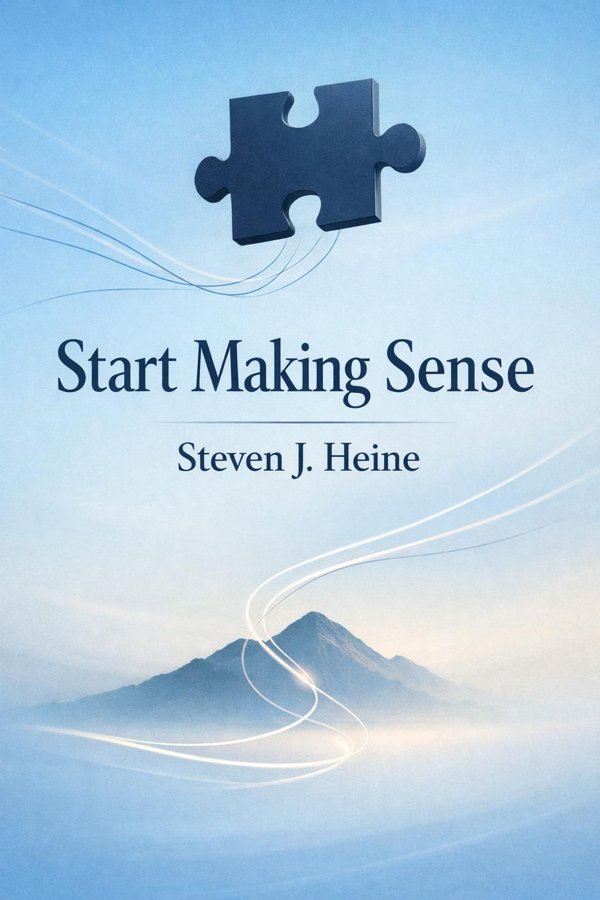
Start Making Sense: How Psychology Explains Why Humans See Meaning Everywhere: Summary & Key Insights
 10 min9 chaptersAudio available
What Is Start Making Sense: How Psychology Explains Why Humans See Meaning Everywhere About?
Start Making Sense: How Psychology Explains Why Humans See Meaning Everywhere by Steven J. Heine is a cognition book spanning 9 pages. In this book, social psychologist Steven J. Heine explores how humans are driven to find meaning in their lives and experiences. Drawing on research in psychology and cognitive science, Heine examines why people construct narratives, seek patterns, and interpret coincidences as meaningful. The work delves into existential psychology, cultural influences, and the human tendency to impose order on randomness, offering insights into how meaning-making shapes identity and behavior.
This FizzRead summary covers all 9 key chapters of Start Making Sense: How Psychology Explains Why Humans See Meaning Everywhere in approximately 10 minutes, distilling the most important ideas, arguments, and takeaways from Steven J. Heine's work. Also available as an audio summary and Key Quotes Podcast.
Start Making Sense: How Psychology Explains Why Humans See Meaning Everywhere
In this book, social psychologist Steven J. Heine explores how humans are driven to find meaning in their lives and experiences. Drawing on research in psychology and cognitive science, Heine examines why people construct narratives, seek patterns, and interpret coincidences as meaningful. The work delves into existential psychology, cultural influences, and the human tendency to impose order on randomness, offering insights into how meaning-making shapes identity and behavior.
Who Should Read Start Making Sense: How Psychology Explains Why Humans See Meaning Everywhere?
This book is perfect for anyone interested in cognition and looking to gain actionable insights in a short read. Whether you're a student, professional, or lifelong learner, the key ideas from Start Making Sense: How Psychology Explains Why Humans See Meaning Everywhere by Steven J. Heine will help you think differently.
- ✓Readers who enjoy cognition and want practical takeaways
- ✓Professionals looking to apply new ideas to their work and life
- ✓Anyone who wants the core insights of Start Making Sense: How Psychology Explains Why Humans See Meaning Everywhere in just 10 minutes
Want the full summary?
Get instant access to this book summary and 100K+ more with Fizz Moment.
Get Free SummaryAvailable on App Store • Free to download
Key Chapters
Our need for meaning begins with an existential truth: awareness of our mortality. Every human recognizes, sooner or later, that life is finite, unpredictable, and often indifferent. From that awareness grows a psychological drive—the need for coherence and purpose. Existential psychology describes this as one of the pillars of mental stability. Without meaning, the self is adrift, unable to connect experiences into a narrative of purpose. I often think of meaning not as a belief, but as a scaffolding—something invisible but essential, supporting every part of how we perceive and decide.
Across cultures and epochs, people have built this scaffolding differently. Religion offers divine structure; philosophy offers logic and principles; personal narratives give us identity. Yet these all serve one psychological function—to protect us from chaos by offering explanations. Experiments in social psychology reveal this clearly. When subjects are exposed to random or unfair events, they quickly invent emotional or moral reasoning to restore order to their understanding. Meaning fills the void of uncertainty.
We therefore do not seek meaning only when life is at its best. We crave it most in moments of instability. Death, failure, betrayal—these experiences threaten the continuity of our sense of self. When individuals lose meaning, they experience what researchers call existential anxiety or meaninglessness distress. In such times, we feel disconnected, numb, and directionless. The reason psychotherapy often succeeds is precisely because it supports people in rebuilding meaning after breakdowns. What cannot be understood must be restored to coherence, or life itself becomes unbearable.
Understanding this need changes how you interpret yourself. It helps you see that your search for purpose is not vanity—it is a psychological survival strategy. To find meaning is to assert order in the face of entropy.
Meaning rarely arrives through deliberate reasoning. Much of our sense-making begins with the brain’s instinct to detect patterns. This mechanism evolved for survival: recognizing threats, opportunities, and regularities in nature. But our cognitive biases extend this function beyond its practical use. We perceive patterns even where none exist. Psychologists call this apophenia—the spontaneous perception of meaningful connections among unrelated phenomena.
Consider coincidences like thinking of a friend moments before they call. It feels significant, purposeful. But statistically, such coincidences are inevitable. What gives them emotional weight is not the event but the interpretation. Our brains default to agency detection—assuming intentionality—because it historically helped us survive. In the wild, it is safer to mistake a rustling leaf for a predator than to ignore a potential threat. That same tendency makes us perceive fate or divine guidance in everyday occurrences.
These biases, while distorting reality, are not flaws. They are the pathways through which meaning enters consciousness. Pattern recognition helps us build continuity: connecting one day to the next, one choice to another. The comforting illusion of order binds our experiences into a coherent whole. Understanding this mechanism invites humility. It reminds us that our need for meaning is intertwined with our cognitive limitations. Recognizing how biases shape our interpretation does not rob us of wonder—it deepens it, allowing us to appreciate how mind and world collaborate to create a sense of significance.
+ 7 more chapters — available in the FizzRead app
All Chapters in Start Making Sense: How Psychology Explains Why Humans See Meaning Everywhere
About the Author
Steven J. Heine is a Canadian social psychologist and professor at the University of British Columbia. His research focuses on cultural psychology, meaning-making, and self-concept, and he is known for his contributions to understanding how culture influences psychological processes.
Get This Summary in Your Preferred Format
Read or listen to the Start Making Sense: How Psychology Explains Why Humans See Meaning Everywhere summary by Steven J. Heine anytime, anywhere. FizzRead offers multiple formats so you can learn on your terms — all free.
Available formats: App · Audio · PDF · EPUB — All included free with FizzRead
Download Start Making Sense: How Psychology Explains Why Humans See Meaning Everywhere PDF and EPUB Summary
Key Quotes from Start Making Sense: How Psychology Explains Why Humans See Meaning Everywhere
“Our need for meaning begins with an existential truth: awareness of our mortality.”
“Meaning rarely arrives through deliberate reasoning.”
Frequently Asked Questions about Start Making Sense: How Psychology Explains Why Humans See Meaning Everywhere
Start Making Sense: How Psychology Explains Why Humans See Meaning Everywhere by Steven J. Heine is a cognition book that explores key ideas across 9 chapters. In this book, social psychologist Steven J. Heine explores how humans are driven to find meaning in their lives and experiences. Drawing on research in psychology and cognitive science, Heine examines why people construct narratives, seek patterns, and interpret coincidences as meaningful. The work delves into existential psychology, cultural influences, and the human tendency to impose order on randomness, offering insights into how meaning-making shapes identity and behavior.
You Might Also Like
A Field Guide to Lies: Critical Thinking in the Information Age
Daniel J. Levitin
10 min
A Theory of Cognitive Dissonance
Leon Festinger
10 min
Black-And-White Thinking: The Burden of a Binary Brain in a Complex World
Kevin Dutton
10 min
Born Liars: Why We Can’t Live Without Deceit
Ian Leslie
10 min
Collective Illusions: Conformity, Complicity, and the Science of Why We Make Bad Decisions
Todd Rose
10 min
Concrete Mathematics: A Foundation for Computer Science
Ronald L. Graham, Donald E. Knuth, Oren Patashnik
10 minBrowse by Category
Ready to read Start Making Sense: How Psychology Explains Why Humans See Meaning Everywhere?
Get the full summary and 100K+ more books with Fizz Moment.