
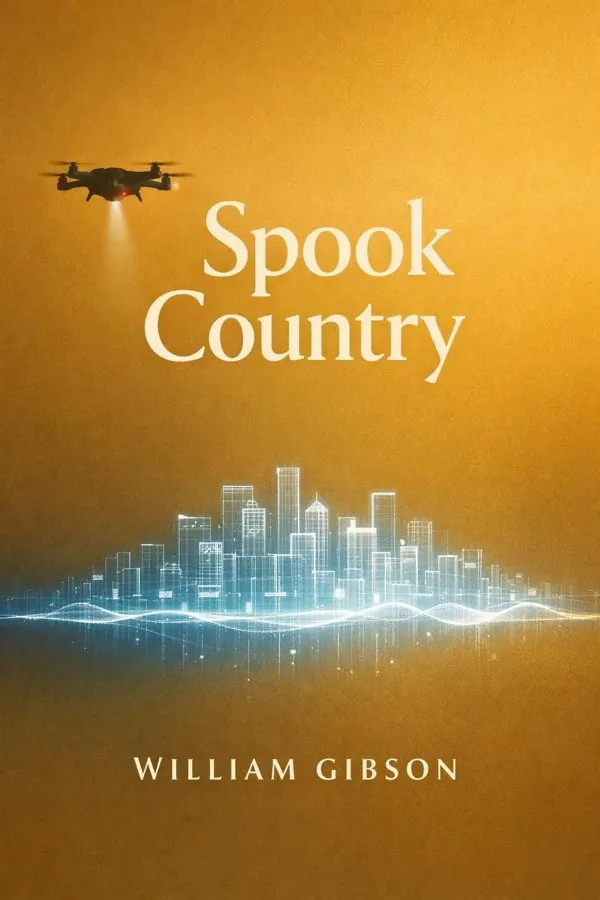
Spook Country: Summary & Key Insights
 10 min9 chaptersAudio available
Key Takeaways from Spook Country
The most powerful technologies are often the ones you barely notice.
In a hyperconnected world, the oldest methods can become the smartest.
Control does not always look like force; often it looks like caretaking.
Some of the most important struggles in the modern world revolve around things nobody can clearly see.
Marketing in Spook Country is never just marketing.
What Is Spook Country About?
Spook Country by William Gibson is a scifi_fantasy book spanning 4 pages. Spook Country is William Gibson’s coolly unsettling novel of a world that already feels like tomorrow. Set in the charged atmosphere of post-9/11 North America, it follows Hollis Henry, a former indie rock singer turned journalist, as she investigates a strange artistic movement that places virtual images into real urban space. Her assignment, commissioned by the enigmatic strategist Hubertus Bigend, soon intersects with the lives of Tito, a young courier trained in covert tradecraft, and Milgrim, a drug-dependent translator trapped inside a private intelligence operation. What begins as a search for a story widens into a map of hidden systems: surveillance networks, outsourced espionage, mobile technology, media manipulation, and invisible flows of money and power. Gibson, best known for Neuromancer and for helping define cyberpunk, brings unusual authority to this terrain because he writes not about distant futures, but about the future already embedded in everyday life. Spook Country matters because it captures the moment when GPS, branding, terror politics, and augmented reality began reshaping how people move, see, and trust the world around them.
This FizzRead summary covers all 9 key chapters of Spook Country in approximately 10 minutes, distilling the most important ideas, arguments, and takeaways from William Gibson's work. Also available as an audio summary and Key Quotes Podcast.
Spook Country
Spook Country is William Gibson’s coolly unsettling novel of a world that already feels like tomorrow. Set in the charged atmosphere of post-9/11 North America, it follows Hollis Henry, a former indie rock singer turned journalist, as she investigates a strange artistic movement that places virtual images into real urban space. Her assignment, commissioned by the enigmatic strategist Hubertus Bigend, soon intersects with the lives of Tito, a young courier trained in covert tradecraft, and Milgrim, a drug-dependent translator trapped inside a private intelligence operation. What begins as a search for a story widens into a map of hidden systems: surveillance networks, outsourced espionage, mobile technology, media manipulation, and invisible flows of money and power. Gibson, best known for Neuromancer and for helping define cyberpunk, brings unusual authority to this terrain because he writes not about distant futures, but about the future already embedded in everyday life. Spook Country matters because it captures the moment when GPS, branding, terror politics, and augmented reality began reshaping how people move, see, and trust the world around them.
Who Should Read Spook Country?
This book is perfect for anyone interested in scifi_fantasy and looking to gain actionable insights in a short read. Whether you're a student, professional, or lifelong learner, the key ideas from Spook Country by William Gibson will help you think differently.
- ✓Readers who enjoy scifi_fantasy and want practical takeaways
- ✓Professionals looking to apply new ideas to their work and life
- ✓Anyone who wants the core insights of Spook Country in just 10 minutes
Want the full summary?
Get instant access to this book summary and 100K+ more with Fizz Moment.
Get Free SummaryAvailable on App Store • Free to download
Key Chapters
The most powerful technologies are often the ones you barely notice. In Spook Country, Hollis Henry is hired to investigate locative art: digital works that can only be seen in specific physical places through devices that align virtual imagery with geographic coordinates. This concept is more than a clever futuristic flourish. Gibson uses it to show how space itself is being rewritten by code, satellite systems, and data layers that hover over ordinary streets, hotel rooms, and waterfronts. Reality is no longer just what is physically present; it is also what software permits you to perceive.
Hollis’s fascination with these artworks mirrors a broader cultural shift. The built environment is no longer stable or singular. Places acquire hidden dimensions through GPS, wireless signals, surveillance systems, and commercial metadata. A street corner can be a memory palace, an advertising surface, a security zone, and an artistic canvas all at once. In Gibson’s world, the invisible architecture of the digital age has become as consequential as concrete and steel.
This idea has obvious real-world echoes. Today, map apps guide our movement, location-based ads target our habits, and augmented reality overlays entertainment or information onto public space. Social life increasingly depends on invisible infrastructures that shape behavior while remaining mostly unseen.
Gibson’s point is not simply that technology changes perception. It is that whoever designs the hidden layer of the world gains quiet power over attention, meaning, and movement. The actionable takeaway: pay attention to the unseen systems around you, because the places you inhabit are increasingly designed by data as much as by walls.
In a hyperconnected world, the oldest methods can become the smartest. Tito, one of the novel’s most compelling figures, belongs to a Cuban-Chinese family network skilled in covert movement, coded communication, and strategic invisibility. While the world around him fills with GPS, mobile devices, and digital tracking, Tito’s strength lies in disciplined attention, embodied training, and low-tech tradecraft. He notices patterns, reads human behavior, and moves through cities in ways that leave little trace.
Gibson uses Tito’s storyline to challenge the assumption that technological sophistication always defeats human skill. In fact, the opposite may be true. The more society depends on searchable, storable, networked systems, the more valuable analog habits become. A handwritten note, a memorized route, a face-to-face exchange, or a carefully chosen public location may offer greater security than encrypted software in a world where every digital action can be intercepted, stored, or later reinterpreted.
Tito’s world is also shaped by family and inherited knowledge. Espionage here is not glamorous spectacle but craft passed through generations. This gives his narrative emotional weight: secrecy is not just a profession but a culture, a discipline, and a way of surviving within larger geopolitical games.
The practical relevance is striking. In daily life, oversharing, convenience apps, and passive data collection expose far more than most people realize. Sometimes resilience comes from reducing your digital footprint, varying routines, or recognizing that not every problem needs a technological solution.
The actionable takeaway: cultivate at least a few analog competencies, because privacy, judgment, and human awareness remain strategic advantages in a world addicted to traceable convenience.
Control does not always look like force; often it looks like caretaking. Milgrim’s storyline makes this disturbing truth painfully clear. A gifted translator with a history of addiction, he is effectively held captive by Brown, a private operative who manages him through a mix of pharmaceutical maintenance, supervision, travel, and implied threat. Milgrim is not chained in a cell. Instead, he is enclosed within a system that keeps him functional enough to be useful and dependent enough to remain compliant.
Gibson’s insight is that modern surveillance is deeply psychological. It is not only about cameras and databases, but also about shaping a person’s options until obedience feels like the easiest path. Brown studies, administers, anticipates, and contains. The result is a relationship that resembles corporate management, intelligence handling, and addiction treatment all at once. This ambiguity is what makes it so unsettling.
Milgrim also embodies a broader social condition: many people live inside soft forms of surveillance that track productivity, location, health, spending, and communication. They are not technically imprisoned, yet their lives are increasingly legible to systems they do not control. Convenience and coercion begin to overlap.
The novel does not reduce Milgrim to a victim. His perspective offers one of the sharpest windows into the machinery around him. Because he is marginal, chemically managed, and highly observant, he sees how power functions through routines and dependencies rather than dramatic confrontation.
The actionable takeaway: examine the systems that make you feel secure or productive, and ask whether they also make you more dependent, more transparent, or less free to choose your own movements.
Some of the most important struggles in the modern world revolve around things nobody can clearly see. As Spook Country’s plotlines converge, attention centers on a mysterious shipping container moving through the global supply chain. This so-called ghost cargo is a perfect Gibson object: mundane in appearance, immense in implication. A container is a symbol of globalization, logistics, and invisibility. Millions move through ports and transport networks, carrying the material substance of the world economy while remaining largely anonymous to the public imagination.
By making this drifting container the gravitational center of the novel, Gibson links espionage, commerce, and geopolitics. Hidden wealth, covert state interests, private intelligence, and opportunistic branding all begin to orbit the same object. The lesson is that power in the twenty-first century often operates through systems of circulation rather than spectacle. Whoever can track, hide, reroute, or interpret those flows acquires leverage.
This is one of the novel’s sharpest structural achievements. The story’s seemingly disconnected threads are not random; they reflect the way modern systems are interconnected without being transparent. Art, journalism, criminality, military secrecy, and corporate strategy share the same infrastructure of movement and information.
In practical terms, the ghost cargo invites readers to think about supply chains, financial opacity, offshore structures, and the hidden routes by which value and influence travel. The visible economy is only part of the picture.
The actionable takeaway: when trying to understand contemporary power, look beyond public narratives and examine the logistical systems, money flows, and hidden channels through which decisions and assets actually move.
Marketing in Spook Country is never just marketing. Through Hubertus Bigend, Gibson presents branding as a form of intelligence gathering, cultural prediction, and strategic influence. Bigend is not merely a businessman looking for trends. He is a hunter of emergent meaning, someone who studies style, subculture, and technological novelty in order to convert them into leverage. His company, Blue Ant, occupies the murky territory where advertising, espionage, and futurism blend together.
Bigend understands that in an information-saturated world, controlling narratives can matter as much as controlling territory. A brand can map desire, identify weak signals before competitors do, and reshape how people interpret reality. Hollis initially approaches him with skepticism, and rightly so. But her work for him reveals a deeper truth: corporations have become some of the most sophisticated interpreters of culture, often rivaling governments in their ability to monitor behavior and anticipate shifts.
This is especially relevant now. Social platforms, attention metrics, algorithmic recommendation systems, and behavioral targeting have made branding more invasive and more predictive than ever. Consumer identity has become a data trail, and taste itself can be harvested as actionable intelligence.
Gibson avoids simple moralizing. Bigend is charismatic, absurd, predatory, and undeniably perceptive. That complexity matters because modern power rarely appears in a single recognizable costume. It may wear a luxury suit, speak the language of trend analysis, and still function like an intelligence service.
The actionable takeaway: treat branding critically, not as harmless persuasion but as a system that studies your desires, organizes attention, and quietly competes to define what feels meaningful.
A society shaped by fear develops strange habits of perception. Spook Country is saturated with the emotional atmosphere of the post-9/11 era: heightened alertness, diffuse anxiety, privatized security, and the normalization of exceptional measures. Gibson does not write a war novel, but war and terror politics haunt the book’s background. They alter how institutions behave, how cities feel, and how individuals interpret risk.
What makes this portrayal powerful is its subtlety. The novel shows a world in which geopolitics has seeped into daily life without always announcing itself. Suspicion becomes ambient. Security language justifies secrecy. Borders become both more rigid and more porous, depending on who is moving and under whose protection. Government and private actors increasingly overlap, making accountability harder to locate.
This context helps explain the book’s texture of unease. Characters navigate not only personal uncertainty but also a broader collapse of trust. Official narratives no longer feel stable. Media, commerce, intelligence, and militarized policy bleed into one another. The result is a culture in which people improvise their own maps of reality.
The practical value of this idea lies in recognizing how crises reshape norms. Fear can make extraordinary intrusions seem reasonable, especially when framed as necessary for safety. That dynamic extends far beyond the novel, applying to digital monitoring, border control, emergency powers, and political messaging today.
The actionable takeaway: when institutions invoke danger to expand secrecy or surveillance, pause to ask what temporary emergency is quietly becoming permanent infrastructure.
In Gibson’s world, identity is never fixed; it is styled, negotiated, and constantly recontextualized. Hollis Henry embodies this instability. Once known as the singer of a cult band, she now moves through journalism, fashion, and media culture with a mix of detachment and vulnerability. Her former celebrity gives her access, but it also makes her aware that public identity can outlive the self who once inhabited it. She becomes an ideal guide to a world where people are tracked not only by governments and corporations, but also by their own past images.
Spook Country suggests that networked culture turns everyone into a curator of selves. Reputation, aesthetics, and affiliation become strategic assets. Characters manage how they appear, what they reveal, and which signals they send. Some do so professionally, others defensively. In every case, identity is part of the operating system of modern life.
This has become even more visible in the age of social media, personal branding, searchable archives, and persistent digital memory. A past role, opinion, or photograph can remain active long after one’s internal life has changed. The self becomes distributed across platforms, observers, and databases.
Gibson’s achievement is to tie this instability to emotion rather than abstraction. Hollis’s uncertainty is not theoretical. It is what it feels like to live amid images that never fully disappear and narratives that others are always ready to impose.
The actionable takeaway: build your identity deliberately and leave room for reinvention, because in a networked world, the stories attached to you can become systems others use to define your possibilities.
Art in Spook Country is not a retreat from politics or technology; it is a method for detecting what ordinary language misses. The locative installations that Hollis investigates are eerie and emotionally charged, but they also function as diagnostic tools. They reveal how technology changes perception, how memory attaches to place, and how hidden infrastructures shape experience. In a landscape overwhelmed by media noise, art becomes a form of signal extraction.
This is one of Gibson’s most subtle arguments. The artist in the novel is not merely creating aesthetic novelty. The work exposes the seams between physical space and digital mediation. It makes viewers aware of alignment, calibration, and presence. It asks what it means for an image to occupy a place without being materially there, and what kind of reality emerges when software anchors memory or imagination to geography.
Art also offers resistance to utilitarian systems. Governments surveil, corporations monetize, and operatives conceal. The artwork, by contrast, invites attention without obvious instrumental purpose. That very uselessness gives it critical force. It slows perception and creates room for reflection in a culture optimized for speed and capture.
Readers can apply this insight beyond literature. Often, music, visual art, film, and fiction help us understand technological change earlier and more deeply than policy debates do. They register mood, texture, and moral ambiguity before institutions find the language for them.
The actionable takeaway: use art as a way of reading your era, because creative work often reveals the emotional truth of technological and political transformations before official analysis catches up.
The future in Spook Country does not arrive with fanfare; it leaks into ordinary life. That may be the novel’s deepest insight. Gibson largely abandons the distant, neon-soaked futurism associated with classic cyberpunk and instead turns his attention to the uncanny qualities of the present. Airports, hotels, smartphones, container ports, medications, metadata, and trend consultancies become the furniture of a reality that is already strange enough to qualify as speculative fiction.
This shift matters because it changes how readers think about technological change. The key question is no longer, “What fantastical inventions are coming next?” but, “What systems are already here, and how are they reorganizing perception, freedom, and power?” Gibson invites us to see the contemporary world with speculative intensity. The ordinary becomes alien when viewed through its infrastructures.
That perspective has practical force. It encourages intellectual vigilance. Rather than waiting for dramatic disruption, we can study incremental shifts: the migration of decision-making into algorithms, the merging of commercial and state data collection, the increasing dependence on location-aware devices, and the quiet normalization of constant tracking.
The brilliance of the novel lies in how naturally it trains this way of seeing. By the time its threads converge, readers have learned to look for hidden layers, indirect influence, and the ghostly systems beneath everyday surfaces.
The actionable takeaway: read your present as if it were science fiction, because the most consequential changes in your world may already be embedded in routine technologies you have stopped noticing.
All Chapters in Spook Country
About the Author
William Gibson is a Canadian-American novelist and short story writer widely regarded as one of the most important voices in modern speculative fiction. He rose to prominence with Neuromancer, the landmark 1984 novel that helped define cyberpunk and introduced influential ideas about cyberspace, hacking, and virtual identity. Over the course of his career, Gibson has explored how technology, media, fashion, capitalism, and global networks reshape everyday life. His fiction is known for its precision, atmosphere, and ability to make the present feel uncanny. Rather than simply predicting the future, Gibson often reveals the future already embedded in current systems and cultural habits. His major works include Count Zero, Mona Lisa Overdrive, Pattern Recognition, Spook Country, and Zero History.
Get This Summary in Your Preferred Format
Read or listen to the Spook Country summary by William Gibson anytime, anywhere. FizzRead offers multiple formats so you can learn on your terms — all free.
Available formats: App · Audio · PDF · EPUB — All included free with FizzRead
Download Spook Country PDF and EPUB Summary
Key Quotes from Spook Country
“The most powerful technologies are often the ones you barely notice.”
“In a hyperconnected world, the oldest methods can become the smartest.”
“Control does not always look like force; often it looks like caretaking.”
“Some of the most important struggles in the modern world revolve around things nobody can clearly see.”
“Marketing in Spook Country is never just marketing.”
Frequently Asked Questions about Spook Country
Spook Country by William Gibson is a scifi_fantasy book that explores key ideas across 9 chapters. Spook Country is William Gibson’s coolly unsettling novel of a world that already feels like tomorrow. Set in the charged atmosphere of post-9/11 North America, it follows Hollis Henry, a former indie rock singer turned journalist, as she investigates a strange artistic movement that places virtual images into real urban space. Her assignment, commissioned by the enigmatic strategist Hubertus Bigend, soon intersects with the lives of Tito, a young courier trained in covert tradecraft, and Milgrim, a drug-dependent translator trapped inside a private intelligence operation. What begins as a search for a story widens into a map of hidden systems: surveillance networks, outsourced espionage, mobile technology, media manipulation, and invisible flows of money and power. Gibson, best known for Neuromancer and for helping define cyberpunk, brings unusual authority to this terrain because he writes not about distant futures, but about the future already embedded in everyday life. Spook Country matters because it captures the moment when GPS, branding, terror politics, and augmented reality began reshaping how people move, see, and trust the world around them.
More by William Gibson
You Might Also Like
Red Rising
Pierce Brown
10 min
Stranger in a Strange Land
Robert A. Heinlein
10 min
AI Valley
Chen Qiufan
10 min
Bloodchild
Octavia E. Butler
10 min
Do Androids Dream of Electric Sheep?
Philip K. Dick
10 min
Jujutsu Kaisen, Vol. 24
Gege Akutami
10 minBrowse by Category
Ready to read Spook Country?
Get the full summary and 100K+ more books with Fizz Moment.