
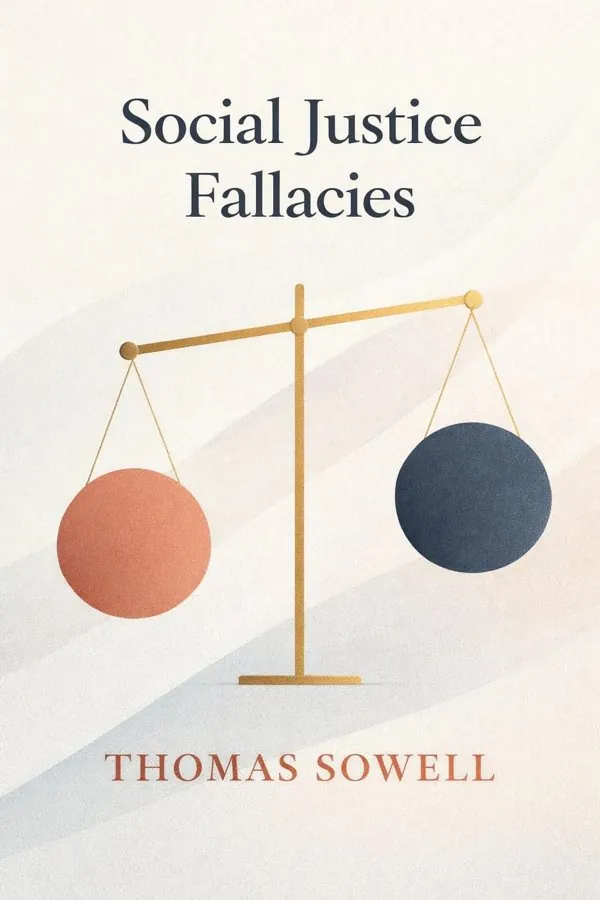
Social Justice Fallacies: Summary & Key Insights
 10 min12 chaptersAudio available
What Is Social Justice Fallacies About?
Social Justice Fallacies by Thomas Sowell is a politics book spanning 12 pages. In this book, economist and social theorist Thomas Sowell examines the assumptions and misconceptions underlying modern social justice movements. He argues that many popular claims about inequality, discrimination, and privilege are based on flawed reasoning and a misunderstanding of economic and social realities. Sowell uses historical and empirical evidence to challenge prevailing narratives and to advocate for a more evidence-based approach to social policy.
This FizzRead summary covers all 12 key chapters of Social Justice Fallacies in approximately 10 minutes, distilling the most important ideas, arguments, and takeaways from Thomas Sowell's work. Also available as an audio summary and Key Quotes Podcast.
Social Justice Fallacies
In this book, economist and social theorist Thomas Sowell examines the assumptions and misconceptions underlying modern social justice movements. He argues that many popular claims about inequality, discrimination, and privilege are based on flawed reasoning and a misunderstanding of economic and social realities. Sowell uses historical and empirical evidence to challenge prevailing narratives and to advocate for a more evidence-based approach to social policy.
Who Should Read Social Justice Fallacies?
This book is perfect for anyone interested in politics and looking to gain actionable insights in a short read. Whether you're a student, professional, or lifelong learner, the key ideas from Social Justice Fallacies by Thomas Sowell will help you think differently.
- ✓Readers who enjoy politics and want practical takeaways
- ✓Professionals looking to apply new ideas to their work and life
- ✓Anyone who wants the core insights of Social Justice Fallacies in just 10 minutes
Want the full summary?
Get instant access to this book summary and 100K+ more with Fizz Moment.
Get Free SummaryAvailable on App Store • Free to download
Key Chapters
To understand social justice as it is spoken of today, we must first understand its evolution. The term itself has a long pedigree, dating back to philosophical traditions that sought to correct inequalities inherent in society. But its modern form, which assumes that differences in outcomes must reflect injustice, took shape during the ideological upheavals of the twentieth century. Thinkers from Rousseau to Marx shifted the notion of justice from individual responsibility toward collective outcomes. This transformation, while emotionally appealing, carried profound consequences.
By the mid-twentieth century, movements for civil rights and equality began merging with economic doctrines that viewed disparities through the lens of exploitation rather than voluntary exchange. The idea that society could—and should—be redesigned to produce uniform results found new strength in political rhetoric and academic theory. Yet history repeatedly demonstrates that such projects falter when faced with the complexity of human interaction. The belief that centralized authority can rationally allocate opportunity ignores the decentralized knowledge that guides markets and communities. It replaces the organic diversity of human experience with formulaic mandates, assuming equality must be achieved regardless of cost.
This shift explains why so many policies labeled 'social justice' end up disregarding actual justice—based on rules, due process, and accountability—in favor of outcomes measured purely by statistical aggregation. The ideological journey from liberty to leveling began when well-meaning advocates mistook moral aspiration for empirical reality. That confusion remains at the center of modern debates.
One of the most persistent errors in modern discourse is the belief that fairness means equality of results. The assumption is deceptively simple: if people start from similar points but end up with different incomes, education levels, or social status, something unjust must have occurred. Reality, however, refuses to conform to such neat models. Outcomes differ not because the rules are unfair, but because people differ—by choices, cultures, aptitudes, and interests.
Consider education. Even within the same school, students display immense variation in effort and engagement. When reformers interpret disparities in test scores as proof of systemic bias, they overlook these differences. The same applies to income: wage gaps between professions usually reflect market value and accumulated skill, not moral failing. Attempts to impose equal results inevitably weaken incentives for achievement. When success is penalized and mediocrity rewarded, progress stalls. The irony is that in trying to make outcomes equal, we create more inequality—between those empowered by connections and those dependent on bureaucratic favor.
The lesson is straightforward: equality of opportunity is compatible with freedom; equality of results is not. A society committed to justice should enable individuals to pursue their own paths, not dictate where everyone must end up. Pretending otherwise is not compassionate—it is destructive.
+ 10 more chapters — available in the FizzRead app
All Chapters in Social Justice Fallacies
About the Author
Thomas Sowell is an American economist, social theorist, and senior fellow at the Hoover Institution, Stanford University. He has written extensively on economics, history, and social policy, and is known for his clear, data-driven analyses and critiques of political and social ideologies.
Get This Summary in Your Preferred Format
Read or listen to the Social Justice Fallacies summary by Thomas Sowell anytime, anywhere. FizzRead offers multiple formats so you can learn on your terms — all free.
Available formats: App · Audio · PDF · EPUB — All included free with FizzRead
Download Social Justice Fallacies PDF and EPUB Summary
Key Quotes from Social Justice Fallacies
“To understand social justice as it is spoken of today, we must first understand its evolution.”
“One of the most persistent errors in modern discourse is the belief that fairness means equality of results.”
Frequently Asked Questions about Social Justice Fallacies
Social Justice Fallacies by Thomas Sowell is a politics book that explores key ideas across 12 chapters. In this book, economist and social theorist Thomas Sowell examines the assumptions and misconceptions underlying modern social justice movements. He argues that many popular claims about inequality, discrimination, and privilege are based on flawed reasoning and a misunderstanding of economic and social realities. Sowell uses historical and empirical evidence to challenge prevailing narratives and to advocate for a more evidence-based approach to social policy.
More by Thomas Sowell
You Might Also Like

Antifa: The Anti-Fascist Handbook
Mark Bray
10 min
Attack from Within: How Disinformation Is Sabotaging America
Barbara McQuade
10 min
Coercion, Capital, and European States, AD 990–1992
Charles Tilly
10 min
Digital Democracy: Concepts, Methodologies, Tools, and Applications
Various Authors
10 min
Fascism
Stanley G. Payne
10 min
Fire And Fury: Inside The Trump White House
Michael Wolff
10 minBrowse by Category
Ready to read Social Justice Fallacies?
Get the full summary and 100K+ more books with Fizz Moment.