
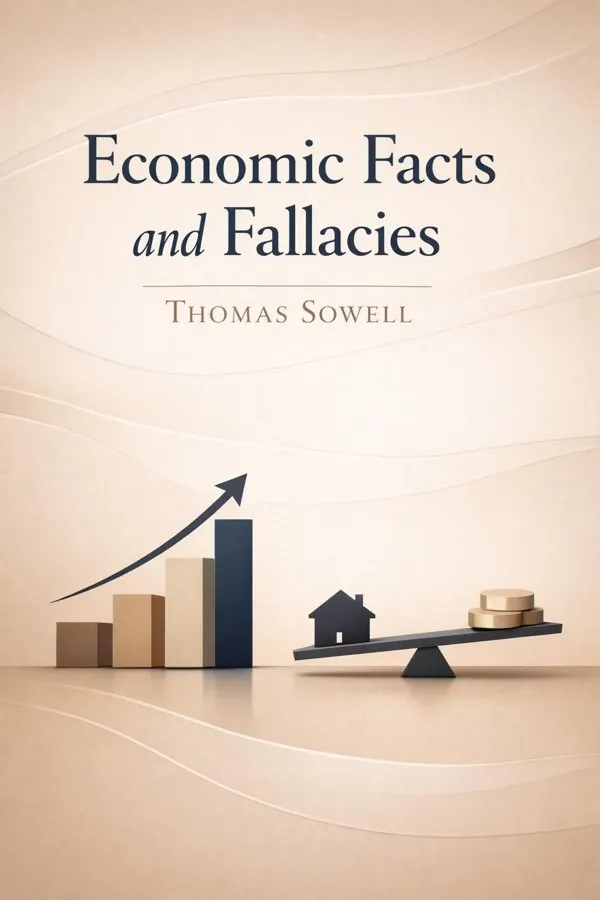
Economic Facts and Fallacies: Summary & Key Insights
 10 min9 chaptersAudio available
What Is Economic Facts and Fallacies About?
Economic Facts and Fallacies by Thomas Sowell is a economics book spanning 9 pages. Economic Facts and Fallacies is a work by economist Thomas Sowell that challenges widely held misconceptions about economics and public policy. Sowell examines topics such as gender, race, income inequality, housing, and education, using empirical evidence to debunk popular myths and clarify how economic principles operate in real-world contexts.
This FizzRead summary covers all 9 key chapters of Economic Facts and Fallacies in approximately 10 minutes, distilling the most important ideas, arguments, and takeaways from Thomas Sowell's work. Also available as an audio summary and Key Quotes Podcast.
Economic Facts and Fallacies
Economic Facts and Fallacies is a work by economist Thomas Sowell that challenges widely held misconceptions about economics and public policy. Sowell examines topics such as gender, race, income inequality, housing, and education, using empirical evidence to debunk popular myths and clarify how economic principles operate in real-world contexts.
Who Should Read Economic Facts and Fallacies?
This book is perfect for anyone interested in economics and looking to gain actionable insights in a short read. Whether you're a student, professional, or lifelong learner, the key ideas from Economic Facts and Fallacies by Thomas Sowell will help you think differently.
- ✓Readers who enjoy economics and want practical takeaways
- ✓Professionals looking to apply new ideas to their work and life
- ✓Anyone who wants the core insights of Economic Facts and Fallacies in just 10 minutes
Want the full summary?
Get instant access to this book summary and 100K+ more with Fizz Moment.
Get Free SummaryAvailable on App Store • Free to download
Key Chapters
One of the most persistent errors in human thought is the idea that wealth is a fixed pie—if one person gains, another must lose. It is a view as old as mercantilism, yet it survives in modern discussions of class, race, and gender. I begin here because this single misunderstanding underlies so many others. To think in zero-sum terms is to forget that wealth is not money—it is the ability to produce goods and services. When two people trade voluntarily, both expect to benefit; otherwise they wouldn’t trade. This simple truth challenges centuries of rhetoric about exploitation.
Consider international trade. When critics claim that outsourcing jobs or importing goods harms a nation, they assume the economic pie shrinks when foreigners produce. In reality, specialization allows both sides to expand their productive capacity. Workers in one country focus on what they do best while purchasing cheaper goods from others. The result is a larger total output, not a transfer of wealth from one to another.
The same logic applies within societies. The rich are not rich because the poor are poor; one group’s advancement does not inherently cause another’s decline. Economies grow through innovation and productivity, not through redistribution. Yet political appeals often exploit this fallacy, promising equality through confiscation rather than creation.
As I explain with historical data, periods of economic expansion have benefited even the lowest income groups. The 20th century provides abundant examples—industrialization, technological invention, and entrepreneurship have raised living standards globally. The notion that the working class is permanently shackled because the elite hoard wealth collapses under scrutiny.
Once we reject zero-sum thinking, we can begin to ask productive questions: How do incentives foster growth? What policies unleash creativity rather than suppress it? Understanding this distinction between creation and transfer liberates us from envy-based politics and opens the door to genuine progress.
Perhaps nowhere is the clash between intentions and outcomes more poignant than in housing policy. For decades, governments have tried to make housing 'affordable' through interventions that, paradoxically, make it scarcer and more expensive. Rent control is the classic example. By capping rents, politicians promise relief to tenants—yet the result is fewer rental units built, poorer maintenance, and long waiting lists. It is an illustration of how price controls distort incentives.
In this chapter, I explore how zoning laws, planning regulations, and bureaucratic barriers contribute to urban crises. When we restrict construction, we implicitly choose higher prices. When we make it harder to convert land usage—from industrial to residential, for instance—we create artificial shortages. The intent may be aesthetic or environmental, but the social cost is borne by ordinary families who cannot afford places to live.
Empirical evidence from cities such as San Francisco and New York reveals that restrictive policies enrich those who already own homes while excluding newcomers. It is a transfer of privilege disguised as compassion. Housing should be treated as an economic good subject to supply and demand, not as an entitlement detached from market reality.
As I show, real-world solutions come not from subsidies or controls but from freeing markets to respond. Land prices, building regulations, and taxation collectively determine housing costs. When these are distorted, markets cannot naturally expand supply. Understanding this dynamic makes one see that policy slogans about 'affordable housing' are often based on fallacies about how prices work.
+ 7 more chapters — available in the FizzRead app
All Chapters in Economic Facts and Fallacies
About the Author
Thomas Sowell is an American economist, social theorist, and senior fellow at the Hoover Institution, Stanford University. Known for his clear and accessible writing, Sowell has authored numerous books on economics, history, and social policy, emphasizing empirical analysis and the unintended consequences of political decisions.
Get This Summary in Your Preferred Format
Read or listen to the Economic Facts and Fallacies summary by Thomas Sowell anytime, anywhere. FizzRead offers multiple formats so you can learn on your terms — all free.
Available formats: App · Audio · PDF · EPUB — All included free with FizzRead
Download Economic Facts and Fallacies PDF and EPUB Summary
Key Quotes from Economic Facts and Fallacies
“One of the most persistent errors in human thought is the idea that wealth is a fixed pie—if one person gains, another must lose.”
“Perhaps nowhere is the clash between intentions and outcomes more poignant than in housing policy.”
Frequently Asked Questions about Economic Facts and Fallacies
Economic Facts and Fallacies by Thomas Sowell is a economics book that explores key ideas across 9 chapters. Economic Facts and Fallacies is a work by economist Thomas Sowell that challenges widely held misconceptions about economics and public policy. Sowell examines topics such as gender, race, income inequality, housing, and education, using empirical evidence to debunk popular myths and clarify how economic principles operate in real-world contexts.
More by Thomas Sowell
You Might Also Like

Business Adventures
John Brooks
10 min
Nudge
Richard H. Thaler, Cass R. Sunstein
10 min
The Hitchhiker"s Guide to the Galaxy
Douglas Adams
10 minThe Muqaddimah
Ibn Khaldun
10 minThe Outsiders
William N. Thorndike
10 min
A Little History of Economics
Niall Kishtainy
10 minBrowse by Category
Ready to read Economic Facts and Fallacies?
Get the full summary and 100K+ more books with Fizz Moment.