
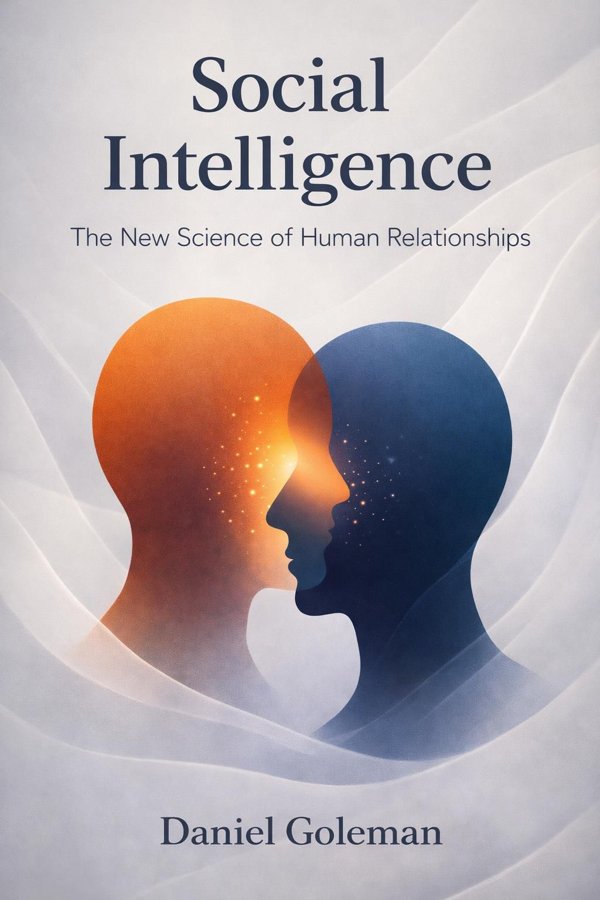
Social Intelligence: The New Science of Human Relationships: Summary & Key Insights
 10 min9 chaptersAudio available
Key Takeaways from Social Intelligence: The New Science of Human Relationships
One of the book’s most powerful insights is that relationships are not external to human biology; they are woven into it.
Most people think of empathy as simply feeling for someone else, but Goleman presents it as a layered capacity that lies at the heart of social intelligence.
A striking theme in Social Intelligence is that relationships do not merely influence mood; they literally help shape the brain and body over time.
A common assumption is that compassion belongs to the moral realm while science belongs to cold description.
Toxic interactions—criticism, contempt, emotional neglect, humiliation, unpredictability—place the body under strain.
What Is Social Intelligence: The New Science of Human Relationships About?
Social Intelligence: The New Science of Human Relationships by Daniel Goleman is a psychology book spanning 8 pages. What if your relationships are not just part of your life, but one of the main forces shaping your brain, body, and future? In Social Intelligence, Daniel Goleman argues that human beings are biologically built for connection, and that the quality of our interactions affects everything from emotional stability and health to performance, leadership, and moral behavior. Expanding on the ideas that made Emotional Intelligence influential, Goleman turns outward, exploring the intelligence that operates between people rather than only within the self. Drawing on neuroscience, psychology, and behavioral research, he explains how empathy works, why moods spread, how toxic relationships damage the body, and why compassion can be a measurable social force rather than a vague ideal. The book matters because it reframes relationships as a core human skill, not a soft extra. In a world of workplace pressure, social fragmentation, and digital distraction, Goleman shows that attention, attunement, and care are essential capacities for living well. As a psychologist and science journalist, he brings both authority and accessibility, translating complex research into practical insight about how we connect, influence, and heal one another.
This FizzRead summary covers all 9 key chapters of Social Intelligence: The New Science of Human Relationships in approximately 10 minutes, distilling the most important ideas, arguments, and takeaways from Daniel Goleman's work. Also available as an audio summary and Key Quotes Podcast.
Social Intelligence: The New Science of Human Relationships
What if your relationships are not just part of your life, but one of the main forces shaping your brain, body, and future? In Social Intelligence, Daniel Goleman argues that human beings are biologically built for connection, and that the quality of our interactions affects everything from emotional stability and health to performance, leadership, and moral behavior. Expanding on the ideas that made Emotional Intelligence influential, Goleman turns outward, exploring the intelligence that operates between people rather than only within the self.
Drawing on neuroscience, psychology, and behavioral research, he explains how empathy works, why moods spread, how toxic relationships damage the body, and why compassion can be a measurable social force rather than a vague ideal. The book matters because it reframes relationships as a core human skill, not a soft extra. In a world of workplace pressure, social fragmentation, and digital distraction, Goleman shows that attention, attunement, and care are essential capacities for living well. As a psychologist and science journalist, he brings both authority and accessibility, translating complex research into practical insight about how we connect, influence, and heal one another.
Who Should Read Social Intelligence: The New Science of Human Relationships?
This book is perfect for anyone interested in psychology and looking to gain actionable insights in a short read. Whether you're a student, professional, or lifelong learner, the key ideas from Social Intelligence: The New Science of Human Relationships by Daniel Goleman will help you think differently.
- ✓Readers who enjoy psychology and want practical takeaways
- ✓Professionals looking to apply new ideas to their work and life
- ✓Anyone who wants the core insights of Social Intelligence: The New Science of Human Relationships in just 10 minutes
Want the full summary?
Get instant access to this book summary and 100K+ more with Fizz Moment.
Get Free SummaryAvailable on App Store • Free to download
Key Chapters
One of the book’s most powerful insights is that relationships are not external to human biology; they are woven into it. Goleman shows that the brain is fundamentally social, equipped with systems that constantly monitor other people’s expressions, tone, intentions, and emotional states. Research on mirror neurons and related neural circuits suggests that when we observe another person’s action or emotion, our own brain partially simulates that experience. This helps explain why a smile can lift our mood, why tension in a room feels contagious, and why face-to-face interaction carries a force that abstract communication often lacks.
This biological design means that human beings do not regulate themselves in isolation as much as we like to think. We co-regulate. A calm parent settles a frightened child. An anxious boss raises team stress. A warm friend helps the nervous system recover after a difficult day. In this sense, every interaction leaves a trace. We are continuously influencing one another’s emotional and physiological state, often below conscious awareness.
The practical implication is profound: everyday social behavior matters more than we assume. Small moments of attention, eye contact, encouragement, and emotional steadiness are not trivial niceties. They are forms of biological support. Likewise, chronic coldness, hostility, or indifference can become forms of social damage.
If you want to improve your relationships, start by treating connection as a biological event, not just a social preference. Your actionable takeaway: in your next important conversation, give full attention for two uninterrupted minutes—make eye contact, listen closely, and notice how quickly genuine presence changes the interaction.
A striking theme in Social Intelligence is that relationships do not merely influence mood; they literally help shape the brain and body over time. Goleman highlights findings showing that repeated social experiences affect stress systems, immune function, cardiovascular health, and neural development. This is especially true in childhood, when attentive care helps wire emotional regulation, trust, and resilience. But the principle continues throughout life because the brain remains plastic. Healthy relationships can strengthen positive patterns, while harmful ones can reinforce fear, vigilance, and emotional instability.
This means that social environments act like invisible training grounds. A household filled with criticism teaches the nervous system to brace. A workplace marked by respect and support allows greater creativity and calm. A close friendship can become a space where old wounds soften because the person repeatedly experiences safety instead of judgment. The body learns from interaction.
Goleman’s point is hopeful as well as cautionary. People are not trapped forever by early patterns. Supportive mentoring, therapy, loving partnerships, and emotionally intelligent communities can help reshape expectations and reactions. Change often happens not through insight alone, but through repeated experiences of healthier connection.
In practical terms, this suggests that self-improvement cannot be reduced to individual willpower. Sometimes the fastest way to change yourself is to change the relational context around you. Seek out people who regulate rather than inflame you, and be that kind of presence for others.
Your actionable takeaway: identify one relationship or environment that consistently leaves you calmer, clearer, and more grounded, and make regular time for it this week as an investment in your emotional and physical well-being.
A common assumption is that compassion belongs to the moral realm while science belongs to cold description. Goleman challenges that divide by showing that compassion and altruism have observable psychological and biological effects. Human beings are capable not only of sharing emotion but of extending care, even at personal cost. This capacity is not random sentimentality; it can be strengthened, weakened, or redirected by experience, culture, and attention.
Compassion begins when empathy moves beyond recognition into concern and action. Seeing someone suffer is one step. Feeling moved to help is another. In organizations, compassionate cultures increase loyalty and trust. In medicine, compassionate care improves patient experience and often outcomes. In education, emotionally supportive classrooms improve learning because students feel safe enough to engage. Even in ordinary life, small acts of generosity can shift the emotional climate of a family or team.
Yet compassion is not automatic. People often withdraw when overloaded, threatened, or dehumanizing others. Goleman suggests that moral action depends partly on whether we perceive someone as fully real and connected to us. Social intelligence therefore has an ethical dimension: how we attend to others influences how we treat them.
This insight has practical value. Compassion can be built through habits such as perspective-taking, gratitude, active helping, and expanding the circle of who counts as “us.” It also requires boundaries, because exhausted people struggle to remain openhearted.
Your actionable takeaway: practice one deliberate act of compassion each day this week—send encouragement, offer practical help, or give full presence to someone distressed—and notice how intentional care changes both them and you.
One of Goleman’s most practical contributions is his argument that leadership is not merely strategic competence; it is relational influence at scale. Leaders shape the emotional climate of groups, and that climate affects motivation, cooperation, creativity, and resilience. A leader’s mood, listening habits, empathy, and self-control ripple through teams because people unconsciously track authority figures for cues about safety, urgency, and belonging.
This is why technically brilliant managers can still fail. If they humiliate people, ignore emotional undercurrents, or create fear, performance eventually suffers. People become cautious, political, and disengaged. By contrast, leaders with high social intelligence notice morale, read conflict early, adapt communication to context, and create environments where people feel both challenged and valued. They do not avoid hard truths, but they deliver them in ways that preserve dignity and momentum.
In organizations, social intelligence matters in hiring, feedback, negotiation, cross-functional collaboration, and culture building. A leader who can sense what is not being said, respond to resistance without defensiveness, and model calm under pressure becomes a stabilizing force. These skills are especially crucial during change, when uncertainty heightens emotional sensitivity.
For individual professionals, the lesson is clear: career success depends not only on what you know, but on how others experience you. Do you make cooperation easier or harder? Do people trust your intentions? Do you regulate tension or spread it?
Your actionable takeaway: in your next leadership moment—whether managing a team, running a meeting, or guiding a family decision—focus on emotional tone as deliberately as agenda. Ask yourself, “What state am I creating in others right now?”
Before empathy, compassion, or collaboration can happen, one basic condition must be present: attention. Goleman repeatedly suggests that social intelligence begins with noticing. People miss emotional signals not only because they lack kindness, but because they are distracted, rushed, or preoccupied with themselves. In modern life, fragmented attention weakens connection. We half-listen, check devices, anticipate our reply, and overlook the tiny cues through which others reveal what they feel.
This matters because relationships are built in moments of attunement. A child telling a story, a partner pausing before admitting hurt, a colleague masking frustration with politeness—these moments require presence to be understood. Attention communicates value. When someone feels genuinely noticed, trust grows. When they feel repeatedly skimmed over, connection thins even if no obvious conflict exists.
Attention also improves judgment. Socially intelligent people read context better because they take in more information: facial expression, pacing, hesitation, inconsistency between words and tone. They are less likely to react mechanically because they are actually perceiving what is happening. In this sense, attention is both a moral act and a practical skill.
A simple example is meetings. Teams often waste time because no one is truly listening; people defend positions instead of understanding concerns. One attentive question can unlock clarity faster than ten clever arguments.
Your actionable takeaway: choose one daily interaction to make device-free and interruption-free. For that conversation, listen until the other person feels fully understood before offering advice, opinions, or your own story.
All Chapters in Social Intelligence: The New Science of Human Relationships
About the Author
Daniel Goleman is an American psychologist, journalist, and internationally bestselling author known for bringing psychology and neuroscience to a broad audience. He studied at Amherst College and earned his PhD in psychology from Harvard, where he also taught. Goleman worked as a science journalist for The New York Times, reporting on the brain and behavioral sciences, which helped shape his clear and accessible style. He became globally influential with Emotional Intelligence, a book that changed how many people think about success, leadership, and human capability. In later works, including Social Intelligence, he expanded these ideas into relationships, compassion, focus, and leadership. His writing has had a major impact on education, business, coaching, and personal development around the world.
Get This Summary in Your Preferred Format
Read or listen to the Social Intelligence: The New Science of Human Relationships summary by Daniel Goleman anytime, anywhere. FizzRead offers multiple formats so you can learn on your terms — all free.
Available formats: App · Audio · PDF · EPUB — All included free with FizzRead
Download Social Intelligence: The New Science of Human Relationships PDF and EPUB Summary
Key Quotes from Social Intelligence: The New Science of Human Relationships
“One of the book’s most powerful insights is that relationships are not external to human biology; they are woven into it.”
“Most people think of empathy as simply feeling for someone else, but Goleman presents it as a layered capacity that lies at the heart of social intelligence.”
“A striking theme in Social Intelligence is that relationships do not merely influence mood; they literally help shape the brain and body over time.”
“A common assumption is that compassion belongs to the moral realm while science belongs to cold description.”
“We often think of stress as something caused by deadlines, money, or uncertainty, but Goleman makes clear that relationships themselves are major stress generators or stress buffers.”
Frequently Asked Questions about Social Intelligence: The New Science of Human Relationships
Social Intelligence: The New Science of Human Relationships by Daniel Goleman is a psychology book that explores key ideas across 9 chapters. What if your relationships are not just part of your life, but one of the main forces shaping your brain, body, and future? In Social Intelligence, Daniel Goleman argues that human beings are biologically built for connection, and that the quality of our interactions affects everything from emotional stability and health to performance, leadership, and moral behavior. Expanding on the ideas that made Emotional Intelligence influential, Goleman turns outward, exploring the intelligence that operates between people rather than only within the self. Drawing on neuroscience, psychology, and behavioral research, he explains how empathy works, why moods spread, how toxic relationships damage the body, and why compassion can be a measurable social force rather than a vague ideal. The book matters because it reframes relationships as a core human skill, not a soft extra. In a world of workplace pressure, social fragmentation, and digital distraction, Goleman shows that attention, attunement, and care are essential capacities for living well. As a psychologist and science journalist, he brings both authority and accessibility, translating complex research into practical insight about how we connect, influence, and heal one another.
More by Daniel Goleman
Emotional Intelligence
Daniel Goleman
10 min
Primal Leadership: Realizing the Power of Emotional Intelligence
Daniel Goleman, Richard Boyatzis, Annie McKee
10 min
Emotional Intelligence: Why It Can Matter More Than IQ
Daniel Goleman
10 min
Focus: The Hidden Driver of Excellence
Daniel Goleman
10 minYou Might Also Like
The Body Keeps the Score
Bessel van der Kolk
10 min
Surrounded by Idiots
Thomas Erikson
10 minEmotional Intelligence
Daniel Goleman
10 min
Attached
Amir Levine
10 min
Why Does He Do That
Lundy Bancroft
10 min
Women Who Run with the Wolves
Clarissa Pinkola Estés
10 minBrowse by Category
Ready to read Social Intelligence: The New Science of Human Relationships?
Get the full summary and 100K+ more books with Fizz Moment.