
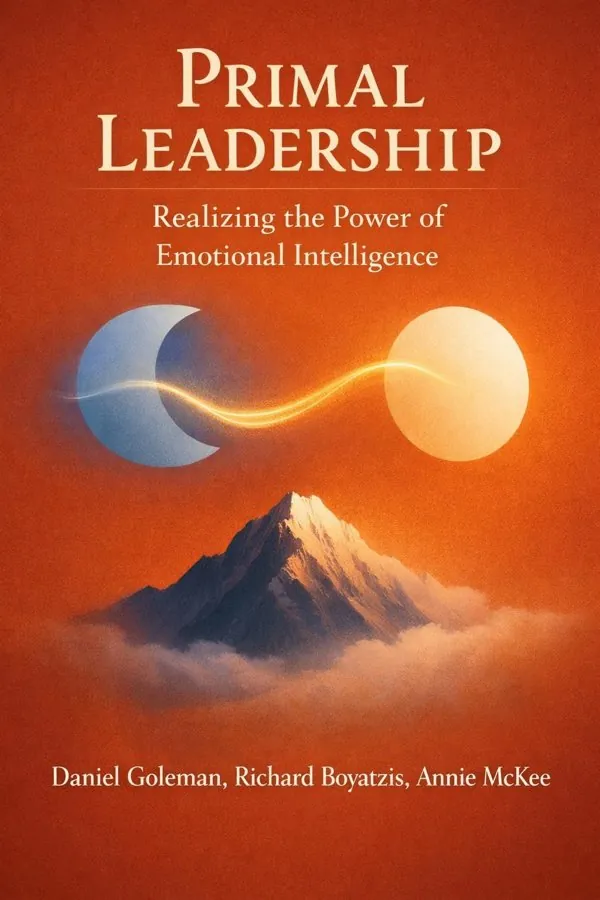
Primal Leadership: Realizing the Power of Emotional Intelligence: Summary & Key Insights
by Daniel Goleman, Richard Boyatzis, Annie McKee
 10 min9 chaptersAudio available
Key Takeaways from Primal Leadership: Realizing the Power of Emotional Intelligence
A leader’s mood is never private for long.
Great leadership begins with inner mastery and extends outward into relationships.
You cannot lead others well if you are a stranger to yourself.
Knowing your emotions matters, but leading effectively requires more than recognition.
The most overlooked leadership skill is often the simplest: accurately sensing what other people are experiencing.
What Is Primal Leadership: Realizing the Power of Emotional Intelligence About?
Primal Leadership: Realizing the Power of Emotional Intelligence by Daniel Goleman, Richard Boyatzis, Annie McKee is a leadership book spanning 6 pages. Primal Leadership argues that the most important task of a leader is not merely setting strategy or driving execution, but shaping the emotional reality in which people work. Daniel Goleman, Richard Boyatzis, and Annie McKee show that leaders transmit moods constantly, and those moods directly influence attention, trust, motivation, collaboration, and performance. In other words, leadership is emotional before it is operational. The book brings together research from psychology, neuroscience, and organizational behavior to explain why some leaders energize teams while others create anxiety, disengagement, or silent resistance. At the center of their framework is emotional intelligence: the ability to understand and manage yourself while also reading and guiding the emotions of others. The authors are uniquely qualified to make this case. Goleman popularized emotional intelligence worldwide, Boyatzis is a leading scholar of leadership development, and McKee has spent years helping organizations build healthier cultures. Their combined perspective makes this book both rigorous and practical. For anyone responsible for people, culture, or change, Primal Leadership offers a powerful reminder: the tone you set becomes the climate your team lives in.
This FizzRead summary covers all 9 key chapters of Primal Leadership: Realizing the Power of Emotional Intelligence in approximately 10 minutes, distilling the most important ideas, arguments, and takeaways from Daniel Goleman, Richard Boyatzis, Annie McKee's work. Also available as an audio summary and Key Quotes Podcast.
Primal Leadership: Realizing the Power of Emotional Intelligence
Primal Leadership argues that the most important task of a leader is not merely setting strategy or driving execution, but shaping the emotional reality in which people work. Daniel Goleman, Richard Boyatzis, and Annie McKee show that leaders transmit moods constantly, and those moods directly influence attention, trust, motivation, collaboration, and performance. In other words, leadership is emotional before it is operational. The book brings together research from psychology, neuroscience, and organizational behavior to explain why some leaders energize teams while others create anxiety, disengagement, or silent resistance. At the center of their framework is emotional intelligence: the ability to understand and manage yourself while also reading and guiding the emotions of others. The authors are uniquely qualified to make this case. Goleman popularized emotional intelligence worldwide, Boyatzis is a leading scholar of leadership development, and McKee has spent years helping organizations build healthier cultures. Their combined perspective makes this book both rigorous and practical. For anyone responsible for people, culture, or change, Primal Leadership offers a powerful reminder: the tone you set becomes the climate your team lives in.
Who Should Read Primal Leadership: Realizing the Power of Emotional Intelligence?
This book is perfect for anyone interested in leadership and looking to gain actionable insights in a short read. Whether you're a student, professional, or lifelong learner, the key ideas from Primal Leadership: Realizing the Power of Emotional Intelligence by Daniel Goleman, Richard Boyatzis, Annie McKee will help you think differently.
- ✓Readers who enjoy leadership and want practical takeaways
- ✓Professionals looking to apply new ideas to their work and life
- ✓Anyone who wants the core insights of Primal Leadership: Realizing the Power of Emotional Intelligence in just 10 minutes
Want the full summary?
Get instant access to this book summary and 100K+ more with Fizz Moment.
Get Free SummaryAvailable on App Store • Free to download
Key Chapters
A leader’s mood is never private for long. One of the book’s most important insights is that leadership works through emotional contagion: feelings spread from one person to another, especially from those in authority. The authors call the positive version of this effect resonance. Resonant leaders create an atmosphere in which people feel seen, valued, and energized. In that state, teams think more clearly, collaborate more easily, and persist longer through setbacks. By contrast, dissonant leaders fill the room with anxiety, irritation, confusion, or emotional distance, often without realizing it.
Resonance does not mean being endlessly cheerful or avoiding hard truths. It means aligning people around purpose while managing emotion constructively. A resonant leader can deliver difficult feedback, make unpopular decisions, or navigate crisis without poisoning the emotional environment. For example, a department head facing budget cuts might acknowledge fear and disappointment openly, explain the rationale transparently, and focus the team on what can still be controlled. That approach preserves trust. A dissonant leader in the same situation might become defensive, curt, or silent, leaving people to fill the gaps with suspicion and worry.
The core lesson is that leadership effectiveness depends not only on what leaders decide, but on how people feel in their presence. Culture is shaped interaction by interaction, meeting by meeting, conversation by conversation. If employees become more focused and hopeful after speaking with you, you are likely creating resonance. If they become guarded or drained, you are likely creating dissonance.
Actionable takeaway: At the end of each day, ask yourself, “What emotional tone did I spread today?” Then choose one habit tomorrow—such as listening more fully, acknowledging effort, or speaking more calmly—to create stronger resonance.
Great leadership begins with inner mastery and extends outward into relationships. The book organizes emotional intelligence into four domains: self-awareness, self-management, social awareness, and relationship management. Together, these capacities explain how leaders handle themselves and how they handle others.
Self-awareness means recognizing your emotions, triggers, strengths, values, and limits in real time. Without it, leaders operate on autopilot. Self-management is the ability to regulate impulses, stay adaptable, act with integrity, and remain effective under pressure. Social awareness expands attention beyond the self; it includes empathy, organizational awareness, and sensitivity to group dynamics. Relationship management turns that awareness into action through influence, coaching, conflict management, inspiration, and collaboration.
These four domains are interconnected. A leader who lacks self-awareness may misread others because personal defensiveness clouds perception. A leader with empathy but weak self-management may understand people’s feelings yet react poorly under stress. A manager who can stay calm but lacks relationship skills may remain composed while still failing to inspire or unite the team.
Imagine a project leader whose team misses a deadline. Self-aware leadership notices personal frustration before it spills out. Self-management prevents blame or panic. Social awareness picks up that the team feels discouraged and overloaded. Relationship management then guides a productive response: reset expectations, clarify obstacles, and rebuild momentum. The same event handled without emotional intelligence can quickly become a cycle of tension and underperformance.
The authors stress that emotional intelligence is not a soft extra. It is a practical leadership system that shapes decision quality, trust, morale, and results.
Actionable takeaway: Assess yourself across all four domains and identify the weakest one. Improving the weakest domain often creates the biggest gain in overall leadership effectiveness.
You cannot lead others well if you are a stranger to yourself. The authors emphasize that self-awareness is the foundation of emotional intelligence because it allows leaders to recognize what they are feeling, why they are feeling it, and how those emotions affect behavior. Leaders often assume they are being rational when they are actually being driven by ego, fear, impatience, or the need for approval. Self-awareness interrupts that illusion.
This inner clarity also supports authenticity. People trust leaders who seem grounded in their values rather than performing a role. Authenticity does not mean sharing every feeling or speaking impulsively. It means understanding your internal state well enough to act consistently with your principles. A self-aware leader knows, for example, that criticism triggers defensiveness and therefore pauses before responding in a tense meeting. That pause protects credibility and keeps the discussion constructive.
The book also points out that self-awareness includes an accurate view of strengths and limitations. Many leaders overestimate their impact or underestimate their blind spots. Feedback, reflection, and honest relationships are essential correctives. Consider a senior manager who believes he is decisive, while his team experiences him as intimidating. Only through feedback and reflection can he see that what feels like clarity to him feels like shutdown to others.
Developing self-awareness requires deliberate practices: journaling after difficult interactions, noticing bodily signals of stress, seeking 360-degree feedback, and reflecting on moments of pride and regret. Over time, these habits make emotional patterns visible. Once visible, they become manageable.
Actionable takeaway: After your next emotionally charged interaction, write down what you felt, what triggered it, how you behaved, and what effect you likely had on others. Repeating this practice builds the self-knowledge leadership depends on.
Knowing your emotions matters, but leading effectively requires more than recognition. It requires regulation. Self-management is the capacity to handle disruptive impulses, stay composed under pressure, and choose responses that serve long-term goals rather than short-term emotion. In leadership, this is critical because people watch not only what leaders say, but how they behave when things go wrong.
The book describes self-management as a combination of emotional self-control, transparency, adaptability, initiative, and optimism. A self-managed leader does not suppress emotion mechanically; instead, they channel it intelligently. Anger can become clarity about standards. Anxiety can become preparation. Disappointment can become learning. Without self-management, however, emotions hijack judgment. A leader snaps in a meeting, sends a reactive email, micromanages during uncertainty, or retreats into avoidance when conflict emerges.
In organizational life, self-management often shows up in small moments with large consequences. Imagine a founder receiving bad sales numbers before an all-hands meeting. A reactive response might be visible panic or blame, instantly lowering morale. A self-managed response would acknowledge concern, present the facts calmly, invite focused problem-solving, and communicate confidence in the team’s ability to adapt. The situation remains hard, but the emotional climate stays workable.
This domain also includes resilience. Leaders face repeated setbacks, ambiguity, and criticism. Those who recover quickly are better able to sustain hope and strategic focus for others. Importantly, resilience is not denial; it is the ability to remain resourceful without becoming emotionally flooded.
Actionable takeaway: Build a personal reset ritual for stress—such as pausing before replying, taking three slow breaths, or delaying difficult emails by ten minutes. Small regulation habits prevent momentary emotion from becoming lasting damage.
Leadership becomes real in relationships. The first three emotional intelligence domains prepare the ground, but relationship management is where influence, inspiration, coaching, and conflict handling come alive. According to the authors, this is the domain that allows leaders to move people together toward meaningful goals.
Strong relationship management includes communicating a compelling vision, developing others, handling disagreements productively, building bonds, and fostering teamwork. It is not manipulation. It is the disciplined use of emotional intelligence to help groups function at their best. Leaders with this capability know when to encourage, when to challenge, when to listen, and when to step in decisively.
Consider a team with growing friction between product and sales. A weak leader may ignore the tension until it hardens into blame. A technically strong but emotionally unaware leader may impose a process without addressing mistrust. A leader with relationship management skills will name the tension, create space for each side to express concerns, refocus everyone on shared goals, and establish routines that improve coordination. The emotional repair enables the operational fix.
This domain also includes coaching. Rather than solving every problem personally, effective leaders help others grow their own capacity. They tailor feedback, recognize effort, and stretch people without overwhelming them. Over time, this builds confidence, accountability, and loyalty.
The book makes clear that relationship management is not an optional add-on for extroverts. It is a core leadership capability because organizations run through conversations, and conversations are emotional events. Leaders who manage relationships well create trust that carries teams through uncertainty and change.
Actionable takeaway: Choose one relationship at work that feels stuck. Schedule a direct conversation focused not on tasks first, but on expectations, tensions, and shared goals. Repairing one key relationship can improve an entire team’s performance.
No single leadership style works in every situation. One of the book’s most practical contributions is its description of six distinct leadership styles: visionary, coaching, affiliative, democratic, pacesetting, and commanding. Each style shapes team emotions differently, and the best leaders use several rather than relying on one default mode.
Visionary leaders mobilize people toward a shared direction by connecting work to purpose. Coaching leaders focus on long-term development and help individuals grow. Affiliative leaders build harmony, belonging, and emotional repair. Democratic leaders create buy-in by inviting participation. Pacesetting leaders set high standards and model intensity. Commanding leaders demand immediate compliance and are most useful in crises or clear emergencies.
The key is not memorizing the styles but understanding their emotional impact. Visionary, coaching, affiliative, and democratic styles tend to create resonance when used well. Pacesetting and commanding can produce results in the short term, but overuse often creates dissonance, exhaustion, or fear. For instance, a startup founder who constantly uses pacesetting may initially inspire hustle but eventually leave people feeling inadequate and burned out. A democratic style may build commitment for strategic decisions, but in a crisis it can slow response. Skill lies in matching style to context.
The authors argue that leadership flexibility is a hallmark of emotional intelligence. Leaders must read the room, understand the demands of the moment, and shift styles without losing authenticity. This requires self-awareness, empathy, and judgment.
Actionable takeaway: Identify your default leadership style and one style you underuse. Then intentionally practice that underused style this week—for example, replacing pacesetting with coaching or replacing democracy with clear vision when direction is needed.
Organizations often misdiagnose performance problems as purely strategic or structural when the real issue is emotional climate. The book warns that dissonant leadership creates an environment in which fear, frustration, confusion, or apathy spread downward from the top. Even highly capable people struggle in such conditions because cognitive performance suffers when emotional energy is drained.
Dissonance can emerge in many forms: sarcasm from senior leaders, chronic unpredictability, lack of empathy, pressure without support, or constant urgency that leaves no room for reflection. A leader may think he is pushing for excellence while his team experiences humiliation and threat. Another may avoid emotional reality altogether, creating a vacuum in which rumors and anxiety flourish. Over time, people protect themselves by withholding ideas, minimizing risk, disengaging emotionally, or leaving.
The damage is often subtle at first. Meetings become quieter. Collaboration weakens. Innovation declines. People comply rather than commit. Because some dissonant leaders still hit short-term targets, organizations can mistake fear-driven output for healthy performance. But the long-term costs appear in turnover, burnout, poor succession, and cultural brittleness.
A practical example is a manager who responds to bad news by punishing the messenger. Soon the team stops surfacing issues early. Problems worsen, and the manager interprets the silence as control. This is how emotional dysfunction becomes operational failure.
The authors’ point is sobering: leaders do not merely influence morale; they shape the human conditions under which performance becomes possible or impossible. Technical competence cannot compensate indefinitely for emotional toxicity.
Actionable takeaway: Ask a trusted colleague or team member, “What is it like emotionally to work with me when pressure rises?” Listen without defending yourself. Honest data about your dissonant moments is the first step toward changing them.
Most leadership development fails because insight alone does not produce lasting change. Primal Leadership argues that becoming a resonant leader requires intentional, sustained practice supported by reflection, feedback, and relationships. Emotional habits are deeply ingrained; they cannot be transformed by a workshop or a burst of motivation.
The authors draw on Boyatzis’s work on self-directed learning to suggest a more effective path. Change begins with an ideal self: a vivid sense of the leader you want to become. From there, you compare that vision with your real self, including strengths and gaps. Then you create a learning agenda, experiment with new behaviors, and rely on supportive relationships to sustain the effort. This process is developmental rather than performative.
An important part of this idea is renewal. Leaders who are always giving emotional energy without replenishing it become brittle, reactive, and disconnected. Renewal can come through reflection, meaningful relationships, purposeful work, mindfulness, rest, learning, or time spent in environments that restore perspective. Without renewal, even capable leaders drift toward dissonance because stress narrows empathy and patience.
Imagine a senior executive who wants to become less controlling and more coaching-oriented. Reading about coaching helps, but real change requires noticing controlling impulses in the moment, practicing new questions, asking for feedback after meetings, and recovering from setbacks without quitting. Over time, repeated practice rewires leadership behavior.
The deeper message is hopeful: emotional intelligence is not fixed. Leaders can grow substantially if they approach development as a long-term discipline rather than a personality trait.
Actionable takeaway: Write a short statement describing the kind of leader you want to be in three years, then choose one recurring behavior to practice for the next month that moves you toward that ideal.
All Chapters in Primal Leadership: Realizing the Power of Emotional Intelligence
About the Authors
Daniel Goleman is an American psychologist, former science journalist for The New York Times, and one of the world’s best-known voices on emotional intelligence. His work helped bring psychology and neuroscience into mainstream conversations about leadership and performance. Richard Boyatzis is a professor of organizational behavior, psychology, and cognitive science, widely respected for his research on leadership competencies, emotional intelligence, and intentional change. Annie McKee is a leadership scholar, executive advisor, and educator whose work focuses on resonant leadership, organizational culture, and helping leaders sustain effectiveness over time. Together, Goleman, Boyatzis, and McKee combine scientific research, academic rigor, and practical experience, making Primal Leadership a foundational book for understanding the emotional side of effective leadership.
Get This Summary in Your Preferred Format
Read or listen to the Primal Leadership: Realizing the Power of Emotional Intelligence summary by Daniel Goleman, Richard Boyatzis, Annie McKee anytime, anywhere. FizzRead offers multiple formats so you can learn on your terms — all free.
Available formats: App · Audio · PDF · EPUB — All included free with FizzRead
Download Primal Leadership: Realizing the Power of Emotional Intelligence PDF and EPUB Summary
Key Quotes from Primal Leadership: Realizing the Power of Emotional Intelligence
“A leader’s mood is never private for long.”
“Great leadership begins with inner mastery and extends outward into relationships.”
“You cannot lead others well if you are a stranger to yourself.”
“Knowing your emotions matters, but leading effectively requires more than recognition.”
“The most overlooked leadership skill is often the simplest: accurately sensing what other people are experiencing.”
Frequently Asked Questions about Primal Leadership: Realizing the Power of Emotional Intelligence
Primal Leadership: Realizing the Power of Emotional Intelligence by Daniel Goleman, Richard Boyatzis, Annie McKee is a leadership book that explores key ideas across 9 chapters. Primal Leadership argues that the most important task of a leader is not merely setting strategy or driving execution, but shaping the emotional reality in which people work. Daniel Goleman, Richard Boyatzis, and Annie McKee show that leaders transmit moods constantly, and those moods directly influence attention, trust, motivation, collaboration, and performance. In other words, leadership is emotional before it is operational. The book brings together research from psychology, neuroscience, and organizational behavior to explain why some leaders energize teams while others create anxiety, disengagement, or silent resistance. At the center of their framework is emotional intelligence: the ability to understand and manage yourself while also reading and guiding the emotions of others. The authors are uniquely qualified to make this case. Goleman popularized emotional intelligence worldwide, Boyatzis is a leading scholar of leadership development, and McKee has spent years helping organizations build healthier cultures. Their combined perspective makes this book both rigorous and practical. For anyone responsible for people, culture, or change, Primal Leadership offers a powerful reminder: the tone you set becomes the climate your team lives in.
You Might Also Like

Extreme Ownership
Jocko Willink
10 min
Dare to Lead
Brene Brown
10 min
Leaders Eat Last
Simon Sinek
10 min
The 21 Irrefutable Laws of Leadership
John Maxwell
10 min
Start With Why
Simon Sinek
10 min
How to Lead When You're Not in Charge
Clay Scroggins
10 minBrowse by Category
Ready to read Primal Leadership: Realizing the Power of Emotional Intelligence?
Get the full summary and 100K+ more books with Fizz Moment.