
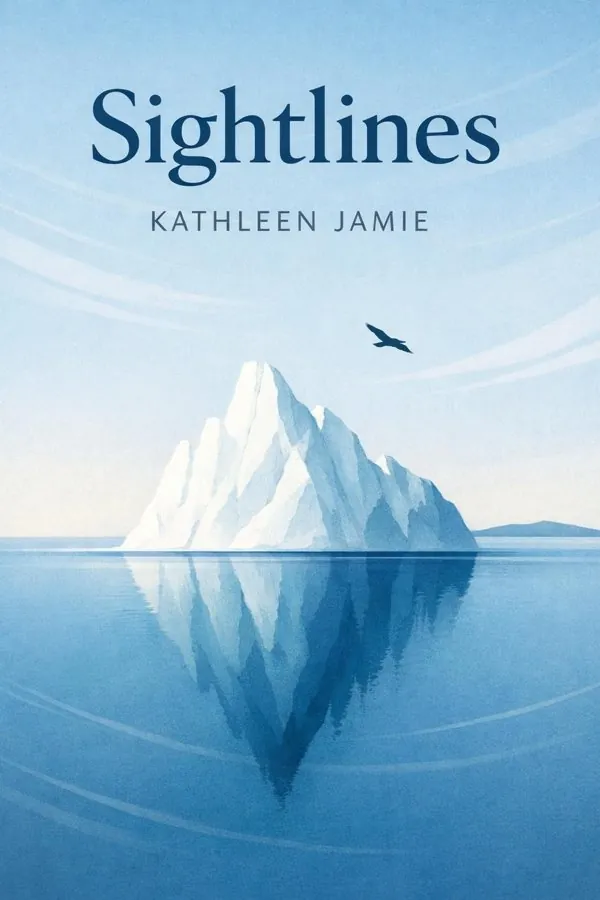
Sightlines: Summary & Key Insights
 10 min9 chaptersAudio available
Key Takeaways from Sightlines
Remote places do not simplify the world; they sharpen it.
The past is not gone; it is embedded beneath our feet.
Some landscapes are so vast and severe that they expose the limits of human self-importance.
Attention does not only move outward toward the grand; it can also move inward toward the minute.
Encountering a whale is not just an experience of grandeur; it is an encounter with another order of life that alters our sense of ourselves.
What Is Sightlines About?
Sightlines by Kathleen Jamie is a environment book spanning 9 pages. Sightlines is a luminous collection of essays in which Kathleen Jamie turns attentive looking into a way of thinking about life itself. Moving across Scottish islands, archaeological digs, hospitals, coastlines, museums, and Arctic waters, she asks what it means to truly see rather than merely glance. Her subject is ostensibly the natural world, but the book reaches much further: into memory, mortality, history, and the uneasy place humans occupy within fragile ecosystems. Jamie’s gift lies in her ability to connect the intimate and the immense. A bird’s movement, a whale’s body, a fragment of bone, or a patch of ice can open into reflections on time, violence, belonging, and care. The essays resist grand declarations, yet together they make a powerful argument for humility and close attention in an age of distraction and environmental neglect. Jamie writes with the precision of a poet and the curiosity of a field observer, which gives the book both lyrical beauty and intellectual depth. Sightlines matters because it teaches readers a rare skill: how to look at the world closely enough that it begins to change them.
This FizzRead summary covers all 9 key chapters of Sightlines in approximately 10 minutes, distilling the most important ideas, arguments, and takeaways from Kathleen Jamie's work. Also available as an audio summary and Key Quotes Podcast.
Sightlines
Sightlines is a luminous collection of essays in which Kathleen Jamie turns attentive looking into a way of thinking about life itself. Moving across Scottish islands, archaeological digs, hospitals, coastlines, museums, and Arctic waters, she asks what it means to truly see rather than merely glance. Her subject is ostensibly the natural world, but the book reaches much further: into memory, mortality, history, and the uneasy place humans occupy within fragile ecosystems. Jamie’s gift lies in her ability to connect the intimate and the immense. A bird’s movement, a whale’s body, a fragment of bone, or a patch of ice can open into reflections on time, violence, belonging, and care. The essays resist grand declarations, yet together they make a powerful argument for humility and close attention in an age of distraction and environmental neglect. Jamie writes with the precision of a poet and the curiosity of a field observer, which gives the book both lyrical beauty and intellectual depth. Sightlines matters because it teaches readers a rare skill: how to look at the world closely enough that it begins to change them.
Who Should Read Sightlines?
This book is perfect for anyone interested in environment and looking to gain actionable insights in a short read. Whether you're a student, professional, or lifelong learner, the key ideas from Sightlines by Kathleen Jamie will help you think differently.
- ✓Readers who enjoy environment and want practical takeaways
- ✓Professionals looking to apply new ideas to their work and life
- ✓Anyone who wants the core insights of Sightlines in just 10 minutes
Want the full summary?
Get instant access to this book summary and 100K+ more with Fizz Moment.
Get Free SummaryAvailable on App Store • Free to download
Key Chapters
Remote places do not simplify the world; they sharpen it. In Sightlines, Kathleen Jamie’s reflections on the Scottish islands show that these landscapes are not empty margins but dense fields of perception where weather, birds, rock, sea, and human presence are intimately entangled. The islands strip away the noise of modern routine and replace it with another kind of busyness: wind directions, shifting tides, nesting patterns, silence, and the awareness of being physically small within a larger ecology. Jamie does not romanticize isolation. Solitude here is not escape but exposure. On an island, one is forced to notice dependence—on shelter, on routes, on local knowledge, on the habits of other living things.
What makes these essays powerful is that Jamie treats islands as places of relationship rather than scenic backdrops. She watches seabirds, studies shorelines, and senses the traces of older human habitation, revealing that landscape is always layered with life and memory. The practical implication is clear: attention grows when we stop treating place as scenery for our thoughts and begin treating it as a living system with its own patterns and claims. Even if you never travel to a remote island, you can apply the same discipline in everyday life. Walk the same local path repeatedly. Learn the names of plants or birds. Notice how weather changes a familiar street. Let a place become specific rather than generic.
Jamie suggests that true seeing begins when we stop asking what a place can do for us and start asking how it exists on its own terms. Actionable takeaway: choose one nearby landscape and return to it regularly until your observation deepens into relationship.
The past is not gone; it is embedded beneath our feet. Jamie’s archaeological reflections reveal burial grounds, standing stones, and excavated remains not as museum pieces but as presences that complicate the idea of linear time. When she encounters old bones, ancient structures, or traces of ritual and habitation, she does not treat them as inert evidence. Instead, she asks what it means to live among the dead, to inherit landscapes already shaped by countless unseen lives, and to recognize that our own era will one day be another layer of debris and meaning.
This perspective transforms archaeology from a specialist discipline into a moral and imaginative practice. To notice the remnants of earlier people is to realize that land is never empty and history is never abstract. Human beings have always sought shelter, made symbols, mourned losses, and tried to leave marks that outlast them. Jamie’s essays quietly resist modern arrogance by showing how brief our moment is compared with geological and cultural time. Yet they also resist despair. These remnants connect us to continuity. The dead are not simply gone; they remain in paths, ruins, field boundaries, and names.
In practical terms, Jamie encourages a form of historical attention. When visiting an old cemetery, a ruined settlement, or an archaeological site, do not rush toward facts alone. Ask what habits of life once unfolded there. Notice materials, weathering, orientation, and silence. Consider what your own surroundings may be preserving without your awareness. Such attention fosters humility and stewardship. We become less likely to treat land as disposable when we recognize it as storied.
Actionable takeaway: next time you visit a historic or ancient site, spend ten quiet minutes observing before reading any plaque, and let the place speak through texture, scale, and atmosphere first.
Some landscapes are so vast and severe that they expose the limits of human self-importance. Jamie’s journey to the Arctic is not a conquest narrative or a performance of endurance. Instead, it becomes an encounter with ice, cold, distance, and ecological fragility that unsettles easy assumptions about mastery over nature. The Arctic in Sightlines is both materially real and symbolically charged: a place where climate, light, and scale alter perception, and where the human observer must confront both wonder and insignificance.
Jamie writes against the old tradition of heroic exploration. She is more interested in the ethics of presence than the drama of arrival. What does it mean to look at ice without turning it into spectacle? How do we witness a vulnerable environment without absorbing it into tourism, nationalism, or scientific abstraction alone? These questions matter even more in the context of climate change. The Arctic is not a remote elsewhere disconnected from daily life; it is part of a planetary system whose transformations affect everyone. Jamie’s reflective style reminds readers that ecological crisis begins in failures of perception as much as in failures of policy.
A practical application of this idea is learning to hold awe and responsibility together. When confronted with a breathtaking environment, ask not only, “Isn’t this beautiful?” but also, “What conditions sustain this place, and how are they being threatened?” The same principle applies closer to home: a river, wetland, or coastline can be appreciated aesthetically while also being understood ecologically and politically.
Actionable takeaway: when encountering a beautiful landscape, pair admiration with one concrete act of inquiry—learn one fact about its vulnerability and one way to support its protection.
Attention does not only move outward toward the grand; it can also move inward toward the minute. In Sightlines, Jamie’s microscopic perspectives reveal that wonder is not reserved for whales, mountains, or polar ice. It also lives in tiny structures, overlooked organisms, and the barely visible forms that make up the fabric of life. By turning toward the small, Jamie challenges a common habit of valuing only what appears dramatic or sublime. She shows that scale shapes imagination: when we examine shells, cells, feathers, or fragments, we discover intricate worlds that unsettle our human-centered sense of proportion.
This shift matters because modern life often trains us to skim. We look for headlines, monuments, and large-scale events while missing the patterns that sustain existence at finer levels. Jamie’s essays model a more patient curiosity. Looking closely at small life forms does not reduce mystery; it multiplies it. The ordinary becomes newly strange and vivid. A practical consequence of this perspective is increased ecological literacy. Many environmental crises begin invisibly—in damaged soil, disappearing insects, polluted water, degraded habitats. If we only respond to spectacle, we respond too late.
You can apply Jamie’s method by practicing deliberate observation of overlooked detail. Spend time in a garden, on a beach, or even near a windowsill plant. Notice textures, movements, repetitions, and interactions. Use a magnifying lens, field guide, or notebook if helpful, but the point is not expert mastery. It is to recover a mode of seeing in which curiosity replaces indifference. The world becomes richer when scale is no barrier to attention.
Actionable takeaway: choose one small natural object this week—a leaf, feather, shell, or insect—and study it for five uninterrupted minutes, writing down everything you notice before you label it.
To study the sky is to remember that human concerns are local, temporary, and incomplete. Jamie’s astronomical observations extend her central practice of attention beyond earthbound landscapes into the night sky, where stars, darkness, and atmospheric conditions shift the scale of thought. Yet even here she avoids abstract grandiosity. The cosmos is not a pretext for philosophical showing off; it is another field in which careful looking can transform consciousness. Looking upward does not solve human problems, but it can reorder them.
The key insight is that perspective is ethical as well as intellectual. When we pay attention to the moon, constellations, darkness, and the rhythms of night, we loosen the grip of self-importance. We remember that our lives unfold within systems far larger than our plans and anxieties. At the same time, Jamie is alert to the local realities of seeing the sky: weather, geography, season, and artificial light all matter. Even the stars are encountered from somewhere specific. This grounds wonder in lived experience.
A practical application of this idea is the cultivation of nighttime awareness. In many modern settings, people rarely experience true darkness or spend meaningful time under the sky. Reclaiming even a small amount of this attention can be restorative. Step outside after dark without headphones. Notice cloud cover, moon phase, air temperature, and ambient sounds. If possible, learn a few visible constellations or simply track how the sky changes over a month. Such habits counter digital overstimulation and reconnect perception with natural cycles.
Actionable takeaway: spend ten minutes outside at night once a week, observing the sky without multitasking, and let the scale of what you see reframe the scale of what worries you.
What falls apart is not always a sign of failure; often it is the condition of renewal. Jamie’s meditations on decay and renewal challenge the modern instinct to sanitize, preserve, and control every sign of breakdown. In natural systems, decomposition is not an embarrassing ending but an essential process through which matter is transformed and life continues. Dead wood feeds insects and fungi, eroded coastlines release histories, and bodily decline reminds us that mortality is woven into existence rather than imposed from outside it.
Jamie’s essays are especially powerful because they connect ecological decay with human finitude. Hospitals, bones, weathered structures, and damaged habitats all call forth a similar question: how do we live honestly in a world where loss is unavoidable? She does not answer with sentimentality. Instead, she models a steadier acceptance. To notice decay without turning away is to become more capable of gratitude, care, and realism. This is not passive resignation. It is a refusal of illusions that keep us detached from the actual cycles sustaining life.
In practical terms, this idea can reshape how we think about aging, maintenance, and environmental stewardship. Rather than aiming for sterile perfection, we might learn to distinguish between harmful neglect and natural transformation. Composting, habitat restoration, seasonal gardening, and even the preservation of old buildings all involve understanding what should be allowed to change and what should be protected from irreversible damage.
Actionable takeaway: identify one aspect of your life where you resist natural change—aging, seasonal transition, or the weathering of a place—and practice responding with observation and care rather than denial or disgust.
There is no pure nature untouched by human presence, yet that fact should deepen responsibility rather than excuse damage. In Sightlines, Jamie pays close attention to human traces in the natural world: paths, ruins, industrial remnants, memorials, noise, extraction, and the subtle habits by which people inscribe themselves onto land and sea. Her essays resist two simplistic views. One is the fantasy that nature exists apart from us in pristine isolation. The other is the equally flawed assumption that because humans are everywhere, our impact no longer matters. Jamie shows that presence comes in degrees, forms, and consequences.
What emerges is an ethics of footprint. Human traces can be reverent, careless, temporary, violent, communal, or extractive. A cairn on a hillside, an abandoned structure, a protected footpath, and an oil-scarred shore are not morally equivalent. Learning to read these marks helps us understand how culture and environment continually shape each other. Jamie’s observational discipline asks readers to notice not only beauty in a place but also evidence of use, control, neglect, and adaptation.
This perspective has practical value in daily life. We can evaluate our own habits not through abstract guilt but through visible consequences. How do our routines alter local spaces? Do we consume environments as scenery, or participate in their care? Even urban living does not exempt us from this question. Streets, parks, rivers, and coastlines all bear cumulative traces of human decision-making. Better attention can lead to better choices: reduced waste, support for conservation, respect for access rules, and involvement in local stewardship.
Actionable takeaway: on your next walk, actively identify five human traces in the landscape and ask of each one: does this mark show care, use, damage, or neglect?
The deepest argument of Sightlines is that perception is never merely visual; it is ethical. Jamie’s closing essays gather the book’s themes into a quiet but powerful claim: how we look shapes how we live. To see hurriedly, instrumentally, or possessively is to move through the world as though it exists for our convenience. To see attentively is to allow other beings, places, and histories their own reality. This shift may sound modest, but Jamie presents it as foundational. Before care comes notice. Before stewardship comes relationship. Before wisdom comes the willingness to stay still long enough to perceive what is actually there.
This idea helps explain why the essays feel so resonant. They are not simply about birds, ice, bones, or islands. They are about the cultivation of a certain stance toward existence—curious, humble, precise, and open to correction. Jamie demonstrates that attention is not passive. It demands patience, discomfort, and a willingness to relinquish the centrality of the self. In return, it offers a richer, more truthful way of inhabiting the world.
The practical application is both simple and demanding. Build moments of deliberate noticing into ordinary life. Put away devices during a walk. Listen before speaking. Observe seasonal change in one tree. Read local histories. Learn the names of what surrounds you. Such acts do not solve environmental crisis alone, but they create the perceptual conditions from which more serious forms of responsibility can grow.
Actionable takeaway: create one daily ritual of attention—five undistracted minutes spent observing a place, creature, or sky—and treat that practice as the beginning of care.
All Chapters in Sightlines
About the Author
Kathleen Jamie is a Scottish poet and essayist celebrated for her luminous prose and exacting powers of observation. Born in 1962 in Scotland, she emerged first as a major poetic voice before gaining wide acclaim for her essay collections, including Findings and Sightlines. Her writing often explores the meeting point between landscape, history, wildlife, and human vulnerability, with a particular sensitivity to Scottish places and the broader natural world. Jamie’s work is distinguished by lyrical precision, moral clarity, and an ability to find philosophical depth in concrete detail. Over the course of her career, she has received numerous literary honors and has become one of the most respected contemporary writers of nature and place. Her essays continue to influence readers seeking a more attentive and humane way of seeing the world.
Get This Summary in Your Preferred Format
Read or listen to the Sightlines summary by Kathleen Jamie anytime, anywhere. FizzRead offers multiple formats so you can learn on your terms — all free.
Available formats: App · Audio · PDF · EPUB — All included free with FizzRead
Download Sightlines PDF and EPUB Summary
Key Quotes from Sightlines
“Remote places do not simplify the world; they sharpen it.”
“The past is not gone; it is embedded beneath our feet.”
“Some landscapes are so vast and severe that they expose the limits of human self-importance.”
“Attention does not only move outward toward the grand; it can also move inward toward the minute.”
“Encountering a whale is not just an experience of grandeur; it is an encounter with another order of life that alters our sense of ourselves.”
Frequently Asked Questions about Sightlines
Sightlines by Kathleen Jamie is a environment book that explores key ideas across 9 chapters. Sightlines is a luminous collection of essays in which Kathleen Jamie turns attentive looking into a way of thinking about life itself. Moving across Scottish islands, archaeological digs, hospitals, coastlines, museums, and Arctic waters, she asks what it means to truly see rather than merely glance. Her subject is ostensibly the natural world, but the book reaches much further: into memory, mortality, history, and the uneasy place humans occupy within fragile ecosystems. Jamie’s gift lies in her ability to connect the intimate and the immense. A bird’s movement, a whale’s body, a fragment of bone, or a patch of ice can open into reflections on time, violence, belonging, and care. The essays resist grand declarations, yet together they make a powerful argument for humility and close attention in an age of distraction and environmental neglect. Jamie writes with the precision of a poet and the curiosity of a field observer, which gives the book both lyrical beauty and intellectual depth. Sightlines matters because it teaches readers a rare skill: how to look at the world closely enough that it begins to change them.
More by Kathleen Jamie
You Might Also Like
A Life on Our Planet: My Witness Statement and a Vision for the Future
David Attenborough
10 min
A Sky Full Of Birds
Matt Merritt
10 min
Carbon Zero: Imagining Cities That Can Save the Planet
Alex Steffen
10 min
Eaarth: Making a Life on a Tough New Planet
Bill McKibben
10 min
The Social Contract and Environmental Governance
Various Editors
10 min
The Wild Places
Robert Macfarlane
10 minBrowse by Category
Ready to read Sightlines?
Get the full summary and 100K+ more books with Fizz Moment.