
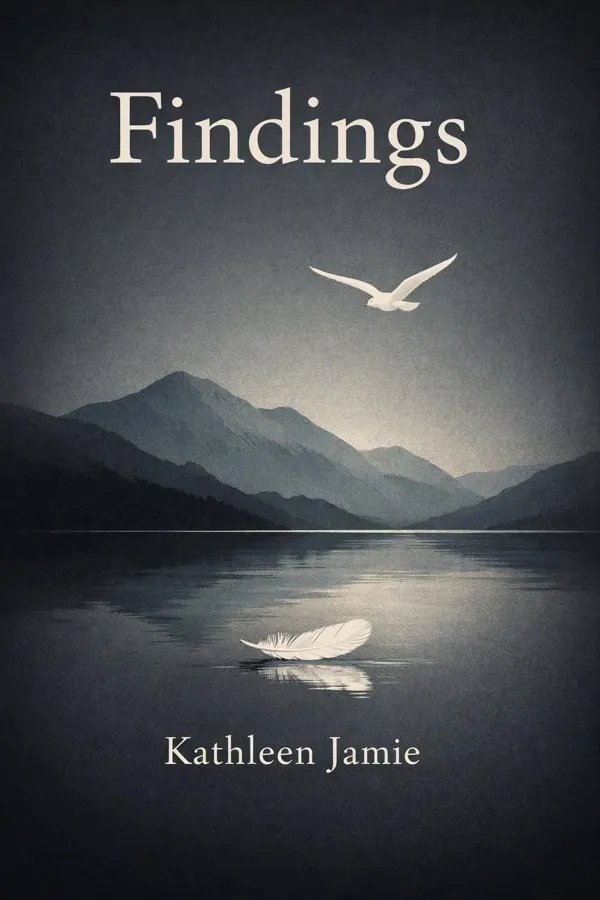
Findings: Summary & Key Insights
 10 min9 chaptersAudio available
Key Takeaways from Findings
The world does not become meaningful because we master it; it becomes meaningful because we learn how to notice it.
A landscape is never just scenery; it is a record of negotiation between people, weather, time, and survival.
Some of the most moving life on earth is also the most transient.
To walk over a field is often to walk over forgotten lives.
Nothing exposes the illusion of stability like the sea.
What Is Findings About?
Findings by Kathleen Jamie is a environment book spanning 9 pages. Kathleen Jamie’s Findings is a luminous collection of nature essays that turns close attention into a form of wisdom. First published in 2005, the book follows Jamie across Scottish coasts, islands, archaeological sites, family spaces, and stretches of seemingly ordinary ground, showing how much life, history, and meaning can be discovered when we truly look. Rather than presenting nature as a distant wilderness separate from human life, Jamie reveals a world where birds, bones, weather, motherhood, memory, and place continuously overlap. Her writing is lyrical yet precise, intimate yet intellectually alert, and deeply rooted in the landscapes of Scotland. What makes Findings matter is its refusal to treat environmental writing as either sentimental escape or abstract argument. Jamie attends to ecosystems through lived experience: watching birds migrate, noticing washed-up remains on a beach, standing among ancient stones, or observing how domestic life is tied to wider ecological rhythms. As an acclaimed Scottish poet and essayist, she brings unusual authority to these subjects, combining literary sensitivity with disciplined observation. The result is a book that helps readers recover attention, humility, and a more ethical relationship with the natural world.
This FizzRead summary covers all 9 key chapters of Findings in approximately 10 minutes, distilling the most important ideas, arguments, and takeaways from Kathleen Jamie's work. Also available as an audio summary and Key Quotes Podcast.
Findings
Kathleen Jamie’s Findings is a luminous collection of nature essays that turns close attention into a form of wisdom. First published in 2005, the book follows Jamie across Scottish coasts, islands, archaeological sites, family spaces, and stretches of seemingly ordinary ground, showing how much life, history, and meaning can be discovered when we truly look. Rather than presenting nature as a distant wilderness separate from human life, Jamie reveals a world where birds, bones, weather, motherhood, memory, and place continuously overlap. Her writing is lyrical yet precise, intimate yet intellectually alert, and deeply rooted in the landscapes of Scotland.
What makes Findings matter is its refusal to treat environmental writing as either sentimental escape or abstract argument. Jamie attends to ecosystems through lived experience: watching birds migrate, noticing washed-up remains on a beach, standing among ancient stones, or observing how domestic life is tied to wider ecological rhythms. As an acclaimed Scottish poet and essayist, she brings unusual authority to these subjects, combining literary sensitivity with disciplined observation. The result is a book that helps readers recover attention, humility, and a more ethical relationship with the natural world.
Who Should Read Findings?
This book is perfect for anyone interested in environment and looking to gain actionable insights in a short read. Whether you're a student, professional, or lifelong learner, the key ideas from Findings by Kathleen Jamie will help you think differently.
- ✓Readers who enjoy environment and want practical takeaways
- ✓Professionals looking to apply new ideas to their work and life
- ✓Anyone who wants the core insights of Findings in just 10 minutes
Want the full summary?
Get instant access to this book summary and 100K+ more with Fizz Moment.
Get Free SummaryAvailable on App Store • Free to download
Key Chapters
The world does not become meaningful because we master it; it becomes meaningful because we learn how to notice it. One of the central insights of Findings is that observation is never merely passive. To pay attention to a coastline, a flock of birds, a feather on the ground, or a shifting sky is to enter into relationship with a place. Jamie’s essays suggest that modern life often teaches us to move too fast, classify too quickly, and overlook what is small, fleeting, or quiet. By slowing down, she demonstrates that the act of noticing becomes ethical as well as aesthetic.
This idea runs through the book’s method. Jamie rarely arrives with a grand theory to impose on the landscape. Instead, she watches, listens, and lets significance emerge gradually. A bird’s movement, the shape of a shell, or the remains of an animal can open larger questions about mortality, belonging, and continuity. In that sense, close observation becomes a way of thinking. It helps us move beyond abstraction and encounter reality as textured, particular, and alive.
In practical terms, this approach can reshape how we move through our own lives. A short walk through a neighborhood park can become richer if we attend to seasonal change, bird calls, plants breaking through pavement, or weather patterns on familiar buildings. Journaling what we see, even briefly, trains perception. So does putting away a phone for ten minutes and standing still in one place.
Actionable takeaway: choose one ordinary place you pass often, return to it repeatedly for a week, and write down five details each time that you had never noticed before.
A landscape is never just scenery; it is a record of negotiation between people, weather, time, and survival. In Findings, Scotland appears not as a postcard wilderness but as a lived terrain shaped by crofting, abandonment, migration, weather, and memory. Jamie’s essays show how moors, glens, islands, and coasts preserve evidence of both human settlement and elemental force. The land bears marks of labor and dwelling, yet it also resists ownership, reminding us that human presence is temporary within larger geological and ecological processes.
This is one reason her environmental writing feels so grounded. She does not romanticize the wild as a place untouched by people. Instead, she notices that many so-called natural spaces are interwoven with history: ruined buildings, paths worn by generations, traces of old livelihoods, and silences left by social change. Such landscapes can instruct us. They show the fragility of our claims to permanence and the humility required to inhabit a place responsibly.
For readers today, this insight has practical significance. We often think of nature as somewhere else: a remote destination rather than the environment of our own communities. Jamie challenges that separation. Urban green spaces, agricultural land, coasts near industrial zones, and seemingly empty countryside all contain stories about how humans shape and are shaped by place. Looking at a landscape historically as well as visually can deepen both care and accountability.
Actionable takeaway: next time you visit a natural area, ask not only what is beautiful there, but also what human histories, livelihoods, losses, and environmental changes the place might be carrying.
Some of the most moving life on earth is also the most transient. Jamie’s attention to bird migration reveals one of Findings’ deepest themes: that movement, disappearance, and return are not opposites of meaning but part of it. Migratory birds cross immense distances with a regularity that dwarfs human schedules and reminds us of rhythms larger than any one life. They appear briefly, vanish, and yet belong to enduring cycles that continue across generations.
Jamie uses birds not simply as natural wonders but as lenses through which to think about time and belonging. A migrating flock represents both precariousness and persistence. These creatures survive through motion, adaptation, and inherited instinct, yet they remain vulnerable to weather, habitat disruption, and human interference. Their journeys therefore embody both resilience and fragility. In observing them, Jamie also reveals the emotional power of watching what cannot be kept. We witness beauty precisely because it passes.
This idea matters in everyday life because many of the most important things we experience are also temporary: seasons with children, conversations, health, places we leave, even forms of work and identity. Bird migration offers a way to think about continuity without permanence. What endures may not be fixed; it may be cyclical, recurring, and relational.
A practical application is to use seasonal events as anchors of attention. Notice the first swallows of spring, geese overhead, or the changing presence of local species. These patterns connect personal life to wider ecological systems and can build a more grounded sense of time than calendars and deadlines alone.
Actionable takeaway: begin a simple seasonal record by noting one recurring natural event each month, and track how it returns, changes, or disappears over the year.
To walk over a field is often to walk over forgotten lives. In Findings, archaeological sites and ancient remains remind us that every landscape holds layers of human and natural history. Jamie is drawn to places where the past has not fully vanished: burial sites, old settlements, standing stones, and traces of habitation that survive in fragments. These remnants complicate the present. They make us aware that what seems empty may be densely inhabited by memory, death, ritual, and long continuity.
What makes Jamie’s treatment of archaeology distinctive is that she does not approach it as detached scholarship. She experiences these sites physically and imaginatively. The land underfoot is not neutral ground but a repository of interrupted stories. Bones, structures, and artifacts do not simply tell us what happened before; they unsettle our assumptions about how central our own moment is. The present becomes just one layer among many.
This insight can change how we understand place. Modern culture often values speed, novelty, and immediate utility. Archaeological awareness slows us down. It asks us to consider the depth of occupation behind roads, houses, shorelines, and fields. Even in cities, beneath modern infrastructure lie earlier communities and ecosystems. Thinking in layers fosters respect: for heritage, for land use, and for the long consequences of human choices.
A practical way to apply this is to learn the history of your local area beyond recent decades. What stood there before current buildings? Which peoples lived there? What was the ecology before development? Such questions make place feel thicker, more morally charged, and less disposable.
Actionable takeaway: research one historical or archaeological site near you and visit it, asking how awareness of deep time changes your sense of your own place in history.
Nothing exposes the illusion of stability like the sea. In Findings, the coast is a place of encounter, evidence, and continual transformation. Jamie walks shorelines where tides rearrange matter, where debris arrives from elsewhere, and where erosion and weather reshape what seems solid. Beaches become reading surfaces on which the sea writes and erases at once. What washes ashore can be beautiful, disturbing, or mysterious: shells, drift, remnants of animals, human litter, signs of travel, and signs of death.
The sea matters in the book because it collapses neat boundaries. It links local life to vast systems of migration, climate, trade, and ecological exchange. A coastal walk is never just local. It is connected to distant currents and far-off events. Jamie notices that this dynamic quality makes the shore a powerful place for reflection. It teaches impermanence, but also relation. What arrives on one beach may have begun its journey elsewhere, reminding us that environmental life is shared and entangled.
This perspective has obvious contemporary relevance. Coastal erosion, plastic pollution, rising seas, and habitat change all make shorelines key sites for understanding environmental crisis. Yet Jamie’s contribution is not to reduce the coast to a warning sign. She also restores its strangeness and vitality. The shore remains a place of wonder even as it reveals damage.
You can apply this idea by treating any transitional environment as worth reading closely: riverbanks, marshes, edges of parks, construction boundaries, or waterfronts. Threshold places often reveal hidden processes more clearly than settled interiors.
Actionable takeaway: on your next visit to a shoreline or edge landscape, collect observations rather than objects, noting what the place reveals about movement, change, and human impact.
A feather, a bone, a shell fragment, or a scrap of fur can speak more powerfully than a grand panorama. Jamie repeatedly turns toward minor objects and remnants, showing that scale has little to do with significance. Findings is full of attention to what others might overlook: the slight, the broken, the partial, the discarded. These objects matter because they are traces. They hint at absent creatures, vanished events, and hidden relationships within an ecosystem.
This way of seeing opposes a spectacular model of nature writing that seeks only dramatic vistas or rare encounters. Jamie teaches that intimacy often begins with fragments. A bone on a beach can lead to thoughts about animal life, predation, decomposition, and the circulation of matter. A feather can suggest migration, vulnerability, and astonishing design. By focusing on remnants, she also asks us to confront mortality without melodrama. Death is present in nature, but so is continuation. What decays feeds other forms of life.
In everyday practice, this insight can deepen ecological literacy. Learning to identify common feathers, seeds, leaves, tracks, or shells makes a place more legible. It also encourages patience. Children especially benefit from this kind of attention, because it turns outdoor exploration into discovery without requiring expensive equipment or distant travel.
The broader lesson is that significance often resides in the overlooked details of ordinary life as well. Relationships, habits, and cultural patterns are often most visible in the small remains they leave behind.
Actionable takeaway: start a notebook of found details from walks or daily routines, recording one small object or trace each day and asking what larger story it might reveal.
Nature is not only out there in remote places; it moves through kitchens, gardens, children’s lives, and the routines of home. One of the subtle strengths of Findings is the way Jamie connects motherhood and domestic life with the wider natural world. She refuses the common split between the heroic outdoor observer and the supposedly lesser sphere of household care. Instead, family life becomes another site of ecological awareness, where attention to bodies, seasons, food, shelter, and vulnerability is constant.
This perspective matters because environmental writing has often been shaped by solitary, mobile, traditionally masculine models of encounter with wilderness. Jamie broadens the field. She writes from within responsibilities rather than outside them. The domestic sphere does not reduce her perception; it sharpens it. Living with children, managing time, and noticing the small cycles of home can intensify awareness of fragility, dependence, and interconnection.
For readers, this is an important corrective. Many people assume they need ideal conditions to cultivate a relationship with nature: more time, more travel, fewer obligations. Jamie suggests otherwise. Watching weather from a window, noticing birds in a yard, observing insects around a doorstep, or tracking the seasonal foods in a household are all real forms of ecological engagement. Domestic routines are not barriers to environmental consciousness; they are among its most immediate foundations.
Practically, families can use this approach to build shared attention. Keeping a windowsill plant journal, identifying backyard birds, or noticing moon phases together are small but meaningful ways to connect daily life to larger patterns.
Actionable takeaway: choose one recurring household activity, such as meals or bedtime, and connect it to a seasonal or natural observation each day for a week.
We may live with modern technologies, but we do so on land dense with older presences. In Findings, Jamie often places contemporary experience against ancient landscapes, creating a productive tension between the speed of modern life and the endurance of geological and historical time. Roads, schedules, and conveniences can make us feel detached from place, yet the ground beneath us continues to hold older rhythms, older stories, and older forms of life. The modern world is not separate from these layers; it is built on top of them.
Jamie’s essays do not simply lament modernity. Instead, they examine what modern habits of distraction, consumption, and mobility may cost us in terms of perception. When we move quickly through landscapes, we risk treating them as backdrops or resources rather than inhabited realities. Ancient sites, long coastlines, and recurring migrations interrupt that mindset. They expose how recent and partial our systems really are.
This idea is useful because it encourages readers to rethink convenience and speed. Technologies can help us learn about ecosystems, navigate trails, or document change, but they can also mediate experience too heavily. Jamie’s work suggests the value of occasional uninstrumented presence: being somewhere without turning it immediately into data, content, or itinerary.
A practical application is to create moments of deliberate friction in how you encounter place. Walk without headphones. Leave the camera in your pocket for part of a visit. Learn a route by memory instead of relying entirely on digital prompts. These habits make room for encounter rather than mere passage.
Actionable takeaway: during your next outing in a natural or historic place, spend at least fifteen minutes without any device, and notice how your perception changes when you are less mediated.
Nature’s endurance should not be mistaken for invulnerability. Across Findings, Jamie conveys both the toughness and the delicacy of ecosystems. Birds continue their migrations, coasts renew themselves, and life persists in difficult conditions. Yet these same systems can be disrupted by habitat loss, pollution, neglect, and human arrogance. Jamie’s tone is especially powerful because she avoids both despair and complacency. She does not portray nature as either doomed or infinitely self-correcting. Instead, she shows living systems as dynamic, adaptive, and vulnerable.
This balanced vision is one of the book’s key contributions to environmental thought. Too much environmental discourse swings between alarmist abstraction and reassuring vagueness. Jamie’s essays return us to particular places where resilience is visible but never guaranteed. A beach recovers in one way while eroding in another. A species returns seasonally but under altered conditions. Human carelessness and human care both matter.
For readers, this perspective can inspire more grounded environmental action. If ecosystems were utterly fragile, effort might feel hopeless. If they were endlessly resilient, effort would seem unnecessary. Jamie offers a middle path: attention leads to attachment, and attachment supports responsibility. When we know places closely, we are more likely to defend them thoughtfully.
This can translate into practical behavior: supporting habitat restoration, reducing litter, participating in citizen science, learning local species, or advocating for green spaces in one’s community. Environmental responsibility begins not only with global awareness but with local relationship.
Actionable takeaway: identify one nearby ecosystem you regularly encounter, learn one concrete pressure it faces, and take one small action this month to support its health.
All Chapters in Findings
About the Author
Kathleen Jamie is a Scottish poet and essayist born in 1962, widely admired for her luminous writing about landscape, ecology, memory, and human belonging. Raised in Scotland, she has become one of the country’s most distinguished contemporary literary voices, with work that moves fluidly between poetry and nonfiction. Her essays are especially noted for combining lyric precision with sharp observation, often focusing on coasts, islands, wildlife, archaeology, and the overlooked textures of everyday life. Jamie’s writing resists easy divisions between nature and culture, showing how deeply they shape one another. Over the course of her career, she has received major literary honors and built an international reputation for essays that are intimate, intellectually alert, and environmentally resonant. Findings remains one of her best-known prose works.
Get This Summary in Your Preferred Format
Read or listen to the Findings summary by Kathleen Jamie anytime, anywhere. FizzRead offers multiple formats so you can learn on your terms — all free.
Available formats: App · Audio · PDF · EPUB — All included free with FizzRead
Download Findings PDF and EPUB Summary
Key Quotes from Findings
“The world does not become meaningful because we master it; it becomes meaningful because we learn how to notice it.”
“A landscape is never just scenery; it is a record of negotiation between people, weather, time, and survival.”
“Some of the most moving life on earth is also the most transient.”
“To walk over a field is often to walk over forgotten lives.”
“Nothing exposes the illusion of stability like the sea.”
Frequently Asked Questions about Findings
Findings by Kathleen Jamie is a environment book that explores key ideas across 9 chapters. Kathleen Jamie’s Findings is a luminous collection of nature essays that turns close attention into a form of wisdom. First published in 2005, the book follows Jamie across Scottish coasts, islands, archaeological sites, family spaces, and stretches of seemingly ordinary ground, showing how much life, history, and meaning can be discovered when we truly look. Rather than presenting nature as a distant wilderness separate from human life, Jamie reveals a world where birds, bones, weather, motherhood, memory, and place continuously overlap. Her writing is lyrical yet precise, intimate yet intellectually alert, and deeply rooted in the landscapes of Scotland. What makes Findings matter is its refusal to treat environmental writing as either sentimental escape or abstract argument. Jamie attends to ecosystems through lived experience: watching birds migrate, noticing washed-up remains on a beach, standing among ancient stones, or observing how domestic life is tied to wider ecological rhythms. As an acclaimed Scottish poet and essayist, she brings unusual authority to these subjects, combining literary sensitivity with disciplined observation. The result is a book that helps readers recover attention, humility, and a more ethical relationship with the natural world.
More by Kathleen Jamie
You Might Also Like
A Life on Our Planet: My Witness Statement and a Vision for the Future
David Attenborough
10 min
A Sky Full Of Birds
Matt Merritt
10 min
Carbon Zero: Imagining Cities That Can Save the Planet
Alex Steffen
10 min
Eaarth: Making a Life on a Tough New Planet
Bill McKibben
10 min
The Social Contract and Environmental Governance
Various Editors
10 min
The Wild Places
Robert Macfarlane
10 minBrowse by Category
Ready to read Findings?
Get the full summary and 100K+ more books with Fizz Moment.