
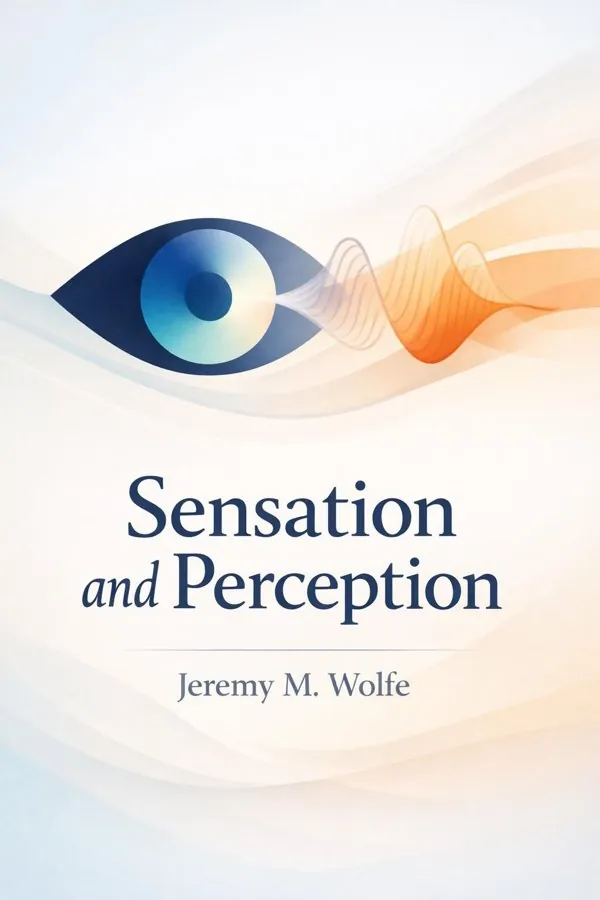
Sensation and Perception: Summary & Key Insights
 10 min9 chaptersAudio available
Key Takeaways from Sensation and Perception
We do not experience the world directly; we experience the brain’s best interpretation of incoming information.
Seeing feels effortless, but vision is one of the brain’s greatest engineering feats.
The world does not arrive labeled with colors, distances, or motion; the brain has to infer all three from patterns of stimulation.
Sound is invisible, fleeting, and often overlapping, yet the auditory system can separate, identify, and localize astonishingly complex acoustic patterns.
Understanding speech feels automatic, but it requires one of the most sophisticated forms of perceptual inference humans perform.
What Is Sensation and Perception About?
Sensation and Perception by Jeremy M. Wolfe is a cognition book spanning 12 pages. Jeremy M. Wolfe’s Sensation and Perception is a clear, wide-ranging guide to one of psychology’s most fascinating questions: how do brains turn physical energy from the world into meaningful experience? The book traces that transformation from the first contact between stimulus and sensory receptor to the rich perceptions that shape thought, emotion, action, and survival. Along the way, it explores vision, hearing, touch, taste, smell, multisensory integration, attention, and the many ways perception can succeed, fail, or be fooled. What makes this book especially valuable is its ability to connect biology, neuroscience, and cognitive psychology without losing sight of everyday life. Wolfe shows that perception is not passive recording but active interpretation. Seeing a face, recognizing a voice, reaching for a cup, or avoiding danger all depend on systems that select, organize, and predict. Wolfe is exceptionally qualified to tell this story. A leading cognitive neuroscientist and professor at Harvard Medical School, he is best known for influential research on visual attention and search. His expertise gives the book both scientific depth and practical clarity, making it an essential resource for students, curious general readers, and anyone interested in how minds make worlds.
This FizzRead summary covers all 9 key chapters of Sensation and Perception in approximately 10 minutes, distilling the most important ideas, arguments, and takeaways from Jeremy M. Wolfe's work. Also available as an audio summary and Key Quotes Podcast.
Sensation and Perception
Jeremy M. Wolfe’s Sensation and Perception is a clear, wide-ranging guide to one of psychology’s most fascinating questions: how do brains turn physical energy from the world into meaningful experience? The book traces that transformation from the first contact between stimulus and sensory receptor to the rich perceptions that shape thought, emotion, action, and survival. Along the way, it explores vision, hearing, touch, taste, smell, multisensory integration, attention, and the many ways perception can succeed, fail, or be fooled.
What makes this book especially valuable is its ability to connect biology, neuroscience, and cognitive psychology without losing sight of everyday life. Wolfe shows that perception is not passive recording but active interpretation. Seeing a face, recognizing a voice, reaching for a cup, or avoiding danger all depend on systems that select, organize, and predict.
Wolfe is exceptionally qualified to tell this story. A leading cognitive neuroscientist and professor at Harvard Medical School, he is best known for influential research on visual attention and search. His expertise gives the book both scientific depth and practical clarity, making it an essential resource for students, curious general readers, and anyone interested in how minds make worlds.
Who Should Read Sensation and Perception?
This book is perfect for anyone interested in cognition and looking to gain actionable insights in a short read. Whether you're a student, professional, or lifelong learner, the key ideas from Sensation and Perception by Jeremy M. Wolfe will help you think differently.
- ✓Readers who enjoy cognition and want practical takeaways
- ✓Professionals looking to apply new ideas to their work and life
- ✓Anyone who wants the core insights of Sensation and Perception in just 10 minutes
Want the full summary?
Get instant access to this book summary and 100K+ more with Fizz Moment.
Get Free SummaryAvailable on App Store • Free to download
Key Chapters
We do not experience the world directly; we experience the brain’s best interpretation of incoming information. That distinction lies at the heart of sensation and perception. Sensation refers to the initial detection of energy by sensory receptors: photons striking the retina, air pressure changes vibrating the ear, or chemical molecules activating taste and smell receptors. Perception begins when the nervous system organizes and interprets these signals into useful patterns such as objects, locations, voices, flavors, and threats.
Wolfe emphasizes that this is not a simple one-way pipeline from sense organ to conscious experience. Perception depends on both bottom-up input and top-down influences such as attention, expectation, memory, and context. The same physical stimulus can produce different experiences depending on surrounding cues and prior knowledge. A blurry shape in the dark may look like a person when you are anxious, but like a coat rack when the lights come on.
Psychophysics, one of the field’s foundational methods, helps reveal these relationships by measuring the link between physical stimuli and subjective responses. Thresholds, signal detection, and adaptation all show that our sensory systems are tuned not to capture everything, but to detect what matters.
In daily life, this explains why strong perfumes fade after a few minutes, why background noises disappear until your name is spoken, and why eyewitnesses can sincerely misperceive events. The senses gather data, but the mind edits, interprets, and prioritizes.
Actionable takeaway: When you feel certain about what you sensed, pause and ask what part came from the stimulus and what part came from your expectations.
Seeing feels effortless, but vision is one of the brain’s greatest engineering feats. Light enters the eye through the cornea and lens, which focus an image onto the retina. There, rods and cones convert light into neural signals. Rods support vision in dim light, while cones help us perceive fine detail and color. From the retina, signals travel through ganglion cells and the optic nerve to the thalamus and then to visual cortex, where increasingly complex features are analyzed.
Wolfe shows that the visual system does not simply take a picture. It extracts edges, contrast, orientation, movement, and spatial relationships, then assembles these into meaningful objects and scenes. Different pathways specialize in different tasks. Broadly speaking, one stream helps identify what an object is, while another helps determine where it is and how to act toward it.
This helps explain familiar experiences. You can recognize a friend’s face quickly even in a crowd, yet struggle to describe the exact visual computations involved. You can catch a ball without consciously calculating its trajectory because visual processing is linked to action systems. Visual limitations also matter. Blind spots are filled in, eye movements constantly refresh input, and context can distort what we think we see.
Applications are everywhere: interface design uses contrast and grouping to guide attention; road signage depends on visibility and quick recognition; sports training improves how athletes track motion and judge space.
Actionable takeaway: Treat vision as a skilled interpretation system, not a camera; when designing visuals or making decisions, use clear contrast, uncluttered layouts, and meaningful spatial cues.
The world does not arrive labeled with colors, distances, or motion; the brain has to infer all three from patterns of stimulation. Color perception begins with different cone types responding to different wavelengths, but the experience of color depends on comparison, context, and opponent processing. A gray patch can look bluish in one scene and yellowish in another. What seems stable is often the result of color constancy mechanisms that discount lighting conditions.
Depth perception is equally constructive. Because the retina is a flat surface, the brain uses multiple cues to infer three-dimensional space: binocular disparity, convergence, occlusion, linear perspective, texture gradients, relative size, shading, and motion parallax. These cues can work together or conflict, which is why illusions are so revealing. A drawing can appear deep despite being physically flat because it mimics the statistical patterns the visual system expects.
Motion perception adds another layer. Specialized systems detect changes over time, allowing us to identify moving objects, estimate direction and speed, and distinguish self-motion from object motion. This is crucial for navigation, driving, and avoiding danger. Yet motion can also be misread, as in apparent motion from rapidly changing static images or the unsettling movement impressions created by patterned displays.
These processes shape everyday behavior. Photographers use depth cues to create compelling images. Pilots and drivers must rely on motion and contrast under uncertain conditions. Designers use color strategically to communicate hierarchy and warning.
Actionable takeaway: When judging visual information, especially in fast or ambiguous settings, rely on multiple cues rather than trusting color, distance, or motion from a single impression.
Sound is invisible, fleeting, and often overlapping, yet the auditory system can separate, identify, and localize astonishingly complex acoustic patterns. Hearing begins when sound waves enter the ear canal and vibrate the eardrum. These vibrations pass through the middle ear bones to the cochlea, where different frequencies stimulate different locations along the basilar membrane. Hair cells transduce this mechanical energy into neural signals, preserving information about pitch, timing, and intensity.
Wolfe explains that hearing is not just about detecting noise. It is about organizing sound into auditory objects: a voice, a violin, a car horn, a barking dog. This involves auditory scene analysis, the brain’s ability to group related acoustic elements and separate them from competing sources. In a crowded restaurant, for example, you can follow one conversation while suppressing many others. This remarkable skill depends on timing, frequency patterns, spatial cues, and attention.
Localization is another essential function. Tiny differences in the time and intensity with which sounds reach each ear help us estimate where a sound originates. This is crucial for navigation, communication, and threat detection. Hearing also connects deeply to emotion and memory, which is why a melody can instantly evoke a place or period of life.
Practical implications include hearing aid design, classroom acoustics, language learning, music production, and workplace safety. Clear sound environments improve comprehension and reduce cognitive load, especially for children, older adults, and nonnative listeners.
Actionable takeaway: Protect and support hearing by reducing unnecessary noise, improving listening environments, and giving full attention when understanding speech matters.
Understanding speech feels automatic, but it requires one of the most sophisticated forms of perceptual inference humans perform. Spoken language unfolds rapidly, varies across speakers, and is often distorted by accent, emotion, speed, and background noise. Yet listeners typically recover words and intentions with astonishing ease. Wolfe highlights that speech perception depends on both acoustic analysis and higher-level knowledge about language, context, and probable meaning.
Phonemes, the smallest sound units in language, are not heard as isolated physical facts. The brain categorizes variable acoustic input into meaningful speech sounds. This is why listeners can recognize the same word across very different voices. Coarticulation makes the challenge even harder because sounds influence one another in fluent speech, but the perceptual system compensates using learned patterns.
Speech also demonstrates that perception is multisensory. Visual information from a speaker’s face, especially lip movements, can strongly shape what we hear. In noisy settings, watching the speaker improves comprehension. In some illusions, mismatched visual and auditory cues can create a completely different perceived syllable, revealing how deeply the senses interact.
Applications are broad. Language teachers can improve learning by pairing clear articulation with visible mouth movements. Meeting leaders can reduce misunderstanding by minimizing noise and ensuring visual access. Clinicians and technologists can design better communication aids by respecting the perceptual complexity of speech.
Actionable takeaway: In important conversations, improve both sound and visibility; face the listener, reduce background noise, and use context deliberately to support understanding.
Touch is not one sense but a family of systems that tells us about pressure, vibration, temperature, pain, and the position of our body parts. Wolfe shows that somatosensation is essential not only for comfort and survival but also for identity and action. Mechanoreceptors in the skin respond to different kinds of contact, thermoreceptors monitor temperature, and nociceptors signal potential tissue damage. Meanwhile, proprioceptive receptors in muscles and joints provide a continuous sense of posture and movement.
The brain organizes touch systematically, mapping different body regions onto somatosensory cortex. But that map is not proportional to body size. Areas requiring fine discrimination, like fingertips and lips, receive much more cortical representation than the back or legs. This helps explain why a tiny splinter in a fingertip can dominate awareness while pressure on a larger area may barely register.
Pain deserves special attention because it is both protective and complex. It is not a direct readout of injury. Attention, expectation, emotion, and context can amplify or reduce pain. This is why athletes may overlook injuries in competition, why fear can intensify discomfort, and why placebo effects can alter real experience. Touch and pain research also illuminate phantom limb sensations, showing that body representation is constructed in the brain, not merely delivered from the body.
These ideas matter in medicine, rehabilitation, product design, ergonomics, and mental health. Better understanding of body maps can improve prosthetics, physical therapy, and pain management.
Actionable takeaway: Notice how attention and context shape bodily experience, and use movement, posture, and focused awareness as tools to improve comfort and reduce unnecessary strain.
Flavor seems simple until you lose it. Wolfe makes clear that what we casually call taste is actually a multisensory construction involving taste, smell, texture, temperature, and even vision. The tongue detects a limited set of basic taste qualities such as sweet, salty, sour, bitter, and umami. Smell, by contrast, can represent a vast range of chemical patterns through receptors in the olfactory system. Together, these systems create the richness of food and the emotional power of scent.
Smell is especially revealing because it is tightly connected to memory and emotion. A faint odor can revive a vivid personal moment faster than deliberate thought. This is partly due to olfactory pathways’ close links with limbic and memory-related brain areas. Smell also warns us of hazards like smoke, spoilage, or gas leaks, though adaptation means we can stop noticing persistent odors surprisingly quickly.
Taste and smell are shaped by learning, culture, and expectation. A food may seem more appealing if plated beautifully, labeled as expensive, or associated with positive memories. Children often reject bitter foods, but repeated exposure can change preferences. In illness, aging, or after sensory loss, changes in taste and smell can affect nutrition, pleasure, and safety.
Applications include culinary arts, health care, marketing, and public safety. Understanding flavor can help people eat more mindfully, maintain appetite during treatment, or detect environmental problems sooner.
Actionable takeaway: If you want to improve eating, health, or enjoyment, pay attention to the full sensory context of flavor, not just the food itself.
The brain’s greatest sensory trick may be making separate inputs feel like one seamless reality. Wolfe shows that perception is deeply integrative: vision, hearing, touch, smell, taste, and body sense interact continuously. We do not merely stack sensory channels side by side; we combine them into unified events. A barking dog is not first seen, then heard, then inferred. Instead, the brain binds location, motion, sound, and meaning into a single perceptual object.
Attention is the mechanism that makes this integration selective and useful. Since the environment contains far more information than the brain can process in detail, attention determines what is enhanced, what is ignored, and what reaches awareness. This is why you can miss a glaring object when focused elsewhere, or suddenly detect a faint sound once you expect it. Attention does not only spotlight information; it reshapes experience itself.
Gestalt principles such as proximity, similarity, continuity, and closure help explain how the brain organizes fragmented input into coherent forms. Illusions reveal the system’s assumptions. They are not errors in an otherwise perfect machine; they are side effects of efficient rules that usually work well. Misperception occurs because the brain bets on what is most likely given limited evidence.
These insights have practical consequences for education, safety, design, and digital life. Cluttered interfaces overload attention. Misleading displays exploit grouping principles. Multisensory cues can improve learning and performance when aligned properly.
Actionable takeaway: Manage attention intentionally by reducing clutter, focusing on one meaningful task at a time, and checking assumptions when a perception seems obvious but the context is complex.
Perception is not fixed at birth, nor is it merely an inner picture detached from behavior. Wolfe presents perception as a developing, adaptive system that matures through biology, experience, and action. Infants arrive with important sensory capacities, but many perceptual skills sharpen over time as neural systems specialize and calibration improves. Depth, face processing, speech discrimination, and object recognition all show developmental change shaped by both maturation and environment.
This developmental perspective also highlights diversity. People vary in acuity, attention, sensory sensitivity, and interpretation. Age, culture, disability, expertise, and experience all influence what is noticed and how it is understood. A musician hears structures in sound that others miss. A radiologist detects subtle visual anomalies through training. Someone with sensory impairment may rely more heavily on other modalities or develop alternative strategies.
Crucially, perception exists for action. The point of sensing the world is to move through it effectively: to grasp, avoid, navigate, communicate, and decide. The visual system supports reaching and locomotion. The auditory system warns and orients. Touch supports dexterity and body control. Perception and action are partners, constantly updating one another. This perspective extends to practical frontiers such as virtual reality, assistive technology, clinical diagnosis, machine vision, and human factors engineering.
The broader message is optimistic: perceptual systems are limited, but they are also trainable and adaptable. Better environments, better tools, and better understanding can improve what people detect and how they respond.
Actionable takeaway: Strengthen perception by treating it as a skill—practice in realistic contexts, seek feedback, and build environments that support accurate sensing and effective action.
All Chapters in Sensation and Perception
About the Author
Jeremy M. Wolfe is a leading cognitive neuroscientist best known for his work on visual attention, visual search, and perceptual processing. He is a professor at Harvard Medical School and has held influential research and teaching roles that bridge psychology, neuroscience, and medicine. Wolfe’s studies have helped explain how people locate targets in cluttered visual environments, how attention is guided, and how perception supports real-world action. In addition to his research articles, he has coauthored important textbooks that make complex scientific ideas accessible to students and broader audiences. His writing is valued for combining experimental rigor with clarity and relevance. In Sensation and Perception, Wolfe draws on decades of scholarship to show how sensory systems and brain mechanisms work together to create meaningful experience.
Get This Summary in Your Preferred Format
Read or listen to the Sensation and Perception summary by Jeremy M. Wolfe anytime, anywhere. FizzRead offers multiple formats so you can learn on your terms — all free.
Available formats: App · Audio · PDF · EPUB — All included free with FizzRead
Download Sensation and Perception PDF and EPUB Summary
Key Quotes from Sensation and Perception
“We do not experience the world directly; we experience the brain’s best interpretation of incoming information.”
“Seeing feels effortless, but vision is one of the brain’s greatest engineering feats.”
“The world does not arrive labeled with colors, distances, or motion; the brain has to infer all three from patterns of stimulation.”
“Sound is invisible, fleeting, and often overlapping, yet the auditory system can separate, identify, and localize astonishingly complex acoustic patterns.”
“Understanding speech feels automatic, but it requires one of the most sophisticated forms of perceptual inference humans perform.”
Frequently Asked Questions about Sensation and Perception
Sensation and Perception by Jeremy M. Wolfe is a cognition book that explores key ideas across 9 chapters. Jeremy M. Wolfe’s Sensation and Perception is a clear, wide-ranging guide to one of psychology’s most fascinating questions: how do brains turn physical energy from the world into meaningful experience? The book traces that transformation from the first contact between stimulus and sensory receptor to the rich perceptions that shape thought, emotion, action, and survival. Along the way, it explores vision, hearing, touch, taste, smell, multisensory integration, attention, and the many ways perception can succeed, fail, or be fooled. What makes this book especially valuable is its ability to connect biology, neuroscience, and cognitive psychology without losing sight of everyday life. Wolfe shows that perception is not passive recording but active interpretation. Seeing a face, recognizing a voice, reaching for a cup, or avoiding danger all depend on systems that select, organize, and predict. Wolfe is exceptionally qualified to tell this story. A leading cognitive neuroscientist and professor at Harvard Medical School, he is best known for influential research on visual attention and search. His expertise gives the book both scientific depth and practical clarity, making it an essential resource for students, curious general readers, and anyone interested in how minds make worlds.
You Might Also Like

A Field Guide to Lies: Critical Thinking in the Information Age
Daniel J. Levitin
10 min
A Theory of Cognitive Dissonance
Leon Festinger
10 min
Black-And-White Thinking: The Burden of a Binary Brain in a Complex World
Kevin Dutton
10 min
Born Liars: Why We Can’t Live Without Deceit
Ian Leslie
10 min
Collective Illusions: Conformity, Complicity, and the Science of Why We Make Bad Decisions
Todd Rose
10 min
Concrete Mathematics: A Foundation for Computer Science
Ronald L. Graham, Donald E. Knuth, Oren Patashnik
10 minBrowse by Category
Ready to read Sensation and Perception?
Get the full summary and 100K+ more books with Fizz Moment.