
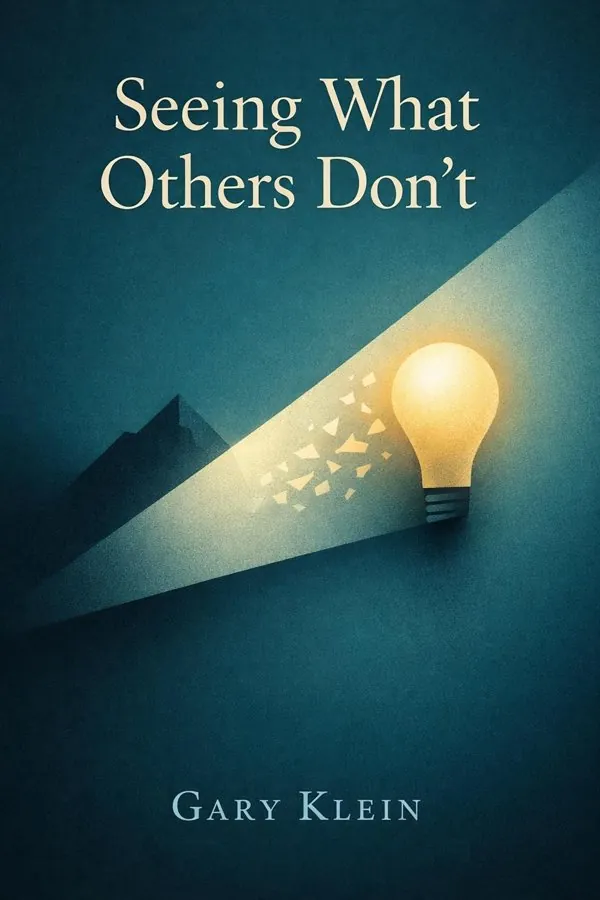
Seeing What Others Don't: The Remarkable Ways We Gain Insights: Summary & Key Insights
by Gary Klein
 10 min6 chaptersAudio available
What Is Seeing What Others Don't: The Remarkable Ways We Gain Insights About?
Seeing What Others Don't: The Remarkable Ways We Gain Insights by Gary Klein is a cognition book spanning 6 pages. In this book, cognitive psychologist Gary Klein explores the nature of insight—those sudden moments of understanding that lead to breakthroughs in science, business, and everyday life. Drawing on decades of research and real-world examples, Klein examines how people generate insights, why organizations often suppress them, and how we can cultivate environments that encourage creative thinking and problem-solving.
This FizzRead summary covers all 6 key chapters of Seeing What Others Don't: The Remarkable Ways We Gain Insights in approximately 10 minutes, distilling the most important ideas, arguments, and takeaways from Gary Klein's work. Also available as an audio summary and Key Quotes Podcast.
Seeing What Others Don't: The Remarkable Ways We Gain Insights
In this book, cognitive psychologist Gary Klein explores the nature of insight—those sudden moments of understanding that lead to breakthroughs in science, business, and everyday life. Drawing on decades of research and real-world examples, Klein examines how people generate insights, why organizations often suppress them, and how we can cultivate environments that encourage creative thinking and problem-solving.
Who Should Read Seeing What Others Don't: The Remarkable Ways We Gain Insights?
This book is perfect for anyone interested in cognition and looking to gain actionable insights in a short read. Whether you're a student, professional, or lifelong learner, the key ideas from Seeing What Others Don't: The Remarkable Ways We Gain Insights by Gary Klein will help you think differently.
- ✓Readers who enjoy cognition and want practical takeaways
- ✓Professionals looking to apply new ideas to their work and life
- ✓Anyone who wants the core insights of Seeing What Others Don't: The Remarkable Ways We Gain Insights in just 10 minutes
Want the full summary?
Get instant access to this book summary and 100K+ more with Fizz Moment.
Get Free SummaryAvailable on App Store • Free to download
Key Chapters
Insight is fundamentally different from both analysis and intuition. When we analyze, we break things down into parts, look for causal chains, and proceed step-by-step. Intuition, on the other hand, relies on experience compressed into rapid judgment—it’s pattern recognition executed subconsciously. Insight sits between these processes but behaves unlike either. It doesn’t emerge from linear thought nor from automatic response. It emerges when the mind reframes a situation, reorganizes its understanding, and suddenly perceives coherence where there was ambiguity.
My research in naturalistic decision making, which involved studying professionals in real-world contexts—from military commanders to emergency room physicians—revealed that insights often arise during moments of failure, confusion, or anomaly. A firefighter might realize that a building’s behavior doesn’t fit the expected pattern of ventilation. A scientist might notice that a set of data defies theoretical prediction. These anomalies serve as triggers for insight because they disrupt our usual frames of reference, forcing us to question our assumptions.
Intuition is often praised for its immediacy, analysis for its precision—but insight provides transformation. It changes not just what we know, but how we see. This reframing enables leaps in understanding that neither calculation nor habit alone can achieve. Insights aren’t just answers; they are reorganizations of the mind’s model of reality. That’s why they are so exhilarating—our mental world literally changes shape.
Over the years I developed what I call the Insight Roadmap—a way of mapping the mental journey from confusion to clarity. Insights rarely occur in calm moments; they arise when something doesn’t make sense. The first step is noticing that anomaly. Instead of ignoring it or forcing it to fit into our existing model, we pause and explore the mismatch. The second step is deepening the confusion—examining the contradictions, exploring alternatives, asking why things should but don’t align. In this space of ambiguity, the mind searches for coherence.
Then comes the pivotal moment: reframing. The mind restructures its representation of the problem. Suddenly, new patterns become visible, connections form, and what was perplexing now reveals a hidden logic. I’ve found that this restructuring—what some might call an aha moment—is accompanied by emotional release, a sense of rightness that immediately signals that the new frame fits.
The fourth stage involves verifying and consolidating the insight. Once clarity emerges, we test whether this new understanding holds up in reality. Insight may begin as intuition, but it earns its place through validation.
This journey mirrors countless real-world experiences. When a detective reinterprets a series of clues that previously seemed unrelated, or when an innovator realizes that a flaw in a product could be the key to a new feature, they are traversing the same roadmap. Confusion is not failure—it’s the birthplace of understanding.
+ 4 more chapters — available in the FizzRead app
All Chapters in Seeing What Others Don't: The Remarkable Ways We Gain Insights
About the Author
Gary Klein is a cognitive psychologist known for his pioneering work in naturalistic decision making. He has advised organizations such as NASA, the U.S. Marine Corps, and Fortune 500 companies on improving decision processes. Klein is the author of several influential books on intuition, expertise, and insight.
Get This Summary in Your Preferred Format
Read or listen to the Seeing What Others Don't: The Remarkable Ways We Gain Insights summary by Gary Klein anytime, anywhere. FizzRead offers multiple formats so you can learn on your terms — all free.
Available formats: App · Audio · PDF · EPUB — All included free with FizzRead
Download Seeing What Others Don't: The Remarkable Ways We Gain Insights PDF and EPUB Summary
Key Quotes from Seeing What Others Don't: The Remarkable Ways We Gain Insights
“Insight is fundamentally different from both analysis and intuition.”
“Over the years I developed what I call the Insight Roadmap—a way of mapping the mental journey from confusion to clarity.”
Frequently Asked Questions about Seeing What Others Don't: The Remarkable Ways We Gain Insights
Seeing What Others Don't: The Remarkable Ways We Gain Insights by Gary Klein is a cognition book that explores key ideas across 6 chapters. In this book, cognitive psychologist Gary Klein explores the nature of insight—those sudden moments of understanding that lead to breakthroughs in science, business, and everyday life. Drawing on decades of research and real-world examples, Klein examines how people generate insights, why organizations often suppress them, and how we can cultivate environments that encourage creative thinking and problem-solving.
More by Gary Klein

You Might Also Like
A Field Guide to Lies: Critical Thinking in the Information Age
Daniel J. Levitin
10 min
A Theory of Cognitive Dissonance
Leon Festinger
10 min
Black-And-White Thinking: The Burden of a Binary Brain in a Complex World
Kevin Dutton
10 min
Born Liars: Why We Can’t Live Without Deceit
Ian Leslie
10 min
Collective Illusions: Conformity, Complicity, and the Science of Why We Make Bad Decisions
Todd Rose
10 min
Concrete Mathematics: A Foundation for Computer Science
Ronald L. Graham, Donald E. Knuth, Oren Patashnik
10 minBrowse by Category
Ready to read Seeing What Others Don't: The Remarkable Ways We Gain Insights?
Get the full summary and 100K+ more books with Fizz Moment.