
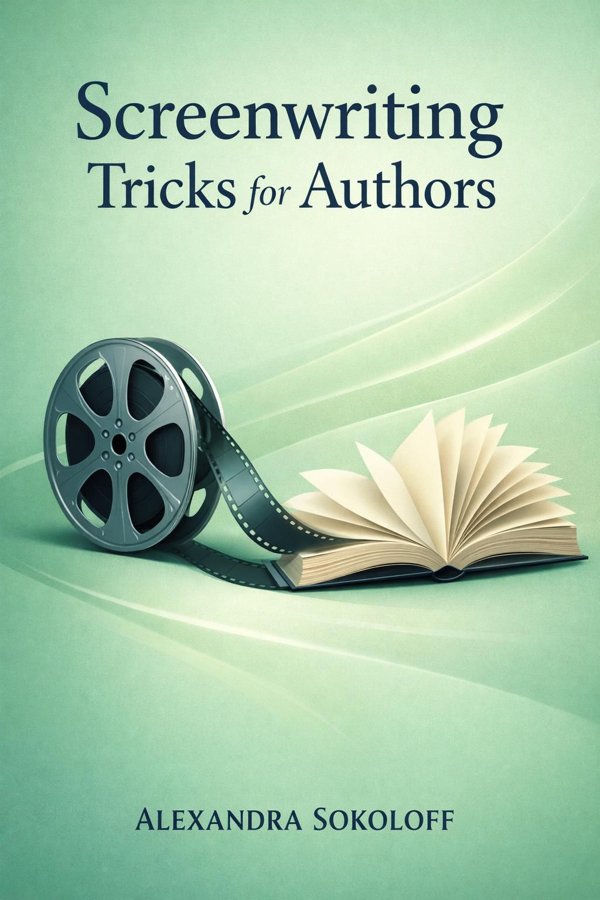
Screenwriting Tricks for Authors: Stealing Hollywood: The 21 Great Screenwriting Strategies for Novelists: Summary & Key Insights
 10 min5 chaptersAudio available
What Is Screenwriting Tricks for Authors: Stealing Hollywood: The 21 Great Screenwriting Strategies for Novelists About?
Screenwriting Tricks for Authors: Stealing Hollywood: The 21 Great Screenwriting Strategies for Novelists by Alexandra Sokoloff is a writing book spanning 5 pages. Screenwriting Tricks for Authors is a practical guide that adapts Hollywood storytelling techniques for novelists. Drawing on her experience as a screenwriter and novelist, Alexandra Sokoloff explains how to use film structure, character arcs, and visual storytelling to craft compelling fiction. The book provides step-by-step methods for plotting, pacing, and building emotional impact, helping authors strengthen their narrative craft through cinematic principles.
This FizzRead summary covers all 5 key chapters of Screenwriting Tricks for Authors: Stealing Hollywood: The 21 Great Screenwriting Strategies for Novelists in approximately 10 minutes, distilling the most important ideas, arguments, and takeaways from Alexandra Sokoloff's work. Also available as an audio summary and Key Quotes Podcast.
Screenwriting Tricks for Authors: Stealing Hollywood: The 21 Great Screenwriting Strategies for Novelists
Screenwriting Tricks for Authors is a practical guide that adapts Hollywood storytelling techniques for novelists. Drawing on her experience as a screenwriter and novelist, Alexandra Sokoloff explains how to use film structure, character arcs, and visual storytelling to craft compelling fiction. The book provides step-by-step methods for plotting, pacing, and building emotional impact, helping authors strengthen their narrative craft through cinematic principles.
Who Should Read Screenwriting Tricks for Authors: Stealing Hollywood: The 21 Great Screenwriting Strategies for Novelists?
This book is perfect for anyone interested in writing and looking to gain actionable insights in a short read. Whether you're a student, professional, or lifelong learner, the key ideas from Screenwriting Tricks for Authors: Stealing Hollywood: The 21 Great Screenwriting Strategies for Novelists by Alexandra Sokoloff will help you think differently.
- ✓Readers who enjoy writing and want practical takeaways
- ✓Professionals looking to apply new ideas to their work and life
- ✓Anyone who wants the core insights of Screenwriting Tricks for Authors: Stealing Hollywood: The 21 Great Screenwriting Strategies for Novelists in just 10 minutes
Want the full summary?
Get instant access to this book summary and 100K+ more with Fizz Moment.
Get Free SummaryAvailable on App Store • Free to download
Key Chapters
When you strip away everything else — genre, theme, even setting — storytelling comes down to a pattern as old as myth itself: the three-act structure. It’s not just a Hollywood trick; it’s how human beings process narrative. Every satisfying story takes us through a beginning, a middle, and an end — a setup, confrontation, and resolution.
In Act One, the audience meets the protagonist and understands their world. This is where the story’s central question is born: what does this person want, and what will they have to do to get it? In film and fiction alike, that question often becomes urgent through an inciting incident — something that shatters equilibrium and forces a choice. By the end of Act One, the protagonist has crossed a threshold. There’s no going back.
Act Two is the crucible. Here, conflict intensifies, relationships deepen or fracture, and stakes rise. In Hollywood, we think of the midpoint as a mirror — a moment that reflects how far the hero has come and hints at how far they must still go. This act is twice as long, and that’s what makes it tricky. It is where momentum can sag unless every sequence builds toward transformation.
Act Three delivers emotional payoff. This is where everything — thematically, emotionally, visually — comes full circle. It’s not simply about victory or defeat; it’s about meaning. What does the protagonist’s journey say about courage, love, or fear? What truth has been revealed? As a novelist, when you embrace this structure, you’re not limiting yourself — you’re designing an emotional architecture strong enough to carry your readers through to the end without losing them along the way.
Film taught me that plot and character are inseparable — that every external event must mirror an internal shift. A good screenplay can be summarized as a story about transformation. The same principle applies to novels. Your protagonist must evolve, consciously or unconsciously, by the story’s end. Without that evolution, the plot is motion without meaning.
In a cinematic sense, we track the hero’s change through visible behavior — choices, dialogue, actions under pressure. In a novel, you have access to the inner world — thought, perception, memory — but the same rule applies: characters reveal themselves when they are tested. Each act amplifies this test until the climax demands a definitive choice. The internal journey — from ignorance to knowledge, fear to courage, denial to acceptance — is what makes a story universal.
One way to visualize this is to think in reversals. Who is your protagonist at the start? Who must they become to survive the end? Everything in between is the struggle to bridge that gap. In *The Silence of the Lambs*, Clarice’s external goal is to catch a killer. Her internal transformation is about confronting the fear that drives her. When these two strands align, the story becomes cohesive and resonant.
Structure enables that alignment. Each turning point in your plot should force an emotional revelation. The midpoint, for example, is a mirror moment — a reckoning with self. The climax should represent the ultimate test of the protagonist’s core flaw. That’s why structure isn’t mechanical. It’s psychological. It gives the writer a scaffold for emotional truth.
+ 3 more chapters — available in the FizzRead app
All Chapters in Screenwriting Tricks for Authors: Stealing Hollywood: The 21 Great Screenwriting Strategies for Novelists
About the Author
Alexandra Sokoloff is an American author and screenwriter known for her work in both fiction and film. A former Hollywood screenwriter, she has written several acclaimed thrillers and developed workshops on story structure for writers. Her teaching and writing focus on bridging the gap between screenwriting and novel writing, offering practical tools for storytelling across mediums.
Get This Summary in Your Preferred Format
Read or listen to the Screenwriting Tricks for Authors: Stealing Hollywood: The 21 Great Screenwriting Strategies for Novelists summary by Alexandra Sokoloff anytime, anywhere. FizzRead offers multiple formats so you can learn on your terms — all free.
Available formats: App · Audio · PDF · EPUB — All included free with FizzRead
Download Screenwriting Tricks for Authors: Stealing Hollywood: The 21 Great Screenwriting Strategies for Novelists PDF and EPUB Summary
Key Quotes from Screenwriting Tricks for Authors: Stealing Hollywood: The 21 Great Screenwriting Strategies for Novelists
“When you strip away everything else — genre, theme, even setting — storytelling comes down to a pattern as old as myth itself: the three-act structure.”
“Film taught me that plot and character are inseparable — that every external event must mirror an internal shift.”
Frequently Asked Questions about Screenwriting Tricks for Authors: Stealing Hollywood: The 21 Great Screenwriting Strategies for Novelists
Screenwriting Tricks for Authors: Stealing Hollywood: The 21 Great Screenwriting Strategies for Novelists by Alexandra Sokoloff is a writing book that explores key ideas across 5 chapters. Screenwriting Tricks for Authors is a practical guide that adapts Hollywood storytelling techniques for novelists. Drawing on her experience as a screenwriter and novelist, Alexandra Sokoloff explains how to use film structure, character arcs, and visual storytelling to craft compelling fiction. The book provides step-by-step methods for plotting, pacing, and building emotional impact, helping authors strengthen their narrative craft through cinematic principles.
You Might Also Like
The Art of Perspective
Christopher Castellani
10 min
Making a Point: The Persnickety Story of English Punctuation
David Crystal
10 min
The Elements Of Eloquence: How To Turn The Perfect English Phrase
Mark Forsyth
10 min
The Pocket Muse: Ideas and Inspirations for Writing
Monica Wood
10 min
A Little Book on Form: An Exploration into the Formal Imagination of Poetry
Robert Hass
10 min
Adventures In The Screen Trade: A Personal View Of Hollywood And Screenwriting
William Goldman
10 minBrowse by Category
Ready to read Screenwriting Tricks for Authors: Stealing Hollywood: The 21 Great Screenwriting Strategies for Novelists?
Get the full summary and 100K+ more books with Fizz Moment.