
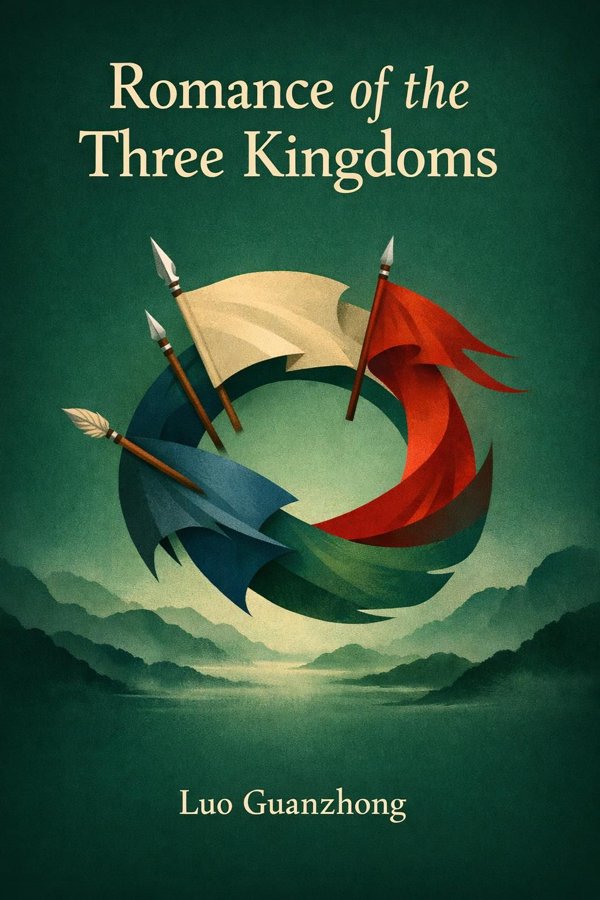
Romance of the Three Kingdoms: Summary & Key Insights
 10 min9 chaptersAudio available
Key Takeaways from Romance of the Three Kingdoms
Political collapse rarely begins with one dramatic event; it usually starts when institutions become hollow long before they visibly fall.
Power is strongest when it looks lawful.
In a broken world, private promises can become the last refuge of public virtue.
One of the novel’s deepest strategic lessons is that survival often depends less on individual strength than on timely cooperation.
Great strategy is not just cleverness in the moment; it is the disciplined ability to see consequences before others do.
What Is Romance of the Three Kingdoms About?
Romance of the Three Kingdoms by Luo Guanzhong is a chinese_history book spanning 5 pages. Romance of the Three Kingdoms is one of the foundational works of Chinese literature and one of the world’s great epic novels. Traditionally attributed to Luo Guanzhong, it transforms the historical collapse of the Eastern Han dynasty and the rise of the states of Wei, Shu, and Wu into a sweeping drama of war, diplomacy, betrayal, and moral choice. At one level, it is a story of armies, emperors, and brilliant strategists. At another, it is an extended meditation on legitimacy, loyalty, ambition, and the painful gap between virtue and political success. What makes the novel endure is its extraordinary range. It gives us heroic brotherhood through Liu Bei, Guan Yu, and Zhang Fei; chilling statecraft through Cao Cao; patient state-building through Sun Quan; and near-mythic intelligence through Zhuge Liang. The book matters not just because it dramatizes a pivotal era in Chinese history, but because it captures patterns that recur in every age: weak institutions, opportunistic elites, fragile alliances, and leaders forced to choose between principle and survival. Luo Guanzhong’s lasting authority comes from the way he fused history, folklore, and moral reflection into a narrative that remains as politically sharp as it is emotionally unforgettable.
This FizzRead summary covers all 9 key chapters of Romance of the Three Kingdoms in approximately 10 minutes, distilling the most important ideas, arguments, and takeaways from Luo Guanzhong's work. Also available as an audio summary and Key Quotes Podcast.
Romance of the Three Kingdoms
Romance of the Three Kingdoms is one of the foundational works of Chinese literature and one of the world’s great epic novels. Traditionally attributed to Luo Guanzhong, it transforms the historical collapse of the Eastern Han dynasty and the rise of the states of Wei, Shu, and Wu into a sweeping drama of war, diplomacy, betrayal, and moral choice. At one level, it is a story of armies, emperors, and brilliant strategists. At another, it is an extended meditation on legitimacy, loyalty, ambition, and the painful gap between virtue and political success.
What makes the novel endure is its extraordinary range. It gives us heroic brotherhood through Liu Bei, Guan Yu, and Zhang Fei; chilling statecraft through Cao Cao; patient state-building through Sun Quan; and near-mythic intelligence through Zhuge Liang. The book matters not just because it dramatizes a pivotal era in Chinese history, but because it captures patterns that recur in every age: weak institutions, opportunistic elites, fragile alliances, and leaders forced to choose between principle and survival. Luo Guanzhong’s lasting authority comes from the way he fused history, folklore, and moral reflection into a narrative that remains as politically sharp as it is emotionally unforgettable.
Who Should Read Romance of the Three Kingdoms?
This book is perfect for anyone interested in chinese_history and looking to gain actionable insights in a short read. Whether you're a student, professional, or lifelong learner, the key ideas from Romance of the Three Kingdoms by Luo Guanzhong will help you think differently.
- ✓Readers who enjoy chinese_history and want practical takeaways
- ✓Professionals looking to apply new ideas to their work and life
- ✓Anyone who wants the core insights of Romance of the Three Kingdoms in just 10 minutes
Want the full summary?
Get instant access to this book summary and 100K+ more with Fizz Moment.
Get Free SummaryAvailable on App Store • Free to download
Key Chapters
Political collapse rarely begins with one dramatic event; it usually starts when institutions become hollow long before they visibly fall. Romance of the Three Kingdoms opens in exactly this atmosphere. The Eastern Han dynasty still possesses imperial prestige, but corruption, court intrigue, and elite selfishness have emptied that prestige of real strength. Eunuchs dominate the court, officials exploit the people, and widespread suffering erupts into the Yellow Turban Rebellion. That rebellion is more than a military crisis. It is the signal that the old order has lost moral and administrative legitimacy.
Luo Guanzhong uses this disintegration to show how regional strongmen emerge when central authority can no longer protect the realm. Men who might once have remained local officers now become warlords, governors, and kingmakers. Figures such as Dong Zhuo, Yuan Shao, Liu Bei, Cao Cao, and Sun Jian rise not in stable times, but because instability rewards ambition, adaptability, and force. The novel’s lesson is not simply that rebellion destroys order; it is that bad governance invites replacement.
This idea remains practical far beyond imperial China. In companies, governments, and communities, leadership vacuums rarely stay empty. When official structures fail, informal power networks form quickly. A neglected workplace breeds political maneuvering. A drifting organization invites aggressive personalities to define its future.
The takeaway is clear: do not wait for visible collapse before repairing weak institutions. When trust, fairness, and competence erode, the struggle for succession has already begun.
Power is strongest when it looks lawful. Cao Cao’s genius lies not only in military skill, but in his understanding that force alone is unstable unless clothed in legitimacy. In the chaos after the Han’s decline, he secures the emperor and rules in the emperor’s name, effectively controlling the court while presenting himself as a defender of order. This is one of the novel’s most important political insights: the appearance of restoring stability can be as valuable as stability itself.
Cao Cao is among literature’s most complex rulers. He is intelligent, practical, and capable of recognizing talent across social boundaries. He is also ruthless, suspicious, and willing to eliminate threats preemptively. Luo Guanzhong does not portray him as a simple villain. Instead, Cao Cao embodies the uneasy truth that state formation often depends on morally compromised but highly effective leadership. He feeds armies, disciplines territories, and consolidates northern China, yet does so through manipulation, intimidation, and calculated cruelty.
The practical application is easy to see in modern leadership. Some executives, politicians, or founders succeed because they understand systems better than idealists do. They frame decisions as necessary, centralize authority, and convert uncertainty into disciplined execution. But the novel warns that fear-based order carries costs. It can produce compliance without affection and efficiency without moral trust.
An actionable takeaway: if you lead, learn from Cao Cao’s strategic clarity but reject his corrosive cynicism. Build legitimacy through competence and fairness, not just control. Lasting authority requires more than winning; it requires being seen as worthy of power.
In a broken world, private promises can become the last refuge of public virtue. The oath of brotherhood among Liu Bei, Guan Yu, and Zhang Fei is one of the novel’s most famous moments because it offers a moral counterpoint to political decay. Their bond is not merely sentimental. It represents an attempt to create loyalty, duty, and shared purpose when the empire itself no longer provides a reliable ethical center.
Liu Bei is presented as humane and legitimate-minded, Guan Yu as steadfast and honorable, and Zhang Fei as fierce and impulsive. Together they form an idealized but imperfect alliance. Their brotherhood gives emotional depth to the military campaigns and reminds readers that history is shaped not only by institutions and armies, but by personal commitments strong enough to survive hardship. At the same time, Luo Guanzhong is too sophisticated to romanticize loyalty blindly. The same deep bonds that inspire heroism can also narrow judgment, intensify vengeance, and make compromise harder.
Modern readers can apply this idea by thinking about values-based partnerships. In business, creative work, activism, or community leadership, success often depends on a small circle of trusted people who remain aligned under pressure. Skill matters, but character alignment matters more when resources are scarce and outcomes uncertain.
The actionable lesson is to build your closest alliances deliberately. Choose collaborators whose principles, not just talents, you respect. Shared values will sustain a team when formal structures fail, and they will help ensure that ambition does not outrun conscience.
One of the novel’s deepest strategic lessons is that survival often depends less on individual strength than on timely cooperation. The alliance between Liu Bei and Sun Quan against Cao Cao, culminating in the Battle of Red Cliffs, shows how weaker forces can defeat a more powerful enemy through coordination, intelligence, and environmental awareness. Zhuge Liang’s diplomacy and Zhou Yu’s command become decisive not because either side is all-powerful, but because they recognize that fragmentation would guarantee defeat.
Red Cliffs is remembered for fire attacks, naval tactics, and dramatic reversals, yet its true importance is political. It establishes the triangular balance that defines the Three Kingdoms era. More importantly, it shows that alliances are rarely built on trust alone. Liu Bei and Sun Quan are not natural friends. They are wary, ambitious, and aware that each may become the other’s future rival. Still, necessity compels cooperation.
That makes this episode highly relevant today. In competitive environments, organizations often need to partner with uneasy counterparts to face a larger threat. Startups join forces to challenge dominant incumbents. departments collaborate during crisis despite long-running internal friction. Nations align not because interests are identical, but because they overlap enough to require joint action.
The key is disciplined realism. Successful alliances need clear shared objectives, honest recognition of tensions, and defined expectations about what comes after victory. Do not confuse temporary alignment with permanent friendship.
Actionable takeaway: when facing a stronger opponent, ask not only, “How can we become stronger?” but also, “Who can we align with, and under what terms, to change the balance of power?”
Great strategy is not just cleverness in the moment; it is the disciplined ability to see consequences before others do. Zhuge Liang enters the novel as a reclusive genius and becomes its clearest symbol of intelligence directed toward public purpose. His plans, negotiations, logistical thinking, and ability to assess character make him more than a battlefield tactician. He is a statesman of anticipation.
Luo Guanzhong uses Zhuge Liang to dramatize an ideal many societies admire: the wise adviser whose mind can compensate for material weakness. Serving Shu, a state often disadvantaged in resources compared with Wei, Zhuge Liang relies on planning, diplomacy, terrain, timing, and psychological insight. Whether in securing alliances, pacifying rivals, or launching northern campaigns, he reminds readers that intelligence is a form of force.
But the novel also introduces a sobering limit. Brilliant planning cannot fully overcome structural weakness. Zhuge Liang’s campaigns are admirable, but they also reveal the burden of trying to preserve a state whose ambitions may exceed its demographic and economic base. In modern terms, even the best strategist cannot save an organization from every underlying constraint.
For readers, the practical lesson is twofold. First, cultivate foresight: gather information, understand incentives, and think several moves ahead. Second, distinguish between solvable problems and structural disadvantages. Strategy should not become fantasy.
Actionable takeaway: before acting, ask three questions Zhuge Liang would appreciate: What are the hidden constraints? What are the likely reactions? And what outcome remains achievable even if everything goes less well than planned?
Institutions rise or fall depending on whether they can identify, recruit, and retain capable people. Throughout Romance of the Three Kingdoms, rulers are measured not only by what they do personally, but by the quality of talent they attract. Cao Cao gathers brilliant advisers and generals because he recognizes usefulness even in unconventional people. Liu Bei’s greatness partly lies in his willingness to seek out Zhuge Liang with humility. Sun Quan preserves Wu through balanced reliance on experienced commanders and administrators.
The novel repeatedly contrasts leaders who value merit with those trapped by vanity, suspicion, or favoritism. Yuan Shao, despite immense resources, is often undermined by indecision and poor judgment about subordinates. Lesser rulers destroy themselves by ignoring good counsel or elevating flatterers. Luo Guanzhong’s message is unmistakable: one leader cannot think, plan, and execute alone. Political success is collective intelligence organized well.
This idea translates directly to modern life. A company with a charismatic founder but weak hiring discipline will eventually stall. A government filled with loyalists rather than experts grows brittle. Even a small team suffers when leaders choose comfort over competence.
There is also a personal application. You should judge opportunities partly by the people involved. Environments that respect talent, debate, and honest feedback tend to outperform those built on ego management.
Actionable takeaway: if you lead, spend as much energy building a strong bench as making top-level decisions. If you do not lead, seek institutions where ability is noticed, developed, and trusted. Talent does not guarantee success, but neglecting talent almost guarantees decline.
Moral reputation is one of the novel’s most powerful currencies, but Luo Guanzhong also shows how honor can become a trap. Guan Yu stands as the clearest example. He is revered for loyalty, courage, and righteousness, and across Chinese culture he becomes almost saintlike. Yet in the novel, the same uncompromising pride that makes him admirable also leaves him vulnerable. His disdain for rivals, misreading of political realities, and resistance to flexibility contribute to disastrous consequences.
This is one of the book’s most mature insights. Virtue is not the same as wisdom. A person may be brave, loyal, and upright, yet still fail because they cannot adapt. Honor gives meaning to action, but strategy determines whether noble intentions survive contact with reality. Liu Bei’s camp often draws moral strength from its reputation, but reputation alone does not prevent military overreach or political miscalculation.
The lesson matters today because many people confuse identity with judgment. Professionals can become so attached to being principled, independent, or tough that they stop listening. Teams can cling to “how we do things” long after conditions change. Even admirable traits can become liabilities when detached from context.
This does not mean abandoning principle. It means integrating principle with flexibility. True integrity is not stubborn performance; it is the ability to preserve core values while adjusting methods to circumstance.
Actionable takeaway: regularly ask yourself whether a cherished trait is still serving your purpose. Strength becomes weakness when it hardens into reflex. Protect your values, but never let pride prevent recalibration.
Epic battles often look like contests of heroism, but the novel consistently reminds us that wars are won through preparation as much as valor. Supplies, terrain, morale, weather, transport, communication, and timing repeatedly determine outcomes. Red Cliffs succeeds not merely because of boldness, but because of wind, naval conditions, intelligence, and Cao Cao’s overextension. Northern campaigns stall not simply because opponents are brave, but because distance, attrition, and provisioning matter.
Luo Guanzhong understands a truth every serious strategist learns: dramatic moments are built on invisible systems. Generals may receive glory, but grain routes, engineers, scouts, and disciplined administration make campaigns possible. Leaders who ignore these basics often mistake short-term momentum for lasting advantage.
This principle has broad practical relevance. In modern projects, people celebrate launches, presentations, and public wins, but sustained success depends on operations. A brilliant product fails if customer support is weak. A social movement loses energy without organizing infrastructure. A personal ambition collapses if routine and resources are neglected.
The novel encourages readers to look beneath spectacle. Ask what unseen mechanisms support visible achievement. If those mechanisms are weak, success may be temporary no matter how inspiring the headline victory appears.
Actionable takeaway: before pursuing any major goal, audit your logistics. Do you have time, resources, systems, and contingency plans? Bold strategy without operational support is just theater. Build the supply lines of your ambition before you charge into battle.
The novel’s famous opening idea is that empires long divided must unite, and long united must divide. This is not merely a dramatic hook; it is the philosophical backbone of the entire story. Romance of the Three Kingdoms presents history as cyclical, driven by recurring patterns of consolidation, decay, fragmentation, and reunification. Human actors matter enormously, but they operate inside larger historical rhythms that no single hero can fully control.
This perspective gives the novel its tragic grandeur. Victories are never final, and defeats are rarely permanent. Kingdoms rise through talent, discipline, and legitimacy, then weaken through complacency, succession struggles, corruption, or strategic exhaustion. The result is a narrative that balances admiration for extraordinary individuals with skepticism about permanence. Even the greatest figures cannot escape time, mortality, and institutional entropy.
For modern readers, this cyclical lens is a useful antidote to both panic and arrogance. When industries shift, political coalitions fracture, or cultural norms change, people often assume the moment is unprecedented. The novel suggests otherwise. Systems repeatedly pass through phases of expansion, stagnation, and reset. Understanding the cycle helps leaders act with patience rather than desperation.
At the same time, cycles are not excuses for passivity. Historical patterns shape opportunities, but human decisions still influence how destructive or constructive transitions become.
Actionable takeaway: learn to diagnose the phase of the system you are in. Are you building, maintaining, declining, or restructuring? Strategy becomes far more effective when it matches the cycle instead of pretending conditions are static.
All Chapters in Romance of the Three Kingdoms
About the Author
Luo Guanzhong was a Chinese novelist and dramatist traditionally placed in the late Yuan and early Ming dynasties. Although the details of his life are uncertain, he is widely recognized as the author of Romance of the Three Kingdoms, one of the Four Great Classical Novels of Chinese literature. He is often regarded as a foundational figure in Chinese historical fiction because of his ability to fuse dynastic history, folklore, oral storytelling, and moral reflection into a compelling long-form narrative. His work helped define the chaptered novel form and shaped later ideas about heroism, legitimacy, loyalty, and strategy. Through Romance of the Three Kingdoms, Luo Guanzhong left a lasting mark not only on Chinese literature, but also on theater, popular culture, and political imagination across East Asia.
Get This Summary in Your Preferred Format
Read or listen to the Romance of the Three Kingdoms summary by Luo Guanzhong anytime, anywhere. FizzRead offers multiple formats so you can learn on your terms — all free.
Available formats: App · Audio · PDF · EPUB — All included free with FizzRead
Download Romance of the Three Kingdoms PDF and EPUB Summary
Key Quotes from Romance of the Three Kingdoms
“Political collapse rarely begins with one dramatic event; it usually starts when institutions become hollow long before they visibly fall.”
“Power is strongest when it looks lawful.”
“In a broken world, private promises can become the last refuge of public virtue.”
“One of the novel’s deepest strategic lessons is that survival often depends less on individual strength than on timely cooperation.”
“Great strategy is not just cleverness in the moment; it is the disciplined ability to see consequences before others do.”
Frequently Asked Questions about Romance of the Three Kingdoms
Romance of the Three Kingdoms by Luo Guanzhong is a chinese_history book that explores key ideas across 9 chapters. Romance of the Three Kingdoms is one of the foundational works of Chinese literature and one of the world’s great epic novels. Traditionally attributed to Luo Guanzhong, it transforms the historical collapse of the Eastern Han dynasty and the rise of the states of Wei, Shu, and Wu into a sweeping drama of war, diplomacy, betrayal, and moral choice. At one level, it is a story of armies, emperors, and brilliant strategists. At another, it is an extended meditation on legitimacy, loyalty, ambition, and the painful gap between virtue and political success. What makes the novel endure is its extraordinary range. It gives us heroic brotherhood through Liu Bei, Guan Yu, and Zhang Fei; chilling statecraft through Cao Cao; patient state-building through Sun Quan; and near-mythic intelligence through Zhuge Liang. The book matters not just because it dramatizes a pivotal era in Chinese history, but because it captures patterns that recur in every age: weak institutions, opportunistic elites, fragile alliances, and leaders forced to choose between principle and survival. Luo Guanzhong’s lasting authority comes from the way he fused history, folklore, and moral reflection into a narrative that remains as politically sharp as it is emotionally unforgettable.
More by Luo Guanzhong
You Might Also Like
1587, A Year of No Significance
Ray Huang
10 min
A Brief History of the Song Dynasty (Chinese Edition)
Chen Zhen
10 min
Comprehensive Mirror to Aid in Government (Zizhi Tongjian)
Sima Guang
10 min
General History of China (Chinese Edition)
Lü Simian
10 min
Modern History of China (Chinese Edition)
Li Kan
10 min
Records of the Grand Historian (Chinese Edition)
Sima Qian
10 minBrowse by Category
Ready to read Romance of the Three Kingdoms?
Get the full summary and 100K+ more books with Fizz Moment.