
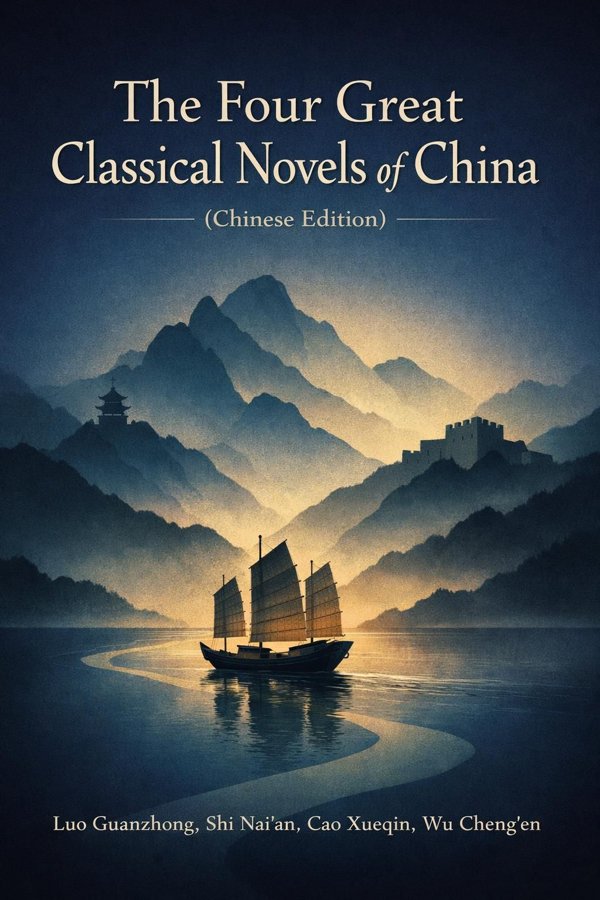
The Four Great Classical Novels of China (Chinese Edition): Summary & Key Insights
by Luo Guanzhong, Shi Nai'an, Cao Xueqin, Wu Cheng'en
 10 min4 chaptersAudio available
What Is The Four Great Classical Novels of China (Chinese Edition) About?
The Four Great Classical Novels of China (Chinese Edition) by Luo Guanzhong, Shi Nai'an, Cao Xueqin, Wu Cheng'en is a classics book spanning 4 pages. The Four Great Classical Novels of China comprise Romance of the Three Kingdoms, Water Margin, Dream of the Red Chamber, and Journey to the West. These works represent the pinnacle of classical Chinese literature, offering profound depictions of society, vivid character portrayals, and exceptional artistic achievement. Together, they form a cornerstone of Chinese cultural heritage, reflecting the social and human landscapes from the late Yuan and early Ming dynasties through the Qing dynasty.
This FizzRead summary covers all 4 key chapters of The Four Great Classical Novels of China (Chinese Edition) in approximately 10 minutes, distilling the most important ideas, arguments, and takeaways from Luo Guanzhong, Shi Nai'an, Cao Xueqin, Wu Cheng'en's work. Also available as an audio summary and Key Quotes Podcast.
The Four Great Classical Novels of China (Chinese Edition)
The Four Great Classical Novels of China comprise Romance of the Three Kingdoms, Water Margin, Dream of the Red Chamber, and Journey to the West. These works represent the pinnacle of classical Chinese literature, offering profound depictions of society, vivid character portrayals, and exceptional artistic achievement. Together, they form a cornerstone of Chinese cultural heritage, reflecting the social and human landscapes from the late Yuan and early Ming dynasties through the Qing dynasty.
Who Should Read The Four Great Classical Novels of China (Chinese Edition)?
This book is perfect for anyone interested in classics and looking to gain actionable insights in a short read. Whether you're a student, professional, or lifelong learner, the key ideas from The Four Great Classical Novels of China (Chinese Edition) by Luo Guanzhong, Shi Nai'an, Cao Xueqin, Wu Cheng'en will help you think differently.
- ✓Readers who enjoy classics and want practical takeaways
- ✓Professionals looking to apply new ideas to their work and life
- ✓Anyone who wants the core insights of The Four Great Classical Novels of China (Chinese Edition) in just 10 minutes
Want the full summary?
Get instant access to this book summary and 100K+ more with Fizz Moment.
Get Free SummaryAvailable on App Store • Free to download
Key Chapters
In *Romance of the Three Kingdoms*, Luo Guanzhong paints the turbulent epoch of the late Eastern Han dynasty, when the empire lay in ruins under the weight of corruption and rebellion. From this chaos emerged heroes whose aspirations shaped an entire era of strife and glory. The novel begins with a haunting line that has echoed across centuries: the rise and fall of dynasties is as inevitable as the ebb and flow of the Yangtze River. This sets the tone for a tale where political ambition and moral integrity perpetually collide.
At the heart of the narrative are Liu Bei, Guan Yu, and Zhang Fei — bound by brotherhood in a world of deceit — contrasted against the formidable, cunning, and ruthlessly pragmatic Cao Cao. It is through these figures that Luo Guanzhong explores the eternal tension between virtue and power. Liu Bei’s moral idealism is dignified but tragic; Cao Cao’s brilliance is tainted by his moral ambiguity; Zhuge Liang’s wisdom becomes both his strength and his burden. The story progresses across decades of campaigns, alliances, and betrayals, reflecting how personal virtue interacts with the unfathomable currents of fate.
Beyond the battlefield, *Romance of the Three Kingdoms* is a treatise on strategy and statecraft. It portrays the fragility of empires and the brilliance of human mind confronting destiny itself. The author’s depiction of Zhuge Liang’s tactical genius — his Empty Fort strategy, his command of the elements, his unwavering loyalty after Liu Bei’s death — transcends pure military intrigue. These episodes become meditations on intellect as a moral force. Yet, behind every triumph looms the awareness that all things rise and fall. Luo Guanzhong’s prose thus carries a quiet sadness: no matter how noble one’s cause, history devours all greatness in time.
Through this heroic tragedy, Luo invites the reader to reflect on what it means to live rightly in a world ruled by impermanence. The valor of these heroes is not measured solely by victory but by conviction — that to remain loyal, even unto ruin, is itself a form of immortality.
Shi Nai’an’s *Water Margin* moves from imperial courts to the marshes, from the refined to the raw. Here, the heroes are not noble lords or strategists but men and women cast aside by society — bandits, soldiers, monks, and wanderers who find freedom and dignity in defiance. Set during the Song dynasty, it chronicles how injustice and oppression drive 108 outlaws to gather at Liangshan Marsh, forming a brotherhood that exists in defiance of corrupt authority.
The novel celebrates loyalty in its fiercest and most paradoxical form: the loyalty of rebels. Under the leadership of Song Jiang, the Liangshan heroes rally in the name of righteousness, yet their moral path is riddled with contradiction. Song Jiang himself exemplifies the tragedy of loyalty; though he rebels against a corrupt regime, his yearning for imperial pardon ultimately leads to his downfall. Through him, Shi Nai’an explores the cycle of rebellion and co-optation that haunted Chinese history — how those who fight tyranny often become its victims when they seek legitimacy within the same system.
What gives *Water Margin* its vitality is its vast gallery of characters, each drawn with bold strokes and unforgettable vitality. From the mighty Wu Song who slays a tiger with bare hands, to Lin Chong, the betrayed instructor of the Imperial Guards, to Li Kui, the wild and honest brute who kills out of rage but weeps for friendship — their stories form a grand mosaic of human passion. Each outlaw embodies a protest against a world where virtue is punished and villainy rewarded. Yet within their violence and excess lies an enduring humanity; even in sin, they exhibit a fierce moral clarity.
Shi Nai’an crafts a universe where righteousness is no longer confined to the palace or the scholar’s study but found among the downtrodden. His narrative is both heroic and mournful, revealing the eternal tension between personal justice and social order. By the book’s end, when the band’s glory is extinguished through imperial deception, the reader senses not merely the defeat of outlaws but the collapse of an age’s dream — the dream that ordinary men could carve justice out of a corrupt world. This is *Water Margin’s* legacy: a savage hymn to human brotherhood in the face of betrayal.
+ 2 more chapters — available in the FizzRead app
All Chapters in The Four Great Classical Novels of China (Chinese Edition)
About the Authors
Luo Guanzhong (c. 1330–c. 1400) was a novelist of the late Yuan and early Ming dynasties, best known for Romance of the Three Kingdoms. Shi Nai'an (c. 1296–c. 1370) was a novelist of the late Yuan and early Ming dynasties, author of Water Margin. Cao Xueqin (c. 1715–c. 1763) was a Qing dynasty novelist, author of Dream of the Red Chamber. Wu Cheng'en (c. 1500–c. 1582) was a Ming dynasty novelist, author of Journey to the West. All four are regarded as major figures in classical Chinese literature.
Get This Summary in Your Preferred Format
Read or listen to the The Four Great Classical Novels of China (Chinese Edition) summary by Luo Guanzhong, Shi Nai'an, Cao Xueqin, Wu Cheng'en anytime, anywhere. FizzRead offers multiple formats so you can learn on your terms — all free.
Available formats: App · Audio · PDF · EPUB — All included free with FizzRead
Download The Four Great Classical Novels of China (Chinese Edition) PDF and EPUB Summary
Key Quotes from The Four Great Classical Novels of China (Chinese Edition)
“In *Romance of the Three Kingdoms*, Luo Guanzhong paints the turbulent epoch of the late Eastern Han dynasty, when the empire lay in ruins under the weight of corruption and rebellion.”
“Shi Nai’an’s *Water Margin* moves from imperial courts to the marshes, from the refined to the raw.”
Frequently Asked Questions about The Four Great Classical Novels of China (Chinese Edition)
The Four Great Classical Novels of China (Chinese Edition) by Luo Guanzhong, Shi Nai'an, Cao Xueqin, Wu Cheng'en is a classics book that explores key ideas across 4 chapters. The Four Great Classical Novels of China comprise Romance of the Three Kingdoms, Water Margin, Dream of the Red Chamber, and Journey to the West. These works represent the pinnacle of classical Chinese literature, offering profound depictions of society, vivid character portrayals, and exceptional artistic achievement. Together, they form a cornerstone of Chinese cultural heritage, reflecting the social and human landscapes from the late Yuan and early Ming dynasties through the Qing dynasty.
You Might Also Like




Browse by Category
Ready to read The Four Great Classical Novels of China (Chinese Edition)?
Get the full summary and 100K+ more books with Fizz Moment.